Showing posts with label Amstrad. Show all posts

Sunday, 25 September 2022

PCW Plus - The magazine for the Amstrad PCW

For being one of the most prominent productivity computers for home users of the late 1980's, the Amstrad PCW never seems to get much appreciation. Released at a time when DOS PC's were a four figure purchase (unless you also went to Amstrad for those as well), the PCW became a success because it offered the basic office computer experience by bundling a printer and the software you needed for a very competitive price. Naturally, this led to dedicated publications, one of which was 8000 Plus. In 1992, Amstrad launched the 9000 series of the PCW range so the magazine changed its name to PCW Plus. Join me, then, on a quick look at two issues of this fine publication.

As I only have two issues of this magazine, March '92 and November '94, I may be missing out on the heyday of the format, but these still offer intriguing insights as to the state of the PCW market at the time of their publication and, perhaps more poignantly, demonstrate the decline of a format specific magazine.
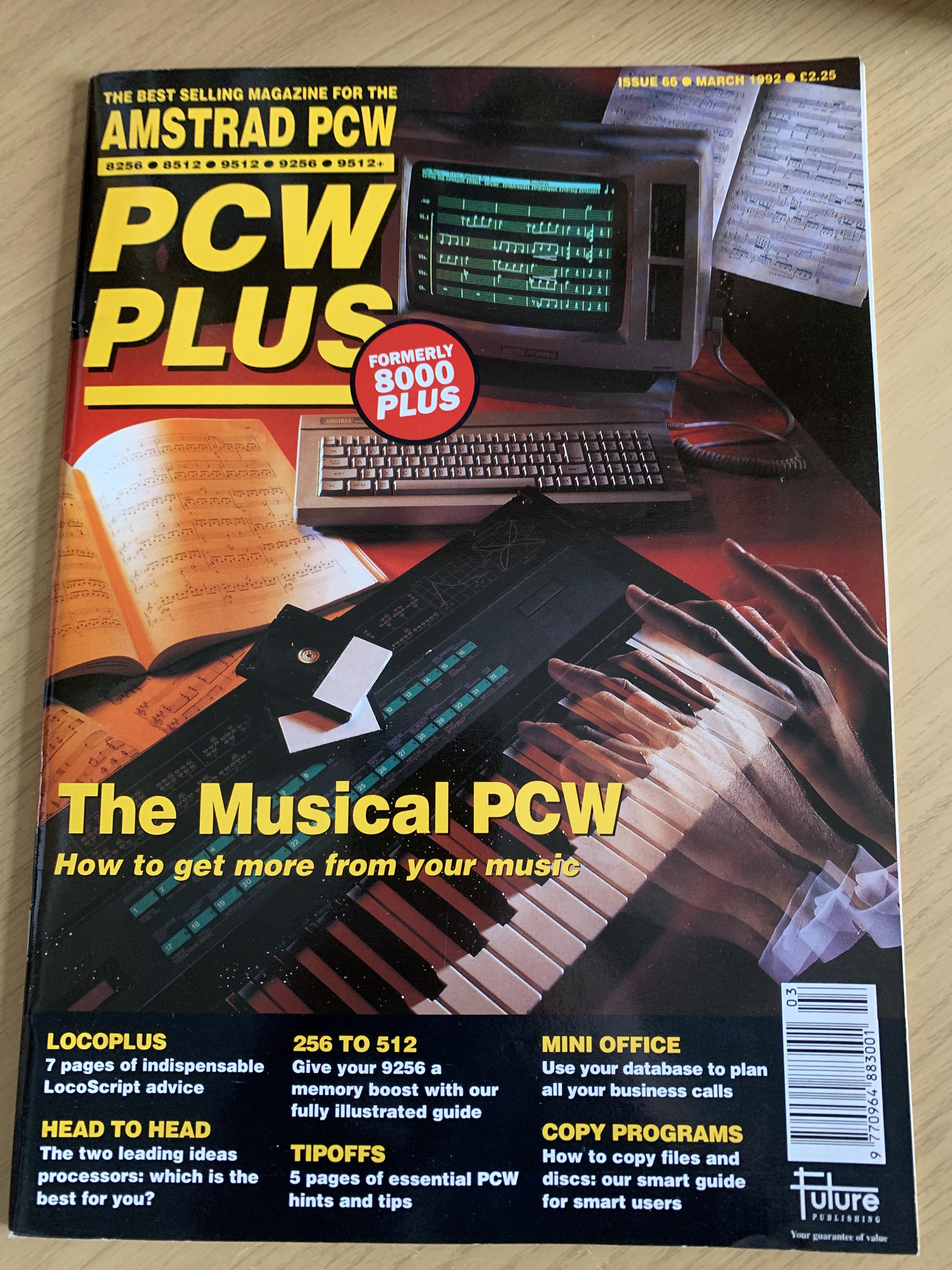
The cover of March 92's issue headlines the way you can get music from your PCW. You might be surprised at this as the machine was launched with a focus purely on office productivity. Yet being a 256kb/516kb CP/M machine meant that it was much more than a word processor. The are also articles offering LocoScript advice, a guide to memory upgrades for owners of 256kb machines, and how to make the most of copy programs. 

As befits the period, the cover is glossy and has a nice feel to it. The stock quality is also quite good, and although there is colour throughout, it is limited to specific features and adverts. Page count comes in at 84 including the covers. All that for £2.25. 

The editorial is quite bullish when covering the news that Amstrad had made a trading loss. With the prospect of price cuts and possibly a higher level of ownership of the format, the editor believed the future looked bright. Never mind that this completely ignores the growing popularity and decreasing prices of the DOS PC but there you are - the editor seems very happy preaching to the converted. The news section that follows takes up three pages, and there are plenty of adverts too, yet throughout the magazine, I can only find a couple that are actually selling the new 9256/9512+ computers. 

Ah, yes, the machine. A 9256 with a dot matrix printer would set you back around £400 inclusive, which wasn't too shabby even for 1992. 8086 PC's were still hovering around that mark excluding VAT and that didn't include a printer (and probably not any software either). The 9512+ with daisy wheel printer was about £500 inclusive, and the 9512+ with a Canon BJ10 inkjet was just over £600. The issue here that for £600, you could get an Amiga, Atari or a DOS set up with a printer. It might not be the best of specifications, but it would be more than a match for the Z80 in the Amstrads. By the end of the year, Acorn would have the A3010/3020 series out that would hover between the £500 and £700 mark, whilst even Apple would see sense and release the Mac Classic that would give you that famous single button experience for about £600 inclusive. You'd need to add a printer for those, but then you had the freedom of choice. Sad to say, one of the key selling points of the PCW in the 1980's (the cheap integrated package) had been superseded by faster and increasingly cheaper machines. But I digress.

It was lovely to see a column in PCW by Dave Langford, whose work in SFX magazine was always a good read, and I never knew he wrote for PCW Plus. The other features are well written and seem like they would have been useful to PCW owners. 

Back to the adverts and there are quite a few, although I suspect this was the sum of PCW retailing at the time. There's plenty of software advertised, including a few games, although I believe the company selling the space saving desk on page 36 had been watching too much BBC sci-fi... Another thing to note is the sheer number of add-ons and improvements for the machines - external disk drives, ram packs, and interfaces.

Straight off the set of Star Cops...

On to the November '94 issue, and it's here that we see the magazine epitomise the decline in the format. 

The cover is still shiny but feels thinner than the one from '92. There seems to be more colour but the stock is also of lower quality. The cover price has increased to £2.95 yet the page count is down to 68 including the covers. Mr Langford is still present and there is a cracking feature on how to add flash storage to your PCW! 

It is in the advertising that you really notice the difference. Sure, there are still many advertisers covering the format and its add-ons, and one that was still selling the 9000 series, although not the PCW10, which very much seems to have been the odd model out, despite being launched only the year before. A note on prices - the 9512+ had not changed in price since the March '92 issue. What was borderline competitive in then was massively over-priced by 1994. 

Anyway, back to the advertising, and it's the inclusion of three adverts for PC's that stand out. One, from S.C.S. (not the sofa people) offers a 386SX 40MHz with 2MB of RAM, a 170MB hard drive and a 14-inch SVGA monitor for just £469 excluding VAT. You need to add DOS, Windows and a mouse to that (£70 ex VAT) for a total of ££539 ex VAT, or £630-ish inclusive. Source a printer from somewhere and you have a much faster, capable and expandable machine than any PCW. If you were spending several hundred pounds on a computer, you'd want a degree of longevity and even a 386 in 1994 offered that compared to a PCW.

The back cover - and that is NOT a PCW!

It also highlights a sign that the magazine was in decline. It is a similar story to Amiga Format and Acorn User. Towards the end of their print lives, advertisers were covering anything from actual hardware to internet providers and the like (this was 2000 and 2003 respectively). Anything to fill the space in the mag and bring in the money. As far as mass market magazines went, the platforms were dying. 

Confirming this are the Audit Bureau of Circulation figures. The '92 issue has the figures from January-June 1991, stating that an average of 27,186 copies were sold every month. The July-December '93 figures in the '94 issue is 16,335. I know that figures like that are pretty standard now, given the changes to the market and people's reading habits, but for the early 1990's, they were not looking good 

As it was, time was running out for the PCW. Amstrad pulled the plug after the PCW10. Well, I say pulled the plug. There was the PcW16 launched in 1995 for £299 that was a last gasp for the name. It wasn't directly compatible and you couldn't use the floppy drive to run new programs. It was a sad way to end the PCW name. As for PCW Plus, it soldiered on until December 1996, which isn't bad considering the lack of hardware. 

It's always cool reading format specific magazines from decades past (do you feel old yet?) as it gives you an look at how computing used to be before Windows cemented itself as the OS for the masses, MacOS survived long enough to hitch a ride on the iPhone business (only half joking there) and Chrome OS became the defacto Linux distribution(!). It's partly the reason why I love retro computing so much, the variety of machines and operating systems. 

Would I want a PCW on my desk today? Hell, yes! Is there any chance of that? Not really, space and cost being the prime issues, but for the period they were around, they demonstrated that you could have practical, productive computing at a reasonable price, and a magazine such as PCW Plus is a perfect reminder of that.

Monday, 14 January 2019

The Amstrad NC100 - portable perfection?

A new year has arrived and this being the first new post of the year, I thought I'd begin with a retro-tech post, forward looking and all that malarky. As some of you may have noticed, I have a bit of an interest in old tech. More specifically, the tech of the early 1980's to early noughties. This encompasses the period of first generation consumer computing tech hitting the market to the final generation before the homogeneity of today's smartphone culture, where two operating systems and an almost identical form factor have combined to remove almost any individuality from the market. Indeed, where there are modern day unique devices: The Astrohaus Freewrite/Traveller, the Gemini handheld and even the open-source Pandora-derived Pyro, these tend to be small scale production models with prices commensurate to their niche appeal.

In part, this interest stems from growing up looking at such devices and thinking they were the dog's danglies (and some actually were for their time). It's also in part in seeing how much technology has developed and whether or not the original device designers got it right at the time but no-one noticed. There is also the self imposed challenge of seeing if tech discarded as obsolete fifteen, twenty or even twenty five plus years ago can still cut it today. Obviously, I am not going to try and run Pocket Internet Explorer from a 1998 vintage Windows CE palmtop or lug around an Amstrad PPC-512 portable from 1988. That would just be silly. No, it's more a case of if the device and software can still be used today, can they be used in a genuinely productive manner.

As such, it's time to talk about the oldest piece of retro-tech (outside of games consoles) that I own: The Amstrad NC100. Launched for the princely sum of £199.95 in 1992 (that's about £406 in today's money), the NC100 is an A4-sized slab of plastic with a qwerty keyboard, mono-LCD screen and 64kb of RAM. Powered by the ubiquitous Zilog Z80 processor racing at 4Mhz, you could expand the memory via PCMCIA cards of up to 1Mb (wooooo!!!) capacity. Four AA batteries offered a twenty hour lifespan, you have an RS-232 serial port for PC connectivity and a parallel port for printers. Primary applications include a word processor, calculator, diary and organiser. It even has BASIC for any programming needs and a terminal emulator/XMODEM ability for file transfers - indeed, a reviewer at the time of launch typed her review on the machine and filed back to the office via a 300-baud modem link. Take that you youngsters with your high speed fibre :-). In short, this was a device I really wanted when I was a teenager and I finally have my hands on one now, including it's original packaging which has not handled the passage of time too well.
In not too bad a condition considering the age.

Back when packaging was practical and informative.

First things first, the look. It follows the design of the Cambridge Z88, another device that found heavy use in educational and journalistic circles due to its ease of use and portability. It's a slab of black plastic, yes, but livened up by brightly coloured function keys that allowed shortcut commands for the built-in software. Why? To make it easy to use. That was the design brief from Mr Sugar himself (to the point where he wrote the introduction to the manual - so the story goes). And by and large, they did it. True, a younger user would struggle (where's the screen to tap away on?), but within ten minutes of switching the NC100 on, I'd figured out pretty much every menu and that was just by trial and error.
Everything that came in the box.

Build quality is fairly good. There is a bit of creaking if you really try and bend it but otherwise, it's a solid machine. Less hollow sounding than the Alphasmart 3000 I am typing this one and, dare I say it, a bit more durable. The manual is very detailed and handy for perusal but I get the feeling that new owners of the machine were meant to switch it on and get on with it.
The main menu - simplistic and clean

Although basic, the screen does its job well

The screen is basic, very basic, with 80 characters per row and 8 rows visible on-screen. it's not going to win any beauty contests and the text is rather small, but it does the job, unless it's dark. No back-lighting here but that helps with the battery live immensely. The follow up NC200 offered a half-clam-shell design with a built-in 3.5 inch floppy drive and a bigger, back-lit screen. You also got a spreadsheet, database and some games. The downside here was the move to C-cell batteries and the inability for the device to access the floppy drive if the batteries were even slightly below a full charge.
Organiser applications.

Calculator.

What the NC100 does benefit from is the keyboard. It clacks reassuringly like a typewriter, it's not overly loud but the sound is pleasing and not overly plasticky like most modern keyboards. The keys have a good amount of travel and spring back with just the right amount of tension. Honestly, this is the best non-desktop keyboard I have ever experienced for its size. Sitting down and bashing out a couple of hundred words was effortless and rather enjoyable and the only fault I can mention with the design is the slightly iffy angle of the screen which made viewing it a little bit of a chore. Other than that, the NC100 is superbly designed.

This brings me to the major issue with using it today. Whatever I type on the machine is held in battery backed up RAM. Finding 1Mb or smaller PCMCIA cards has proved a tad difficult and where I have found one, the prices being asked are eye-watering. There is the option of a serial cable so that will probably be my preferred method of transfer, but that may take some playing about with terminal programs and the like. Sadly, the NC100 pre-dates plug and play (even the hated Windows 95 idea of P&P) and lacks the easy transfer option of the Alphasmart. If only there were a way of combining the keyboard of the NC100 with the slightly more modern tech of the Alphasmart...

In a way, it's a shame. the concept is sound, the tech is good enough and the implementation excellent for its time. Yet, because of its age, it's not easy to use today. However, there are workarounds and with a bit of care and effort, I can see the NC100 lasting a good few years yet. What would be really good is if instead of going down the big-business data collection route of Google with their Chromebooks, or the bloated and relatively poorly performing budget Windows laptops or even the tablet/keyboard hybrids that are neither fish nor fowl, someone put together a low cost typing device that follows the mould of the NC100/Alphasmart/Z88? Think about it, a decent low power screen (doesn't have to be colour - in fact it shouldn't be to preserve battery life), in an A4 format with an ARM chip, a couple of GB of storage and the ability to run off either removable lithium-ion batteries or AA's. Using a basic operating system with applications saving in modern file formats, I think there could be a market for this device. Less fragile and cheaper than laptops, a better typing experience than tablets, what's not to like?

It won't happen, not least when you have the likes of the Astrohaus Traveller which offers something similar but in a clamshell format and a price that's just scary ($238 when the Indiegogo campaign launched, $349 (£270-ish) now - though comparing to the inflation adjusted price of the NC100, that's not too bad). It also doesn't help that if such a mythical machine were available, it would need to retail for $150 or less, and that would have to make it a relatively high volume, low margin product and I don't think the volume would be there, not compared to Chromebooks and tablets. Of course, it would be a niche product and by its very nature, lack the "perceived" value competitors offer.
As for me, I'll keep using  the Alphasmart and, when I have the cabling, the NC100. They are specifically focused machines with cracking battery lives and decent (in the case of the NC100, brilliant) keyboards. For simple text entry, nothing comes close. Sometimes, it's true, they just don't make them like they used to.

Monday, 15 October 2018

Amstrad GX4000 - Swansong for the 8-bit console era

The box in all of its glory

The Amstrad GX4000 was, for me, and only for a short time, the dream machine. Launched in the autumn of 1990, Amstrad hoped to prolong the life of their CPC home computers by bringing in an updated range of CPC+ machines and an associated 8-bit games console, the GX4000. It turned out these were the last throw of the dice for 8-bit machines in the UK. Indeed, it was probably not the greatest business decision by Amstrad to launch an 8-bit console as the era of the 16-bit Sega Megadrive and Nintendo SNES was beginning but by this time, Amstrad were turning away from home computing and focusing on the expanding PC market, leaving their older machines to die off slowly.
Still in decent nick
What did the +plus machines bring to the market? Well, some fancier graphics modes (compared to the older models), a SCART socket and a cartridge slot that permitted software to access the new graphics modes. And that was part of the problem, the requirement to use the cartridge slot to benefit from the new capabilities. The plan was that the new fancy games on cartridge benefited both the home computers and the console and Amstrad made more money from the use of cartridges. Bear in mind that this was also the period of breakout sales for the Commodore Amiga and Atari ST, computers that hovered around the £300 to £400 mark that Amstrad had also priced the +plus range at. Ok, you got a dedicated monitor with the Amstrads' but portable TV’s were also decreasing in price and in most cases, people already had a portable TV before buying a computer so didn’t really need another display on their desk.
Ports at the back - 2 x power (mains and monitor), RBG, SCART and RF.

Ports at the front - headphone, 2 x 9 pin controller, 1 x 15 pin analogue and RJ11 for light guns.
Still, they released the new range, with an unlikely competitor from Commodore with their C64GS which was basically a Commodore C64 computer without the keyboard. With nothing new to add to that platform, the C64GS disappeared with barely a whimper. Amstrad did gain the support of quite a few European software houses, with the likes of Ocean, Titus and US Gold promising new titles. What consumers ended up getting, however, were conversions of CPC titles that cost £24.99 to £29.99 due to their cartridge format. Most of these looked no better than their cassette brothers retailing for under a tenner. Lazy conversions and pricing aside, the GX4000 carts also suffered when compared to similarly priced 16-bit software, which looked better, had a higher resolutions and offered better sound quality. Yet, for all of that, early reactions were positive and at £99, the GX4000 compared favourably to the existing 8-bit Sega Master System and Nintendo NES machines, especially when programmers took advantage of the extra graphics modes the cartridge access allowed. One final +plus (see what I did there) was that the machine had a distinctive look, similar to a Cylon fighter from the original Battlestar Galactica TV show. It certainly looked different to the usual black or grey box under the TV.
Evil, just evil.
The one other downside that needs to be mentioned is the controller. Yes, you got two of them in the box, but they were and are horrible. They’re tiny, cause hand cramp within 10 minutes of use and the response from both the d-pad and buttons is mushy and lifeless. The plastic also creaks alarmingly.
I suppose I liked the GX4000 so much at the time because of its heritage. Having owned a CPC464 since 1987, and only just about to make the jump to the Amiga 500. The CPC464 was my formative home computer and I will never forget the fun playing games, programming and just plain messing about on it that took up many a weekend. Times, they were a changing though, and as far as Amstrad was concerned, they simply couldn’t compete with the likes of Sega and Nintendo who had the software pedigree and sheer volume of titles to bury the little British upstart. It didn’t help that the software support pledged was dependent upon the machine selling well. But as the machine sold poorly, partially due to lack of software, few games were released.

A total of 27 titles were released for the GX4000, most of which were straight conversions of existing CPC games. Looking at contemporaneous reviews, few of them reviewed well, with only the likes of "Burning Rubber", "Robocop 2" and "Pang" getting anywhere near above average scores. One thing of note is the cartridge packaging which, although outlandish compared to the boring DVD-style case mundanity we have now, brought a certain sense of style to any shelf and are more robust that the cardboard or plastic jewel cases used by other consoles in the ‘90’s.
90's game packaging - rather unique.

And also bigger than strictly necessary.
That the GX4000 is comparatively rare is underlined by the quite high prices they go for on E-Bay, around £50 for the console itself and more than a few sellers asking for £80+ for individual titles. The machine I have was about that price but comes in the original packaging with inserts. The plastic hasn’t dis-coloured too much and the condition overall is very good. I think this is the start of a collection for me and I’ll be keeping an eye out for games on E-Bay, retro games shows and online dealers, all the while avoiding the scalping that the rarity (and lack of popularity) of the machine seems to bring. I think getting hold of every game will be a challenge but a worthwhile one and like I said before, the cases do look good on the shelf (ok, one case, but it’s a start).

Lacking the exotic appeal of the NEC PC-Engine (which never received an official European release) or the extreme expense of the 16-bit SNK Neo Geo AES, the GX4000 is little known outside Western Europe and even then, you have to be of a certain age or a console history buff to know of it. The GX4000 represented the end of the European manufacturers in the home videogame market and, shortly afterwards, the home computer market too. The more advanced 16-bit generation was the dawn of the US and Japanese companies which had a whole different scale of operation that the likes of Amstrad couldn’t match. Nonetheless, that Amstrad tried shouldn’t be criticised. It was a worthy effort, with decent specs even for the time and as such, deserves to be remembered for that, if nothing else.

Friday, 27 October 2017

More Computer musings...

Growing up in the 1980's and 90's and being interested in tech, his meant that I read voraciously about home computing. True, it is a topic that still interests me now but, compared to that period, the market today seems so... boring. By that, I mean that whilst there was a lack of standardisation, there was a vivacity that is lacking today. True, todays machines and software are infinitely more powerful and capable but at heart, they are pretty much the same. From different formats to weird designs, the computer market did suffer from beige box hell but you could still find some individuality. These days, it's black box hell with some neon strip lighting if you feel the need

As the years passed by, there were a handful of machines that appealed to me, either because of the way they looked and/or the functionality they offered. The following is a list of five machines that at some point, appeared on my wish list. I will add though that at no point have I ever owned these machines. I doubt I will as they are of their time and perhaps should remain there. Operating systems, however, do not follow that rule as my previous posts have noted. Having said that, if one of these machines was available, I'd give it a go just to see how much things have changed.

Amstrad PC 5286


First up, the Amstrad PC 5286. Why, you may ask? Well, I have always had a thing for tidy little desktop machines, designed from the ground up to do a job reasonably well without taking up half the floor or desk space in the room. This was a neat little machine that had enough power to work, 1Mb of Ram and a 40Mb hard drive, and a neat little case design that Amstrad used for several of its later PC ranges. Expandability was extremely limited, this machine was a sold as a straight forward package . I do recall that the monitors were horrible and the later 7xxx series were offered with a 10 inch VGA monitor that must have played hell with your eyes! This was a machine that could have seen me through most of my secondary school years but instead, we picked up a cheaper but much bigger LG Goldstar 286 that lasted a few years.

Apple PowerBook Duo 230


Now this machine covered two areas of personal computing, desktop and laptop, by way of a rather clever and tidy docking system. By day, a mild mannered, decently spec'd portable; by night, a decently spec'd desktop by the way of a companion dock.

Monitor and accessories were extra (naturally)
Remember, this was long before the time of fast and secure remote working so the idea was valid back then. It compared well with buying multiple machines (At launch the Powerbook Duo was $2,160 - a corresponding Powerbook 140 was north of $1,600 and a Color Classic was another $1,400, though you needed to add the dock, monitor, keyboard and mouse for the Duo. The Duo combination was a one fits all solution, rather than a multi-device kludge). The Duo did its job rather well, a 33 Mhz Motorola 68030 processor, 4Mb of RAM and an 80Mb hard drive was not too bad a spec for a portable warrior. The dock added a full range of ports, room for an expansion slot, more video memory and a hard drive bay. Altogether, a practical set up and one that worked well. True, it was expensive (and the prime reason this was never on my reality based shopping list - but that can be said of so much Apple kit throughout the years!), but for early 1990's tech, it was rather good. It was probably the sub-notebook format that worked best for me and I eventually got into that format with the Asus eee-PC, which still works as a handy little Linux device to this day. The Duo, however, was the portable for me at the time. Before that, however...

Amstrad PPC 512


Dialling back a few years, this was the machine on this list I came closest to being able to buy. Not that I did as the Amiga 500 was the computer of choice back then and, looking back, it would not have worked well. The PPC 512 was Amstrad's attempt at a luggable. I say luggable and not laptop as seriously, would you put this on your lap??? And which train/plane seat would you occupy? Admittedly, its size does allow it to sport a full sized keyboard and it can be powered by 10 (ten!!!) C-batteries, but the while thing is totally impractical.
Yet at the same time, it isn't. It was an eye opener back then and thirty years of advances make it ludicrous now, but I still like it. Why? Because it offered a chance of portable computing at a price that wasn't stratospheric. Okay, it was only a slight improvement on the likes of the Osborne 1 from several years prior but this was fully PC compatible, offered an MDA/CGA compatible monochrome screen and you could have two floppy drives. Aftermarket accessories included internal hard drives so there was a decent ecosystem around the machine. The 8Mhz NEC V30 processor did the job and there was a non-too shabby for the time 512Kb of RAM. And it looked cool in that 80's industrial plastic kind of way. Buying one today is relatively easy and cheap on ebay, the only downside being that they all seem to lack system disks. But still, not that tempting for me...

Acorn Risc PC

This one came with a pizza oven and the kitchen sink! Seriously, look at the pic below:

The full monty (including the kitchen sink!)

The Risc PC was the follow up to the Archimedes range and, for its time, offered a bang per buck that was hard to match. Using the (then) new StrongArm processors, the Risc PC was a bit of a powerhouse that had been carefully designed around slice based casing.

The bog-standard casing
You see, each slice had space for a 3.5" and a 5.25" drive bay so slice one could handle your floppy drive and CD-ROM, slice two could take an additional hard drive and a tape back-up drive and so on. Each slice could also fit two podule expansions and were easily stack-able, sometime to the extreme. As you have seen above, at one show, a demo machine was set up with every bell and whistle they could think of, including a pizza oven and working tap and sink. Comedy value aside, the industrial design is superb and extremely forward thinking. 
The back end, showing podule expansion backplanes.
If there was a fault, well two in be specific, they were the lack of shielding that scuppered the design when changes were made to electrical specifications and the speed of the bus connecting the motherboard components. However, for the latter, direct access expansion cards allowed new processor and RAM expansions to run without being slowed down by the motherboard. 
By the time this machine came out, I was at the tail end of my Amiga phase and it wouldn't be too long before I joined the Windows PC brigade. It was priced too highly for what I needed and could afford so a cheaper generic PC was the order of the day instead.
Only a couple of re-sellers stock these today and prices are quite high for what you get. Buying one would be for novelty value only as Risc-OS has moved on since then but the physical design has an almost timeless quality and one that I think would work well today. It's just a shame that no-one else took this up.

Commodore Amiga 1200


Finally, we have the Amiga 1200. The last of the affordable Amiga range to be released before Commodore's demise, this was the machine that could, maybe, have saved the company if they had released it a couple of years earlier. Well, probably not saved, but at least let it have another shot in the mid-90's. As it was, company politics and some downright immoral behaviour by the company's management meant that it would have been a tough challenge no matter what the company had produced. 
Similar in style to the Amiga 500 but with a more compact design, the 1200 had enough oomph to act as a basic but decent internet capable machine, even in the mid-90's. It was expandable and more than a few have been converted to tower configurations where the wealth of third-party add-ons in surprising.
It offered a hefty bump in power from the A500/A500 Plus range and demonstrated that with the tools and finance, Commodore's engineers could do the business. The less said about the management pushed A600 (the successor to the A500 range, the better). 
However, the era of cheaper PC's was beginning and it wouldn't be long before Windows 95 ushered in a (relatively) user friendly experience on hardware that was much more capable (albeit more expensive but better value). The closest I came to getting one of these was when Escom bought out the remnants of Commodore and released an internet-access based pack. Alas, I was torn between this and the Risc-PC so settled on a PC (yeah, I know), and as it turned out, Escom was not long for this world anyway.

So there you have it, a short list of the computers that interested me back in the day. Like I said, I doubt I will ever buy any of these for use in the present day but that doesn't mean to say I haven't been a little bit busy on E-bay either, but more of that in the future.