Showing posts with label Team Yankee. Show all posts

Monday, 2 June 2025

Stop me if you've heard this one before...

For those out there who enjoy a touch of modern wargaming, there seems to be a common thread about boring games where a number of Challenger tanks engage an overwhelming number of enemy tanks and take down the lot. This can be quite tedious, at least for one side, if not both, so when I offered to jump into the chair for our next meeting of the TWATS using a partially amended set of Team Yankee rules that have been trialled before, that was the outcome I wished to avoid. 

Then Shaun emailed me the night before. Did I fancy adding a 28 tank T54/55 battalion and a 10-strong T62 company to the mix? Well, that kind of sunk my original plans, but seeing that huge numbers of 15mm vehicles can look damned impressive on the table, I gladly accepted the offer.

So it was that on the Saturday afternoon, Shaun, Steve, Paul, Andy and myself congregated at The Blue Bell in Kip Hill, who as well as offering good quality ales and a fantastic array of Turkish and British dishes, also host the Forlorn Hope Wargames Group. Sadly, the club itself will be closing in August so future plans are up in the air, but it's not the first time the TWATS have been venue-less, and we'll see what happens. 

Steve handled the Royal Marine contingent, and Andy presided over the main armoured force of six Challengers, a quartet of Scimitars, and some Warrior-bound infantry. For the opposition, Shaun was going to play with his frankly ludicrous amount of armour, and Paul would have total rights to the rabble of militia and the main striking force of a reinforced Republican Guard battalion. 

The premise was simple: the British were acting as a trip wire to prevent the Harraqui armed forces from invading their peaceful neighbour of Huwait (not, incidentally, a Geordie asking someone to slow down). The British could deploy their main force within 12 inches of their table edge, the Harraqui's the same from their end. The actual border was about 14 inches from that edge, and there was a border town on the Huwaiti side that Steve promptly decided to fill with his commandos. Their trio of support WMIK's were positioned just outside of the town. The British also had a strip of mines across a section of the table (the location of which was unknown to neither Shaun nor Paul), as well as an off-table battery of 8 105mm Light Guns. 

The Harraqui plan was simple - use the militia to push the RM's out of the town, and basically smeg the British with a full frontal assault using the older vehicles to mask the approaching Republican Guard heavies. 

And, to a degree, that plan worked to begin with. It took a couple of turns, but the militia performed better than expected (what would you expect for a rabble, even if they did have four T55's attached for the LOLs). Half of them took a smacking from the Light Guns after being caught out in the open, but once the town was cleared, their T55's restored honour by taking out a handful of the retreating British light-skinned transports as the latter raced for home. 

Before...

After...

It was not all one-sided, and the trio of Milan-wielding WMIK's dealt serious damage to the T62 company and were nibbling away at the T55 battalion before being pushed back by the militia.  

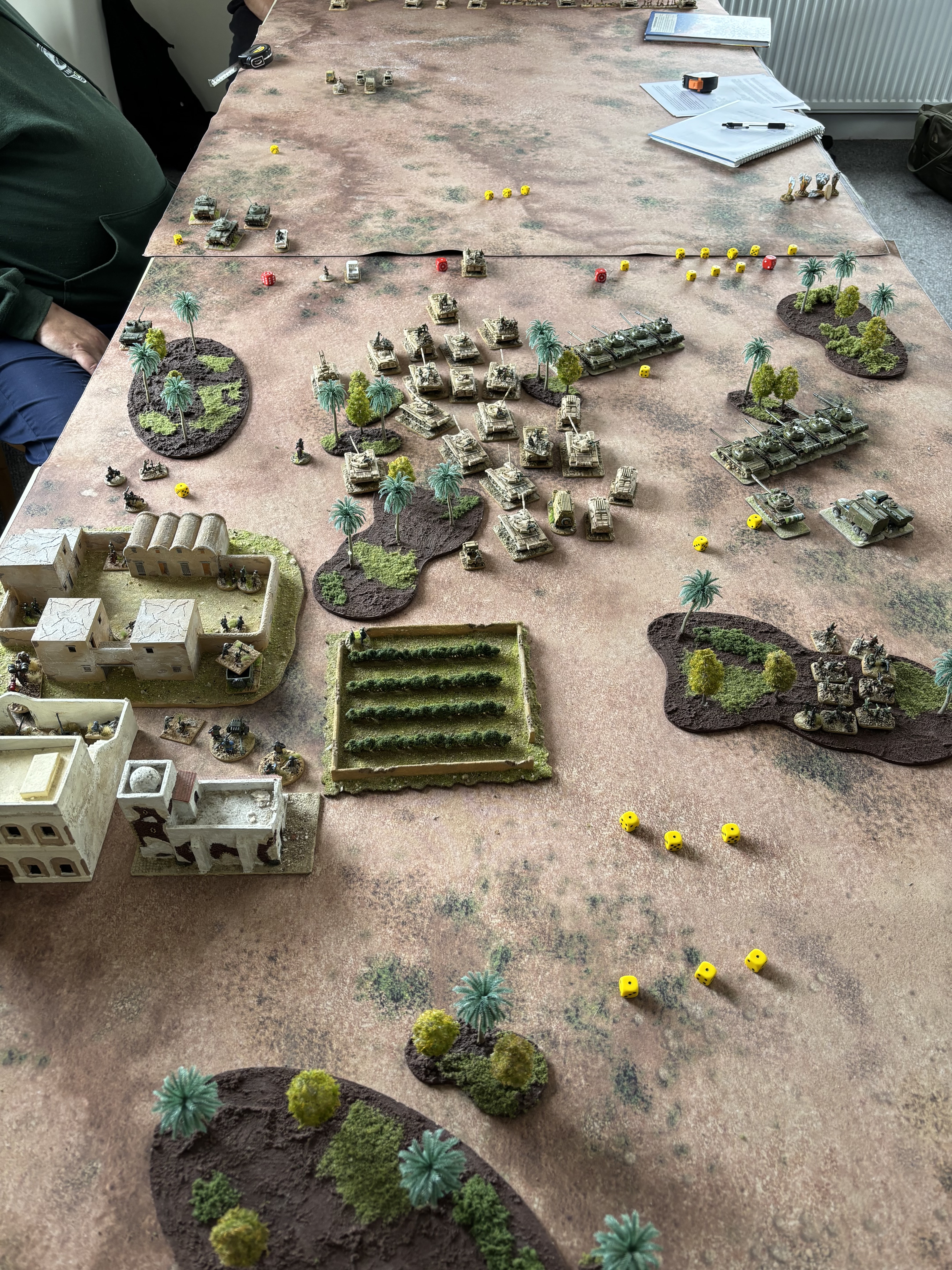
A light screen of recce Scimitars noted the approach of the T55's before turning back to safety, leaving the Harraqui forces free to continue their advance... straight over the thin minefield that the British had bisected the playing area with. Although not causing many casualties, those that did make it across were then immediately in range of the hull down Challengers. 

Each die is a vehicle casualty - and those T55's in the foreground are about to pass their deceased colleagues. 

What followed next was a stunning display of dice throws, halting the T55 lads in their tracks, but given the choice of either run away and being shot, or staying just out of range, the Harraqui commander chose the latter. The effectiveness of the British fire was tailing off, but it was enough to pause the attack, and the table seemed awash with yellow (and red - we ran out of yellow) marker dice. 

This left the Harraqui forces in a quandry - what could they do in the face of the Challenger "massive" and avoid the much maligned concept of a Challie turkey shoot? Time was pressing in the real world, so the game ended there, although there was a conversation had about  could be done.

Time permitting, the best case would have been to use the Republican Guard integral ATGM contingent to sit outside of Challenger range and pelt them with missiles until two or three were destroyed. Then, a single file advance of the Guard over the minefield outside of effective British fire before regrouping, and then charging with everything. As the umpire, I'd have allowed the T55 lot to re-engage, especially given the motivational techniques available to The Great Leader! 

This was a bit of a mixed game for me - the additional amendments to cater for damaged armour never came into play (based on these amendments from all the way back in 2018), and I'm searching for a better way to handle infantry and artillery - I'm not a great fan of either in the original Team Yankee rules, but since this is a work in progress set of amends, there's plenty of time to pull in more stuff. Shaun recommended Sabre Squadron, Andy proposed Combined Arms. Both will be consulted. I also think that I need to work on the unit stats for infantry in general - again, it's a TY thing. 

There was a slightly unsettled feeling after this game, and a lot of that was to do with the quick change in scenario - some of the questions raised during this game would not have been otherwise. Whilst this did lead to some discussion throughout the day, valid points were raised that will be addressed in future, and it was good to have input. Anything that makes the game play better to the period is always a plus, hence the rather Frankenstein nature of the rules. What I will add is that in future, if umpiring a period that some of the attendees have little knowledge about, maybe some cue cards might be in order so they have a basis of knowledge about the forces they control. Another point to consider me thinks.

Wednesday, 24 July 2019

Seven Days to the River Rhine - Preview


Seven Days to the River Rhine by Great Escape Games describes itself as a fast play set of rules covering the NATO/Warsaw Pact 1980’s. It claims it is suited especially for large multi-player games where each side has an overall commander who guides strategy and the other players control the actual units. In this preview, I’ll let you know what I think.

Not as gung-ho as Team Yankee
I had heard of this game last year but it wasn’t until the First Partizan of 2019 that I saw a demo game taking place. Intrigued, I searched for a copy of the rules and found a set for around a tenner. The rules themselves are a nicely produced 44-paged softback accompanied with a set of special cards. More on them later.

The overall layout is clear and concise, with quite large text and numerous photographs. Unlike Team Yankee, these picture detail miniatures from several manufacturers and credit is given to them with each picture.

The process of play is based on command tokens and initiative. One player has the initiative, uses their command tokens, then there are reaction rolls and this continues until all of the command tokens have been used or the other player steals the initiative via a 6 on a reaction dice roll. On the whole, this is probably the part of the game that I am dubious about the most. It just seems so finicky and I can’t help but think that the process as described might hinder fast play more than help. Having said that, most games I have played are simultaneous movement and effect so this initiative malarkey is a bit of a stranger to me. When we do get round to playing these rules, we’ll see how this goes. There is the usual morale and stats sections and the rules don’t get too bogged down in minutia unlike some sets I could care to mention.

The biggest game changing aspect of the rules would be the Tactical Advantage Cards. These are mostly generic but there is a card specific to each side and whilst I can see how they can add to the game, I am not entirely sure they help the game play to the period, and that is a thing for me and my approach to historical gaming, hence the amendments I made to the core Team Yankee rule set last year. A play through will sort out that question. 

Another interesting part of the game is range, or lack of it. Except for infantry fire, there are no defined ranges for weapons, the inference being that given the scale of miniatures used, assigning ranges to say tank cannon fire in relation to an assault rifle would make the scale of the game look a bit funny. Again, I can see how this would help the game but would add a caveat in that if you game on quite a large table as we often do (say 16x5 feet), you’ll need to consider terrain and buildings in you scenarios or you’re just going to have a shoot ‘em up on your hands. Then again, maybe that was what they were going for with the fast paced point of the game.

Sgt Bradford and a QR code? Tsk!
There is one bugbear that I must comment upon, and it’s nothing to do with the mechanics or the style of play. No, it’s a layout choice and one that peeved me slightly with my recent look at Cruel Seas. It’s the ‘advice’ boxes, from either Sgt Bradford for the British or Lieutenant Vasilov for the Soviets. These seek to impart tactical or strategic advice for those in it for the game and whilst I can understand why the designers put these sections in, they do come across as a little condescending for anyone with only a little knowledge of the tactics of the period. It’s a small thing, and you may very well disagree, but I would prefer it if games designers did not think every reader is a bored child with the attention span of an MP in a re-election campaign. Oh, and in case you don’t understand what the rules are trying to tell you, there are QR codes that will lead you to videos explaining the relevant section of the rules. Helpful, maybe, appearing to cater for the Fisher Price ‘My First Wargame’ market, almost certainly. I know I am being waspish here but if you can’t explain a simple process in two paragraphs, are you really trying at all?

It could be considered easy, and lazy, to think of Seven Days to the River Rhine as a kind of Team Yankee lite without the model catalogue level of miniature pictures. And yes, it would be. The designers have clearly thought long and hard about what they wanted to put on the table and, my reticence aside for initiative table tennis, it feels like they have succeeded in their self declared goal. For the price, I don’t feel set upon by the rules and there isn't the relentless commercialism of Team Yankee and its ilk. As with my recent Cruel Seas preview, I have certain doubts but am more than willing to give these rules a full airing, probably in late 1990’s H’irraq at 15mm or West Germany in 20mm if the kit is available. Command Decision is our usual modern rule set (albeit at a different unit scale to Seven Days or Team Yankee), but the latter has become our alternate go to set with suitable amendments. You never know, maybe Seven Days could replace TY in that role. We shall have a play and find out.

Sunday, 4 November 2018

Interest or Hobby?

Part of the joys of work is that you interact with people of different ages and this can lead to some interesting conversations. I got talking to a gentleman who is a few years younger than myself who has an interest in videogames. Aha, I thought, this could be enlightening. It was, but not necessarily in a good way. You see, whilst he has fifteen years of console and PC gaming to his name, he has very little awareness of the history of his chosen hobby and, more importantly, no interest at all in expanding his knowledge. His is a transitory hobby, whatever new thing is in front of him is either great or shit. There are no levels in between these two extremes, just a binary yay or nay. So me being me, I raised this question: "Is this a hobby or an interest that you have?"

Now we each have our own approach to our hobbies. Indeed, how we approach a hobby defines that hobby's appeal to us (so the history and design of console hardware is of particular interest to me as an off-shoot to actually gaming itself). In the case of this younger gentleman, his was almost proud announcement that he knew nothing of gaming before he started playing back in the early 2000's and had no interest in what had happened before then, even to the point of not playing games that were released on his first console before he started gaming. I wasn't particularly surprised but it was quite saddening to hear.

The gentleman's first console was the Sony Playstation 2. A fine piece of hardware that hosted some of the best games of its generation, but my colleague expressed a narrow minded view that other console hardware released around that time (the sublime Sega Dreamcast, Nintendo's under-appreciated GameCube and the ground breaking original Microsoft X-Box) didn't matter because the PS2 won the sales war and as the other three lost, they didn't matter. As he wanted the best (in popularity at least), all other alternatives were discarded. Once the PS2 was replaced by the PS3, the older hardware was discarded and the games collection sold on. They were now old and of no further use. The latest was now, in his mind, the greatest.

A classic of its time.

Horses for courses I suppose, but then I have always been a collector (or hoarder as my better half would have it). Since the last house move, I have sold on most of my collection due to space issues but I did keep a few titles that have never been replicated since their original release. For example, Sky Odyssey for the PS2. The aim of the game is to pilot your aircraft successfully from A to B, encountering various obstacles and challenges along the way. There is no shooting, no whizz bang explosions, just pure flying. This title was in some way a slightly more realistic spiritual successor to the "Pilotwings" series that had releases on the Nintendo SNES (1990), the Nintendo 64 (1996) consoles. That such titles are few and far between demonstrates their sheer niche appeal and since then, only the lightweight Pilotwings Resort, released for the Nintendo 3DS (2011) has offered anything similar in the flying genre. I know Pilotwings Resort is lightweight by the fact that I have played both of its predecessors. Sky Odyssey, by the way, is still a great experience today and well worth a try if you can pick up a copy and have the hardware to play it on.

But what really made me think was how shallow my young colleagues approach to his hobby was. I struggled to bring together the two ideas of loving a hobby but having no knowledge or interest in anything outside of your own sphere of experience. In fact, he wouldn't countenance any move to expand that knowledge - it's old and therefore it's shit. That attitude, it must be said, is not just limited to videogames. Wargaming also has a similar issue.

Now, to be fair, I am not going to be tarring everybody with this brush, but lack of knowledge seems to be a badge of pride, and not just for the younger generation. Without a depth of knowledge in your hobby, how do you put what is current market offering into perspective? How can you judge any perceived improvements when you have no background on the subject you are purported to enjoy? That was evident when, at a show a couple of years back, one guy wanted fighting camels for his forces. When told they weren't used for that during the period he was fighting, he replied "It doesn't matter, you can still put them on the table." Historical wargaming indeed!

Back to my colleague. As gaming to him doesn't exist prior to 2002, he has never, and proudly claims will never, play classics like Command and Conquer, any LucasArts point and click adventure, Super Mario 64, Goldeneye, Resident Evil, Half Life and countless other titles because they don't matter. Yet without those titles, we wouldn't have the games we have today. True, time has not been kind to most of these, but some have aged well and to miss out on those today, if you are a gamer, is a crying shame.

From a wargaming perspective, I'll use Team Yankee. I like them for what they are (and the chance to tinker with them at will adds some of the depth that a hobby needs), but subjectively, how different is the core mechanism from Operation Warboard? Or Featherstone's rules? Not much, but because TY has shiny hard-backed rule sets with lots of pictures, they are perceived by quite a few gamers as better - and that is a conversation I had at the Durham show this year where I ran a demo game. It also revealed that most of the people who asked questions about my amendments (which were based on my reading of texts both modern and contemporaneous) had taken what was offered in the rule sets as sufficient knowledge of the period - further reading was something that seemed like an anathema to them. Woe betide anyone (i.e. me) to use actual knowledge to dis-abuse them of their ignorance. Hey ho.

Take your pick...
Personally, I don't follow the "newer is better" mindset - after all, I am typing this on an 18-year old Alphasmart 3000. Yes, there are new niche text entry products (looking at you, Astrohaus) but I'm not willing to spend a few hundred quid on something when a more convenient (and cheaper) option exists. The same can be said for wargames rules - our recent attempts at playing Charge (I picked up a re-print at Salute this year for my own perusal after the first kicking I received) and other older rule sets have been interesting. They don't have lots of pictures or specialised kit, but they do the job and (this is important) they follow the historical period they model. Certainly compared to some more modern rules (Black Powder, Pikeman's Lament and others), the older set's adherence to history is refreshing, possibly demonstrating how far the modern wargaming market has lost its way from historical knowledge and focuses on rolling lots and lots of dice.

It does make me wonder if we are moving to a point where the history and context of any particular hobby no longer matters to the individuals partaking in that hobby. Whilst people may demonstrate a breadth of knowledge, there is so little depth that the individual misses out on the richness that makes a hobby enjoyable. Without that depth, could the hobby be classed as such at all? Is it not just then a passing interest? Also, without context, how do you judge whether the latest rule set/game/whatever is an improvement on what came before or just a money making enterprise by the creator and will it enrich your enjoyment of your hobby? As far as hobbies go, surely this is a bad thing? 

Wednesday, 5 September 2018

Team Yankee - Amendments

I have had a couple of requests to share the amendments that I have made to the Team Yankee rules, so here they are. A couple of points to note first. These are amendments that we have play-tested. There are more on the way, some of which are fully formed, some which are just thoughts at the moment, but in any case, until they have been used in a live game, I'm not going to detail them here. That can be for a future post. Secondly, the amendments were made so that the game played in what I believed to be a more nuanced manner. As such, you may (should, and indeed, will) disagree with some of the changes made. That's a good thing and I welcome comments, suggestions and points of view.

Playing Team Yankee for the first time was an enlightening experience. Very different from our usual moderns rule set (Combined Arms), TY was a fast paced and rather bloody game and this raised some questions. Undoubtedly, it filled an afternoon, but what it lacked was a sense of satisfaction. It was too lightweight, too gamesy. So here we are.

Can't fault the production values...
The first thing that I changed was the hit values on the main battle tanks. This was to counter the "BANG, You're dead!" style of game play and to bring a dose of reality to the table. Modern MBT's can take some punishment and I wanted to reflect that in the game. Once a hit was scored, I made the player roll for hull or turret. If the hit was on the hull, another dice roll decided if the tracks were hit (1 or a 6) or the main body (2 to 5). A hit to the tracks created a mobility kill which meant the tank could still fight but not move. If a turret hit, then a roll decided if it was main armour (1-2 and 5-6) or mantlet (3 and 4). Take the Leopard 2 for example: the sighting system carves out a great chunk of the turret front. For tanks with Chobham type armour, their values were inflated too. Again, with the Leopard 2, the frontal armour went from a flat 18 to 24/18/24 (right panel/mantlet/left panel). This meant that a T-72 hit (with a value of 22) could kill with one shot but it wasn't a certainty. I also added a rule that if one section of the armour was hit and the tank survived, that section was now rated down to the weakest level on the front of the tank (18 in this instance), meaning a second shot on the same area had more of a chance of destroying the tank but allowed the game to reflect that the armour was doing what it does in the real world. In the same vein, Soviet vehicles fitted with Explosive Reactive Armour resulted in a temporarily higher defense value, but if hit and the armour saves the tank, the original armour value comes into play as that panel has now been used.

After the armour came the bailing out rules. A previous comment on the Durham post tried to clarify that the rules don't necessarily mean bailing out, just a possibly short term effect that can be recovered from. Me, I take the direct English here and the rules say bailing out and re-mounting. I changed this by asking if the crew wanted to bail and if they did, and the enemy were in MG or small arms range, they would have to deal with incoming fire. Any hits rendered the crew out of action.

The assault rules were also looked at. No more bouncing back. If you failed to pass over an obstacle, you got stuck, effectively giving yourself a mobility kill. Speaking of obstacles, if fording, Soviet crews had to roll a D6 and if they got a 1, their engine stalled. Rolling another D6 and another 1 led to the engine compartment flooding. This was, apparently, quite common and river obstacles were only traversed during exercises by vehicles equipped with radios in case such events happened. Probably not the same possibility as the two D6 roll gives but it adds a bit of flavour.

Ranges were next examined after the Durham game and the following were put in place for the most recent one:


Allies

L30 120 mm = 60 inches – 3000m
7.62mm MG = 16 inches – 800m
30mm Rarden = 30 inches – 1500m
SA80 = 8 inches – 400m
MBT LAW = 1 to 20 inches – 50 to 1000m
Hellfire = 10 to 160 inches (500m to 8000m)
Javelin = up to 50 inches – 2500m
30mm Avenger – 24 inches = 1200m
Maverick = off the table

H’aarqui


T72 125mm = 50 inches – 2500m
12.7mm = 20 inches – 1000m
AK47 = 7 inches – 350m
73mm cannon = 10 inches – 500m
30mm cannon = 30 inches (armour) 80 inches (ground 1500m and 4000m
AT3 Sagger = 10 to 60 inches – 500m to 3000m
AT5 Spanderl = 2 to 80 inches – 100 to 4000m
SA-9 = up to 84 inches – 4200m

Whilst not 100% accurate, they are close enough and now fit in relation to each other. Additional calculations were used for the effect of 30mm Avenger fire, based on the A-10 travelling at 400 knots, covering 175m/s (so 3 inches). A one second burst when used for strafing would cover 3 inches, a two second burst covering 6 inches and so on. This led to ammunition rules so the A-10 was limited to 5 one second bursts. In the same vein, armoured vehicles firing MG's had a maximum of three consecutive turns before rolling for heat-related jams (1-3 jammed, 4-6 ok).

Aircraft were also changed and can loiter for as long as five turns before fuel becomes an issue and removes them from the table. Naturally, if you have weapons that can shoot at them, if the aircraft is on the table, they are a target.

Finally, artillery. Well, mortars so far. Instead of an over-priced piece of plastic, I used the ground scale. One mortar with observed fire could accurately hit a 50 x 50m square (1 inch by 1 inch). Hit rules remain the same and I'll look at battery fire later on. This makes mortar fire more of the pin-point weapon it should be and forces the player to think about target selection.

It may seem that this puts a heavy responsibility on the game umpire to keep track of things and yes, you'd be right. Our group uses the umpire system as it fits in well with our outlook of the hobby and , for one, quite enjoy umpiring now and again as it's something different.

As I have said above, any comments, queries and suggestions are most welcome and I'll try and reply to each in turn.

Saturday, 1 September 2018

Sarge! This f***ing f***er's f***ing f***ed!

So rang out the cry from "Wor Lass", the lead Challenger 2 of the Prince Regent's Own Heavy Hussars as its crew took stock after an IED forced them off the main causeway to the Harraqui provincial capital of Q'uon-Shett. The British advance had been halted and recovery crews had taken heavy fire from Harraqui militia forces positioned in the nearby marshes. It was now a race against time. Could the British re-group and rescue the beleaguered tank and its crew, or would they be taken by the fanatical defenders?

So lonely, oh so lonely...
Such was the scenario last Saturday when a trio of TWATS converged on the Commercial pub for a game. I was running it (using Team Yankee again, with not only the revisions added for the Durham show but also revised ranges and artillery rules), Andy played the hapless British and Shaun took on the Harraqui's. Now, being the umpire (and a twat), I chose to make things difficult for both players. Andy had the disabled Charlie 2 and a single Snatch Landrover, the rest of the British forces re-organising for a recovery attempt, whilst Shaun had two groups of militia, a group of tooled up Technicals and a quartet of T-55's. The issue he had was that the Technicals and T-55's needed to be told of the British plight and a pair of motorcycle dispatchers were required. Oh, and there were some victory rules - Andy had to get the tank crew (and the tank if possible as they only have 226 left) out of trouble. Shaun had to capture the tank crew alive for propaganda purposes, so he couldn't shoot "Wor Lass", however tempted he might have been. With the scenario set, off we went.

Shaun started off with dispatching the motorcyclists to get help. Andy brought up his Landrover and laid suppressing fire on the western militia group to the rear of "Wor Lass". The crew of "Wor Lass" were no less busy laying down accurate fire from both co-ax and cupola MG's on the eastern group, causing the first militia casualties. A roll for the appearance of the A-10 failed.

In no way endorsed by the Consett Ale Company
Turn two saw a kill for the Landrover crew with their .50-cal and another dead militiaman on the  east. The motorcyclists continued their weekend ride towards Q'uon-Shett. Still no A-10.

Still lonely, oh so f***ing lonely...
Turn three, and still no air support. Another casualty either side of the causeway on the militia and things were looking a tad brighter for the British - until your humble Umpire made them roll for their MG's jamming. After sustained fire, it might be expected that some of the guns would be running hot. A simple 1-3 fail/4-6 pass saw Andy roll well and the MG fire continued. Also at this point, the first of the British support appeared, (the British having superior comms) - three Scimitars of the North West Durham Yeomanry (The Commercials) alongside a pair of REME support vehicles.

The AA, REME style (other roadside assistance organisations are available...)
At the start of the fourth turn, the A-10 finally showed up, which was fortunate, as the first rider had reached the Harraqui support forces and the Technicals rolled out. Andy ordered the Scimitar Troop to race up the road; he needed more firepower alongside "Wor Lass" since he now couldn't trust his MG's. He could, however, trust his 120mm L30A1 main gun, so lobbed a HESH round towards the eastern militia group. This killed two, forcing a morale check, which they passed, but were left suppressed. 30mm RARDEN fire from The Commercials killed another militiaman to the west and the A-10, feeling left out, spotted the T-55's and decided a Maverick was called for. Cue one dead T-55.

As close as you'll get to a money shot (special effects courtesy of Flash Gordon).
They look pretty. But pretty is as pretty does...
As the fifth turn started, things quietened down a bit, with another HESH round dispatching two more militia and the A-10's second (and final) Maverick destroying another T-55. You may wonder why only two missiles? That's all the model had, so that's all they could fire. There were still two cluster bombs, two dumb 500lb-ers and two Paveway laser guided bombs plus the internal cannon though, so the A-10 was still in the fight. Renewed MG fire caused no further casualties.

This is not going to end well...
As is always the case in our games, the Umpire can do pretty much what they want as long as it suits the style and period of the game, and as turn six began, the message had gotten through to the regular Harraqui army so they started piling onto the table, looking for a piece of the glory. Three AT-5 equipped BRDM's with an SA-9 SAM launcher in support were the beginning, though the British had also managed to get three Warriors with elements of 69 Commando on the road too. The A-10 was being helpful, dropping a 500-pounder and a cluster bomb on the approaching Technicals, two of which were hit and destroyed. Then things got messy.

Andy had placed The Commercials in front of "Wor Lass", screening her from traffic coming down the causeway. Shaun thought that was a bit cheeky and rolled his two surviving T-55's right up to them. All but one of the remaining Technicals were also jammed in there. Like I said, messy.

Our Eye in the Sky reports heavy traffic on Highway 8
So this is what they call CQB...
The Commercials fired first, the first Scimitar getting two hits on the right-hand T-55 and causing a mobility kill. Second Scimitar was aiming for a Technical and at close range, the 30mm rounds had no issues at all. The third Scimitar engaged the last T-55 and although scoring two good hits on the turret, didn't penetrate the armour. Then came the T-55 reply. Or not, as the case may be. Poor dice rolling saw one Scimitar obliterated but the other shot was a miss. Overall, not as bad as it could have been for The Commercials.

The Aftermath (part one)
Shaun also used this opportunity to fire off his rocket pod equipped Technical. Using a bit of Umpire knowledge and know-how (i.e. making stuff up as I went along - albeit having read and seen how these things have worked in real life and knowing the established ground scale), I let him rip, the effect of which was a lovely piece of churned up causeway, a possibly very relieved Technical operator and not much else.

Turn seven saw more of the British response, with the 69 Commando-laden Warriors advancing further along the causeway and a gaggle of "Wor Lass's" mates (three more Challenger 2's) now on table. The A-10 was once more useful with a 30mm gun run against the two T-55's. This took a little bit of maths and realism. Working out the distance traveled in one second at 400 knots, then the burst length that an A-10 would normally have, then fitting that into the ground scale and finally offering Andy a selection of burst lengths (fire longer, less bursts, fire shorter, more bursts), Andy decided upon an aim point and a one second burst. The T-55's died quickly. The SA-9 was not happy about this and decided the A-10 should leave, but poor dice rolling saw a miss. Not that this was entirely a bad thing as Andy retired the air support out of missile range (effectively off-table).

The Aftermath (part two)
Turn eight and the final one as it transpired. The AT-5 BRDM's came into action and the rest of The Commercial troop died quickly, though not before replying with cannon fire that killed two of their attackers. "Wor Lass" stepped up and finished the last one off. And that was it.

At last...
Why? Well, the British now had enough on the table to support the recovery operation and the surviving Harraqui forces were in no fit state to oppose them. True, there were a nearly a dozen T-72's in a box that could have been put on the table. However, they didn't fit in the scenario (and the Harraqui forces were not in that much of a fighting mood) and it would have devolved into a dice rolling contest for the sake of it. What would be the point of that (apart from "the game, innit" mentality)? As such, a British victory, but a Pyrrhic one. Yes, they saved their tank crew, but lost the Scimitar troop in the process. Honour, however, was maintained.

So, the game organisation. I wanted this to be another example of asymmetric warfare, where both sides have to think carefully. As Andy pointed out at the end of the game, it was effectively over by turn three but neither side realised this. And that is kind of the point. He also commented that if he had made a mistake at any point, it would have been game over for him. That was what I was aiming for, not just a gung-ho "Bang! You're dead" style shoot-em up. No, a bit of finesse here and there does wonders.

As for the rules, the Durham amendments were in place and both artillery and ranges were tweaked, setting a hard 1 inch to 50m scale so that everything worked on that level. Weapons were changed to fit that too, so whilst it meant that missiles could rule the table, it added a dash of realism that TY normally lacks because they want pretty models on the table (so you need to buy them) and you won't get upset when said pretty models are blown away the second they pop their head up (nullifying the reason for buying them in the first place). Should there be more amendments? Yeah, a probability dice could smooth out the decision making process a bit more, and movement ranges need a bit of refining but then what started off as a bit of tinkering is starting to seem like more of a major revision. The point I am making here is that the core mechanics of TY are pretty basic (and have been seen many times in the past) yet they can be fit for purpose depending upon what you want to put on the table. If it's dice rolling a-go-go hour long games then, out of the box, TY will  suit you. If you want something more in line with the real world where you get to choose your tactics and actions (I really don't like how the game mechanics are set up to replicate tactics - surely that is the job of the player???), then it is a decent framework to hang your own amendments off. All it takes is a bit of thought. Speaking of which, the values for vehicles not currently listed in TY were made up by me, using existing values as a guide.

This is the third game I've ran using these rules within the last twelve months and I think they are developing quite well. Certainly there have been no complaints about the changes made and more than a few suggestions which have been, and will be, acted upon. They are turning into something quite respectable for modern wargaming. Then again, I would say that.


Tuesday, 12 June 2018

A Day Out in Durham

Last Saturday witnessed an assemblage of TWATS at the Vane Tempest Hall on the outskirts of Durham for our annual demonstration game at the Durham Wargames Show. This is a small, local show but it's always nice and welcoming and the game itself is a chance to show off some kit, rules and speak to interested passers-by, which is the point of a demo game, isn't it???

Joining me were Andy, Jim, Steve and Shaun and we were off to the mid-1980's for a spot of Cold War gone hot with Steve's excellent 20mm East and West Germans. Honestly, the pictures don't do them justice, the kit is excellent. Terrain was a mixture of Steve's and Andy's and the rules, well, the rules were Team Yankee. But with a few changes here and there. Let me explain.

I have quite liked TY when we've played them in the past and whilst they are essentially Lionel Tarr with bits on, I have found them quite gamesy and very "BANG! - you're dead!" and that didn't sit well with me, especially for a full day demo game. So, with pad and pen ready, I had a bit of a review.

First off, I got rid of the silly bouncing rule when assaulting - if you fail to pass the roll, you bounce back. Nope, now you get stuck and become even more of a target. I mean, if you hesitate when going in, you'll get punished for it. I also changed the Bailing section. Now I know, in the novel Team Yankee, there are instances of bailing out, but in the game, this is more of a second life mechanism. You're hit, not yet dead; here, have another go. Well, I still allowed that BUT if the attacking vehicle is in range when you did that, you got a good MG-ing as well. If you survived that, you could try and re-mount. If you didn't, bye-bye tank crew. As pointed out to one interested spectator, no vehicle crew plays hokey-cokey with their vehicles in the real world. I also changed the minimum ranges for some of the anti-tank guided weapons, just so they fell in line with their real world counterparts - but more about that later on.

Finally, I completely changed the frontal armour for tanks. Why? Because the front of a tank is not a uniform piece of metal/ceramic/whatever. As it stands, TY gets you to roll for hull or turret impacts but then does nothing else. I didn't like that so sectioned the results of a frontal hit as follows:

  • Roll a D6 for where the hit landed: 1-4 hull, 5-6 turret.
  • If a hull hit, another D6, 1 or a 6, it's a track shot and results in a mobility kill. 2 to 5 is a straight hit to the hull itself.
  • If a turret hit, another D6. 1, 2, 5 and 6 mean a hit to the main turret armour. A 3 or a 4 means a hit to the gun mantlet which on post WW2 tanks is less well armoured than the rest of the turret front.
This, of course, meant playing with the armour values of the tanks to be used in the game, which made them harder than their ruleset counterparts at first sight. For example, the Leopard 2, instead of having a frontal value of 18, now had turret values of 24/18/24, the 18 being for the mantlet. Does that make it very hard to kill? Yes, and doubly so when I also added a side rule stating that the first hit on an L2, if it bettered the defense value, had no overall effect. However, another hit on the same spot would use the lower frontal value, resulting in an easier kill for the second shot but taking into account the abilities of the armour package as designed in the real world to take multiple hits (at least in development, it did), so second hit values of 18/18/18.

All tanks were amended accordingly, so the Leopard 1 had turret values of 12/9/12, the T-72 20/15/20 and the T-55 14/10/14.

With that covered, let's get on with the game. As Andy has already pointed out, it was Day 6 of the War and the Warsaw Pact forces had shot their bolt. It was time for a Western counter strike to reclaim lost territory, in this case, the town of Bratberg. The East German forces held the town, forming a defensive line along the autobahn. These comprised of six T-55's, a platoon each of BMP-1's and BTR-60's, one SA-9 and 1 Shilka AAA, two BRDM-2 with AT 5's, an HQ platoon and three PT-76's for flavour. There was one BM-21 and a Hind D on call. Reserves of six T-72's were off the board to begin with, depending upon a dice roll for where and when they appeared.

Shaun's initial deployment

Steve's initial deployment

Attacking would be a scratch force of West Germans, six Leopard 1A5's, four Leopard 2A1's, two Jaguar's with HOT, two platoons of Marders, one platoon in TPZ-1's, two Luch's recce vehicles, 1 Gepard AA and one Marder Roland. An MBB-105 with HOT was also available.

Andy and Jim took the West Germans and decided on a bit of a feint, with Jim taking a platoon of Marders, both Jaguars and a detached TPZ squad to probe the Ossie's right. He also had the helo in support. Andy led the strike against the Ossie left with everything else; the Leopard 1's and the Marder platoon in the lead, followed by the AA detachment, the Leopard 2's and finally the remaining TPZ's.

Steve and Shaun formed a defensive line with the road bridge over the autobahn dividing their forces. These were pretty evenly split, the BMP's holding the Ossie right with three T-55's, and the BTR-60's helping the remaining T-55's on the left. With that all set up, we were off to the races.

Pretty much nothing happened for the first few turns as Jim and Andy got into position, Jim approaching the T-55/BMP line cautiously. Once the action started, though, it got a bit more interesting and for the sake of clarity, I'll describe each flank in its entirety, starting with Jim.

Jim starting off
Once both sides were in missile range, dice were rolled and a game of attrition began - the missiles out-ranged the 100mm tank guns which meant that when there were hits, the targets invariably died. Long range ATGW fire was very tit-for-tat. Jim de-bussed his infantry for the long slog to the treeline (keeping out of range of tank fire) and in doing so took two salvos of BM-21 fire which killed two infantry squads by the end of the game. Even the appearance of the MBB-105 didn't cause that much excitement as although it managed one T-55 kill, it missed on the rest of its shots. It died at the hands of the SA-9 after Steve moved it out of cover. It took some doing but eventually, Jim wore down Steve's East Germans to 1 BMP, the Shilka and four infantry squads. In doing so, he lost a Marder, both Jaguars, a Luchs and the MBB-105.

West Germans obviously forgot to pay the taxi fare...

Jim means business...

If all that sounds rather boring, it wasn't. It was, however, bitty and it took a good fifteen (15!) turns to get to that point, including one turn (#10), where out of six rounds of firing, only one hit was scored! Truly bum dice rolling indeed! However, this feint allowed Andy to do the business on his side of the road so the sacrifices made by Jim were not in vain.

Andy led off with the Marder platoon, coming into contact with Shaun's T-55's. Although he covered his forces with 120mm mortar fire (using Asquith's rules for WW2 as I don't like how TY handles artillery and mortars - although the physical copy of Asquith I picked up at the Durham show for £1 served as a handy template!), Andy rolled snake eyes more than once for his mortar fire - Oops! He had to get closer to the Ossie line. This was where the amended hit rules came into play.

As early as turn 8, Andy's Leopard 1's were effective, killing a T-55 and a BRDM, whilst attaining mobility kills against two more T-55's. The following turn saw a mobility hit against a Leopard 1 and another dead T-55/BRDM combo. Turn 10 finally saw the appearance of the first T-72 unit, right where they needed to be! The missed with each shot they fired! Shaun was not overly impressed. Andy's return killed two of the three T-72's.

Looks rather impressive...
At this point, Mr B Bunny Esq declared "This means war!" and the East German Hind appeared. A very brief but illuminating conversation was had by Steve and Shaun towards me. You see, the AT-6 on a Hind, in TY world, has a range of 20 inches - under half the range of HOT and just over half for Milan. In the real world, the AT-6 out ranges Milan 5 km to 2 km so not unreasonably, I, as merely a humble umpire, thought sod that and gave the AT-6 the range to hit whichever target Steve wanted to aim for. I'll cover more on the range issue at the end of the post.

Mr Hind makes an appearance...
Mr Roland thinks he shouldn't.
All of that was for no effect as the Hind missed and was promptly shot down by the Marder Roland. Oh well. Not to be dissuaded, the final three T-72's rolled on to the table and Steve also moved his PT-76's to the line, meaning the surviving East German forces occupied a tank heavy line behind cover. Facing them was pretty much all of Andy's forces minus the mobility kill Leopard 1.

Charge!!!
The climax of the battle was pretty much a dice fest for each side, with more misses than hits, plus plenty of mobility kills which prevented any kind of withdrawal. The PT-76's lived a charmed life for a turn, killing two Marders. They didn't last long, yet Andy was hurting too as the T-72's proved rather effective against the Leopard 1's and even got a mobility kill on a Leopard 2! Shaun had one T-72 crew bail out - they survived their MG experience - but that didn't help as additional fire killed their tank dead. By turn 15, it was all over, with Andy reduced to plinking BTR-60's. There was a brief round of infantry fire but that ended up evens. Overall though, it was over for the East Germans.

The final defence before...
And after...
How over? Well, quite over. They had 1 BMP, the Shilka, two BTR-60's, a T-72, the SA-9 and the HQ unit (plus six infantry squads). The West Germans had three Leopard 2's, 2 Leopard 1's, four Marders plus infantry and the untouched TPZ platoon. The East Germans withdrew, leaving the town of Bratberg to be liberated.

Looking back at the game, the participants said they enjoyed it and I certainly enjoyed umpiring it. Umpiring is a conscious choice in wargaming and I often hear how people don't like it as it means they don't get to play the game. The fun I had was in knowing the period and using that knowledge to run a game that would be both fun and true to the period. And be a twat. :-)

There were issues encountered, both with my amendments (which I'll refine for the next time, which we don't know when that will be but it will be a while of yet, variety and all that being important to our club) and the rules themselves. I am still not happy with the handling of artillery in TY and I really don't like how they group arty and mortars in the same class. They aren't and that should be reflected appropriately in any rules.

The biggest bug bear - ranges. To be Frank (not Turner, Eddie!), TY's ranges are all over the place. Along with the aforementioned AT-6 issue, Steve pointed out the range of Roland compared to the Hind's armament. Roland has a range of 56 inches (8 km in the real world), yet compare that to the AT-6 (20 inches/5 km). MG and rifle fire were also discussed (AKM rifle 8 inches, G3 16 inches - yet although the bullets may travel further, effective rifle range for most infantry in the real world is rarely over 300-400m, whatever tools they are using - and yes, I am aware that it's different in Afghanistan but that's a different case altogether). The ranges are very gamesy and as Steve pointed out, it only took thirty seconds to find the relevant information online about real world ranges.

What this means is that some more fiddling about with the rules is needed and this will be done in time. That may offend some ruleset purists who declare that the written word is gospel but for me, and the rest of the TWATS, the rules form the framework, not the entirety of a game. If it is bollocks in the rules, we call it and change it. And Lord forbid what people think of us playing Team Yankee with non-TY kit!!! Speaking of rules, Jim did pose the question, "What would it have been like with Combined Arms? Same scenario, just a different ruleset". Good question and one that we may answer in a future Saturday game.

One final point. The game was designed as a demonstration game. In other words, to show what wargaming can be like and for anyone who was interested to stop us and ask questions. This people did and it was part of  the enjoyment of the day to talk to different people and inform them of what we were doing. It was not, and never will be a chore to talk about my hobby when putting something like this on. Some demo wargamers at other shows should follow that train of thought too.

Tuesday, 22 November 2016

The Road to Bad'gagh

Last Saturday saw a gathering of TWATS at the usual venue for what was planned as a three way test of rulesets that was proposed quite a while back. However, as playing the same period/ruleset does get quite monotonous very quickly, we waited until the back end of the year before we tackled the triple challenge. And what a challenge it turned out to be. 

The initial brief was simple. I was to run a game using three Modern period rulesets, Combined Arms, our usual set; Team Yankee, a lower level fast paced 'fun' set, and Cold War Commander, back to a similar command level as CA. To make this possible, the scenario was as simple as can be, the briefings designed to make the individual games quite quick and offer an opportunity to put some awfully bad jokes in there as well.

Before I list the briefings, a note on amendments: As Team Yankee does not cover Challengers, we basically used the Chieftain's stats with Stillbrew. Similarly, Warriors were classed as BMP 2's. This didn't make much of a difference overall. 

The British Briefing


The Road to Bad'gagh - Bar-Alnnabidh Aleasaria - British Briefing

To: Colonel Richard Bartholomew Copestake

What ho! Dickie!

Sorry to get down to business, old chap, just we have found ourselves in a bit of a squeaky bum situation. As you know, Christmas is nearly here and, like you, I was hoping to get a bit of skiing in with the family at Klosters. Bit of bad luck that the American hope of a quick bish bash bosh and home by Chrimbo seems to have been a tad over-presumptuous.

However, the Greenflies have heard that there is a nice big gap in the Hirraqui lines leading to a rather important town and oil field. More so, the town overlooks the main highway to Bad’gagh, so offers the perfect opportunity to cut off the head whilst giving him a damn good thrashing to the kidneys.

All is not green and pleasant though. Seems the Yanks don’t have the spare tools for the job so want us to make a lightning strike and capture the town and the oil (nothing new there then!). So, your job is to take a scratch Battle Group and sort the buggers out. I don’t have an exact Or-Bat, you’ll find out when you get there. However, I do know that the Green Howards will be your boots on the ground, the Royal Irish Hussars will provide your firepower and recce will be courtesy of the Royal Scots Dragoon Guards.

I can also give you the basic plan of attack.

Start line is SHAKESPEARE, follow on is objective BARD. From there, you’ll have phase line HORSE, with secondary objective LONG FACE. Finally, there is phase line DICKENS, where you’ll need to decide upon objectives OLIVE or TWIST. And shout up if you need support, you never know, there may actually be some this time. As an aside, you might want to capture OLIVE, just to get in your cousin’s good books. I hear he quite enjoyed his little helicopter escape action a few weeks ago.

Good luck, and God’s speed.

Oh, and one more thing. There is frightfully awful Haboob heading your way. Best be at that town quick smart!

As always,

Nocky!


(Brigadier Norris St. Michael Farquhar)

The Hirraqui Briefing

To: Commander Hirraqui Republican Forces, Bar-Alnnabidh Aleasaria

Greetings and Salutations on this pleasant day. I hope all is well as your valiant forces rest after teaching the Infidel the true error of his ways. Although your losses were heavier than I had foretold, I understand that you find the rest and recuperation pleasing, and that material defects to your combined arms forces are being repaired quickly and efficiently.

I am sorry to say that your forces will be required again in the very near future, so please do not delay in training and melding the numerous brave soldiers of the 3rd, 5th, 9th, 31st and 33rd Armoured Divisions into the Sword of Allah I know you are capable of being. I believe that you and the four hundred brothers in arms you lead will be the key to our victory! You should not be disturbed by the Infidel as the 6th, 10th, 14th and 22nd Armoured Divisions are at this moment weathering the sandstone of his pride.

Allahu Akbar

The Great Leader.

As you can see, nothing too specific regarding forces, as the whole point was to playtest the different rules. It pretty much ended up being 6 Challengers, 4 Warriors, and 4 Scimitars versus a dozen or so T72's and 5 BMP 2's. Also, the approaching storm was designed to limit the games to 5 turns apiece so we could fit everything into an afternoon, especially the Beef butties and chips! As for the jokes, well, I'll let you guess at those - there is a common theme.

Game One - Team Yankee

As this was the ruleset that kicked off the idea of the challenge, Team Yankee got first shot. Andy took on the role of the resting and recuperating Hirraqui commander, whilst Jeff and Paul were the British.

First turn was pretty much the British dashing to contact, the second turn slowing to a more tactical pace that ended with an ATGW strike against one of Paul's Challengers without effect. The British reply was a volley against the offending BMP that quickly ended it's participation in the proceedings. A T72 tried it's luck, again without effect and it too ended up dead once the British had replied.

Turn three saw Andy get the bulk of his T72's into line on a ridge to await the British advance. At this point, the British closed again and the real tank engagement began. Three Challengers fired, killing two T72's, the return of which killed a Challenger! I know, shock and horror!!! Paul, on the other flank, targeted three '72's and killed two. Things were not going well for the Hirraqui's!

Turn four saw the British dash their Scimitars through an ambush point towards the town, a point they had to reach to class the encounter as a win. This, it must be said, did not go well. In quick succession, cannon fire destroyed a Warrior and three Scimitars. On Paul's side, a BMP took out a Challenger with flanking cannon fire.Not to be totally outdone, the British claimed two more '72's and a BMP. At this point, the game was declared over by both sides, and I couldn't blame them as the slaughter had been quite horrific.

Now, before we continue, yes, Jeff and Paul were forces to be overly aggressive, so in a full afternoon game, tactics would have played more of a part. However, the original aim of the game was achieved. We had play tested Team Yankee and although, compared to CA, it lacked nuance and seemed to be quite dice driven, it was actually good fun. I would certainly have a go again, and maybe tinker a bit here and there, as is the wont of our Group.

Game Two - Cold War Commander

The second game saw a reversal of players, Andy and the recently arrived Shaun taking the British, and Jeff and Paul turning Hirraqui. I will be honest and say that none of us were au fait with the rules but between myself and (mostly) Andy, we had a bash. Early on, we ditched the five turn rule as the distance to be covered and the scale of movement being too great.

Turns one and two were just the British advance, though it did give us an idea of the initiative system between formation leaders and CO's. And by idea, I mean chucking a lot of dice for not much effect.

Turn three saw Challengers take up a firing position and the British recce fail a command roll, though the CO saved them, so all continued as planned. Still, if I had 10p for every dice rolled so far, I could have bought myself a pint!

Turn four saw the action kick off, Three Challengers against T72's, who remained out-ranged throughout the game. 18(!!!) dice saw 4 hits (bearing in mind, it takes 5 hits in a turn to kill a T72 unit) saw some suppression but as two of the hits were saved, no other effect. Another three Challenger round of firing, another 18 dice, another four hits, but with only one save this time. So, 36 dice(! - another pint there plus change) and five hits. Ok, bad dice rolls but still.

During the mass firing, a pause was held for the as-usual excellent beef butties and chips, before we went back to see what we could salvage from this game. And there was the rub. CWC is an extremely dice driven game and seems aimed at the professional dice roller, rather than what we would call an historical wargamer. Harsh? Maybe, and I have borrowed the ruleset from Andy to have a proper look over but to a man, none of us thought the system was any good. As for the third game, CA, we simply ran out of time, but since we have been playing those rules for several years, we know how they work.

Conclusion

So, where to begin. Well, without a doubt, CA remains the group favourite. However, the surprise of the afternoon was Team Yankee, very playable, not without fault but at the same time, they fill a gap and I can think of making a couple of amends to add a dash of flavour and we'll have at these again. I would, however, avoid the game extras: £16.50 for the artillery template! No thanks, cheaper to find a sailor down the docks!

CWC was the real disappointment. Too faffy, far too dice driven and very much of the "rules say this, you must do this, nothing else is permitted" school of thought. Not my cup of tea and, judging by the other guys (including a couple of former competition players), theirs either. It was still a good afternoon though and that's what it's all about, isn't it?

The Jokes

The basic premise was an Englishman, Irishman and Scotsman walk into a (trendy wine) bar (in arabic, obviously). After that, it was the trio of bar jokes: Shakespeare walks into a bar, Barman says You're barred! A horse walks into a bar, barman asks, why the long face. Finally, Dickens walks into a bar and asks for a martini, barman asks, olive or twist.

I am truly sorry!