Saturday, 17 October 2020

Was That Film Really That Bad??? - Who Dares Wins

It's that music. 

Simple and to the point

When you start watching Who Dares Wins and that music plays, you get it. You get what they're aiming for. The film announces itself with all of the subtlety of Lily Savage and, after a brief initial credits sequence with war memorials and Parliament (that's a big hint for it's politics), continues into a peace rally (without the stirring music) and we're into the set up proper. Unlike a similar vintage film, North Sea Hijack, where the music exists to batter you into submission proclaiming it's an action movie like it's got five lights, Who Dares Wins immediately tells you what you should expect - drama, action, tension, right wing politics!

Sadly, this is its first mistake (aside from the politics). You see, this 1982 release, inspired heavily by the 1980 Iranian Embassy Siege, is less of an action film and more of a slow pot-boiler with an action heavy finale. The title, using the motto of the Special Air Service, does fit the film well, though, so I'll give it that.

The world's worst Grindr profile pic?

Also known by its US title, "The Final Option", this film shows the planning and execution of a nuclear disarmament group's operation to take the US Ambassador to the UK and several high level guests hostage in order to force the launch of a nuclear missile at Holy Loch in Scotland. To prevent this from happening, an SAS officer (who resigns his commission rather than be returned to unit after a set up involving an interrogation almost gone wrong with two visiting NATO officers on an exercise) ingratiates himself with one of the leaders of the anti-proliferation group and ends up taking part in the op, becoming a key figure in ending the hostage situation. In between all this, there is a family sub-plot where the SAS dude's family are held as an insurance policy so he does what he's told, as well as a nod to the politics involved where a visiting rich Libyan dude splashes the cash on far left groups in the UK and US, as well as keeps ties with a UK politician (a not so light nod to the Labour Party at the time). With me so far? Good!

Nefarious Lefties - They've left their Marx on the wall.

So with the plot dealt with, let's get straight into the casting, where the film shows its relatively low £5m budget. Headlining is Lewis Collins as SAS Captain Peter Skellen. Coming at the end of his "Professionals" stint, this was Collins' attempt to start a movie career (and ultimately, though unsuccessfully, grab a casting session for James Bond). Describing the film as less action orientated than his first script reading led him to believe, he gives the role some welly, and he can do "serious bastard looking" rather well. True, he can come across as a bit cold at times, but then he's a killer, even with the devoted family life (despite forming the beast with two backs with Judy Davis' terrorist leader Frankie Leith and showing no remorse over it). No, this is Collins' show and he plays the part perfectly. He's looks impeccable whether out on exercise or visiting a pub and you can believe he was in the military. Which he was: a private in the Territorial 10th Battalion, Parachute Regiment. He would later pass selection for the Territorial SAS but refused entry because of his fame. Would he have made a good Bond? I would like to think so. Instead we got another two Moore entries that, being realistic, he was far too old to play. Anyhoo, back to the rest of the cast.

Judy Davis is the co-leader of the People's Lobby, the terrorist group attached to CND. She's good and spars well against pretty much everyone, showing a degree of enthusiasm lacking in some of the smaller roles. Her gradual un-hinging as the siege develops demonstrates this perfectly. Indeed, she is the best member of the cast and her later career garnered her two Oscar nods as well as BAFTA, Emmy, SAG and Golden Globe wins, plus many more than there is space to mention. A truly class act. 

Playing to her favourite character type, we have Ingrid Pitt as a rather nasty piece of work. She's definitely a killer and very convincing in the role. You can certainly tell she likes playing to this type and her method of killing Skellen's contact (a perfume spray on a bus) is both chilling and camp silliness at the same time.

We do get some Hollywood dazzle with the inclusion of Richard Widmark as the US Secretary of State and Robert Webber as the head of Strategic Air Command. The former was a last minute replacement for William Holden who passed away prior to filming. Both give steady performances for the relatively brief time they are onscreen and add a bit of gravitas, especially in the politics discussion that I'll get to later.

The majority of the rest of the cast are a mix of familiar British names. Edward Woodward, Tony Doyle, John Duttine, Paul Freeman, Nick Brimble, Kenneth Griffith, Maurice Roeves, Trevor Byfield, Tony Osoba, Norman Rodway, Patrick Allen and even Oz Clarke. Yes, that Oz Clarke! All are decent to good, though shout outs go to Doyle, Roeves and Duttine. The first two play Skellen's SAS superiors, the latter is the People's Lobby co-leader. Each brings a bit more oomph to their portrayals and really get into character.

He doesn't like the look of his Pinot Grigio!

On the film's technical side, it does quite well. No, the budget wasn't massive but it does show what it needs to. They used Pinewood's main building as the embassy, there's some fairly long talky bits and it has a very grimy feel at times, though that could also just be 1982. I remember it vaguely but that was mostly the period after the steel works closed and the demolition of the cooling towers. One thing I will comment upon is the sound editing. A lot of the sound design is library stuff that often doesn't relate to what's happening onscreen. For example, they randomly use Sterling SMG gunfire for MP5 firing. It's only at the beginning of the film but having fired the latter, I know what it sounds like. For some unknown reason, they change the sound editing for the final assault. Nope, no idea either and strange as they want to go for realism elsewhere in the film. They did get SAS support and help for the production, to the point of taking up their SAS advisors offer to do the embassy assault themselves, knowing that real SAS bods would look much more realistic than stuntmen. You also get some decent Westland Scout action, though you also get to appreciate how bloody small those things actually were.

Dyb, Dyb, Dyb!

Politics is a biggie in this film and considering when it was made and who the opposing sides were, it's very much a hit job on the anti-nuclear lobby. They are seen as a front for more radical, anti-capitalist groups. They are funded by countries who are opposed to western democracy and, in a six minute long discussion at the beginning of the siege, lose a political argument to some of their hostages about the west disarming first. Not wanting to start a fight about 40 year old politics, I will say that it was a different time, with different priorities and the ever present threat of nuclear conflict. For those of you too young to remember the 1980's, check this out about how close we came to missiles flying in 1983. That said, it's a right wing film that is very pointed in its depiction of left wing supporters - the (presumably Labour) politician dealing with a foreign financier, the parody of Bruce Kent (the Roman Catholic general secretary of CND at the time portrayed by Kenneth Griffith) and the fact that the radical Leith is living a comfortable lifestyle after inheriting wealth. Balanced, it is not. Creating conflict for the sake of a film story, it does. 

I'm going to mention the music again. The majority of it is ok, but the main theme is ear worm brilliance and worth the price of admission alone. It suits the action parts of the film spectacularly well. There you go.

This bit, with that music, is cool.

Aside from the dated and questionable political views, some technical points of order and iffy sound design, is this film any good? As a time capsule from the early Eighties, yes, yes it is. It looks and feels authentic in the mundane detail of the period. From the smoky, ill-lit pubs to diabolical home furnishings and Dear God, those fashion choices (some of which you can buy today in Primark - youths wear them, Jesus wept!), it's 1982 all over. The film itself is unevenly paced, with a strong start, but then sags whenever we get to Skellen's family life. Yes, that builds up to one half of the climax but still, it's drags on the film. The film does raise tension well, but it is let down by silly, stupid character choices, such as letting Skellen use a bathroom without a guard, which handily lets him use a mirror to signal the police outside. That said, the SAS assaults on the embassy and Skellen's home are done well, and when you get Collins on-screen doing his thing, there is a pang of sadness that he didn't become Bond.

It's one way to clean the windows, I suppose.

Who Dares Wins, then, is a decent combination of political thriller and action film. It falls between the two stools and the politics half of the film is definitely the weaker of the two but the overall result is not bad. A bit like Britain at the time, it shows that the job could be done despite the lack of money. You can watch this film on YouTube at present, a quick search will see to that, or you can pick up a copy on DVD or Blu-ray from the usual places. 

Saturday, 10 October 2020

RISC OS Cloverleaf - thoughts and comments

In my last post, I mentioned the Cloverleaf project (possibly a dream given form but definitely not our last, best hope for peace...) that is gaining a fair amount of attention in the RISC OS world. As a keen RISC OS user and someone who is considering a new hardware purchase, I thought I'd give you a run down of the project and my own thoughts on it.

At heart, Cloverleaf is an attempt to use crowdfunding to not only bring new hardware to the RISC OS market, but also to support development of and improvements to the OS itself. Their website states that they aim to provide an alternative to Microsoft, Apple and Google produced operating systems, and bring support for modern day functionality such as Wifi, USB3 and NVMe drives to the OS. These are noble goals. The crowdfunding isn't live as of yet but they have provided details on the hardware and prices on their website, screenshots of which are below. So let's have a look at what they are asking for.

For 99 euros (approx £90), you can become a RISC OS supporter.

Screenshot from Cloverleaf Website.

This gets you a download of the Cloverleaf Distro for RISC OS hardware and emulators, and supports development of the OS. There is also a t-shirt and a printed copy of Archive magazine. Depending on how much you want a t-shirt, this isn't a bad pledge amount. The copy of Archive is a nice touch (and also included with each computer bought as well) and I hope the t-shirt's are available in a suitable range of sizes - not all of us are as slim as we used to be!

If it's hardware you're after then the cheapest option is the Cloverleaf Kitten 64 for 299 euros (£275 approx). This includes a 100 euro (£91 approx) support pledge for further RISC OS development.

Screenshot from Cloverleaf website.

Taking the support pledge away for a moment, £184 for that spec machine is rather decent, using as it seems to the Pine ROCKPro64 board as its foundation. You get a fast multi-core processor (of which RISC OS will only support one core but hey, it's a development need), 4GB of RAM, which is more than enough for RISC OS, and a reasonable amount of storage to get you going. This does sound like a handy little machine though, from the listing, you don't get a keyboard or mouse. Then again, they're not going to break the bank to add yourself if you don't have any lying around the house. 

The step up from the Kitten is the the Cloverleaf Puma 128, costing 599 euros (£550), again with a 100 euro (£91) support pledge. 

Screenshot from Cloverleaf website.

This ups the storage to a 128GB NVMe drive, so bigger and faster. You also get a keyboard and mouse in with the package. As the main board is the same as the Kitten 64, I am wondering what else there is to justify the 300 euro (£275) price difference. I have seen pictures on the Cloverleaf Facebook Group that shows the case with a DVD drive installed but there's no reference yet as to whether it's included in this higher priced machine or if it's an extra to be added later.

On to the laptops now, and this is an area that, outside of old Acorn A4's, has lacked dedicated hardware until the release of the Armbook and re-purposing of Pi-Tops. As with the desktops, there are two models in the Cloverleaf line-up. 

Your budget option is the Cloverleaf Netbook, yours for 399 euros (£365) including a 50 euro (£45) support pledge. 

Screenshot from Cloverleaf website.

Unlike the desktop options, you have a different processor but still more than enough for the purpose of the OS. You get an 11-inch display, 2GB of RAM, a reasonable amount of SD storage and, well, that's pretty much it. From what I can tell, this is a re-badged Pinebook which is no bad thing. After all, that's also what the Armbook is. I do have a question as to whether the Netbook will have a similar set of RISC OS utilities as supplied with the Armbook to improve the RISC OS laptop user experience. That same question also applies to the high-end machine.

The Cloverleaf Notebook is 599 euros (£550) with a 100 euro (£91) support pledge. 

Screenshot from the Cloverleaf website.

This sees a return to the same Rockchip RK3399 processor as the desktop range. We have 4GB of RAM and 128GB NVMe storage of the Puma desktop along with a 14-inch display. This is a re-badged Pinebook Pro - again, no bad thing. For the sake of appearances though, I do feel they shouldn't have just copied the Puma spec for the Notebook - unless you also get a wireless keyboard and mouse with the laptop...

The last machine in the line up is the Cloverleaf All-in-one PC, yours for 899 euros (£820) with that 100 euro (£91) support pledge. 

Screenshot from the Cloverleaf website

I'm not sure about the need for an all in one design but since they're offering it... You get the same basic spec as the Puma desktop but with a different storage set up and that built-in 24-inch display. This is probably the machine I am the least excited about just because I am not a fan of all-in-one designs. I prefer to have the freedom of hooking up my own monitor, but that shouldn't take away from the intention of producing such a form factor.

So there you have it, the range of computers Cloverfield want to release. By using the already available hardware from Pine64.org, a lot of the risk any crowdfunded hardware project entails should be mitigated, as the availability of the Pinebook-based Armbook attests. That surely counts in the project's favour.

But...

(and you knew there would be a "but", right?)

But... there are a few questions I'd like to see answered by the time pledges go live. 

Question One: What is the reason for the price difference between the Kitten and the Puma (either a line from an episode of The Man from Uncle or one of the worst interview questions ever devised)? That 300 euro difference cannot just be for the NVMe drive, keyboard and mouse. Those three items can be had from Amazon for less than 80 euros (£72) so even doubling that for fitting and margin, that still leaves a hefty 140 euro difference and at heart it is the same specification board.

Question Two: Will there be a similar suite of utilities as provided with the already available Armbook to cover keyboard/mouse mapping, battery, lock screen and the like? That software is something that makes the Armbook a more attractive purchase than the Netbook/Notebook models at the moment and from a laptop users perspective, near essential.

Question Three: How exactly is the support funding going to be used? I can see from the website the project targets but some more detail on where and how the money is to be spent would be nice. After all, they're asking for £45/£90 per pledge to go into a pot that ideally requires some explanation beyond "here's what we'd like to spend it on."

I am incredibly interested in the aims of the Cloverleaf project. I've followed them via their various social media profiles from their early days and have appreciated how engaged they have been with the RISC OS community in general. I know crowdfunding has had its share of successes and failures, but I'd say I am optimistic about this one. The basic hardware is already in production for other purposes so I am intrigued to see how much their funding goals are (given the relatively small size of the RISC OS market at present). If the above questions are answered in due time (and address the points raised), then I'll happily support the initiative, leading to a dilemma: choosing which of the machines to get (apart from the all-in-one, obviously!). 

Friday, 9 October 2020

Alternative Computing, but at what cost?

You may have noticed that I have posted several pieces about using operating systems other than Windows over the last couple of years. Since then, I've had a few queries about how much it would cost to purchase hardware capable of running these alternative OS's. For your enlightenment, but possibly not your entertainment, here is my rough, ready and not entirely comprehensive guide to how much it would cost to buy into an OS that isn't Windows. Disclaimer here: this isn't a buying guide as such, with no recommendations about which OS to chose. That decision is up to you. I'm just giving you prices as of October 2020 and a personal comment on those prices where I think necessary. These comments are my own opinion, right or wrong as they may be. All prices are UK GBP unless stated and any conversion to other currencies is the value given by Google on 08/10/2020. These conversion prices do not include shipping, import duty and any other taxes, so watch out for that 20% VAT differential when comparing $ to £. Also, if I've missed something out, please let me know in the comments.

So, first up, we have the other two "mainstream" operating systems: Mac OS and Chrome OS. Neither should need much introduction so I'll just summarise the key points. 

Mac OS is restricted to Apple hardware, the cheapest of which is the Mac Mini starting at £799. You'll need a keyboard, mouse and display to use that but if you've already got those then you're set. If you don't, then you'll either need to factor in the cost of these or chose the next model up, the iMac, which starts at £1,099. Laptops start with the MacBook Air at £999, progressing to the 13-inch Macbook Pro starting at £1,299 and the 16-inch Macbook Pro, whose lowest price model will set you back £2,399. As you can see, these are not small sums of money and if Mac OS is your thing, consider these two caveats. One, Apple is transitioning their range from Intel processors to Apple Silicon (ARM-based) processors. Whilst there is no issue about legacy support (they've been good in previous transitions), there are rumours that the new machines may be slightly cheaper - but that's just a rumour. Also it will take time for Apple Silicon native software to be released, though their translation layer, Rosetta 2, seems to be good enough to run Intel native software in the mean time. The other caveat is that whilst the starting prices might not seem that high (relatively speaking), getting a spec that you want may take the price of the machine to eye-watering levels. For example, that £1,099 iMac - want a Retina 4K display instead of 1080p? £1,299. Want the 27 inch display instead of 21.5 inch? £1,799! And that's before you upgrade the memory or storage as I feel that no machine costing way north of a grand should have less than 16GB of memory these days. Oh, and if you want a Mac Pro, they start at £5,499. The wheels cost another £400 and let's not forget the monitor stand for £949. What about the monitor? Apple's Pro Display XDR will set you back ££4,599. Of course, you can easily buy second-user kit but that's not overly cheap as Apple gear holds its value very well.

Cost of entry: £799 and it only gets higher. 

Chrome OS from Google is available from a ton of manufacturers, such as Acer, Asus, Lenovo, Dell, HP and Google themselves. The issue here is that the budget machines (which can, at times, be had for well under £200, model depending) tend to suffer from budget issues (screen quality, lack of memory, small displays, poor keyboards etc) whereas the pricier machines (e.g. the Google Pixelbook Go) are, well, quite pricey - £629 for the base model. Want a faster processor and more storage? Step up the £829, £949 and £1,349 models! And therein lies the rub. Chrome OS is not that flexible an operating system. True, it does 80% or so of what you want to do but for similar prices to the Pixelbook Go, a Windows (or Mac OS) machine will give you more functionality. 

Cost of entry: Less than £200 though that can be pushed beyond the £1,000 barrier if you feel the need.

Now we get to the trio of operating systems that are less mainstream from a general consumer point of view (that's my Linux defence in place). As a reminder - this is my opinion on the cost of entry for these operating systems. I'm not taking into account what you may or may not want to use them for. Only you can do that and I already know how I do/would use each of the following operating systems.

Amiga OS

I'll be brutally honest, this is a hobbyist OS at best these days. But just like buses, when you want to talk about Amiga operating systems, there are three alternatives to consider. There is v3.1.4 (and the earlier 3.9 - it's briefly explained here) for Classic Amiga hardware, so anything running a Motorola 68k series processor as well as the Vampire boards, Amiga OS 4.1 and Morph OS. This makes things a tad complicated but from a personal point of view, OS 4.1 would be my preference if shopping for an Amiga OS computer. The problem here is that you need to have money to burn. The singular new build Amiga OS 4.1 desktop available now costs £1,799! Yes, I am aware of the Tabor/A1222 board but that's been on the cards for years now and you still can't buy the damn thing, never mind a complete desktop system. That and even though the board should be available for around four hundred euros (£365), a full system would be much more than that. For Amiga OS v3.1.4, you have older hardware that's now at frankly silly prices (and 25 plus years old) or the Vampire accelerator boards, the standalone version costing 579 euros (£530). With Morph OS, that requires either long-unsupported Amiga hardware or a G3/G4 powered Mac, and Apple finished the switch away from those processors in 2007, so good luck sourcing the hardware (or paying a reasonable price when you do find one for sale). As you can see, hobbyist OS with hobbyist pricing. It's do-able, certainly, but it'll cost you.

Cost of entry: Without existing kit, you'll face a steep second-hand market or costly, limited-run hardware. With existing kit, just the costly, limited-run hardware.

Linux

Linux and yes, before the pedants comment, I know Chrome OS is Linux-based but for the sake of this post, I am treating them separately, and that's before we get into the Google discussion. As you can see from my post here, if you have an older Win 7 machine then Zorin Lite will work really well on it. The other versions will suit more powerful hardware, as will pretty much every other Linux distro out there. The choice is yours and as long as you have the hardware, the actual OS tends to be free or very low in price. If you don't have the hardware but you don't want to buy brand new kit, check out places such as Morgan Computers and Tier1 (there are many others) for refurbished machines that can very easily handle Linux. But what if you want to buy new hardware with Linux pre-installed? Just how much would you need to spend to emulate the straight forward process of buying a Windows/Mac OS/Chrome OS device? The answer is, with a couple of exceptions, quite a bit!

The Zorin desktop.

Star Labs advertise two laptops, an 11 inch model for £399 and a 13.3 inch model for £699. For the spec of each machine, 8GB of memory and 240GB of storage for the lower price machine, 16GB and 240GB respectively for the higher price, is pretty good, and you have a choice of Linux distros too: Zorin, Manjaro, Ubuntu, elementary OS, MX Linux and Mint. The reviews seem pretty decent and if I were to buy a new build laptop with Linux pre-installed, UK-based Star Labs would be my first port of call.

Another decently priced vendor is Slimbook, where their Essential range of laptops start at 499 euros (£455). They offer numerous installs and dual-booting with Windows if you so wish. 

Juno Computers offer Linux laptops from £599 at the time of writing, which is a tad pricier but their range is much larger, as are the subsequent price tags. They only seem to offer Ubuntu as a default install though you can buy without an OS.

Prices get a bit sillier when we get to System 76. Their desktops start from $899 (£700) and the laptops from $1,099 (£850). Admittedly, this is a high-end manufacturer and even offer their own distro, Pop! OS alongside Ubuntu. Like Apple, the higher the spec, the more astronomical the price. 

The key thing to remember with Linux is that you are no further away than a free download in order to try it out. Zorin (as well as Puppy Linux, Peppermint OS, MX Linux among others) offers a boot from USB option to give you a taste, and you can always partition your main machine to offer a dual boot into Linux and Windows. 

Cost of entry: Without existing kit, not bad as starting at £400 brand new, less if buying second user hardware. With existing kit, free. Can't say fairer than that!

RISC OS

Finally, we have my favourite alternative OS, RISC OS. This OS could also be described as hobbyist. In fact, until a few years back, it was in a more unenviable position than Amiga OS, but that all changed with the release of the Raspberry Pi single-board computer. In fact, it's a Rasp Pi 3B+ that powers my RISCOSbits desktop that's been in steady use since August last year. That was just over £200 for the spec but, for now, let's start off at the lower end of the price range.

If you don't have a Rasp Pi to hand then this, gentle reader, is the cheapest way of experiencing RISC OS. This memory stick contains an emulator for RISC OS for Windows and Mac, plus the full source code for Linux users. At £14 all in, it's a neat way of having a go without spending too much money. I know this because the stick in the picture below is mine and I wanted to see how it compared to the Pi-based machine. The answer, well, not bad, though it is emulation and I prefer to use native hardware. Highly recommended though as a taster.

An entirely unexciting picture of a USB stick - the backing is colourful though.

If you want native hardware then your cheapest option is buying a Raspberry Pi 3B+ (NOT the Pi 4 as they're still porting the OS to the newer architecture though that is progressing well). You can either buy one yourself then download an image of RISC OS to an SD card or buy a ready made kit (as I did) from the likes of RISCOSbits, CJE Micros, and R-Comp. You're not just limited to the Pi, either. There's other ARM-powered boards that form the basis of RISC OS machines, but they can to cost a bit more - for example a Ti-Machine will set you back £899 which is at the top end of the market but still half the price of an Amiga X5000. 

If you want a laptop, then you're currently limited to variations of the PiTop or the Armbook, the latter of which I am slowly coming off the fence to purchase.

That's not all. There is still a healthy looking market for RISC OS machines and that is aided by the RISCOS Cloverleaf project. This is an effort to use crowd-funding to not only get new hardware out there but also fund development of the OS itself to bring it up to date. As time goes by, more information is released and they have posted the prices they'll be asking for when the crowd-funding begins for each of the five machines they want to release (two desktops, two laptops and an all-in-one design). These are 299 (£275) and 599 (£550) euros for the desktops (each figure contains 100 euros to support RISC OS development), 399 (£365) and 599 (£550) euros for the laptops (50 and 100 euros respectively for OS development) and 899 euros (£820) for the all in one (100 euros for development). Doing a straight euro to pound conversion reveals these prices to be reasonable, especially when you factor in the donation to the software side, but I'll have a dedicated post about this up in the next couple of days.

Cost of entry: Without dedicated ARM hardware, £14. With hardware, can be free. 

So there you have it, my (incomplete) price guide to some alternative operating systems to Windows. Lots of options to pretty much suit every wallet, if not every OS, but I hope you've found it informative.

Wednesday, 30 September 2020

SnackSurprise - the September Box: Sweden

After a couple of month away, we return, gentle reader, to the world of snack boxes and the numerous delights they may (or may not) contain. In case you were wondering, July's box was from Greece though the package looked like it had travelled via Sparta and most of the contents were damaged, hence no review. As for August's box, it was from France but we simply ran out of time in August to try it. Don't worry, though, you didn't miss much. As an aside, you may notice from the picture of the pamphlet below, that they now do a mini box for those wishing to just sample the service. This can be purchased for £6.99 a month.


This month's box is from Sweden and what a selection we have. So, without further ado, join my good lady and myself on this culinary journey of snack delight.


We begin with Cheez doodles, the CHEEZIER snack. If these look somewhat familiar, that is because they are - they're basically Swedish Wotsits.

Herdy Gurdy Wotsits!

There is not much else to say about them - if you like Wotsits, then you'll like these. They have enough of a taste to make them enjoyable without becoming overpowering and overall are quite pleasant.

Keeping with the crisps theme, we have Olw Dill and Graslok, which translates as Dill and Chive crisps. 

GREEN!!!

These are subtle but leave a bit of a dodgy aftertaste. Mostly inoffensive, I would say that if you could ever taste a colour, these would be green. Also, ever so slightly funky. 

The Wasa Sandwich is a pair of hard crispbreads sandwiching a creamy filling of tomato, cheese and basil. Well, I will say this, they got the crispbread part right...

Kind of looks like brains in crispbread form...

...almost to the point of being inedible. And you'll need a plate to catch the crumbs as it practically explodes when you bite into it. The actual taste is a disappointment, with somehow not having much flavour but then also having the ability to leave a bloody awful aftertaste. This is a strange one and not something I'd try it again.

Ahlgrens Bilar are hard marshmallow car shaped sweets that claim to be fruity,

Cars or submarines, your call.

Well, they kind of are and I'd go as far to say they are quite nice, certainly leaving a pleasant aftertaste. Not bad.

Djungelvral are small, super salty monkey-branded sweets that are apparently a must for anyone who calls themselves a liquorice lover. That is complete and utter bullshit!

Just NO! And cat paw to scale.

I tried one and I literally lasted a second before spitting out this little hard sweet of salty shite. It's instant salt overload, leaving a nasty feeling and taste that took a good few glugs of water to get rid of. Honestly, foul spawn of Satan! This packet of disgusting rabbit droppings went straight into the bin. If you happen to like seawater sweets, you know where to look. At least we now know the answer to that hypothetical question...

Kexchoklad was a nice return to something vaguely palatable, a chocolate wafer.

Choklad Kex sounds like an underwear brand...

If you like European milk chocolate, you'll enjoy these. The wafer is just the right texture and the chocolate is smooth and gentle on the taste buds. These were very, very nice though be careful about dropping these...

Another lovely chocolate bar was the Dumle Snacks. A combination of chocolate, sweet toffee and crispy rice, this sounded familiar...

Roar!

And indeed it was - it's basically a Lion bar in a slightly different shape. If you like them, you'll love this. We certainly did.

What we are not fans of is nougat, and the Dubbel Nougat maintains that form. As you can see, it's a combination of almond and hazelnut nougat.

Death by sugar.

It's horribly sweet. I mean, I know nougat is essentially just sugar but Jesus wept, this was sugar coma in a bar. One small bite was enough for us. Naturally, your tastes will vary.

All these snacks were making us thirsty so we went for the included drink next: Trocadero, a sparkling mix of apple and orange that originally launched in the 1950's.

Insipid death piss. You're welcome.

All I can add to that is they must still be using the same apple and orange to get the flavours from as there is bugger all taste and even then, it manages to leave your mouth feeling like a fruit basket has decomposed in it. Insipid to start and death to end with - hardly refreshing...

The penultimate item was Tutti Frutti. You'd think, by now, a small, fruity sweet would be just the job to restore us. Well...

Nope, I don't know what flavours they are referring to either.

These are hard sweets, and I mean, hard! I timed it and it took me four minutes to get just one of these little bastards softened to the point where I thought I could safely chew it. This wouldn't have been so bad if it had that promised taste of orange. But no, there is no taste here at all, which makes this sweet pretty much pointless.

Finally, and not least, we have the Delicatoboll which, as you can see, looks like a coconut covered dog poo. This does not bode well, even if they say it's a great accompaniment with coffee.

Hmmm...

...but tastes great. Good lady hand to scale.

Actually, it's lovely. The soft mocha filling has the proper level of bitterness and the coconut both on the exterior and included in the filling adds sweetness. One thing to note is that the texture may seem a little off, what with that included coconut but it's not a deal breaker. Overall, great taste, dubious appearance.

So there you have it, another SnackSurprise box sampled. Some hits, some definite misses, but that's all part of the fun!

Sunday, 27 September 2020

Was That Film Really That Bad??? North Sea Hijack

"You lucky people!" was the catchphrase of Tommy Trinder, and whilst you may not know who Mr Trinder was, you will, by the end of this post, most certainly agree with the sentiment of that catchphrase in relation to this bespoke piece of British cinematic history. Ahem.

There is a sitcom idea in there somewhere...

North Sea Hijack (nee ffolkes, nee Assault Force, nee Demolition Squad Atlantic) is an "action" film based on the novel "Esther, Ruth and Jennifer" by Jack Davies, who also wrote the screenplay for the movie. It stars Roger Moore, Anthony Perkins, David Hedison, James Mason and so many British TV actors that you'll be constantly shouting out "Weren't they in... you know, that one that was on a Sunday night..." if you sit down to watch this movie. 

The plot is fairly straight forward: Perkins and his team of ne'er do wells hijack a North Sea oil rig support vessel (I can see where they got the title from then...) and plant explosives on the largest of the rigs and its support platform in order to get a ransom of £25m out of the British Government. It is up to private contractor Roger Moore as Rufus Excalibur ffolkes (I shit you not!) and his team of ex-special forces dudes to stop Perkins from getting the ransom and blowing up the platforms. However, the way the film sets this up is that Moore's team have already been given a heads up by the insurance industry that such a thing might happen and then, by huge coincidence, Perkin's mob rock up to do such a thing. Hmmm... Anyway, and SPOILERS, the good guys win, the bad guys loose. See, now you don't have to watch this. 

Oh, you expected Moore? Are three paragraphs not enough? Are you not entertained? Oh well, on your head be it...

Do this and it'll at least numb the pain of watching.

The cast then, and we have both Moore and Perkins playing against type. The former is a hard drinking, cat-loving, needle-working, misogynist ex-commando (put that on a dating site and see what you get back!); the latter a twitchy though steely eyed nut job. Think proto-Die Hard Alan Rickman without the good one liners or the suit but with woollen pullovers. To be fair to both, they're given little to do as the script is pretty bare (just how many times can we repeat how much the oil rigs are worth?) and the direction by Andrew V. McLaglen (son of Victor) is as dull as ditch water/any "Light" beer you care to mention and a good few that are beneath mention/the water you use to soak potatoes in (delete as applicable). Whilst you could put forward the argument that ffolkes is just Bond after he let himself go, he's not quite that one dimensional, and kudos must be given for ffolkes having a black cat called Enoch. For those of you too young for political gags of that vintage, trust me, it raised a smile. Mind you, Moore's facial hair convinces less than the later work done on his hair in the likes of A View to a Kill and if you matched Moore's character drink for drink, you'd be rat-arsed by the end. This may not necessarily be a bad thing...

Perkins in his best "Terrorist Woollen" from the Freemans Catalogue.

Hedison is his usual serious self, always looking comfortable gripping a telephone receiver, though I do feel that since his days on Voyage to the Bottom of the Sea, he never quite hit the limelight he deserved. James Mason just about picks up his cheque, as well as second billing, as a crusty Royal Navy Admiral whilst Jack Watson delivers a good performance as the Norwegian captain of Esther. Incidentally, this was his third film with Roger Moore within a three year period: they co-starred in The Wild Geese and The Sea Wolves, both rather decent movies if you get a chance to watch them though, it must be said, both films suffer from the same lacklustre direction of McLaglan. Honestly, I didn't think it was possible to direct films with all of the vim and vigour of Marvin the Paranoid Android, but McLaglan does it each and every time!

Nothing will happen in the next half hour... or hour...

The rest of the cast are good enough though comment must be made on Faith Brook as the Prime Minister. No, she's not bad in channeling Mrs Thatcher, it's just that in her first appearance onscreen, she looks like she's wearing a cross between the winner's gown from that year's Come Dancing and my grandma's net curtains. In fact, I'd go as far to say that Ballroom Thatcher might have been a winner in the '83 election even without the Falklands War boost! Think of the merch ideas for action figures: Tank Driving Thatcher, Milk Monitor Thatcher, Coal-Miner Thatcher and my personal, and local, favourite, Steel Worker Thatcher. Action Man would have had no chance!

Ballroom Thatcher!

Back to the film and you know there is something up when it starts and the music is all LOUD, EXCITING, STIRRING and LOUD (again)! This, gentle reader, is the first sign that this is not an action film, protesting too much so early on. Oh, there's lots of earnest telephone conversations, lots of examples of ffolkes' "idiosyncratic" character (which has not travelled well to be honest) and many, many scenes set aboard the Esther, which though well acted, suffer from knowledge that the majority of cast and crew on that boat were chugging seasickness tablets to stop themselves upchucking at every available opportunity. Model work is used for pretty much all of the rig work and it's functional at best, cheap at worst. But what the film lacks, despite its cast and overly saturated poster promise, is action. Any action. Apart from the end, you may argue, but even that's dafter than a box of frogs. Nope, this is truly a film you can watch if you've been told to avoid any excitable situations. So a Sunday afternoon then. It's a boring, dated, 100 minute long chore.  

Even Perkins is falling asleep...

If you've not seen North Sea Hijack (nee ffolkes, nee Assault Force, nee Demolition Squad Atlantic), consider yourself one of Mr Trinder's "lucky people". If you want to watch it, then a rather iffy copy is currently on YouTube if you must, though I take no responsibility in any resulting narcolepsy or this:

Th-th-th-th-that's all, ffolkes!

Tuesday, 8 September 2020

PlayStation Vita - The 2 Old 4 Gaming Collection - Review

The PlayStation Vita was Sony's second (and so far final) portable gaming system. Released in Japan in 2011 (2012 in North America and Europe), the Vita followed in the successful footsteps of Sony's earlier PlayStation Portable (which I have covered here). Sadly, the Vita did not repeat the commercial success of its predecessor, selling somewhere in the region of one fifth of the earlier machine's total (something like 16 million units is nothing to sniff at - Sony stopped advertising sales figures - but nowhere near the 80 million of the PSP). That didn't mean it did not host some truly great games and it's the story of the console and its software that Sandeep Rai has covered in this three volume collection.

Quite the selection!

Funded by three Kickstarter campaigns, Rai's trifecta of volumes are Year One, Years Two and Three and The End respectively. An extra for the third Kickstarter was the Vitazine, detailing the top 100 Vita titles (in the humble opinion of the author) as well as a community voted list and the top twenty PSP games that were available via download. This alone has given me much guidance for starting a Vita collection. Oh, and shame on me for forgetting the three bookmarks (one per volume) included.

A nice little extra.

Year One begins with a 28 page section on the background to the Vita and a potted history of its launch in various territories. I'll not go into reasons here (as you'll have to read this yourself), but Sony did not help themselves when it came to getting the Vita into people's hands and the tale is well told. The following 75 pages are interviews, and what an interesting selection they are, from first party developers such as Evolution Studios and Sony Studio Liverpool, to smaller dev's like Honeyslug to third party publishers Limited Run Games. There is a lot to get into here. In fact, there isn't a wasted page and you get a wonderful feeling for the period immediately after the Vita's launch.

The final 75 pages are filled with retrospectives on 19 Vita titles (both good and bad) that give you a cracking selection of games to aim for if you fancy starting (or continuing) a Vita collection. There then follows a pictorial list of all European and North American physical and digital software releases in year one, plus all first party hardware and accessories, and then finally a timeline of notable events in that first year. As volume one of the set, this is a brilliant start, well written, with numerous screenshots and artwork, and an uncluttered design. 

Years Two and Three is the shortest of the volumes, but still reaches 126 pages. It covers developments like the revised 'Slim' model, the criminally under-marketed (and half-baked) PlayStation TV and the connectivity features to the PlayStation 4. There is only one interview in this volume (but it's an interview with Kinda Funny Games' Greg Miller, so it's a corker), but you get a 30 page retrospection on original PSP and PS One titles available on the Vita (via download), as well as a five page section on the limited range of PlayStation 2 remasters that graced the handheld. Original software gets a 40 page section (covering both AAA titles and indie favourites), plus there is another pictorial list of physical and digital software releases from 2013/14 as well as first party hardware and a timeline for the period.

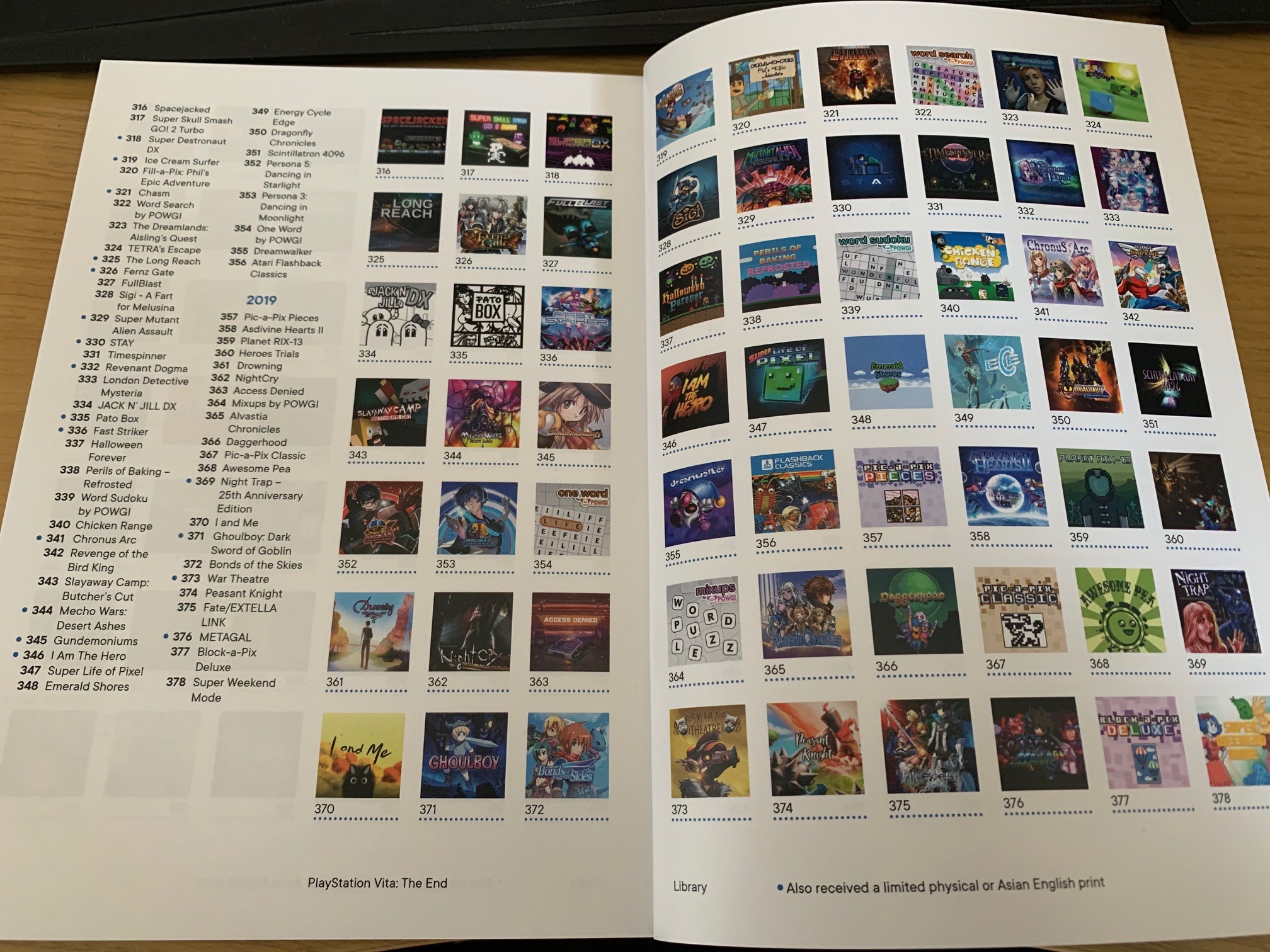
Volume three, The End, covers 2015 to 2020 and the decline of the console. The stand outs here are the interview with Shahid Kamal Ahmad, head of Sony's PlayStation Strategic Content Division and the retrospectives, covering a diverse range of niche titles (most of which, I must admit, I had never heard of - bad Andu!). These retrospectives are a thing of beauty and show off the breadth and depth of what the Vita was capable of. Finally, you get the software list again, and this time, it's huge - as you might expect from a five year period but considering that Sony let the platform wither away... well, 103 physical games and a whopping 481 digital titles (as of 12th August 2020), well, that's just amazing. All told, these volumes list 229 physical and 661 digital game releases - no software for the console my backside!

The software catalogue is comprehensive.

As noted above, the Vitazine is a list of the 100 top games as compiled by Rai. You get a community top 100 as well as the top 20 PSP games to play on the Vita and a short "Missed the List" page. I know I'll be perusing that list in future purchases!

Hot bookshelf action!


This collection has been a labour of love for the author, that is plain to see. Getting three Kickstarter projects funded and delivered is some achievement. The content is informative and comprehensive, the design and print quality are superb and I am really pleased to have caught the third project and ordered the three physical copies. The Vitazine is icing on the cake, and all four publications will be used as references when I start my Vita collection. Yes, I don't own one yet but I shall, to sit alongside my PSP and its growing library. I'm not sure if physical copies are still available but you can buy pdf's of the whole collection at 2old4gaming.com. You'll also find some Vita videos here from the author's YouTube channel and I suggest you check out some of his other videos too. In the opinion of your humble scribe, the sum total of £13 for the digital collection is a bargain but if you can, go for the physical editions. Very highly recommended!

Tuesday, 1 September 2020

The Games That Weren't - Book Review

The Games That Weren't is the latest release by Bitmap Books and, I'll admit, the first title I have purchased from the company. Written by Frank Gasking, this tome is the result of five years of research and it certainly shows. Covering over 80 unreleased games, with five hardware pieces and an "honourable mention" section that could make up a second volume (hint, hint), there are over 640 pages of videogame history here. If that wasn't enough, there is even more content available on the Games That Weren't website.


I pre-ordered this when it was announced as it appealed to my interest in videogames history. With a slight delay in release (a matter of days, really), I received an email notification on the new release date and a later email with a link to download a watermarked PDF copy of the book. Whilst I could have started reading that straight away, I wanted to wait for the book itself. This was received on the following Friday afternoon from the hands of a very cheery courier (cheers, Bob!). This was when I got my first surprise: the care and thought that went into the packaging was immediately apparent and much appreciated. Then came the next surprise - it's a hefty book, and of high quality too - the binding, hardback cover and paper quality are all excellent. For £30, I was impressed. That did not change as I started reading.

Now that is well packaged.

The author's style is easy going and very readable. His enthusiasm for the topic is plain to see and you get a sense of joy as each title is covered. Some games only get a two page entry, featuring art and a small text box. Others can be several pages in length with a lot of input by the original developers and more artwork/screenshots etc. This makes the book easy to pick up if you just want to read a couple of entries or, if you're like me, that "just one more section" pull that means you go past midnight without even realising it! For most of the titles, artist impressions have been created to give the reader an idea of what the game may have looked like. Whatever the art, the glossy high quality paper makes these jump off the page. 


There is certainly a lot of content here, as it covers a forty year period (1975 to 2015). What I really like about the author's approach is that where there is a lack of information or help, he clearly states that, which adds an air of poignancy to the book and underlines the importance of preservation for videogames. There is constant referral to the GTW website where more information can be found and the website compliments the book well. Each entry in the book also has a notification as to whether the game is available to experience today or not. 

You do get a real sense of how the industry changed from it's early years to the mass market commercial juggernaut it is now.You also get a real understanding of how much technology has progressed over time and just how cutting edge some of these titles were. Hearing about how developers struggled (and often succeeded) to get software running on some formats was extremely enlightening. It's also nice to see that the titles covered are spread out over numerous formats. As an Amstrad GX4000 fan, the chapter on Gazza 2 answered quite a few questions for me. It was also nice to see the Archimedes get a mention with Spitfire Fury and any mention of the Konix Multisystem always gets my attention, as any reader of ACE magazine and it's hardware section will attest. On a personal note, I must admit this book brought back many happy memories of the 8 and 16-bit era, with the mere mention of long-closed software houses conjuring recollections of buying £2.99 cassettes from the local newsagents.

Are there any negatives to this book? Well, if I am being really picky, I wish maybe a different coloured bookmark as my cat really, really likes that bright green. In all seriousness though, no, I have no negatives to report.

Well laid out with superb print quality.

Overall then, I think The Games That Weren't is an excellent title, one that provides not only an informative and detailed history of a selection of cancelled videogames, but an interesting view of the nature and history of the videogames industry itself. I hope that one day we'll get a follow up volume as there are no doubt many more lost games to be brought to people's attention. In the meantime, for £29.99 including UK delivery, this is a must-buy for anyone with even a passing interest in the hobby.

As for Bitmap Books, they have several other titles that have caught my eye and I think an order for The Art of Point-and-Click Adventure Games is on the cards.