Saturday, 19 April 2025

Magazines of Yesteryear - Personal Computer World - Volume 1 Number 2 1978

Nothing says computers in the 1970's like a maths equation, and with this second issue of PCW, published in April 1978, one way to escape the drudgery of maths was to use a computer - in this case, a Commodore PET. It was early days for the micro, but if you were sufficient of heel, you too could have joined in the fun. And since we're delving back 47 years here, I have relied upon the Bank of England inflation calculator to provide a rough guide to what those far off prices are like today, placed in brackets after the original prices. Please keep in mind that perceived value is something else entirely, as is the actual cost of living - just as Switch 2 games at £75 might be, inflation-wise, similar value than cart games of the early 1990's, seventy five quid is still seventy five quid, and times have most definitely changed. With that noted, on with the magazine.


The publisher's letter on page two grabs your attention immediately, with the heartening news of expected sales of the debut issue hitting 25,000, and some 3,000 subscribers. As will become apparent, just because there were not that many micros in the UK (for sale or actually sold), that didn't mean there wasn't keen interest in computers. Small acorns and all that...


The letters page has the first doozy of the issue, and it's that age-old complaint regarding US and UK pricing - the PET being £695 (£3,700), whereas the US price equated to £305 (£1,600). The author concedes taxes, country specific alterations and logistical costs, but still questions the difference. He also queries Tandy's possible pricing, which turned out to be similarly "high", but hey, individual markets and "reasons" - it certainly didn't matter whether the US had more disposable household income or not - and that was a very general assumption.

One does, however, love the response to the question as to why the US edition of PCW was not $1, so there you go. 


Note, also, the rather tetchy letter from Keith of Intel regarding Guy Kewney's issue one piece on the brief history of the computer. And that final paragraph - be told! 

Contents page.

The first article of entitled "Power to the People", and given 47 years of technological advancement and capitalism, it's rather quaint but also quite prophetic in some instances - flat panel displays and networking, anyone. OK, not huge leaps of faith but an interesting feature nonetheless. 

The keypad was the usual "high quality" item... 

The Might Micromite casts its gaze on the Science of Cambridge MK14 computer kit - well, single board computer, a highly useful and very affordable opening into the world of computing, as the above ad states, at only £39.95 plus £3.20 VAT and postage (or £43.55 (£230) in the order form! - just state the total cost, you planks, marketing be damned!). The author confides that he is sure it will do very well, and if you know your history, Science of Cambridge was previously called Sinclair Instrument Ltd, before evolving into Sinclair Computers and thence Sinclair Research. As for the article, it covers the basics of what the board offers, and what you can do with it. 


Since this was the very early days of the micro, the kit option was often the most affordable, and "The Compleat Kit Builder" feature gives you all the info about the kit you needed to get started. And it was a lot, to be honest. The approach is about right even for the newbie. Oh, and points for cuteness using the archaic spelling for a then-modern tech. 

More user information is on hand with "Yes, but what does the little beast do?" Not a guide to youth-based chimney cleaning from the 1900's (because it should be), but an illustrative guide as to what a microprocessor actually does. Again, aimed at the beginners to the hobby, it should be remembered that at this point, the average person's exposure to computers would have been as a huge box with lots of lights, spinning tapes, and either the offer of light comedy or end of humanity levels of threat. I jest, but this was the kind of article that was needed for the prospective audience. You might have an interest, but in those days, the practical aspects of form and function were important in garnering understanding for end users. 


BASIC - The First Steps is another introductory guide and yes, gentle reader, we have "HELLO" as the first program. It warms the cockles of me 'eart, it does, and the instructions on the use of specific keys highlights just how alien using a computer would have been to some new users - telling people that pressing the "delete" key once removed the last character typed, pressing it twice removed the last two, may seem positively ridiculous now, but given that if you had used a "keyboard" back then, it would likely have been a manual typewriter, these basics were much needed. 

Speaking of which, "Typing Without Tears" aimed to give readers a helpful hand in how to improve their typing skills via two routines, since the primary way of interacting with a computer would remain the keyboard for years to come (and still is for most uses). Given how bad some keyboards on early micros would be (IBM PC Jnr, any Sinclair product - I will die on that hill -  Jupiter, Oric, Atari 400, and yes, the machine of the day as far as this issue of PCW goes, the Commodore PET), one can only look back in amazement and wonder what the actual fuck was going on in the heads of the manufacturers. It's the one accepted method of input. Don't make it shit! Mind you, I could say the same for operating systems in the 21st Century. Looking at you, Microsoft. ESPECIALLY YOU!!!

Wise words, indeed!

Harry Harrison (yes, he of the Stainless Steel Rat) is up next with a look at the Sperry K3 sight, a mechanical analogue computer in use during the Second World War. Point being, don't ignore mechanical computing from the very early days of computing itself. 

Next is an article by Guy Kewney, whose association with PCW would span many, many more years. It's a comment piece and targets the nature of the personal computer business regarding profits and sales. With a mix of anecdotes and observations, it's an intriguing look at the market as was, and signs off with the lovely observation that the high cost companies are not rip-off merchants(!), merely cautious. Over-cautious in the author's mind, and they don't yet really believe that the man-in-the-street wants to spend £300 on a computer. "They'll learn". And look what happened... by the end of 1980, the ZX80 was yours for under a ton (£420 - sweet), and Acorn's Atom for £175 (£740), both assembled. They were spoiling us by then.


What follows is best described as an infomercial. It's an article about Commodore's approach to computing, aka the Commodore PET, it's history, what it could do, and what possibilities awaited. So what, you may think? Well, it was written by Kit Spencer of Commodore UK, but hear me out. I can totally understand why this feature exists. It's a justification as to why a home micro exists and why you might want to buy one over say a MK14 or similar single board computer. Whether you could afford it was a big question, but it was one of the less expensive than most competitors. It's an informative piece and more than justifies its place in this issue. 

The good lady looks as impressed with him as she is with the PET's keyboard*

Martin Collis brings us his experience in bringing a small business system into action in a software house. After choosing an SWTP 6800 from Computer Workshop (more on them in a moment), they spec'd a 4K single interface system, added a further 12K of RAM, a second interface and a cassette controller. The reasons were price, the greater popularity of the Motorola 6800 over the Intel 8080, and the fact that there were (and then still were) plans to manufacture the kit in Britain - this would continue to be a "thing" for years to come, but times would change. The kits arrived about ten weeks later, and it took two of them about two weeks to assemble and solder the beast together. And we complain about the time taken for Windows to update. Actually, yes, we still should, if you are still using Windows. Whatever benefits Win 11 seems to have, I still consider it a dumpster fire of an OS. 

After what seemed to be a dodgy power supply that actually turned out to be duff memory involving several trips to CW, the guys were almost ready to rock and roll. Except an 8K board and the cassette interface were still en-route - and this after nearly four months had passed since ordering them... Throwing caution (and fiscal propriety) to the winds, they cancelled the cassette interface and ordered a twin mini-floppy set up that happened to be in stock. We'll get to prices shortly. 

Software wise, they ended up with version 0.9 of the BASIC when they expected version 2. Still, they got some games running on it (it's always about the games!), and were awaiting the new BASIC version as they'd found some bugs in 0.9. In summary, they found the hardware robust and reliable (albeit not liking a cold room), though the SWTP system software was iffy, and that Computer Workshop's hardware support was excellent - their software support less so. Once the new OS was ready, they would be able to start developing bespoke programs for their needs.

The cost, you may ask? The processor, twin disk drives, and 24K of RAM set them back £1,700 (£9,150). Adding a VDU (that's visual display unit, or monitor for you kids out there) and 30 character per second printer would cost a further £1,500 (£8,000), for a grand total of £3,200 (£17,150). When created, they expected the cost of their software to add £800 (£4,300) to the package, and if you needed "full size" floppy drives, that would add a further £900 (£4,800) on top. 

A similar case study, this time for a ready built system, focuses on Computech, a company that was founded in 1966 as a recruitment agency and as a developer of software for accounting machines and visible record computers. The recruitment side took off, the other, less so, but in this piece that "should be of interest to the hobbyist", (weren't they all hobbyists back then?), the focus was acquiring a computing solution with a hardware cost not exceeding £10,000 (£53,800). Their choice, as you can see, remained handily within their budget. They ended up developing in-house programs, and had at the time of this article, computerised three of their four agencies for a total outlay of about £20,000 (£107,600), and this after they had considered a mini-computer in the form of a PDP-11. As the article notes, the hardware was purchased in November 1976, first live running was April 1977, and within six months of that, things were going great. 

I mentioned Computer Workshop before, and on page 42, we have an interview with John Burnett and Gordon Ashbee of the aforementioned retailer. There's some interesting snippets here, such as a discussion on what the "hobby market" actually was - and a wonderful observation about the difference between the US and UK markets - the former had a higher level of disposable income and different tax rules, so an amateur was truly an amateur, whereas in the UK, they considered people who bought a computer as wanting a return on that investment. That and the US user would have quite the high end set up, whereas a genuine UK amateur would stick to a low cost, barebones system. There's also commentary on the future of computers in education (it's coming), and that they have grown to the point where they can't provide a truly personal service to customers anymore  - a shame but also testament to the growth of their business. 

The PET 2001 review begins with an overall impression (very well constructed and with some nice features), but the reviewer also states that they only had a day with the machine whereas a week would have been preferable. As a review, it gets rather technical, but the last paragraph is a one for the times, leaving a number of questions hanging. Yes, you can easily form an impression, but what happens when you expansion and support? "These are questions worth asking and worth getting answers to" - so provide them please. It's a review, after all. Sadly, no answers are forthcoming, but the reviewer did not like the keyboard. So, do you buy one? I have no idea, and neither did the reviewer. I can't help feel that if the Spencer article and this review were combined, it would have been more helpful to the casual reader, but would have also completely torpedoed the idea of editorial independence. Oh well. 


A second review tackles the Research Machines 380Z, a box I am vaguely familiar with as Tanfield Comprehensive had a single example in one of its Archimedes A3000 suites. The review is more fun than the PET one, as the author here shows a fine line in criticism and humour - the reminder for readers to ensure all of their plugs are correctly fused is a quaint throwback to times when they still showed children how to accomplish such tasks, something that still happened in the early 1990's. Build quality came in for some criticism, with the choice of cabling and lack of shock protection causing some concern, but the software offering was highly praised. The author notes that his criticisms are mostly personal, and that if you could only afford a barebones system for £400 (£2,150), then you'd be well served, and of course the expansion options would be great for schools and businesses. A few quirks, but the reviewer was sorry to see the review unit go. 

Teaching children about maths and ultra small print.

Two programs take up the following four pages, one a pseudorandom number generator, the other a scrambling program, before we get to a piece on teaching packages for the classroom. All three include listings for those with 20:20 vision. 

A comment piece of data processing and analysis NOT happening in the NHS posits some rather good arguments as to the use of computing in medical care to deliver better patient care and outcomes. If that sounds familiar, that probably because that mantra has been repeated often of the intervening forty seven years, and this work comes from a time when you didn't have huge corporations trying to earn billions from multi-year contracts for systems that never seen to deliver on their promise. What? Me, political, pshaw! And don't get me started on data hoovering and monetisation... All I will say is that the author makes some good points, a lot has been achieved since then, but the ever-lasting presence of late stage capitalism in healthcare is royally fucking things up. 

On safer ground is the section dedicated to the Amateur Computer Club View, and the gloriously understated opinion that the £695 (£3,700) of the 8K PET is "a bit much for the average amateur." Who would have thunk it? And in a situation that would be repeated countless times over the next several years, orders for X machine have not been received. In this instance, it's the rather more affordable NASCOM-1, which famously was expected to need 200 sales to make a profit, 400 would have been great, and they sold the latter amount in the first two weeks. Mind you, considering the absolute cluster that was 8-bit micro production in general between 1980 and 1985, this was just a sign of things to come. 

A feature on the small system approach to program editing may be of interest to some - I'm an SQA bod, so whilst I can generally understand RPG in the context of financial programs, writing and editing it is another thing entirely. Hell, I can still forget the odd semi-colon on an ACS command every now and again. Anyhoo...

We have a multi-page deep dive on the E78 Europa Bus for those of a hardware mind, before the Products page, featuring the KIM-1 microcomputer system card, yours for £185 (£1,000). They were quite popular for a time, so a suitable option if the MK14 didn't appeal. 

That's it for editorial, so what about the ads? Considering the era, there are more than you'd think, but at the same time, we were still bound by the aesthetic of the period. 


We have Xitan Systems on page 2 offering a range of Z80 systems from the likes of Cromemco, North Star and Dynabyte, and from only £1,539 ex VAT (£8,300). These names would hang around for a few years, until the slow move away from the Z80 and the "joy" that was CP/M that would define a business machine. In time, PC-DOS/MS-DOS would replace CP/M as the OS of choice, mostly due to the ubiquity of the IBM PC and its kinda/sorta compatibles. True compatibility would take a little while longer to arrive, but for fans of DR's aging OS, at least Amstrad had consumer's backs by using CP/M on its PCW range until 1994. 


Comart were another distributor of the above manufacturers, and use Xitan as a local supplier. 


The Newbear Computing Store would sell you all the bits and pieces you'd likely need, including a vast array of TTL IC's (integrated circuits), literally for pennies, although something like a 2.5MHz Z80 was a more substantial £15.50 ex VAT (£85-ish). 


For books and magazines, L.P. Enterprises has you sorted, and quite the range to US publications. Check out the magazines in the right hand column - even in the beginning of times, there were choices galore for periodicals. 


Compelec Electronics wishes you entry to the Altair Age, and a range of systems that could be expanded with floppy drives and even a ten megabyte disc system, for a price obviously. The System 9V as shown for £6,781 to £7,026 (£36,500 to £37,800) hasn't any specifications listed, but one presumes it was a serious amount of kit for the time. 


Lastly, a final mention of the Computer Workshop, whose ad is straight to the point with a list of machines, in both kit and assembled form, with prices excluding VAT and carriage. 

Regular readers will know that I can be quite waspish when it comes to the magazines of yesteryear, but in this instance, I feel that approach would have been (mostly) unwarranted. This was at the dawn of personal computing, and the focus was still very much on small businesses and the amateur who could afford such frippery. Yet within a couple of years, there were moves to more readily available machines, and sure, the ZX80 was a kickstart the home owner needed, but it was by no means the only option, and you paid for what you got. Mass market offerings would take yet another year or two, and by that I mean games. You may disagree, but whatever "serious" reasons that may have existed for buying a home micro, the creation of a games industry didn't happen because Father wanted to track stocks, or Mother was busy balancing the home economics budget. And yes, those stereotypes lasted for a lot longer than many of the micros that followed these early efforts. 

As for our next sojourn to the periodicals of the past, I have not yet decided, although I feel the mid-1980's  calling. We shall see. 

* The temptation for a Geordie themed caption was high but I controlled the urge, pet.

Saturday, 5 April 2025

The RISC OS North Show - 29th March 2025

It was with some anticipation that we of TIT Towers journeyed to the town of Warrington in Cheshire for the inaugural RISC OS North show being held at the Village Hotel there (sadly not in a Lotus Super Seven S2, but neither being chased by giant white balloons, so clouds, silver linings etc). With the sad demise of the long running Wakefield show (which for the last three years had been held in Bradford, so another chance for the former West Wing star Bradford Wakefield gag to be exhumed for one last huzzah), RISC OS North found itself much like the titular space station in Babylon 5 - RISC OS's last best hope for a show north of London (by a matter of 8 minutes or so compared to the South West Show, according to Google). So how was it?

Well, pretty bloody good, to put it succinctly. I'm not going to repeat the contents of the rather excellent report from The Icon Bar, nor am I going to cover the four theatre talks in much detail - Mark has already done that here, as well as some nice photo coverage, so aside from the top image of the Soft Rock stand, there's no other imagery in this post - please click the link to TIB. An aside: if you want to keep up to date with all things RISC OS, not only do we have The Icon Bar, but also Riscository as well, so bookmark them to stay in the know. The ROOL forums are another font of knowledge that deserves your attention. What does follow, however, are my thoughts, impressions and random musings on the show and the weekend in general.

With TIT Towers location in deepest, darkest County Durham (north by north west at the cathedral, if you hit the old steelworks, you've gone too far, definitely DO NOT turn left at Albuquerque!), it was something of a near three hour drive to Warrington, including a nice little stop off at Kirby Stephen for refreshments on the way, and then a quiet Thursday night spent at The Waterside pub. The attached hotel to the Waterside was our base for the weekend, and just a couple of minutes walk from the Village Hotel itself - and much more reasonable value for rooms, too. 

The Friday was spent seeing what Warrington had to offer and, should we return (see below), we'll be making a quicker beeline to the Warrington Market, where numerous small food businesses are located along with a large seating area. The food we did have to go was lovely, so plenty of other options to try again in the future. As for the town itself, not a bad little place, and although some of it looks like Consett with the charm, none of it approached the level of Stanley without it. If you know, you know. Friday evening saw us back at the Waterside pub where the first points were scored on the "They're in with the RISC OS crowd" bingo card. Next year, we'll have an Observers book(let) ready. 

Saturday dawned and, after a frankly disappointing hotel breakfast (yet their evening meals were really good, so go figure), we wandered to the show venue. Admittance started at 10.30, and we were soon wandering the stalls. Conversations were had, some money changed hands, and it was great to catch up with familiar faces as well as talk to new ones too. It really is a friendly community should you wish to attend future events.

This year, the hardware purchase was a RISCOSbits DIY Three, as my near six year old PiHard began pining for the fjords a couple of months back. I'm looking forward to the build process as well as giving the new casing something of a funky paint job. 

Other pick ups included the Drag N' Drop back catalogue, Soft Rock Software's revised Software Collection, the latest title from Amcog Games, Morphix, and paying my membership dues for the Wakefield Club. A t-shirt from RISC OS Open covered the last of the cash purchases, and the only other item collected that day was the brand new issue of Archive magazine from its stand, manned this year by Colin from Samcoupe.com. It was nice to have a catch up, despite the very last minute delivery of the issues (about 9am, I believe he said), and he also had some top of the counter SAM Coupe goods for sale - issues of SAM Revival, key rings, a framed ASIC, and he was more than happy to show off some new hardware too. 

One thing I didn't pick up from the charity stall was a huge back collection of Archive issues, and although the appearance of an Iyonix was also a temptation, there simply isn't room at TIT Towers to do it justice. Opposite that stall was a lovely display by the North West Computer Museum. We visited (and donated kit) there last year, and although we had no time this year, quite a few of the exhibitors had either taken advantage of its proximity to have a gander before the show, or were planning to go the next day. Warnings were passed on about the rather generous cheese toasties we "experienced" last year. Seriously, there was a lot of cheese!

The layout of the show was dictated by the venue, with a dividing wall blocking off most of the exhibitors from the theatre area, which in the previous venue was is a separate room. This worked pretty well, but there was the slight quibble that if you were sat at the back rows of the theatre seating, there was a bit of noise overspill from the show area. A minor issue and one that was fed back to the organisers. They have thoughts for a show next year which will see that disappear so, yeah, that was my only criticism of the show.  

Everything else was spot on, and credit to Richard, Andrew and everyone else involved in putting this show together at relatively short notice. It was well organised and seemed to have a buzz that made the whole day feel even better. As you may have noted from the above, there are plans for a show at the same venue next year, and probably around the same time of year. Richard explained their reasoning clearly in his theatre chat, and to be honest, the small window between the winter weather and the wedding season is perfectly suited for a northern RISC OS show. What I can say is that if there is a RISC OS North, I will happily make the journey. It's a worthy successor to the Wakefield shows of lore and long may there continue to be a northern event!

There was also, however, talk of the London show at the end of October, and whilst it would make for a lovely trip (as well as seeing the capital because apart from a trio of wargames shows at the Excel pre-Covid, I haven't been to the capital proper for some twenty seven years, and there's a lot of cool stuff to see - the priority, obviously, would be the RISC OS show). I'll look at the logistics to see if that's a go-er, but in the meantime, it's just good to know that the UK has two RISC OS shows well spaced both geographically and in the calendar, and if you can make it, there's always the RISC OS eXperience in The Netherlands in May.

RISC OS is still a fun and funky hobbyist OS for people to use, and as long as you are aware of its limitations, there's no reason not to give it a try if you want to. Maybe the Moonshots Initiative will pick up support to secure the future of the OS in a 64-bit world (The Register covered that as well), but regardless of that, there has never been a better time than the present to dive in. You'll find the majority of the movers and shakers in the RISC OS world listed on the RISCOS North show website here.

Saturday, 22 March 2025

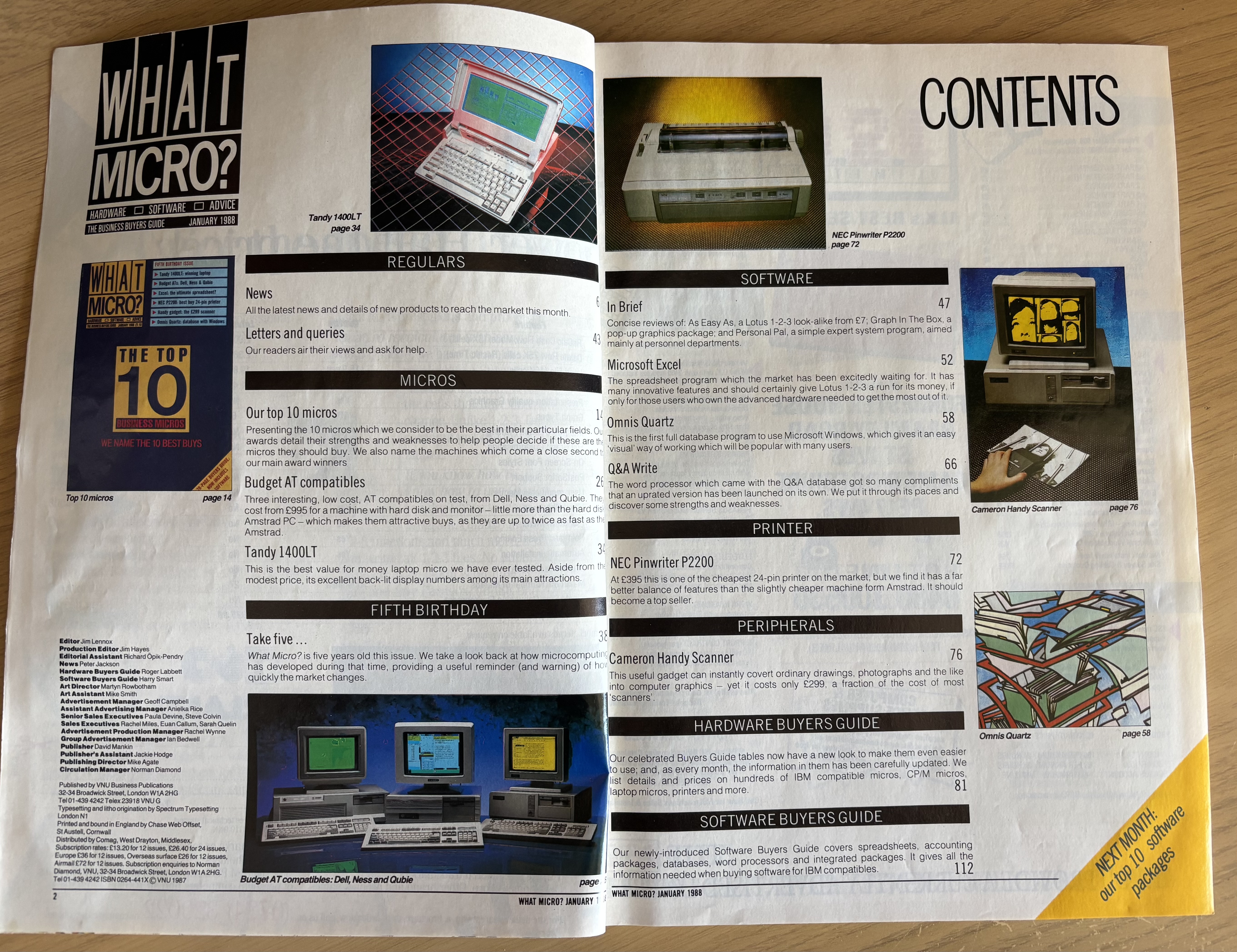
Magazines of Yesteryear - What Micro? - January 1988

What other way for What Micro? to celebrate its fifth birthday than with a declaration of the top ten business machines then available on the market. Given the date, you might be surprised by one or two of the selections, but hey, it was the 80's, and a time that, for computer fans in the UK at least, meant that the 16-bit generation was beginning to hit its stride. 

But first, the news...

Amstrad had launched their portable range, although at 12lbs, the PPC's stretched the definition of portable. Starting at £399 ex for a single floppy, 512Kb model, rising to £499 ex for 640Kb, and an extra £100 each for another floppy (which would make life a hell of a lot easier), these were very competitively priced. That the PPC640 rocked a 2,400 baud modem was a cherry on top. Sure, the LCD was crap, and the keyboard simply mediocre, but if you had to have a computer for use at points A, B and beyond, they did the job.  

Just as Epson's portable could, and with a smaller, but not overly lighter, form factor. There again, that would set you back £1,395 where as a similarly spec'd PPC640 would do you for £599. You pays your money and all that...

The same goes for Apple, and a lot of money too! Even with cuts of up to £300, a hard disk equipped SE would still leave you £2,895 worse off, although the basic Plus was £200 lighter at £1,795 - a veritable bargain... Of the more expandable Mac II, this was a case of there being coughs, near and far. A mono HD model for £5,195 was definitely a far cough moment. 

Back in the clone world, Compaq were trying to tempt users to the joys of VGA graphics, but while you may think that £400 for just the card to get 640x480 at 256 colours was a bit steep, that was a snip considering the accompanying colour monitor was £505. A mono-VGA tube was only £205, but surely you'd never pay that much for a graphics card and not experience glorious technicolour? There again, that £400 in late 1987 is now just over half of the imaginary MSRP of the Nvidia RTX 5090 today! 

Tandy were refreshing their range of machines, and although tempting business options, £595 for a basic 256Kb of RAM was a tad pricey. 640Kb would take the price to £795 with a mono monitor, and £995 for CGA. At this point, the 286 models seemed like a better bet at £895, and with greater expansion options too. Sadly, it was a tad early for the 386 to be anything other than a multi-user (see below) wonder, with the Tandy 4000 expected to start at £1,995 for a system with just a floppy and no monitor. A useable spec with a hard drive and mono screen began at £2,995, and EGA graphics added another £500. 

AST talked of shipping a 20MHz 386, although prices were still to be confirmed. What you would do with a 386 as a single user was a more pertinent question, and providing justification of not spending the money. Meanwhile, Digital Research were upping their efforts to disappear slowly into history by releasing Concurrent DOS 386 2.0. Notable bragging rights were for up to 255 simultaneous tasks on a 386 machine with up to 4 (count 'em) gigabytes of memory, with each terminal user (for what else would you have this OS and such power for in 1988) able to run two MS-DOS programs at the same time. Not bad, but if you could afford that much memory in 1988, the cost of the attached 386 would have been just a mere rounding error. 

VGA graphics got a proper mention with the release of more upgrade boards, although the cheapest still rocked in at £299 and you'd still need the relevant display on top. 

The cover feature next, and by grouping the winners into ten categories, the What Micro? team have tried to cram in as many machines and formats as possible. 

Amstrad won Best Budget IBM Compatible, which is no surprise although comment was made about how the higher end PC1640 with EGA style display option was worse value for money than its compatriots, coming in rather close to some 286 base systems. The 1640 was still better value than the 1512, and it's hard to disagree with that opinion in hindsight. 

Fastest IBM Compatible went to the Compaq Deskpro 386/20, and when something starts at £5,225 ex VAT, it needed to fly off the proverbial shovel. IBM came close, as did the Mission 386.2 (nope, no idea either), but given the scarcity of 386 20MHz offerings out at the time, this was an easy win. 

Most Innovative Micro next and, well, yes, yes it was, and I'm not hiding my favouritism at all here. The Acorn Archimedes beat the Amiga and IBM's PS/2 range for innovation. For its price, it was fast, highly specified, and only lacked software to make it truly fly. If only it had been that simple. 

Cheapest Complete System feels like a section created for one reason and one reason only - the Amstrad PCW must be given its time in the spotlight. And you know what, for the late 1980's, if you wanted a home office system including a printer, there was no better value, and even the runners up section notes that the only real competitor to the £299 PCW would be a PC1512 and printer for about £600. Better, yes, but also double the price of the base PCW, and for that, Amstrad's CP/M wonder deserved its success. 

Back to the PC world with the next two - Best Value AT Compatible and Best Value 386-based Micro. The former was a clear winner given it's from one of the "big" manufacturers, although a tad slow at 8MHz when the competition were turning the dial up to 10 and even 12MHz (Ludicrous speed indeed!). The latter was a timely win for Apricot, being both British (when such malarkey still mattered), and being a relatively long time solid company. Whilst not as fast as say IBM's offerings (which were £2k more expensive, albeit with better expansion options), the Xen-I 386 was seen as a safer bet than the small company offering the cheapest 386 at that time, the Stanhope Baby 386, yours for £2,290. 

Laptops now (and Portables to come), with Zenith taking the honours for a 12 lb wonder that delivered a backlit LCD screen, something of a winner for any user. Toshiba, who would become synonymous with laptops as the 80's turned to the 90's, arrived as a runner up with their 1400LT - nearly half the price of the Zenith and suffering from only a squashed screen. Their more expensive models were considerations if you wanted more power (see below), and the Cambridge Z88 walked off with a nod to extreme portability. 

Ah yes, power. For the true "portable" warrior, the Compaq Portable III and Portable 386 took the larger of the mobile categories. They were expensive (£3.5k plus), heavy (20lbs), and mains only, but if you needed the grunt, these were the ones for you. There were many other options for the form factor, some even rocking under a grand, but Toshiba's T3100 and T5100 (also considered as laptops), were good alternatives as long as you had access to a mains point. 

The final two winners are the polar opposites of the era, Apple and IBM. Apple grabbed the Easiest to Use Micro award, which wasn't difficult to be fair, and with those new, "cheaper" prices... That, and it would take another year and a bit before the beauty that was RISC OS 2 descended from the heights for Archimedes owners... IBM had to settle for the Best Quality AT Compatible, which again wasn't difficult for the time. Yeah, the PS/2 Model 50 was expensive (£3,048 ex VAT), but you got some serious class for that outlay, with only Hewlett Packard and Compaq making up the rest of the running. 

A varied mix, to be sure, the same of which could be said for the AT trio from Dell, Ness and Qubie. Starting at £1,085 with the Ness, the Qubie and Dell offerings clocked in at £1,330 and £1,364 ex respectively, and while none of the machines had any major failings, the key differentiator was the service package - Dell's was highly professional, whereas Ness provided the bare essentials. Whether the extra £300 was worth it for the Dell was the key question. That being said, adding EGA colour to the trio varied wildly in price - Qubie for £325, Dell for £400, and a relatively extortionate £460 from Ness. 

Tandy's latest laptop came under the microscope, a 7.16MHz V20-powered device with 768Kb of memory and two (count 'em!) 720Kb 3.5" floppy drives. At £995 ex, it was a good value proposition compared to its rivals, yes, even the Amstrad PPC. Praise was given for the backlit LCD screen, and although there was a comment about the sheer value of Amstrad's offering (£499 for a similar spec), many would be better off spending more for the Tosh. To be fair, even now, I find the aesthetic really pleasing, although the idea of having a four hour battery life that required fifteen(!) hours to recharge from flat is a very 80's tech memory. 

As this was the fifth anniversary issue, the next feature is an obvious inclusion - a review of major events of the first five years of the magazine's life. It's a good potted history and packed with nice little bon mots of data, such as Amstrad's claim that as of the writing of the article, they had sold 750,000 PCW's. 

The In Brief section hosts a Lotus 1-2-3 competitor priced at under a tenner for the shareware version, and £30 for the full package including a manual, Graph in a Box (a pop up program that could create business graphics from a selection of data sources) was a £95 extra whose usefulness would be devalued as integrated packages came to the fore in the coming years, and Personnel Pal - not an A.I. People Services bot, thankfully, but more of a tech aid for personnel departments in their recruitment goals. No, not sure myself. 

The big software review is for Microsoft Excel, a £395 titan of number crunching. Adhering to the Windows 2 aesthetic, it was a worthy alternative to Lotus 1-2-3, but only for those who could afford the price tag and rocked a hard drive-equipped AT with EGA graphics. Spoiler alert, but as the SBC ad below shows, that set up would be nearly two grand ex VAT, thank you very much, with both Windows and Excel as extras. Onmis Quartz (a database manager/language) and Q&A Write (a would be DOS-based Word competitor) round off the software reviews. 


Hardware wise, NEC's budget (£395 was budget back then) 24-pin printer offered great value for money for the time, whereas the Cameron Handy Scanner was, for £299, limited in its black and white scanning abilities, but seemed good value compared to more feature-rich options if your needs were modest. The usual hardware guides and the like round off the editorial content, so now to the ads. 

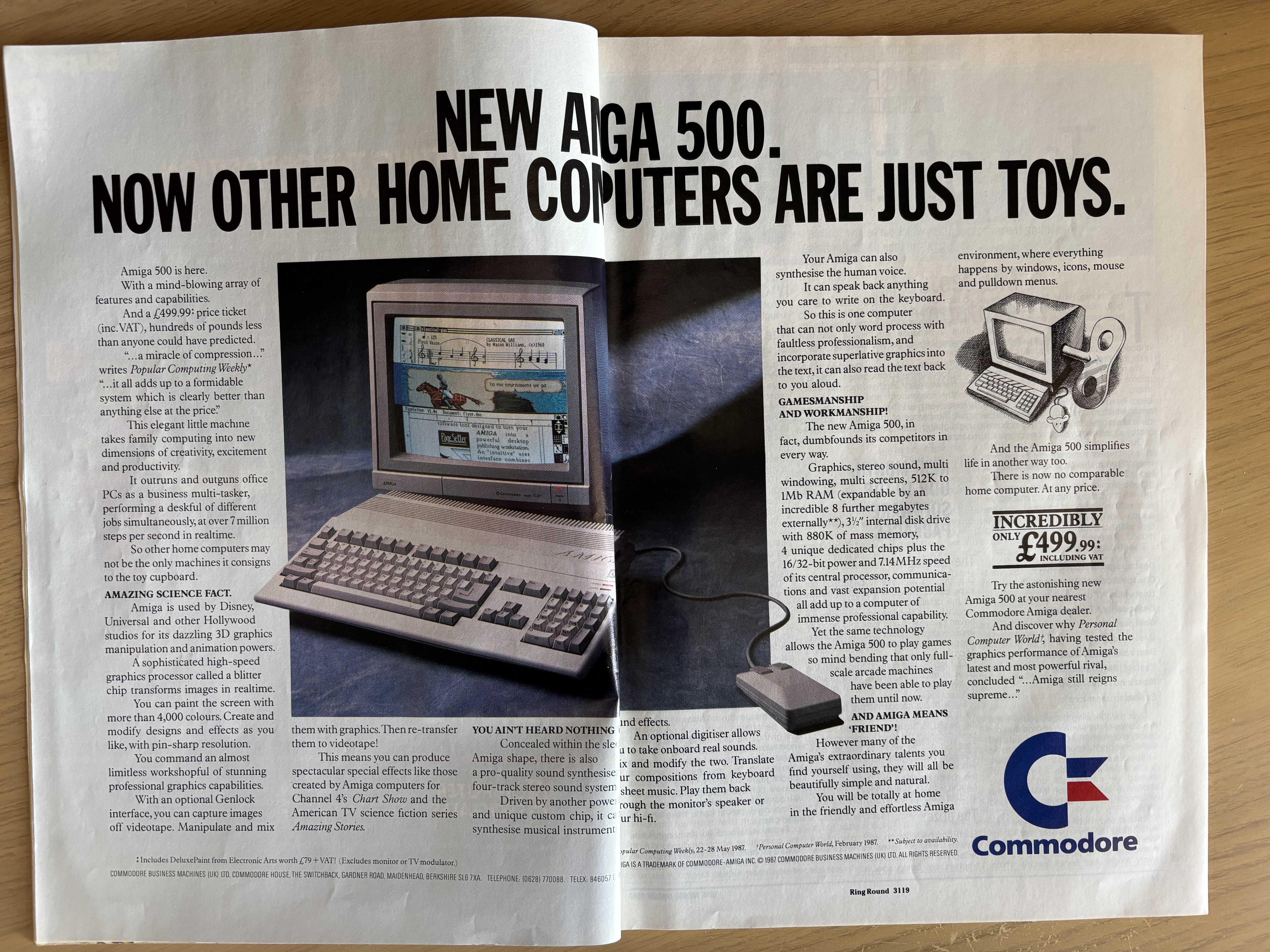
Commodore have the first eye-catching offer as they try to convince people to spend £499 (VAT inclusive) on their new Amiga 500. Even before the price cuts and bundles that would see the Amiga rule the 16-bit home computer world, albeit briefly before consoles and DOS/Windows machines took over, this was astoundingly good value, and as such, was a great home computer choice if you had the money. For business or home office use, there were (as you have seen above), more efficiently aligned (Lord, I've been hanging around managers too much!) options offering a more holistic approach to your computing requirements (Shoot me now!). 

SBC (as previously mentioned), grab two pages for their DOS compatibles, and with fairly decent prices too. Kudos also for the ad that, although it looks rather "busy", manages to convey all the relevant information and the dealer network. The mention of Derwentside ITEC brings back memories too, as they were the school's first choice of work experience placement for several of us back in the day. 

Amstrad have a go at trying to shift their DMP range of printers to business users, and yes, they were cheap, and no, they were not great, not even with that impressive 15" carriage (calm down at the back!).

Meanwhile, OKI (via Technitron Data) were trying their same, and to be fair to them, they had a much greater range (and prices), and were often a reasonable choice. 

Our old favourite, Silica, pop up with an ST ad, and for £299, it was a great buy to those wanting to leave the 8-bit era behind, and at 60% of the cost of an Amiga. 

Here's Elonex with their PC range, and although not the cheapest, by no way the most expensive, and they would become a regular name in group tests and awards round ups throughout the 90's, at least until they gave up on computers and went down the novelty tech route. 

Hi-Voltage's spread has the usual Amstrad, Opus and SBC shenanigans. alongside the NEW Amiga A500 from £399 (ex, so don't get too excited, although still a discount), and the A2000. They even had the Acorn Archimedes on demonstration. Great news, and all that, but wait until prospective buyers saw the price tag... 

Speaking of Cambridge's finest Anglo-Italian team, Acorn have an advert, placed lovingly(!) on the back cover, extolling the virtues of the A300 series. Ignore all of the asterisks, they're just copyright nods, and take note of not only the pricing (£795 ex for the half-meg 305 with mono monitor, £1,035 ex for the one-meg A310 with a colour display - i.e. the one you should have gone for!), but also of the 0% finance offer. Not a bad idea, considering the price, but for a maximum period of 12 months, you still had to have some serious incomings to afford nearly £1200 at £100 per month. Dealer prices were a smidge cheaper, but consider the 2025 equivalent (courtesy of the Bank of England inflation calculator) - a total of £3,400 equalling £283.54 per month just for a computer. That might even make some Apple fans wince these days! Back then, however, that didn't even cover the cost of a basic Mac Plus!

That, gentle reader, was January 1988 for What Micro?, and I feel the need to once again move away from the DOS-centric world for the next MoYY. The question is, what publication, and when from... Have you ever considered the aesthetic qualities of a kipper tie?

Saturday, 15 March 2025

The Games of a Lifetime by Julian "Jaz" Rignall - Book Review

To say that I have been looking forward to this book since it was announced would be an understatement. I have read, and reviewed, many histories focused on video games, but this one held the promise of being truly special because of who the author is and his role in the UK games magazine industry of the 1980's and 90's. Was The Games of a Lifetime worthy of such anticipation?

As someone whose childhood years spanned the 1980's, reading about the author's early life resonated greatly with me. Growing up around Stanley and Consett after the latter's steel works were shuttered in 1980 defined the period known as "Thatcher's Britain" very differently from the more economically protected areas of the UK, and it's this socio-economic framing that makes the Jaz's journey from rural Wales to the US all the more interesting. 

But as we continue through the years in this highly polished 400-plus page tome, there is much more than just the "wasn't it grim?" trope that people who have never actually experienced the horrors of the that government (and I'm not just talking about those who could afford a Beeb either - joke, btw) trot out. No, we're here for the games, as well as to find out just how good this guy's taste in music and books actually is. Oh, and the curse of micro-management. Yeah, right with you there...

Told chronologically, each chapter zeroes in on a particular title to which is given a whole page for a frankly glorious screenshot. What follows is a mix of detail about the selected games, anecdotes on the gaming industry, the author's personal life and career, rumination's on games that didn't quite make the author's grade but are still worth mentioning, and any other topic of interest whose inclusion is more than justified. 

From the glory days of the arcades, via the then cutting edge 8- and 16-bit computers, to the mass market home console scene, the man's love for gaming is never in doubt, and the enthusiasm and passion I remember so well from reading Computer and Video Games, and Mean Machines/Mean Machines Sega is still obvious in the text here. His style is easy to follow and packed with humour too, and where he does voice his thoughts and opinions, it's done so confidently yet with care. Well, mostly, because when fuckwits are gonna fuckwit, you got to call them out (and maybe ask some why they became politicians in the first place...). 

There is much to learn about the early games media industry too, as well as some links that, whilst I was hazily aware of them, had never actually clicked before - Chris Anderson for one, whose attempt at a magazine business (Amstrad Action, how I loved thee back in the day) and it's "future" successes, you may have heard of. That and some website called IGN... I loved the behind the scenes details of ZZAP! 64 (NEC PC-8021's indeed), as well as the fast and furious days of the later EMAP titles. As an aside, ZZAP!  64 is still a going concern, now published as part of the range of magazines from Fusion Retro Books, and whose sister publication, Fusion Magazine,  your humble scribe contributes to. Look, if I can't get a plug in my own blog post, what's the point???!!! Also, Battletech!!! 

The Games of a Lifetime is the finest autobiography/games history book I have ever read. The tone is pitched perfectly between the personal and the career aspects of Jaz's life, and I cannot stress enough how refreshing it was to see a different voice to the growing repository of the videogames history texts. It would also be highly remiss of me if I didn't highlight the touching foreword by Richard Leadbetter, the sublime artwork from Wil Overton and Gary (from Army of Trolls), as well as the efforts of those who helped with the screenshots and other imagery within. 

The Games of a Lifetime is one of those tomes that should appeal to everyone with an interest in videogames - for those who lived through those times, it's a pure nostalgia trip as well as a reminder of how bad things really were if you happened to live anywhere not in the Home Counties. For those too young to have had the "joys" of secondhand smoke, three (later four, oooohhhhhh!) TV channels, and a fascination with the colour brown, it will entertain and inform as to how the games and associated media industries developed from a particular UK perspective during their early years and beyond. I loved it, and this will remain a fixture in my gaming-related library for years to come. Bravo to Mr Rignall, those who contributed in delivering the final result, and to Bitmap Books for publishing yet another corker. 

You can pick up a copy of The Games of a Lifetime from the usual physical and online bookstores, as well as the likes of Forbidden Planet in the UK, and direct from the publisher's website here, where you'll get to experience the frankly nuts quality of their packaging. 

You can also follow the author on X/Bluesky via the following handles: @JazRignall and @jazrignall.bsky.social, and the publisher via @bitmap_books and @bitmapbooks.com respectively. 

Sunday, 2 March 2025

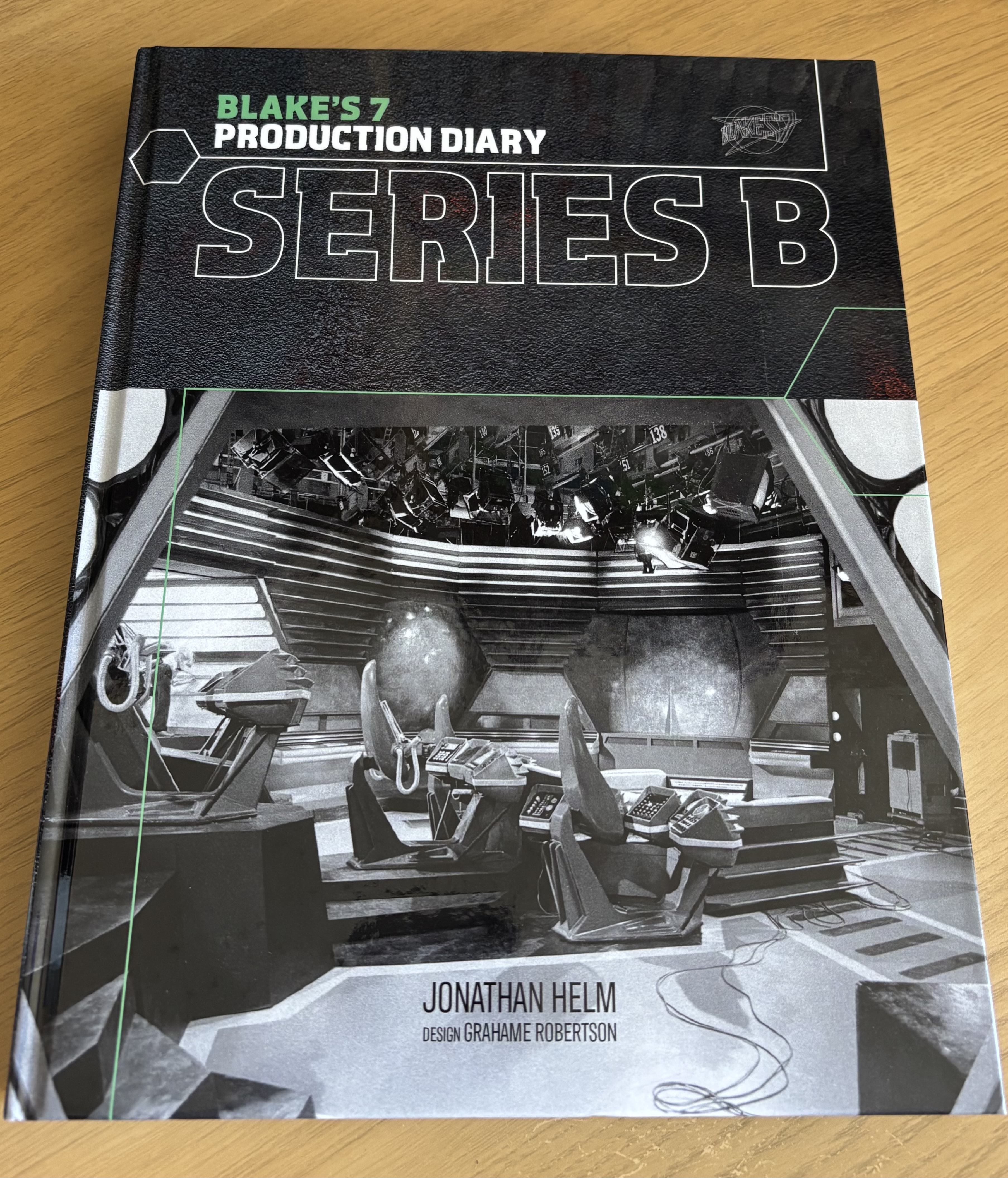
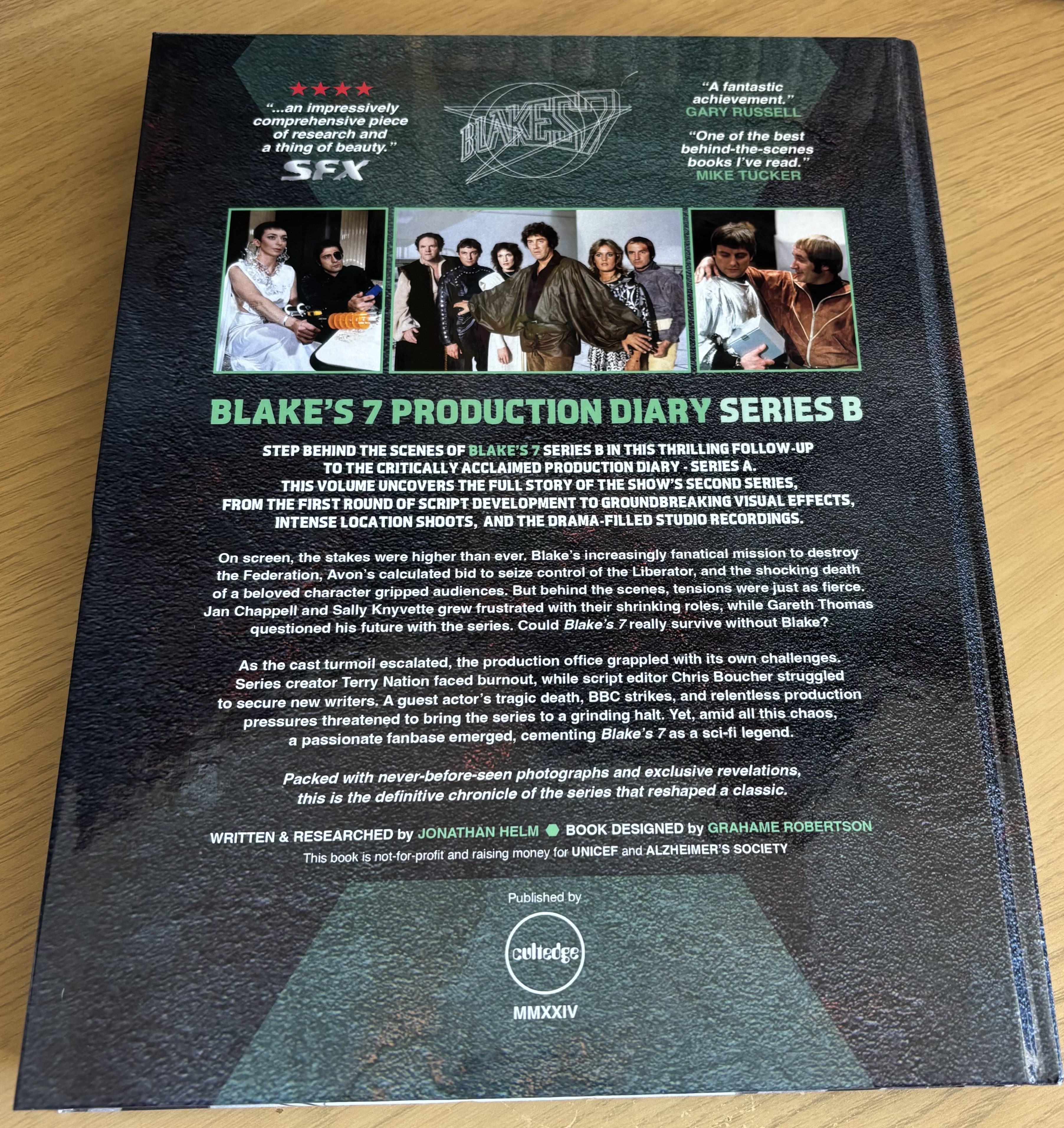
Blake's 7 Production Diary Series B by Jonathan Helm - Book Review

Well, I guessed correctly, as on Christmas Day, I unwrapped this lovely book and promptly had to place it on a shelf as it was considered poor form to sit reading it through the seasonal family gatherings. Damn!

Fast forward a few weeks and the time was taken to slowly savour what turned out to be a cracking follow up to the Series A volume. It feels like there are even more photographs and illustrations, and the gang behind what will hopefully become a four volume set have outdone themselves.

Through some 300 plus pages, you will discover how the creation of a follow up to a highly successful series of television became fraught with inter-personal tensions, re-casting, and doubts about the future of the show. As a production diary, the reader feels they're accompanying the cast and crew as these drama's play out, and whilst the overall result was as good as the first series (in your scribe's considered opinion), the continuous challenges over budget spends and some individual's particular approaches to their job had soured things a tad. 

One cannot help but feel for David Jackson for the way his character atrophied, and the way in which Brian Croucher tried gamely to inhabit a role already warmed by another. Hey, he did a great job in highly difficult circumstances and based upon the narrative presented here, truly deserved better. The travails of making an obviously inadequate budget stretch are also pure TV production gold, and just goes to show that almost anything is possible with the time and effort, as well as being genuinely amusing to read about. What may look laughable now to modern day audiences more than passed muster back then, and in one's humble opinion, there is a charm and timelessness to practical effects and model work that CGI lacks. That and CGI ages very poorly in all but the most exemplary of instances, but that's a discussion for another time. 

That being said, it was not all doom and gloom, and the various reminiscences are a joy to discover - Gareth Thomas with his costume shenanigans, and the general approach to the show's creative choices are particular highlights. Those and the seemingly traditional nightly booze ups whilst on location shooting duties. The inclusion of boxouts for deleted scenes and dialogue, as well as an episode by episode synopsis, are also highly informative.

Once again, the design of the book permits zero criticism, and the combination of publicity photographs and behind the scenes captures are a wonderful mix for a show, and a time, long ago. As with the Series A diary, all profits from this tome go to charity, and it should go without saying, but I'll say it anyway, this is an essential purchase for Blake's 7 fans and fans of science fiction shows in general. You can pick up your copy from here. Roll on Series C!

And just to spoil you lucky people, here's a rather lovely cast photo to be on your way with!

Sunday, 16 February 2025

The Legacy of Oblivion by Martin Gamero Prieto - Book Review

This, gentle reader, is how you run a book campaign on Kickstarter! After the sublime Legacy of the Forgotten, Mr Prieto has let loose with a tome that wants, nay demands, that you take note of those companies that tried, and ultimately failed, to make their mark in the world of computer graphics card hardware. But do you know what the weird part is? Despite twenty plus years of AMD (nee ATI) and Nvidia (and occasionally Intel), reading through the many chapters present here brought back so many familiar names. Geez, I should have had a life in the 90's!

Jesting aside (honestly, I did more than play video games and read sci-fi!), what we have here is another tremendously researched history of the many entities that were, at one point or another, actual names a consumer would have seen when buying PC or gaming tech through the last two decades of the twentieth century. 

Cirrus Logic, SIS Corp, Trident Microsystems and NeoMagic Corporation are some of the more familiar inclusions, although for the life of me, Chromatic Research were a complete mystery until reading their chapter here. Company histories are detailed and where there is doubt or uncertainty, the author points this out clearly.

One of the most interesting chapters for me was that about Argonaut Software. I was aware of their work due to the FX chip so beloved of Nintendo, but there was much more to them than just that, filling in more than a few gaps in my knowledge. Also well worth reading were the near one hundred pages dedicated to "lesser companies." Therein lies a true education. 

This volume is very clearly laid out, with plenty of room for diagrams, artwork and tables. There are appendices detailing the various display standards used by the DOS/Windows PC format, as well as video interfaces, and a handy glossary. For those of a hardware bent, there are several pages of eye candy to finish off this volume - some lovingly taken photographs of the various cards and boards referenced throughout the book. 

As with The Legacy of 3dfx and The Legacy of the Forgotten, this is another essential reference for those with an interest in the admittedly rather niche subject of PC display technology. You can pick them up from the Kentinel Studios website here, and their prices are very reasonable. Shipping, as is the way of things, is something they cannot control.

There is, however, one more volume from Martin, this one taking a keen eye to the history of Nvidia and ATi. That wasn't funded as part of any Kickstarter, yet I would like to highlight just how good the campaign for Oblivion volume was run. When it came time to ship Oblivion, Martin contacted the backers and asked if they wanted a copy of his fourth book in order to save shipping costs - two volumes at the same time. To be honest, I'd missed his earlier email offering this and it was a nice touch to be asked so close to final shipping. I immediately paid the required amount and thus ended up receiving the two books. Throughout this and the prior campaign I'd backed, Martin's communication's were timely and reassuring. There will be a review of book four in due course.

In short, if Martin, via Kentinel, ever decide to crowdfund for another tome, and if the subject piques my interest, I can honestly say that I shall have no qualms about supporting him again. 

Sunday, 2 February 2025

The Saga Uncharted by Nicolas Deneschau and Bruno Provezza - Book Review

After thoroughly enjoying The Mysteries of Monkey Island back in October last year, I thought I'd try another of the growing range to tomes from Third Editions, and since I've loved Uncharted since playing the first game on the PlayStation 3, this tome seemed like the natural choice. 

A team effort by Nicolas Deneschau and Bruno Provezza, over the course of seven chapters they have delivered a highly detailed and interesting look at what the Uncharted series is, and why it became such a beloved series.

The coverage the book provides can be divided into four keys topics: the founding of Naughty Dog, the making of the main series entries and the spin offs, a retelling of the various narratives combined with deep dives into the inspirations for each of the stories, and then an analysis which, as you may have already guessed,  covers Drake's reputation as a mass killer along side the more usual thematics arising from the nature of the games. 

As befits the standard set by my experience with the Monkey Island volume, this is another well written tome, with a lightness of touch and a sense of humour running throughout the 230 pages. Illustrations are kept to maps at the beginning of each chapter, which match the style so familiar to fans of the games. 

There is much on offer as far as learning about the series goes, and there's no sugar-coating the perils of video game development during the period the series established itself. As someone who detests the crunch culture and brazen unfairness of the current industry, it would be nice to see leadership types suffer the same pressures and worries as the devs/artists/writers/QA and many others involved in game creation. Sure, there's a "vision", but continuing to hear about long hours, people never going home, and mental and physical burnout, is that price worth it? Especially when it's those who suffer these conditions are usually the first to be kicked out the door in the name of streamlining and "agility'. No, corporate leadership, you made the decisions, you fall on your swords first. Anyhoo, rant over. 

Taken as a whole, The Saga Uncharted is a great single volume focusing on a gaming series that has made countless fans over the years, as well as cementing Nolan North, Emily Rose and Richard McGonagle to name just three as brilliant actors within the video game art form. Video games are more than just interactive movies, but the quality of the performances within the Uncharted series are truly high points.

Checking Amazon recently, it seems the only version of this book is for the Kindle, and the hardback copy isn't showing on the publisher's website. That's a shame, though there do still seem to be copies available from other retailers, so an online search will sort you out. As for my copy, it will join its Monkey Island cousin as a go to future reference, for you never know if someday the Uncharted games will be no longer playable, so this excellent tome will remain as a highly regarded record of them.