Wednesday, 30 September 2020

SnackSurprise - the September Box: Sweden

After a couple of month away, we return, gentle reader, to the world of snack boxes and the numerous delights they may (or may not) contain. In case you were wondering, July's box was from Greece though the package looked like it had travelled via Sparta and most of the contents were damaged, hence no review. As for August's box, it was from France but we simply ran out of time in August to try it. Don't worry, though, you didn't miss much. As an aside, you may notice from the picture of the pamphlet below, that they now do a mini box for those wishing to just sample the service. This can be purchased for £6.99 a month.


This month's box is from Sweden and what a selection we have. So, without further ado, join my good lady and myself on this culinary journey of snack delight.


We begin with Cheez doodles, the CHEEZIER snack. If these look somewhat familiar, that is because they are - they're basically Swedish Wotsits.

Herdy Gurdy Wotsits!

There is not much else to say about them - if you like Wotsits, then you'll like these. They have enough of a taste to make them enjoyable without becoming overpowering and overall are quite pleasant.

Keeping with the crisps theme, we have Olw Dill and Graslok, which translates as Dill and Chive crisps. 

GREEN!!!

These are subtle but leave a bit of a dodgy aftertaste. Mostly inoffensive, I would say that if you could ever taste a colour, these would be green. Also, ever so slightly funky. 

The Wasa Sandwich is a pair of hard crispbreads sandwiching a creamy filling of tomato, cheese and basil. Well, I will say this, they got the crispbread part right...

Kind of looks like brains in crispbread form...

...almost to the point of being inedible. And you'll need a plate to catch the crumbs as it practically explodes when you bite into it. The actual taste is a disappointment, with somehow not having much flavour but then also having the ability to leave a bloody awful aftertaste. This is a strange one and not something I'd try it again.

Ahlgrens Bilar are hard marshmallow car shaped sweets that claim to be fruity,

Cars or submarines, your call.

Well, they kind of are and I'd go as far to say they are quite nice, certainly leaving a pleasant aftertaste. Not bad.

Djungelvral are small, super salty monkey-branded sweets that are apparently a must for anyone who calls themselves a liquorice lover. That is complete and utter bullshit!

Just NO! And cat paw to scale.

I tried one and I literally lasted a second before spitting out this little hard sweet of salty shite. It's instant salt overload, leaving a nasty feeling and taste that took a good few glugs of water to get rid of. Honestly, foul spawn of Satan! This packet of disgusting rabbit droppings went straight into the bin. If you happen to like seawater sweets, you know where to look. At least we now know the answer to that hypothetical question...

Kexchoklad was a nice return to something vaguely palatable, a chocolate wafer.

Choklad Kex sounds like an underwear brand...

If you like European milk chocolate, you'll enjoy these. The wafer is just the right texture and the chocolate is smooth and gentle on the taste buds. These were very, very nice though be careful about dropping these...

Another lovely chocolate bar was the Dumle Snacks. A combination of chocolate, sweet toffee and crispy rice, this sounded familiar...

Roar!

And indeed it was - it's basically a Lion bar in a slightly different shape. If you like them, you'll love this. We certainly did.

What we are not fans of is nougat, and the Dubbel Nougat maintains that form. As you can see, it's a combination of almond and hazelnut nougat.

Death by sugar.

It's horribly sweet. I mean, I know nougat is essentially just sugar but Jesus wept, this was sugar coma in a bar. One small bite was enough for us. Naturally, your tastes will vary.

All these snacks were making us thirsty so we went for the included drink next: Trocadero, a sparkling mix of apple and orange that originally launched in the 1950's.

Insipid death piss. You're welcome.

All I can add to that is they must still be using the same apple and orange to get the flavours from as there is bugger all taste and even then, it manages to leave your mouth feeling like a fruit basket has decomposed in it. Insipid to start and death to end with - hardly refreshing...

The penultimate item was Tutti Frutti. You'd think, by now, a small, fruity sweet would be just the job to restore us. Well...

Nope, I don't know what flavours they are referring to either.

These are hard sweets, and I mean, hard! I timed it and it took me four minutes to get just one of these little bastards softened to the point where I thought I could safely chew it. This wouldn't have been so bad if it had that promised taste of orange. But no, there is no taste here at all, which makes this sweet pretty much pointless.

Finally, and not least, we have the Delicatoboll which, as you can see, looks like a coconut covered dog poo. This does not bode well, even if they say it's a great accompaniment with coffee.

Hmmm...

...but tastes great. Good lady hand to scale.

Actually, it's lovely. The soft mocha filling has the proper level of bitterness and the coconut both on the exterior and included in the filling adds sweetness. One thing to note is that the texture may seem a little off, what with that included coconut but it's not a deal breaker. Overall, great taste, dubious appearance.

So there you have it, another SnackSurprise box sampled. Some hits, some definite misses, but that's all part of the fun!

Sunday, 27 September 2020

Was That Film Really That Bad??? North Sea Hijack

"You lucky people!" was the catchphrase of Tommy Trinder, and whilst you may not know who Mr Trinder was, you will, by the end of this post, most certainly agree with the sentiment of that catchphrase in relation to this bespoke piece of British cinematic history. Ahem.

There is a sitcom idea in there somewhere...

North Sea Hijack (nee ffolkes, nee Assault Force, nee Demolition Squad Atlantic) is an "action" film based on the novel "Esther, Ruth and Jennifer" by Jack Davies, who also wrote the screenplay for the movie. It stars Roger Moore, Anthony Perkins, David Hedison, James Mason and so many British TV actors that you'll be constantly shouting out "Weren't they in... you know, that one that was on a Sunday night..." if you sit down to watch this movie. 

The plot is fairly straight forward: Perkins and his team of ne'er do wells hijack a North Sea oil rig support vessel (I can see where they got the title from then...) and plant explosives on the largest of the rigs and its support platform in order to get a ransom of £25m out of the British Government. It is up to private contractor Roger Moore as Rufus Excalibur ffolkes (I shit you not!) and his team of ex-special forces dudes to stop Perkins from getting the ransom and blowing up the platforms. However, the way the film sets this up is that Moore's team have already been given a heads up by the insurance industry that such a thing might happen and then, by huge coincidence, Perkin's mob rock up to do such a thing. Hmmm... Anyway, and SPOILERS, the good guys win, the bad guys loose. See, now you don't have to watch this. 

Oh, you expected Moore? Are three paragraphs not enough? Are you not entertained? Oh well, on your head be it...

Do this and it'll at least numb the pain of watching.

The cast then, and we have both Moore and Perkins playing against type. The former is a hard drinking, cat-loving, needle-working, misogynist ex-commando (put that on a dating site and see what you get back!); the latter a twitchy though steely eyed nut job. Think proto-Die Hard Alan Rickman without the good one liners or the suit but with woollen pullovers. To be fair to both, they're given little to do as the script is pretty bare (just how many times can we repeat how much the oil rigs are worth?) and the direction by Andrew V. McLaglen (son of Victor) is as dull as ditch water/any "Light" beer you care to mention and a good few that are beneath mention/the water you use to soak potatoes in (delete as applicable). Whilst you could put forward the argument that ffolkes is just Bond after he let himself go, he's not quite that one dimensional, and kudos must be given for ffolkes having a black cat called Enoch. For those of you too young for political gags of that vintage, trust me, it raised a smile. Mind you, Moore's facial hair convinces less than the later work done on his hair in the likes of A View to a Kill and if you matched Moore's character drink for drink, you'd be rat-arsed by the end. This may not necessarily be a bad thing...

Perkins in his best "Terrorist Woollen" from the Freemans Catalogue.

Hedison is his usual serious self, always looking comfortable gripping a telephone receiver, though I do feel that since his days on Voyage to the Bottom of the Sea, he never quite hit the limelight he deserved. James Mason just about picks up his cheque, as well as second billing, as a crusty Royal Navy Admiral whilst Jack Watson delivers a good performance as the Norwegian captain of Esther. Incidentally, this was his third film with Roger Moore within a three year period: they co-starred in The Wild Geese and The Sea Wolves, both rather decent movies if you get a chance to watch them though, it must be said, both films suffer from the same lacklustre direction of McLaglan. Honestly, I didn't think it was possible to direct films with all of the vim and vigour of Marvin the Paranoid Android, but McLaglan does it each and every time!

Nothing will happen in the next half hour... or hour...

The rest of the cast are good enough though comment must be made on Faith Brook as the Prime Minister. No, she's not bad in channeling Mrs Thatcher, it's just that in her first appearance onscreen, she looks like she's wearing a cross between the winner's gown from that year's Come Dancing and my grandma's net curtains. In fact, I'd go as far to say that Ballroom Thatcher might have been a winner in the '83 election even without the Falklands War boost! Think of the merch ideas for action figures: Tank Driving Thatcher, Milk Monitor Thatcher, Coal-Miner Thatcher and my personal, and local, favourite, Steel Worker Thatcher. Action Man would have had no chance!

Ballroom Thatcher!

Back to the film and you know there is something up when it starts and the music is all LOUD, EXCITING, STIRRING and LOUD (again)! This, gentle reader, is the first sign that this is not an action film, protesting too much so early on. Oh, there's lots of earnest telephone conversations, lots of examples of ffolkes' "idiosyncratic" character (which has not travelled well to be honest) and many, many scenes set aboard the Esther, which though well acted, suffer from knowledge that the majority of cast and crew on that boat were chugging seasickness tablets to stop themselves upchucking at every available opportunity. Model work is used for pretty much all of the rig work and it's functional at best, cheap at worst. But what the film lacks, despite its cast and overly saturated poster promise, is action. Any action. Apart from the end, you may argue, but even that's dafter than a box of frogs. Nope, this is truly a film you can watch if you've been told to avoid any excitable situations. So a Sunday afternoon then. It's a boring, dated, 100 minute long chore.  

Even Perkins is falling asleep...

If you've not seen North Sea Hijack (nee ffolkes, nee Assault Force, nee Demolition Squad Atlantic), consider yourself one of Mr Trinder's "lucky people". If you want to watch it, then a rather iffy copy is currently on YouTube if you must, though I take no responsibility in any resulting narcolepsy or this:

Th-th-th-th-that's all, ffolkes!

Tuesday, 8 September 2020

PlayStation Vita - The 2 Old 4 Gaming Collection - Review

The PlayStation Vita was Sony's second (and so far final) portable gaming system. Released in Japan in 2011 (2012 in North America and Europe), the Vita followed in the successful footsteps of Sony's earlier PlayStation Portable (which I have covered here). Sadly, the Vita did not repeat the commercial success of its predecessor, selling somewhere in the region of one fifth of the earlier machine's total (something like 16 million units is nothing to sniff at - Sony stopped advertising sales figures - but nowhere near the 80 million of the PSP). That didn't mean it did not host some truly great games and it's the story of the console and its software that Sandeep Rai has covered in this three volume collection.

Quite the selection!

Funded by three Kickstarter campaigns, Rai's trifecta of volumes are Year One, Years Two and Three and The End respectively. An extra for the third Kickstarter was the Vitazine, detailing the top 100 Vita titles (in the humble opinion of the author) as well as a community voted list and the top twenty PSP games that were available via download. This alone has given me much guidance for starting a Vita collection. Oh, and shame on me for forgetting the three bookmarks (one per volume) included.

A nice little extra.

Year One begins with a 28 page section on the background to the Vita and a potted history of its launch in various territories. I'll not go into reasons here (as you'll have to read this yourself), but Sony did not help themselves when it came to getting the Vita into people's hands and the tale is well told. The following 75 pages are interviews, and what an interesting selection they are, from first party developers such as Evolution Studios and Sony Studio Liverpool, to smaller dev's like Honeyslug to third party publishers Limited Run Games. There is a lot to get into here. In fact, there isn't a wasted page and you get a wonderful feeling for the period immediately after the Vita's launch.

The final 75 pages are filled with retrospectives on 19 Vita titles (both good and bad) that give you a cracking selection of games to aim for if you fancy starting (or continuing) a Vita collection. There then follows a pictorial list of all European and North American physical and digital software releases in year one, plus all first party hardware and accessories, and then finally a timeline of notable events in that first year. As volume one of the set, this is a brilliant start, well written, with numerous screenshots and artwork, and an uncluttered design. 

Years Two and Three is the shortest of the volumes, but still reaches 126 pages. It covers developments like the revised 'Slim' model, the criminally under-marketed (and half-baked) PlayStation TV and the connectivity features to the PlayStation 4. There is only one interview in this volume (but it's an interview with Kinda Funny Games' Greg Miller, so it's a corker), but you get a 30 page retrospection on original PSP and PS One titles available on the Vita (via download), as well as a five page section on the limited range of PlayStation 2 remasters that graced the handheld. Original software gets a 40 page section (covering both AAA titles and indie favourites), plus there is another pictorial list of physical and digital software releases from 2013/14 as well as first party hardware and a timeline for the period.

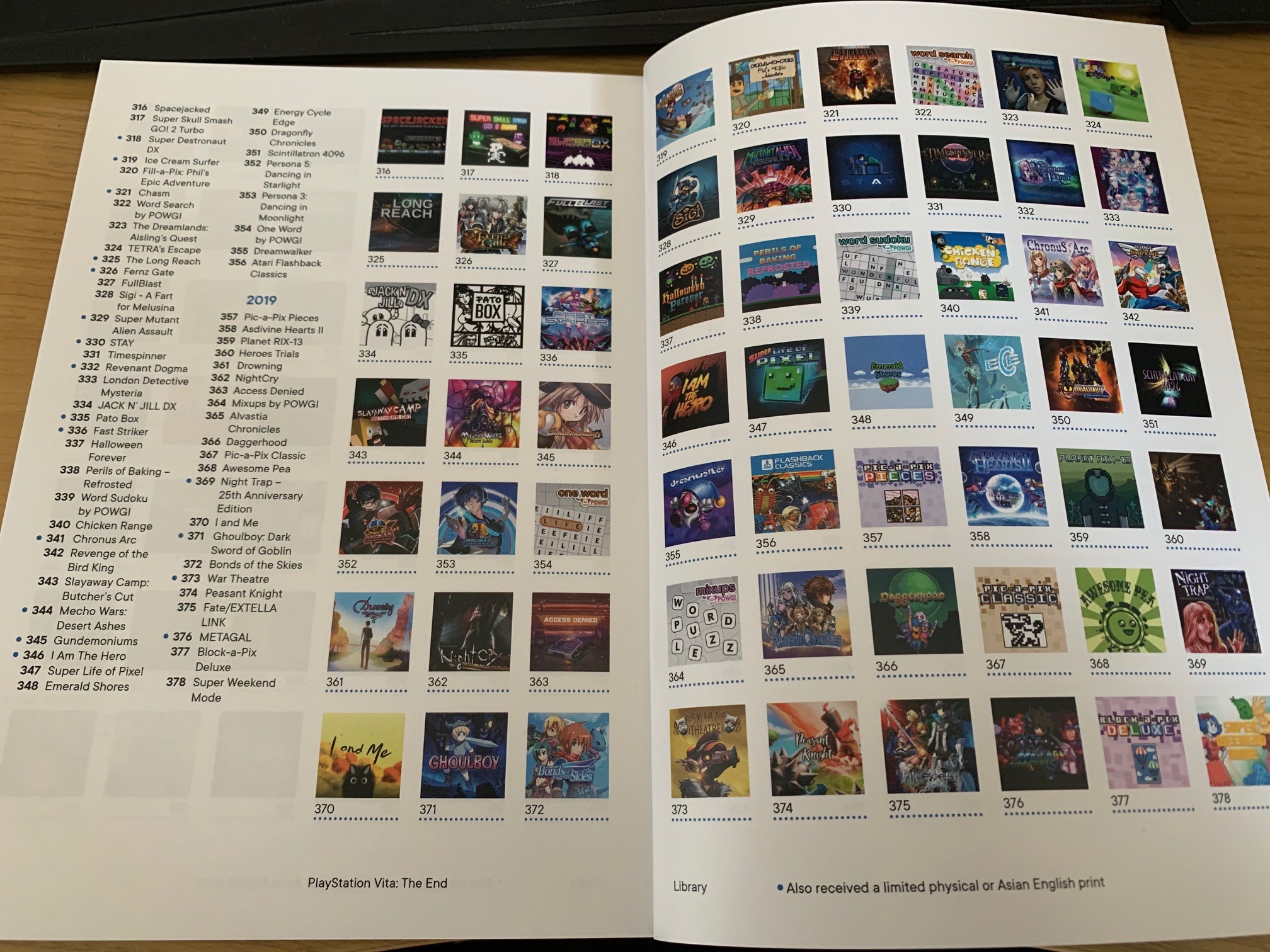
Volume three, The End, covers 2015 to 2020 and the decline of the console. The stand outs here are the interview with Shahid Kamal Ahmad, head of Sony's PlayStation Strategic Content Division and the retrospectives, covering a diverse range of niche titles (most of which, I must admit, I had never heard of - bad Andu!). These retrospectives are a thing of beauty and show off the breadth and depth of what the Vita was capable of. Finally, you get the software list again, and this time, it's huge - as you might expect from a five year period but considering that Sony let the platform wither away... well, 103 physical games and a whopping 481 digital titles (as of 12th August 2020), well, that's just amazing. All told, these volumes list 229 physical and 661 digital game releases - no software for the console my backside!

The software catalogue is comprehensive.

As noted above, the Vitazine is a list of the 100 top games as compiled by Rai. You get a community top 100 as well as the top 20 PSP games to play on the Vita and a short "Missed the List" page. I know I'll be perusing that list in future purchases!

Hot bookshelf action!


This collection has been a labour of love for the author, that is plain to see. Getting three Kickstarter projects funded and delivered is some achievement. The content is informative and comprehensive, the design and print quality are superb and I am really pleased to have caught the third project and ordered the three physical copies. The Vitazine is icing on the cake, and all four publications will be used as references when I start my Vita collection. Yes, I don't own one yet but I shall, to sit alongside my PSP and its growing library. I'm not sure if physical copies are still available but you can buy pdf's of the whole collection at 2old4gaming.com. You'll also find some Vita videos here from the author's YouTube channel and I suggest you check out some of his other videos too. In the opinion of your humble scribe, the sum total of £13 for the digital collection is a bargain but if you can, go for the physical editions. Very highly recommended!

Tuesday, 1 September 2020

The Games That Weren't - Book Review

The Games That Weren't is the latest release by Bitmap Books and, I'll admit, the first title I have purchased from the company. Written by Frank Gasking, this tome is the result of five years of research and it certainly shows. Covering over 80 unreleased games, with five hardware pieces and an "honourable mention" section that could make up a second volume (hint, hint), there are over 640 pages of videogame history here. If that wasn't enough, there is even more content available on the Games That Weren't website.


I pre-ordered this when it was announced as it appealed to my interest in videogames history. With a slight delay in release (a matter of days, really), I received an email notification on the new release date and a later email with a link to download a watermarked PDF copy of the book. Whilst I could have started reading that straight away, I wanted to wait for the book itself. This was received on the following Friday afternoon from the hands of a very cheery courier (cheers, Bob!). This was when I got my first surprise: the care and thought that went into the packaging was immediately apparent and much appreciated. Then came the next surprise - it's a hefty book, and of high quality too - the binding, hardback cover and paper quality are all excellent. For £30, I was impressed. That did not change as I started reading.

Now that is well packaged.

The author's style is easy going and very readable. His enthusiasm for the topic is plain to see and you get a sense of joy as each title is covered. Some games only get a two page entry, featuring art and a small text box. Others can be several pages in length with a lot of input by the original developers and more artwork/screenshots etc. This makes the book easy to pick up if you just want to read a couple of entries or, if you're like me, that "just one more section" pull that means you go past midnight without even realising it! For most of the titles, artist impressions have been created to give the reader an idea of what the game may have looked like. Whatever the art, the glossy high quality paper makes these jump off the page. 


There is certainly a lot of content here, as it covers a forty year period (1975 to 2015). What I really like about the author's approach is that where there is a lack of information or help, he clearly states that, which adds an air of poignancy to the book and underlines the importance of preservation for videogames. There is constant referral to the GTW website where more information can be found and the website compliments the book well. Each entry in the book also has a notification as to whether the game is available to experience today or not. 

You do get a real sense of how the industry changed from it's early years to the mass market commercial juggernaut it is now.You also get a real understanding of how much technology has progressed over time and just how cutting edge some of these titles were. Hearing about how developers struggled (and often succeeded) to get software running on some formats was extremely enlightening. It's also nice to see that the titles covered are spread out over numerous formats. As an Amstrad GX4000 fan, the chapter on Gazza 2 answered quite a few questions for me. It was also nice to see the Archimedes get a mention with Spitfire Fury and any mention of the Konix Multisystem always gets my attention, as any reader of ACE magazine and it's hardware section will attest. On a personal note, I must admit this book brought back many happy memories of the 8 and 16-bit era, with the mere mention of long-closed software houses conjuring recollections of buying £2.99 cassettes from the local newsagents.

Are there any negatives to this book? Well, if I am being really picky, I wish maybe a different coloured bookmark as my cat really, really likes that bright green. In all seriousness though, no, I have no negatives to report.

Well laid out with superb print quality.

Overall then, I think The Games That Weren't is an excellent title, one that provides not only an informative and detailed history of a selection of cancelled videogames, but an interesting view of the nature and history of the videogames industry itself. I hope that one day we'll get a follow up volume as there are no doubt many more lost games to be brought to people's attention. In the meantime, for £29.99 including UK delivery, this is a must-buy for anyone with even a passing interest in the hobby.

As for Bitmap Books, they have several other titles that have caught my eye and I think an order for The Art of Point-and-Click Adventure Games is on the cards.

Saturday, 22 August 2020

Was That Film Really That Bad??? Johnny Mnemonic

Ah, the early 1990's. That time when the Net/Information Superhighway was the bright new future of communication, learning and even society itself, instead of just porn. Hollywood wasn't slow to pick up on this (the society bit, not the porn!) what with such cinematic gems as "The Net", "Lawnmower Man", "Virtuosity" and "Hackers", all of which tried to show the public their own vision of a cyber future. If you've not heard of any of those, check them out (but beware that the 90's was a different country, they did things differently there...), and there will be a future post on Hackers when I get round to watching it. But whilst cinema was catching up, some authors had already forged names for themselves in the sub-genre of cyber-fiction. First and foremost of these is William Gibson, whose debut novel "Neuromancer" remains a seminal work of fiction, science or otherwise. It is one of his short stories that we're going to be looking at today, one that Gibson himself expanded into a cinematic release: Johnny Memenic... Memomic... Memenenenic... Mahna Mahna do do do do do, Mahna Mahna do do do do...

Apologies, enough of that earworm.

It's Johnny Mnemonic.

This makes it look far better than it is.

Released in 1995, Johnny Mnemonic stars a young Keanu Reeves as the titular character, an underground data courier tasked with moving illegally obtained data from Beijing to Newark (That’s the place in New Jersey, not the one on Trent with the National Civil War Centre and the Air Museum – the film’s first fatal flaw!). This data, concerning a life threatening condition that affects users of the virtual reality based internet (which is pretty much everyone), is property of a large corporation that will stop at nothing to get it back (it’s the only copy left after the people who stole the data deleted the original). Chased by the Yakuza and a bible-thumping mercenary (Dolph Lundgren), Mnemonic must survive their efforts and download the data in his head before he suffers brain damage and death. That’s pretty much the plot. Oh, and if you need background to all of this, there is a handy explainer at the very beginning of the film. Outside of Star Wars (and even that’s on dodgy ground), any movie that has to have a scrolling exposition at the start to tell audiences what they’re watching has storytelling issues. It’s also extremely po-faced.

Someone's aiming for a GCSE in exposition...

With a budget of $26 million ($43m in 2020), this was initially supposed to be a low budget art-house film that film exec’s hyped up (and suitably budgeted) into a mid-range release. Given its final box office score of $52m ($86m in 2020), the film was not a terrible box office disappointment though it didn’t review well at the time, hence the poor reputation today. I quite liked it back then (when getting online was limited to the computers in college – no home access for me), so thought a re-watch was in order. And yes, it has dated badly…

I can guarantee this will not be the Internet in 2021

Oh boy! Dated? Ok, the idea of using your brain to transport 80GB of data is not that silly. In fact, as a secure storage medium, the idea has legs (so to speak). No, what comes across as silly is the amount of data concerned. With a limit of 80GB, doubled to 160GB (remember when you could get RAM and hard drive storage doublers???) then stretched to 320GB, Reeves’ head holds less than a mid-range laptop. Hell, a 512GB SD card can be had for less than £40 these days. Okay, this is an easy target, as almost every depiction of the future gets it wrong, though I will give Johnny Mnemonic kudos for portraying city wide riots by masked civilians in 2021 (just a year out but hey, things ain’t changing...). The film’s depiction of online access is, of course, suitably twee and CGI overload, also totally ignoring any kind of user friendly interface or even plain user experience planning. OK, that’s a bit of a professional opinion here, but it’s a bugbear of mine when I see people navigate overly complex interfaces or take multiple button presses to complete simple tasks (I’m looking at you, SeaQuest – poor Ted Raimi must had had callouses just to turn on a screen!). Keep It Simple, Stupid is a very worthy principle.

Very... 90's...

Anyhoo, the film, and it is your standard chase flick with a slightly different setting. A grey setting, to be sure. You see, whilst it goes for dark and moody, the lighting is all over the place. Scenes that should be dark are well-lit, and others that should be well lit are submerged in grey. What you can see, when it’s visible, is very obviously a mid 90’s take on what the future should look like, which in this case is pretty much just like the mid 90’s. The direction is also poor, with action scenes lacking any kinetic energy (or sense of place - Keanu has a fight in a bathroom whilst another fight happens in the next room yet the two are totally disconnected), and the special effects, outside of that twee online stuff are suitably bad (including the projection work). The less said about the CGI fight/experience/brain melting mess at the climax of the film, the better. Things are not improved by Gibson’s woeful script, trying to sound like an edgier action movie from the late 80’s/early 90’s but failing badly at it. Lines that should have sparkled just limp out of the actors mouths. Expanding a novella in to a feature film hasn’t helped things here either and you end up watching the credits thinking that, although it was supposed to be a tale of the future, it’s all just complete bobbins, mother AI and all. But surely, you say, fine acting can save any film from these issues?

Still not the Internet in 2021 but with added VR gloves

Look, it’s easy to criticise Reeves for his acting career – aside from a few big (and I mean hugely successful) roles, he doesn’t get to show much range – and even then, you’re limited to Bill and Ted, Speed, Point Break, The Matrix and the John Wick series. Outside of those movies, well, it’s not good. True, his portrayal of Mnemonic isn’t as bad as his turn in Francis Ford Coppola’s Bram Stoker’s Dracula (say that quickly five times!), but it’s not far off. The issue here is that Reeves doesn’t have any real character to play with. That’s the writing and the directing but still, he doesn’t come off great here. Personally, I think he was miscast but if we’re going for positives, maybe the best that can be said is that he’s at good playing a blank slate…

As for the rest of the cast, Dina Meyer gives it some welly as Jane, Henry Rollins is ok as Spider whilst both Takeshi Kitano and Denis Akiyama are suitably solemn as the bad guys. But there are a trio of cast members who define this film and how bad it is.

Ice-T gets the first mention – he’s terrible. I know that I said Reeves doesn’t show much range, but at least he has one. Ice-T plays only one character, and that’s Ice-T. His delivery is stilted and lines crash into every scene he’s in. Even when he’s trying to act hard, he comes across just like next door’s toddler would when trying to trash talk you.

Hey, man! Did you just drop one?

Then we have Udo Kier, a prolific German actor who for several years between 1993 and 2019 managed to get up to seven (7!) film credits per year! Now I have no problem with the guy working hard, but that does mean he’s starred in some absolute shite, and it’s no different here. The thing is, he’s not that bad in the actual film, just that his presence on a cast list pretty much tells you what to expect. As an aside, he’s in 2001’s “All the Queen’s Men” a WW2 action comedy where four male Allied agents infiltrate an all-women factory that produces Enigma machines. I never knew this existed and now I wish to see it just for the premise alone. His stand out performance, for me, remains Yuri in Command and Conquer Red Alert 2.

All the Queen's Men - not JM related but hey, it's LeBlanc!

Finally, we have Dolph Lundgren. Yes, he of Universal Soldier fame (and a Masters in Chemical Engineering, which I never knew before now!). He plays a religious zealot hitman and by God, it’s over the top. Think of the most ludicrous Panto dame you have ever seen, coke that lady up to the hilt and then start feeding her acid, and you might just approach what can only be described as an extraordinary piece of acting. It’s gloriously bad but also, at the same time, a marvellous performance. Not good for the film, but it sure makes watching it all the more enjoyable. Sad to say, this was Lundgren’s last cinema release until 2010’s The Expendables – all other efforts were direct to video efforts aside from a cameo in 2004’s Fat Slags. Yes, those Fat Slags. Yeah…

"Jesus" wept...

... and still weeping.

Is there anything else to criticise this film for? Erm, yeah – a dolphin. They have a tanked up crypto-enabled dolphin that neatly fits into the plot like I do in a Wilkinson-Sword advert. Plus it’s another on-screen dolphin that just annoys the crap out of me (think Flipper and bloody Darwin!). The last good TV dolphin said so long and thanks for all the fish way back in 1981.

So, Johnny Mnemonic, good film or bad? Well, it’s certainly not good, though if you watched this as a teenager, you might have a certain nostalgia for the look and style. Not for me though, as there are too many casting, production and stylistic flaws for that. It’s definitely worth a re-watch but more as a curio in the genre of “Internet” films of the period. In no way, however, does that make it a good film. 

Friday, 14 August 2020

Recent gaming pick-ups

One of the advantages of living where I do is the relative close proximity of Games Galaxy. I have mentioned this emporium before but it bears repeating that this is one of the finest retro gaming shops I have ever visited. The owner and staff are friendly and knowledgeable, there is a ton of stock (seriously, their PC Engine range is just silly!) and it's not all retro-gaming either. The fact that this is on my doorstep, so to speak, is an added bonus. So much so that over the last couple of weekends, my good lady and I have ventured out to Consett and called in to the shop. Here's what I picked up.

First up is Outrun 2006: Coast 2 Coast for the PSP. Released in 2006, this is a corking arcade racer and worthy of continuing the illustrious Outrun series. Developed by the ever-dependable (and that is not meant as damning faint praise either, I meant that entirely as a compliment) Sumo Digital, this is a brilliant racer, with enough thrills and spills to draw you in, as well as enough content to keep you playing. That is something that cannot always be said about arcade titles. With Outrun 2006, you have 13 cars, 30 tracks and wireless play for up to 8 people. Whilst the latter is wasted on me, I have been enjoying the game immensely. As you can see, it looks lovely on the PSP’s screen and, alongside Ridge Racer, is for me the pinnacle of easy to pick up/hard to master racing games on the PSP.


Still looks brilliant 14 years on.

Still on the PSP, we have Field Commander, a turn-based tactical game by Altus. Released in 2006, this title features 30 missions with 36 different unit types and a built-in map editor. I remember playing this the first time I had a PSP and still had a save on the memory card. After a couple of hours with that, I did the decent thing and started from the beginning again, to truly appreciate the challenge. And challenging it certainly is. Fun too, and if you like this sort of title, you’ll soon find yourself engrossed in some of the more complex missions. It was a nice little find.


Next up is a PlayStation 2 launch title, Kessen. Meaning “Decisive Battle”, this is a real-time tactical game set in feudal Japan. Boasting an impressive (for its day) 100 plus characters on-screen at one time, several different troop types and multiple game views, this was heady stuff for console gaming in 2000. I’ve not had much of a chance to really get into this game yet but what I can say is that the best part so far is the soundtrack – it’s superb. The benefit of great music for the atmosphere of a title as “Japanese” as Kessen cannot be overstated. Upon release, there were criticisms that it veered away from historical accuracy, but to be honest, I don’t know enough about that period of Japan’s history. Having said that, having played this briefly, I’ve now got a couple of books on my Amazon wish-list to change that situation. Who said games can’t promote education? Whilst it looks simplistic now, it more than held its own back in the day and if you have a PS2 (or an emulator), look out for a copy. Incidentally, Games Galaxy also had Kessen 2 and 3 in stock, and part of me thinks it was a mistake not to pick those up as well. Oh well, just means another trip is on the cards…


The final couple of titles are old favourites, Broken Sword 2: The Smoking Mirror for the PlayStation and Broken Sword: The Sleeping Dragon for the PlayStation 2. If you have never played any of the Broken Sword series of (mostly) point and click adventure games then you’re missing a treat. Following the adventures of American tourist (and patent lawyer) George Stobbart and French journalist Nico Collard, you guide them on tales of mystery and daring do across several continents. Broken Sword 2 was the surprisingly good follow up to the first title, in itself a landmark title. I say surprisingly as usually most sequels fall a little flat, but in my opinion, BS2 is very much the equal of the first. The jokes are just as funny, the puzzles are still as infuriating (at times), and everything is still wrapped up in the loving warmth of the late Barrington Pheloung’s amazing music plus the brilliant vocal work of Rolf Saxon as George. 

Mayan gods this time instead of Knights Templar

Broken Sword: The Sleeping Dragon was a change for the series, moving into 3D territory for the first time and losing the point and clock control scheme. I originally playing this title on the X-Box but that’s since long gone and to be honest, I never fully completed it. Picking up this PS2 copy brought back some great, and not so great, memories and I shall get to the end this time! That is not to say it’s not a fun game to play, it really is good, but if you’re a fan of the original titles (or the two following sequels), then this might be a step too far for you.

Much more moodier and darker this time.

A decent haul from a cracking little shop. If you’re into videogaming in any way, you’d be hard pushed to not find something that catches your eye (and probably your bank card too) at Games Galaxy. I know for my next visit, I’ll be looking for the Kessen sequels and maybe a few more from my list of PSP games I want to add to an ever growing collection.

Wednesday, 5 August 2020

Was that film really that bad??? Sahara (2005)

After the really, really bad experience from the filming of Raise the Titanic, it took over twenty five years before another attempt was made to adapt a Clive Cussler novel for the silver screen. Sahara, published in 1992, was the book chosen and it was given a fairly hefty budget of $160 million ($211m in 2020). It ended up being one of the biggest box-office bombs of all time. I loved it when I first saw it and despite its reputation of being a stinker, wanted to give it a re-watch to see if my opinion then still holds today.


The poster does not lack for confidence.

As a big-budget action adventure comedy movie, there is a suitably starry cast, with Matthew McConaughey playing Dirk Pitt, Steve Zahn as Al Giordino (already, this film is much closer to Cussler’s novel than Raise the Titanic ever was), Penelope Cruz as World Health Organisation Dr Eva Rojas, William H. Macy as Admiral James Sandecker and Rainn Wilson as Rudy Gunn. The bad guys are played by Lambert Wilson, as corrupt businessman Yves Massarde, and Lennie James as General Zateb Kazim. We also get the ever great Delroy Lindo as US government agent, Carl.


This is not a comment on actors and film production...

The plot is pretty straight forward. NUMA are in Mali recovering sunken treasures for museum display whilst Rojas is there investigating a new disease that is threatening the population. When Pitt saves Rojas from an attack whilst at the same time learning of tales of a missing Confederate ironclad, he and Giordino agree to transport Rojas and her colleague so that they can investigate the source of the disease and the two adventurers can look for the legendary ship. Along the way, they discover that Massarde is using a solar tower to burn toxic waste which is causing the disease and is in cahoots with General Kazim, who is running his own little civil war against the Taureg. Along the way, Pitt and Giordino discover the Confederate ironclad which they use in a rather silly way to kill Kazim, thus ending the civil war. Massarde gets his comeuppance and Pitt, Giordino and NUMA carry on with hints that there are more adventures to come. Except there won’t be, but I’ll get to that.

At heart, Sahara is a big dumb action movie that wants you to like it. Starting off with a breezy credits scene set to “Right Place, Wrong Time” by Dr John that details the pair’s previous adventures, you know straight away that it’s going to be ever so slightly goofy, and indeed, that is what it is. Despite the peril set up by the world threatening pollution caused by Massarde’s industrial plant, you never get the feeling our heroes are really in any danger – and yes, that includes the land yacht scene. Even typing that brings a smile to my face as I really do love this film. So why did it bomb and why so hard?


Making the best of a plane crash - again, no comment on movie production...

$160m was a lot of money back then (it’s not exactly small change now!) and it would have taken a breakout box office performance to justify a sequel. Truth is, they spent a lot of money making this film when they could, and perhaps should, have spent an awful lot less. There was money spent on scenes that were not included in the finished run time, as well as money wasted on numerous scriptwriters (each one adding about half a mil to the production budget) as Cussler, who had been promised final say on script, actors etc, becoming more aggravated at the direction of the film. In the end, he disowned it for not getting his own way - but in my humble opinion, he'd been paid well, had the promise of future films getting him $10m per movie and should have just left it at that. But hey ho... 

After gaining the whiff of failure from its first weekend's box office, Sahara couldn’t cover its budget or its distribution costs, leading to a loss of about $73m (although some sources go up to $105m). That’s when the lawsuits started, with Cussler and the production company spending the next seven (yes, seven!) years accusing each other of bad faith and each side claiming damages. Needless to say, neither side came out smelling of roses. 

So, the re-watch. Yes, I still love this film. It’s a goofy, silly, funny two hours of action. However, I did notice the flaws a bit more this time. Let’s start with the casting.

McConaughey is great as Pitt, confident and self-assured, quick with a quip and handy with the physicality the role requires. Unlike the previous occupant in the role, McConaughey’s enthusiasm for the role shines on the screen. Zahn is good as Giordino, that can’t be denied, and he nails the comedy sidekick vibe throughout the film whilst also appearing serious when he needs to be. He’s further away from his literary counterpart than Pitt is, but that makes no difference on-screen. The pair gel well and are a hoot together.

Macy as Sandecker is further away from the original book character but the film moves him from a desk job and into actual command of NUMA’s sole ship, so the change in character does work as far as the film goes. Wilson is also good as Gunn, though to be honest, he’s not given that much to do. Cruz gives it her best, but has little chemistry with McConaughey and is basically there to be rescued, whereas Lindo’s screen time is limited but what he does get, he serves it up with a twinkle in his eye.

It is the antagonists that are the most poorly drawn. If you’re going to have an action comedy then you need the foils to your heroes to be lively and able to spark off against them. Instead, two great actors are left in the lurch, Lambert being suitably slimy and sleazy as Massarde but also extremely two dimensional, whereas James is frankly wasted as Kazim, being more pantomime than military psychopath. For this, I am placing the blame on Breck Eisner, the director. This was only his second film gig (outside of his thesis) and his follow up film work has been suitably lacklustre. This film has its moments, to be sure, but there is a lack of spirit and style. I never really noticed it before - McConaughey's sheer presence does hide most of it - but when Pitt is not on screen, there is an almost visible sag in the film. This continues with the action scenes, lacking as they are a certain pzazz and that is the fault of the director. To the film’s credit, there is a lack of CGI that is a refreshing change, but also bumped up the cost.


See, some people were happy with the movie...

Overall, I still think Sahara is a great film and you’d do far worse than to give it two hours of your time. It’s not ground breaking, or part of a cinematic franchise that the producers so wanted to create (there was even a third person action video game that I remember being featured in Edge magazine 137 but alas, the failure of the film put paid to it ever being finished), but that shouldn’t take away from the fact that it’s entertaining and just plain fun. Where it fell down was in spending far too much money for this kind of movie, and it lacks a lot of spectacle that $160m should buy. Then again, even if the film had cost a more reasonable (for the period) $100m, it would still have turned a loss, though nowhere near as big as it actually did. As it stands, it’s both an example of profligate spending scuppering box office success and a fantastic popcorn movie.