Saturday, 29 October 2022

The History of the Stealth Game by Kirk McKeand - Book Review

Sshhhhh! Be vewy, vewy quiet. I'm hunting wabbits... if wabbits were a) weal real and b) appeared in any one of the twelve genre defining stealth titles featured in this book. As they aren't, and they don't, instead of continuing the hunt for said non-existent bunnies, I'll talk about Kirk McKeand's excellent study of the stealth video game genre. 

The History of the Stealth Game is not a complete history of games of stealth (that would more than likely fill several volumes and forced the author to wade through some absolute pap in the process), but what it does do is focus on a dozen examples and gives you the in-depth skinny on how they were created.

After an introduction by Arkane's Harvey Smith, the author takes over and explains the ground rules, detailing why the book takes 1998 as its starting point. Sure, there were plenty of stealth games around before then, but Tenchu, Thief and Metal Gear Solid are the bedrock upon which he launches the reader on a rollercoaster ride of developmental tales and personal journeys. As well as the aforementioned trio, you'll learn more about titles such as The Last of Us Part II, Assassin's Creed and Deus Ex.

This isn't a dry retrospective on the topic. Indeed, the author steps back and lets those interviewed lead the reader, adding context as and when appropriate. It is this respect for the people, their work and the results of said effort that stands out in this book. For example, it is hard not to feel for Jeremy Blaustein, whose contribution to Metal Gear Solid seemed not only lost to history, but without which would have resulted in a much different experience for the Western players. And that's what I like about this book - it sometimes features the more recognisable names, but as far as MGS goes, Blaustein's story was far more interesting that anything I have read from Kojima in many a year. 

Oh, and about MGS4. Loved it when I first played it (and had loved each game prior to it since the PlayStation MGS). Only ever played 4 once. It was those cutscenes lasting up to 71 minutes that did it for me. I don't care how brilliant the guy is as a developer and producer, I just can't justify using so much of my limited games playing time to watching an f-ing movie! Even back then, when it seemed like I had more time to play games, it often felt like a race between the end of the cutscene and the heat death of the universe... There is only so much difference between being a profound genius and a pretentious wan... thing that needs to be remembered is that these are games and they are meant to be interactive. You may disagree about MGS4, but each to their own.

Anyhoo...

This is yet another book where the experience of developing games comes across as a labour of love, dedication and self abuse (not that, you dirty minded sods!). The long hours, the missed family events, and the physical and mental toll are all too real once again. Maybe things are changing, but where passionate people get involved in creating art (and video games are art!), there is sadly a dose of suffering too. As with other books I have read on the subject, The History of the Stealth Game very much displays the warts and all of video game development and how dedicated/exploited people can be in the industry. As it is, when people speak of their experiences in this book, you immediately hear 'their' voice in the writing.

Where the author gives us his own voice, his easy charm and humour shine through, and on the basis of that alone, I look forward to any future tomes on gaming he cares to write about. There is warmth too, and this makes this book an easy read when you can easily see the author's enthusiasm for the subject. 

The History of the Stealth Game is an excellent addition to my video games library and another must-buy from the White Owl imprint from Pen and Sword Books. Even if you are not a fan of the stealth genre, you will learn much about video games creation and the industry, albeit from the viewpoint of stealth titles. If you are a fan, then the decision to buy this book is a no-brainer. You can pick this up from the publisher directly here, or from the usual online and physical bookstores. You can also follow the author on Twitter here

Thursday, 27 October 2022

The First Atomic Bomb by Jim Mangi - Book Review

I have always enjoyed a good counter-factual story and, when it comes to military history, there have been some corkers - although I leave "For Want of a Nail" out of that list just because it is simply too dry for me. In one sense though, that is a good example to pick (along with Third World War by General Sir John Hackett) in that both books position themselves as historical works published after the events they portray. The First Atomic Bomb does the same thing here, pivoting from actual history at the point of the first nuclear bomb test.

What follows is a well told tale (if sometimes a little dryly - maybe the author is a fan of For Want of a Nail?) where events may or may not diverge as far as you think they would. Here, the Soviets invade Japan, Korea is not divided and, well, you'll need to read the book to find out the rest. The Cold War still plays out, but with different locations and sometimes different players, and certainly with different outcomes, given what we know happened in South East Asia following the end of the Second World War. 

It is sometimes just a case of changing the name of the country affected by a specific political dogma yet the results seems to be awfully familiar. There again, certain political processes lend themselves to failure (certainly when combined with human nature) and more than a few recognisable names pop up here and there to move things along.

Of course, the main question raised by any counter-factual should be "is it realistically possible for these events to have occurred?" and it's a good question to ask. Given the scale of the narration and the more strategic level of detail, I would say yes, it's quite plausible. After all, whilst events may hinge upon the decision of an individual or two at very specific moments, situations tend to develop at a rate often takes that decision making process (and effect) away from those concerned. I think the author here has taken a valid approach and as he has written a previous book (that one asking what if the atomic bomb had been developed early), I think I will have to pick that book up in the future. 

Whoops, SPOILERS!

It is clear that a lot of research has taken place to give the right level of authenticity to the alternate past despite what seems to be the almost inevitable status quo at the turn of the 21st Century having been achieved in this timeline too. There are plenty of photographs which are re-purposed to fit the narrative, but in a nice touch, they are also described in detail for what they actually show. Kudos for that.

For me, this was an entertaining read, and one that put a spotlight on an area that I hadn't seen covered in much detail before in counter-factual history. If this sounds like something for you, The First Atomic Bomb can pick this up at all of the usual physical and online book retailers. 

Tuesday, 25 October 2022

Retro Format and Eight Bit Magazine - Review

After a bit of a break away from the laptop, here is the first of three posts this week that will allow me to have a bit of a catch up on the growing backlog. These two, small publisher magazines were part of the heads up I received about Cool Sh*t Magazine back in the summer. Intrigued, I ordered the then latest issues of each and waited for their arrival. 

We'll start off with Retro Format and this is an A4 stapled magazine coming in at 64 pages including the covers. Paper quality is good and has a nice glossy finish that also helps with the imagery and artwork inside. The cover itself highlights the formats covered, ranging from the venerable 8-bit MSX, CPC and C64, to the more modern (in relative terms) Amiga and Dreamcast. The Spectrum Next gets a mention too, and that's important as it's good to see new hardware come out that mimics older formats. What about the magazine's contents?
The primary feature of this issue is coverage of every Burnout title released, providing a good overview of the various titles in that much-beloved series and taking up six pages. After that, you can see there is a good mix of coverage for the NES, Amiga, ZX Spectrum, C64, CPC, Mega Drive, Super Nintendo and the PC, with an arcade title thrown in for good measure. Fans of first person shooters will appreciate the attention given to E1M1 Magazine, with a review and an interview, whilst film fans get a piece on the Original Trilogy of the Star Wars Saga. 

This is a well laid out magazine, with plenty of spacing and text just the right size to read easily and without eyestrain. The review scores seem quite fair (given for the couple of titles here I have played), although I do question if Quake Remastered is that good, but that's a discussion for another time. What is important is that the quality of the writing is high and there is passion behind the words, so maybe I will go easy on that Quake score... 

Eight Bit is a smaller proposition, a stapled A5 booklet with 56 pages in total. This one is a bit more focussed in its content and that is no bad thing. After all, there were more eight-bit formats back in the 80's than you could shake a stick at and the tighter focus of each article actually permits greater coverage between the formats.

Issue 10 begins with the first part of a console/computer comparison, initially looking at several console titles (Pole Position, Road Rash and Operation Wolf to name but three) to see how they stack up compared to their computer counterparts. Part two will look at games from the computer perspective, and part three will feature the final showdown and results. A neat idea and something that I look forward to seeing the final results of.

Sports Games seems to be another on-going feature series, this issue with part three and looking at tennis games. A few of these I have actually played and, whilst the genre reached a pinnacle (for me anyway) with the Dreamcast's Virtua Tennis, there were some cracking examples of the genre back in the day. 

Coding a Game in NextBASIC reaches parts two and three in this issue, and is something of mild interest given that I keep dabbling with coding, but for those of you with a Spectrum NEXT (or the extension in Visual Studio), these are a handy few pages. 

The last four pages contain an article on the EUROPA Computer Club, a label I had never heard of before (being from Germany), as well as an interview with Arved Pohl, a programmer who worked with the company during its eight bit heydays. Very interesting and a lovely window into an area of home computing that I knew little about. 

As with Retro Format, the layout is good and the production quality is high. The stock is a little thinner but to be honest, it fits the feel of the A5 booklet format better. Issue 11 has been published since I received my copy of number 10, and I shall order this one in the next few days, so that will perhaps tell you my feelings on this publication.

Indeed, these are two cracking magazines and if you're a fan of retro video gaming or computers, you should head on over to their website here and have a gander. In the freebies section, there are pdf's of issues one to six of Eight Bit, so that's definitely a good place to start. As for me, these join the quite numerous small scale independent magazines that continue to thrive in the computing/gaming arena. It's good to see such variety and long may it continue. 

Friday, 14 October 2022

Sierra Collector's Quest by Stephen Emond - Book Review

First of all, an apology. I received these back in July and promised a review within a couple of weeks. Unfortunately, that didn't happen, so better late than never...


Sierra On-Line was one of the biggest computer and video games companies in the 1980's and early 90's. Although it didn't end well for Sierra (see my review of Not All Fairy Tales Have Happy Endings), the sheer number of games that were developed and/or published by the company over the years is staggering and Stephen Emond decided to take it upon himself to present the ultimate guide to Sierra's gaming legacy.

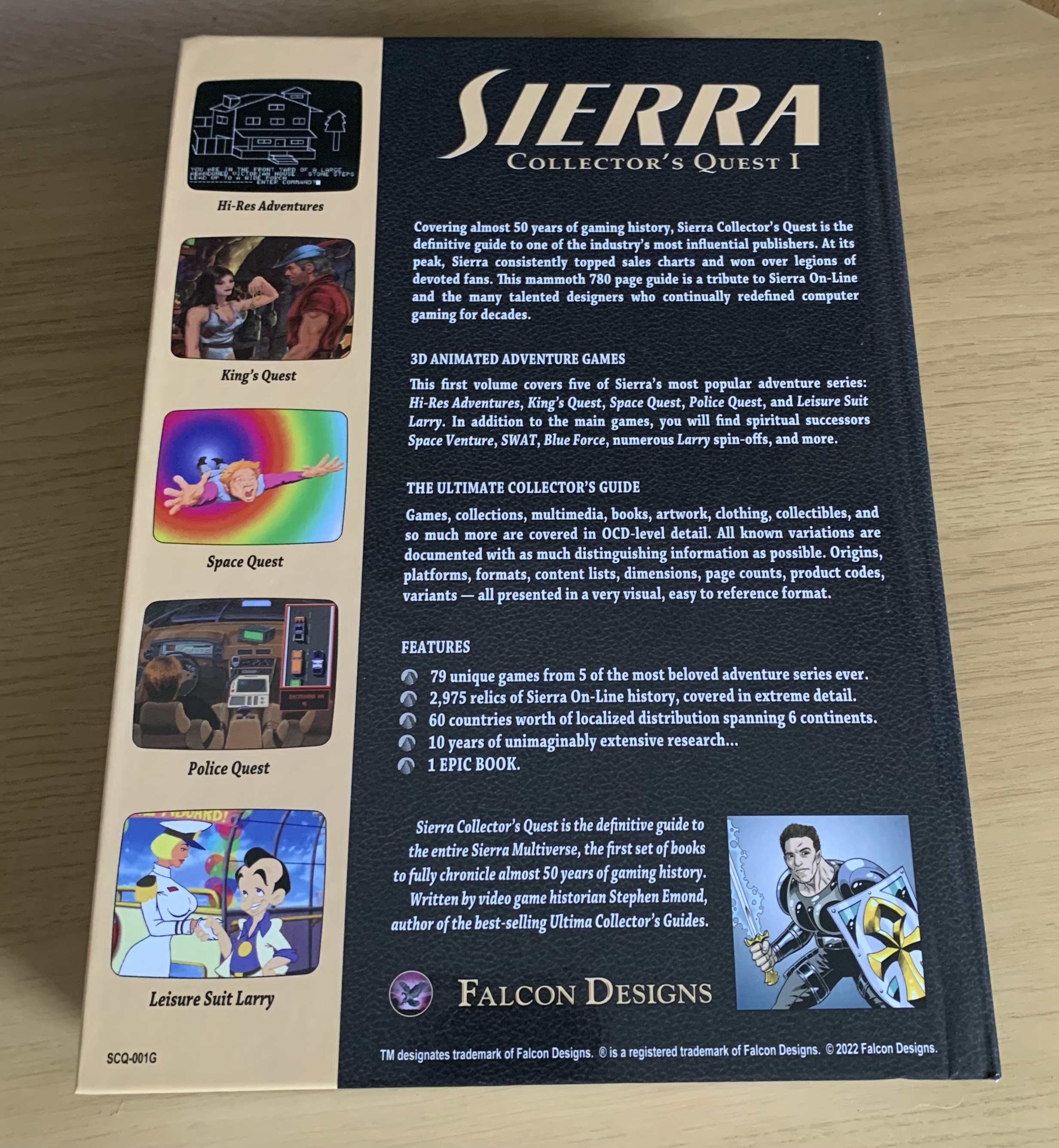
Back of Quest for Glory volume.

Funded by Kickstarter, this led to three volumes at present, with plans for further releases in the future. The initial funding covered Volumes 0, 1 and Quest for Glory, and these arrived after a short delay (nothing unexpected in the current world of crowd-funding projects). As with many of the Kickstarters I have backed, there was always a steady flow of updates and news, which is always a good thing.

Let's take each volume in turn, starting with volume 0 (780 pages). What you'll get is as complete a list as is possible of the games, collections, books, clothing and the like for Sierra and it's diverse range of brands: Dynamix, Coktel Vision, SubLogic, Swordfish and others. The back of the book shows the full list and there has been a ton of effort put in here to pull this all together. 

Back of Collector's Quest volume 0.

There is a foreword by Ken Williams, which is a nice touch, then a brief description of the Sierra multiverse followed by a guide to the format of the entries. 


From a presentation perspective, there is really only one way to include all of that information and yes, it's like a telephone directory (kids, ask your parents or Google that...). That means tiny but perfectly legible text and whilst my own failing eyesight struggled, I didn't have to resort to a magnifying glass. Colour is also present but kept to the title pages for each of the companies. All told, if you're a fan of Sierra or a video game historian, this volume will be of immense value. 

Typical page for Volume 0

Volume 1(780 pages) is the Sierra Adventures book, this time with a foreword by Roberta Williams. There's more text in this volume, as each of Sierra's adventure series gets the full monty - history of the games, the various versions released (and those that never made it to market), along with details of all of the swag that was given away with the various editions. If you wanted to know about Hi-Res Adventures, the three Quest series or Leisure Suit Larry, then this volume has you covered. From collectors to those who might want to write about these games, there is a wealth of information presented in a clean and highly professional manner. 

Back of Collector's Quest volume 1.

The final book from this Kickstarter is set around the Quest for Glory games (190 pages). This is mostly presented in the same manner as volume one, with a volume zero style listing at the back Once again, the amount of information and depth of detail is immense, even if it is the smallest volume of the set.

Page from Volume 1

The Sierra Collector's Quest should be considered the reference for Sierra's games history. You're not going to get a behind the scenes look at the company (see Ken Williams' book for that), but you will learn about the sheer enormity of their published titles and merchandise. I honestly cannot find anything to fault this collection and whilst there were not exactly cheap, the contents are more than worth it. Two more volumes are planned and I fully intend to support their publication too. Well done to Stephen Emond and the team who helped him with this project.

Page from Quest for Glory

You can follow the author on Twitter here, and visit his website here where you can purchase copies of the various volumes and view his other work. I've added some more imagery below so you can see what the books are like in general.


Saturday, 1 October 2022

Evercade Evolution - Magazine Review

Long time readers will know that I've been a fan of the Evercade handheld since it was first released. The idea of a portable console using cartridges is both suitably nostalgic and well implemented in the Evercade and it has grown a steady following. This inspired several people to get together and publish an unofficial magazine for the machine: Evercade Evolution.


Starting off as a free pdf file, you can also buy physical copies produced via Amazon, and it was these I purchased a couple of weeks ago. Issue five is being talked about online so hopefully we'll see that soon, and it was pleasing to see that issue 4 has a lovely note stating that all profits from that issue in April 2022 were being donated to charity. 

As I have said above, these issues are printed on demand by Amazon, which offers high quality binding, good colour reproduction and a decent feel to the magazines. Issue one comes in at 50 pages including the covers, with later issues coming in at the mid-sixties range. 


What is apparent from a general read through is that the team behind the magazine believe in the meaning of the title, as each issue amends and improves the formula. Layouts and content balances change and it's a positive thing to see them alter their approach as the nature of the Evercade market changes too, especially with the addition of the TV-connected VS machine and the Arcade collections. 

Issue one sets the tone with a short news section which is followed by a game-by-game review of the Atari Collection 1 cart. Each game gets looked at and marked (out of five stars) for Graphics, Audio, Gameplay and Fun Factor. A final score out of ten is then awarded, and some games even get a second opinion. After that, we get a "traditional" review of the cart, taking in all the games in a two page piece (by a different reviewer to the individual game section), before finally putting the cart to bed by having a page dedicated to three of the crew scoring it for Game Variety, Game Quality, Play Time and Replay Value - then giving the whole thing a score out of ten. Now I quite like this approach, as you get one person's views on each game, another's of the cart as a whole, then the round up. It makes sense given that this cart alone contains 20 titles and whilst some play reasonably well, others (with their 40-year plus age) most definitely do not, and the team is not scared to say so where needed. 


A small high score section appears before an article on the type of Winter/Christmas titles the team would like to see on the Evercade. James Pond 2 seems to be the popular choice, and I am not one to disagree with that. The next four pages are dedicated to the background of the magazine and the creation of the physical edition, a further page delves further back in to the history of the magazine, and then there's a look at the Fairchild Channel F console. I really did like the approach that last one took too.

Two pages are dedicated to a (then) new TV show based on the game Frogger (I know, but hey, the trailer looks fun), before the last article proper,  a one page interview with Classy Gaming Fun (aka Pete, aka, OEB Pete) of YouTube renown, leads us to the sign off.


Issue two ramps things up with more news pages, and expanded high score section and an interview with Blaze Entertainment's Andrew Byatt. The Namco Collection 2 gets the full review treatment and there are a good few features that a worthy your time (you'll need to read the mag yourself to find out - and remember, it's a free pdf online if you don't want a physical copy...).

EE The Third covers the Evercade, the home console variant of the format, the Data East Collection 1 is the review cart of choice and, once again, the features are a good mix and well written. The most recent issue (as of this post) doubles down on the reviews, with two carts (both of the Interplay Collections) as well as a review of the new Technos Arcade collection. 


I really like this magazine. It's a fan-based publication that not only hit the ground running but also dared to improve itself over the issues produced so far. They've nailed the design and it reads very well. If you're an owner of any of either the Evercade or VS (or have pre-ordered the new EXP handheld (so tempting it is too...), then this mag will have you covered for your reading needs. I know I will be picking up issue 5 when it's available and add it to the other issues in my collection. You can check out the magazine for free here, and buy the physical copies from Amazon here, as well as the Kindle version too. Also check out their Twitter feed for news and announcements.

Sunday, 25 September 2022

PCW Plus - The magazine for the Amstrad PCW

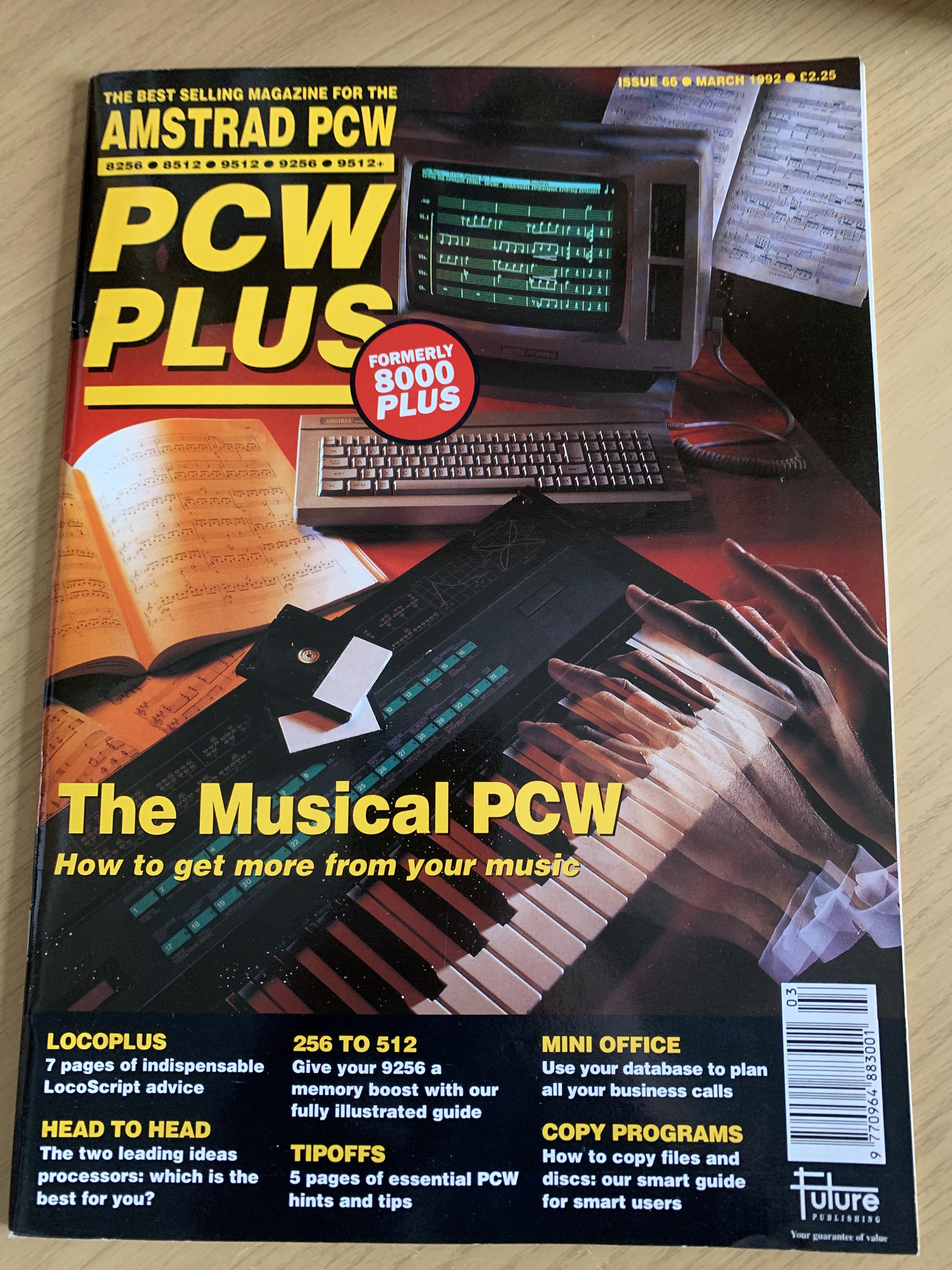
For being one of the most prominent productivity computers for home users of the late 1980's, the Amstrad PCW never seems to get much appreciation. Released at a time when DOS PC's were a four figure purchase (unless you also went to Amstrad for those as well), the PCW became a success because it offered the basic office computer experience by bundling a printer and the software you needed for a very competitive price. Naturally, this led to dedicated publications, one of which was 8000 Plus. In 1992, Amstrad launched the 9000 series of the PCW range so the magazine changed its name to PCW Plus. Join me, then, on a quick look at two issues of this fine publication.

As I only have two issues of this magazine, March '92 and November '94, I may be missing out on the heyday of the format, but these still offer intriguing insights as to the state of the PCW market at the time of their publication and, perhaps more poignantly, demonstrate the decline of a format specific magazine.

The cover of March 92's issue headlines the way you can get music from your PCW. You might be surprised at this as the machine was launched with a focus purely on office productivity. Yet being a 256kb/516kb CP/M machine meant that it was much more than a word processor. The are also articles offering LocoScript advice, a guide to memory upgrades for owners of 256kb machines, and how to make the most of copy programs. 

As befits the period, the cover is glossy and has a nice feel to it. The stock quality is also quite good, and although there is colour throughout, it is limited to specific features and adverts. Page count comes in at 84 including the covers. All that for £2.25. 

The editorial is quite bullish when covering the news that Amstrad had made a trading loss. With the prospect of price cuts and possibly a higher level of ownership of the format, the editor believed the future looked bright. Never mind that this completely ignores the growing popularity and decreasing prices of the DOS PC but there you are - the editor seems very happy preaching to the converted. The news section that follows takes up three pages, and there are plenty of adverts too, yet throughout the magazine, I can only find a couple that are actually selling the new 9256/9512+ computers. 

Ah, yes, the machine. A 9256 with a dot matrix printer would set you back around £400 inclusive, which wasn't too shabby even for 1992. 8086 PC's were still hovering around that mark excluding VAT and that didn't include a printer (and probably not any software either). The 9512+ with daisy wheel printer was about £500 inclusive, and the 9512+ with a Canon BJ10 inkjet was just over £600. The issue here that for £600, you could get an Amiga, Atari or a DOS set up with a printer. It might not be the best of specifications, but it would be more than a match for the Z80 in the Amstrads. By the end of the year, Acorn would have the A3010/3020 series out that would hover between the £500 and £700 mark, whilst even Apple would see sense and release the Mac Classic that would give you that famous single button experience for about £600 inclusive. You'd need to add a printer for those, but then you had the freedom of choice. Sad to say, one of the key selling points of the PCW in the 1980's (the cheap integrated package) had been superseded by faster and increasingly cheaper machines. But I digress.

It was lovely to see a column in PCW by Dave Langford, whose work in SFX magazine was always a good read, and I never knew he wrote for PCW Plus. The other features are well written and seem like they would have been useful to PCW owners. 

Back to the adverts and there are quite a few, although I suspect this was the sum of PCW retailing at the time. There's plenty of software advertised, including a few games, although I believe the company selling the space saving desk on page 36 had been watching too much BBC sci-fi... Another thing to note is the sheer number of add-ons and improvements for the machines - external disk drives, ram packs, and interfaces.

Straight off the set of Star Cops...

On to the November '94 issue, and it's here that we see the magazine epitomise the decline in the format. 

The cover is still shiny but feels thinner than the one from '92. There seems to be more colour but the stock is also of lower quality. The cover price has increased to £2.95 yet the page count is down to 68 including the covers. Mr Langford is still present and there is a cracking feature on how to add flash storage to your PCW! 

It is in the advertising that you really notice the difference. Sure, there are still many advertisers covering the format and its add-ons, and one that was still selling the 9000 series, although not the PCW10, which very much seems to have been the odd model out, despite being launched only the year before. A note on prices - the 9512+ had not changed in price since the March '92 issue. What was borderline competitive in then was massively over-priced by 1994. 

Anyway, back to the advertising, and it's the inclusion of three adverts for PC's that stand out. One, from S.C.S. (not the sofa people) offers a 386SX 40MHz with 2MB of RAM, a 170MB hard drive and a 14-inch SVGA monitor for just £469 excluding VAT. You need to add DOS, Windows and a mouse to that (£70 ex VAT) for a total of ££539 ex VAT, or £630-ish inclusive. Source a printer from somewhere and you have a much faster, capable and expandable machine than any PCW. If you were spending several hundred pounds on a computer, you'd want a degree of longevity and even a 386 in 1994 offered that compared to a PCW.

The back cover - and that is NOT a PCW!

It also highlights a sign that the magazine was in decline. It is a similar story to Amiga Format and Acorn User. Towards the end of their print lives, advertisers were covering anything from actual hardware to internet providers and the like (this was 2000 and 2003 respectively). Anything to fill the space in the mag and bring in the money. As far as mass market magazines went, the platforms were dying. 

Confirming this are the Audit Bureau of Circulation figures. The '92 issue has the figures from January-June 1991, stating that an average of 27,186 copies were sold every month. The July-December '93 figures in the '94 issue is 16,335. I know that figures like that are pretty standard now, given the changes to the market and people's reading habits, but for the early 1990's, they were not looking good 

As it was, time was running out for the PCW. Amstrad pulled the plug after the PCW10. Well, I say pulled the plug. There was the PcW16 launched in 1995 for £299 that was a last gasp for the name. It wasn't directly compatible and you couldn't use the floppy drive to run new programs. It was a sad way to end the PCW name. As for PCW Plus, it soldiered on until December 1996, which isn't bad considering the lack of hardware. 

It's always cool reading format specific magazines from decades past (do you feel old yet?) as it gives you an look at how computing used to be before Windows cemented itself as the OS for the masses, MacOS survived long enough to hitch a ride on the iPhone business (only half joking there) and Chrome OS became the defacto Linux distribution(!). It's partly the reason why I love retro computing so much, the variety of machines and operating systems. 

Would I want a PCW on my desk today? Hell, yes! Is there any chance of that? Not really, space and cost being the prime issues, but for the period they were around, they demonstrated that you could have practical, productive computing at a reasonable price, and a magazine such as PCW Plus is a perfect reminder of that.

Tuesday, 20 September 2022

The N64 Encyclopedia by Chris Scullion - Book Review

Let me take you back to October 1997. The Spice Girls were threatening to "Spice up your life", Aqua were living their "Barbie Girl" best and The Verve were telling us that "The Drugs Don't Work" Speaking as a gentleman in his mid-forties with the back of a 90-year old, it seems they were right, as far as painkillers go anyway! But I digress. What I was actually doing in that autumnal month twenty five years ago (Jesus f-ing wept!) was eagerly dismounting an escalator in the Bentall Centre in Kingston upon Thames to visit HMV where, armed with a debit card and a student loan (those were the days, kids), I was going to pick up a Nintendo 64. And Turok: Dinosaur Hunter. Ok, nobody's perfect...

It seems fitting that in the year of the 25th anniversary of the N64's European launch, Mr Scullion has written about that very games console. His second book this year (his wrists are either made of steel or he has his PC's cooling system plugged directly into his wrists...), this is a continuation of the Encyclopedia series and the most in-depth one so far. By that, I mean that each game has received a larger entry than would normally be expected due to the lower number of games that were released for the system. However, in the case of the N64, quality had a quantity all of its own, so to speak. 

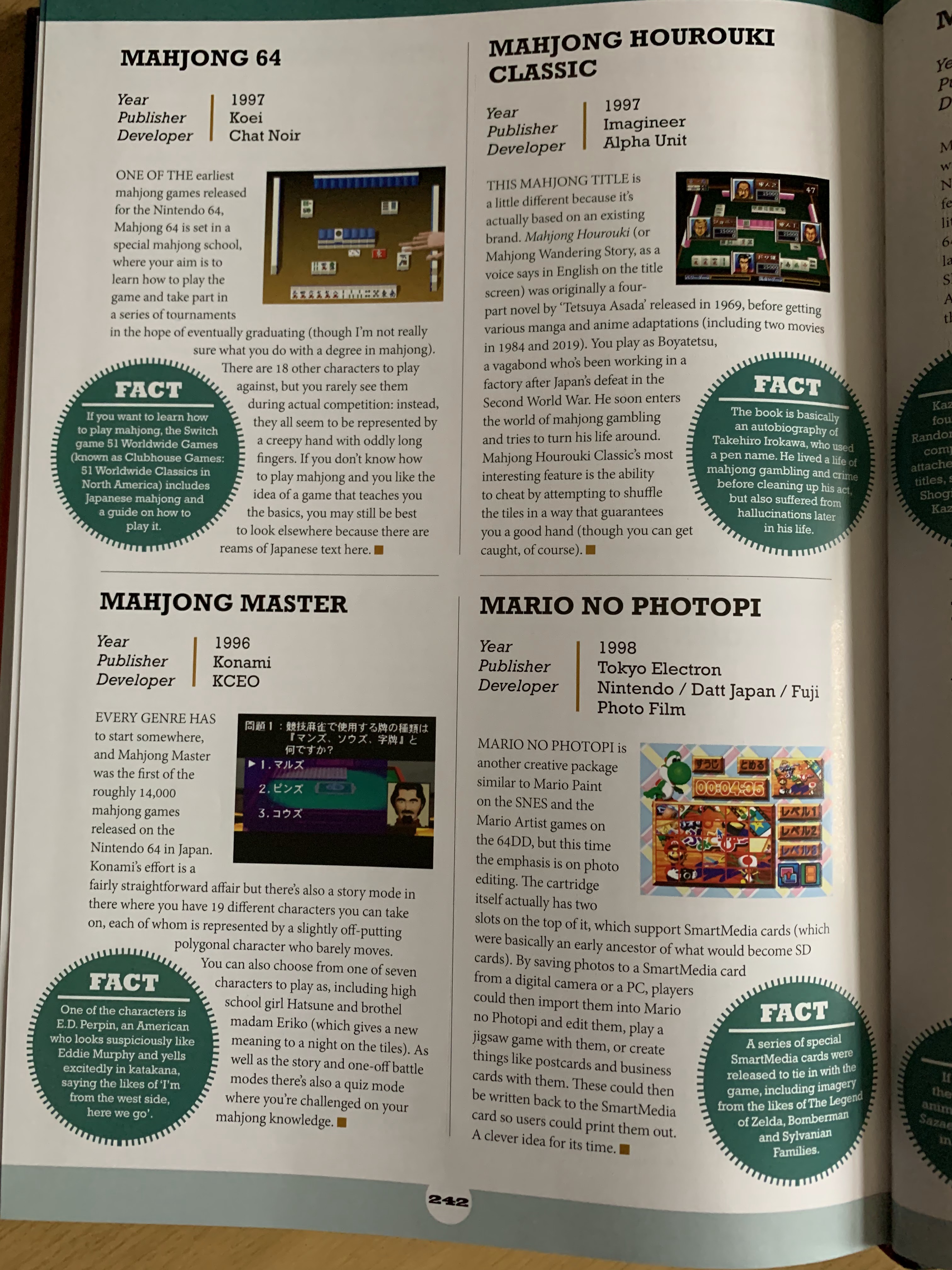
If you've read any of the previous entries, you'll know the score. If you haven't, what you'll get is the US/UK games library for the N64 in alphabetical order. The smallest entries get a quarter page, the largest get a full page. Each entry contains details of the games' year of release, publisher and developer, as well an an indication of which territories it was released in. There is also a screenshot or two and a fun fact. As always, these fun facts vary from funky trivia to observations connected to the game in question, and compliment the style and content of the main articles. This book once again demonstrates that the author is at the top of his game when it comes to writing about videogaming.

Compared to the likes of the PlayStation, the N64 suffered in comparison towards the number of games released for the system, but when you have the likes of Mario 64, The Legend of Zelda: Ocarina of Time and Mario Kart 64, it's hard to argue that from a first-party perspective, Nintendo had you covered. Third-party support wasn't brilliant but the likes of Acclaim, Infogrames and THQ supplied some respectable gaming experiences. 

Of course, the elephant in the room was Rare. Never before (or arguably since) has one developer had such a consistent run to genuinely classic hits, and the ones that might not be described as classics are at least worthy of being called great. I can't think of a single Rare title on the N64 that was naff. Annoying and overly long maybe (looking at you, Donkey King 64!), but not naff. 

As an extra for this volume, space permits the inclusion of all of the Japanese-only releases, including the ten titles released for the 64DD add-on. These are useful for both collectors and those, like me, who didn't know much about the domestic titles that never saw the light of day outside of Japan. 

As you can no doubt tell, this is another of Yer man, Scullion's brilliant books and deserves to be picked up not only by those who loved the N64 the first time round, but also those who maybe missed out or were too young to experience it (and the joys of late 90's Brit-pop). You can pick up a copy of the N64 Encyclopedia directly from the publisher here or from the usual online stores. You should also be able to order it from your local bookshop. I would also advise you to follow the author on Twitter here to keep up with his work as well as his day job at VGC