As 2017 draws to a close, it's that time of year where a look back is required (it's a tradition, or by-law or something). This , the first of four, will cover videogames. The remaining three will cover books, films and TV shows.
2017 has been one hell of a year for videogames, and most of that can be put down to the release of the Nintendo Switch. With new hardware came a new generation of Nintendo titles that demonstrated once again that the company knows its business. There were several titles on the Switch that I managed to play and each provided a highlight to the year.
Super Mario Odyssey was the first to be played and wow! Just wow! I hadn't enjoyed a Mario game this much since Super Mario Sunshine on the GameCube and this game demonstrates why Nintendo are till at the top of their game. Sublime platforming, challenging gameplay and charming game mechanics made this the platformer of the year for me. Not that there wasn't competition in this area. Yooka-Laylee and Super Lucky's Tale were two of the standout console releases, yet both had their issues. YL, from the brains of former Rare employees, tried to capture the style and panache of the best of Rare platformers from the N64 days.Whilst it was charming enough, there were a few niggles here and there (including the camera, so really staying true to form) that stopped it being truly great. SLT meanwhile, was a bit too childish though it retained a charm that appealed.
The Legend of Zelda: Breath of the Wild was a change in direction for Zelda games, with an open world design and crafting mechanics that took the series to new heights. That's not to say it's perfect (I know, heresy if ever you'd heard it): the crafting mechanics, whilst bringing in depth to the game, also mean you have the annoying hassle of weapons breaking mid-fight and inventory management at inopportune moments. That's not to say its a deal breaker and it is one of the best games of the year.
Super Mario Kart 8 was a re-freshed re-hash of the Wii U version that still feels fresh and exciting, something that takes some doing when you are up to 8 in a series. I haven't yet had a chance to try out ARMS or Splatoon but they are on the list for early next year.
Third party titles for the Switch were also a nice surprise, though having said that, they were re-releases of titles familiar to X-Box 360/One, PS3 and PS4 owners. However, not to take anything away from them, it was nice to see high profile third party games being released on a Nintendo console. Doom really was the title that should not have been possible on the Switch. Released in 2016, it was renowned for its graphics and back to basics shoot-em up gameplay. On Switch, there are compromises, notably the docked mode which looks like you are playing the game through a vaseline smeared screen. In handheld mode, however, Doom delivers the frantic and fun you expect. On a portable console. The controls are a bit ham-fisted with the Switch set up, but playing undocked with a Pro controller proved to be the best way to play this title.
LA Noire was another graphical powerhouse back at its release in 2011. It also featured ground-breaking facial animation that meant you could read the characters intentions just as in the real world. Coming to Switch, I expected this to be limited in scope and look, but no, again, an excellent port that whilst there are cutbacks here and there, its plays well and the story is as engrossing as ever.
Finally on Switch, we have Skyrim. This is a game I love, having put two play through's on the X-Box 360, one on the X-Box One and now another on the Switch. The Switch version is a bit more limited graphically compared to the recent re-makes but that is to be expected considering the difference in power between the machines. Overall, this is portable Skyrim and that is the real achievement.
One thing I will say about the Switch: you get what you want out of it by deciding what type of machine it is - a home console that can be turned into a portable, or a portable console that can be docked with your TV. It's a small distinction but an important one. I fall into the latter camp and for me, the Switch is a cracking games console which has had a great first nine months of release and has a good 2018 to look forward to.
As well as the above, both the PlayStation 4 and X-Box One have also had some good releases this year. There were three titles on PS4 that caught my fancy this year. The WipEout Omega Collection was a real blast from the past - I recall playing the original Wipeout on my PS1 in the late 90's and whilst the refreshed graphics are definitely required, the gameplay has remained the same and this title took up many an hour for both myself and my fiance. The music was a highlight too.
Everybody's Golf was a cartoon themed golf series that started way back on the PS1 twenty years ago and this title, the twelfth, still feels as fresh and fun as the original. It will not be for many, and there are more realistic golf games out there, but there is a charm and whimsy about this game that entertains.
Uncharted: The Lost Legacy was a nice add on to Uncharted 4, focusing on a couple of side characters from earlier games. Whilst nothing ground-breaking, it had the same polished gameplay as Uncharted 4 and an intriguing story brought to life by the individual performances of the cast. It was a lower priced release and one that was well worth the time playing through.
Whist I have listed console exclusive and re-releases above, my main gaming system is the X-Box One. (As an aside, the new X-Box One X console is on my wishlist but then so is a 4K TV to make the best use of it so it'll be a while yet before I upgrade to that console). This means that I play most multi-platform titles Microsoft's console and this year, there were a handful of decent to good titles that I played.
Mass Effect: Andromeda was one game I was really looking forward to and ended up being the biggest disappointment. I love sci-fi epics, either written (check out Alistair Reynolds), film, TV or videogames and the Mass Effect trilogy were, despite some flaws that were not game-breaking, the best that action/role-playing-games had to offer during the last console generation. To say that I was excited for Andromeda would have been an understatement. What landed on my doormat was something else though! Game breaking bugs, a facial animation system that begged for internet memes (and got them!), a rushed and poorly defined story and some god-awful voice acting meant that Andromeda's critical and sales reception tanked the series, despite all of the goodwill built up over the last decade. It was a shame, yet totally understandable when the stories started to come out over the troubled development of the title and EA's policy to game development in general.
Agents of Mayhem was another title that looked promising, a single player, cartoon derived shooter with an 80's animation style and a pedigree that included the Saints Row series. In the case of this title, it was a case of "close but no cigar", with curiously annoying two dimensional characters and a general lack of feeling. Another shame.
Before I get to my final game, and the one I enjoyed the most, I must mention Forza 7 and Star Wars Battlefront 2. An X-Box/PC title, Forza 7 comes from a long line of racing titles and whilst extremely technically adept, it felt soulless and frankly boring. That and a move towards Loot boxes means it looks like the end of the line for me and this gaming series. Battlefront 2 was an anticipated title that I sensibly waited for the reviews before deciding not to buy. Never mind the online lootbox controversy, the promise of a single player campaign was what caught my eye. As it turned out, according to some, four to six hours was what you'd get. And sorry, I ain't paying £50 for a game that short.
So, to my game of the year and one that I am still heading back to every now and again: Wolfenstein 2: The New Colossus. Yep, we're back in the alternate 1960's with BJ Blazkowicz, killing Nazi's and generally causing mayhem. A superb story, characters you really get to know and understand, a sense of style and presentation that is second of none; Wolfenstein 2 : The New Colossus is a tour de force of shoot-em up with a purpose, and that purpose is to entertain. And entertain it does! With a good twelve hour campaign and a promised set of DLC stories that add another six or so hours, this game is well worth the money and you'll have a blast experiencing it.
So that's it for games for 2017, coming soon, TV...
Monday, 11 December 2017

Saturday, 2 December 2017
The Emperor's New Clothes
With a couple of recent posts focusing on old tech that still has its uses, a couple of modern day pieces of tech were mentioned and this got me thinking about the usefulness of technology.
Hold on, I hear you say, aren't you a tekkie (techie)??? Well, yes, I am, but I must qualify that as well as assuring you that my sabots are heading nowhere near complex machinery!
Technology, for me, needs to be useful. Useful and what I consider a reasonable price. Whilst I understand that is a very subjective issue, hear me out. We all have our limits as to what we would spend on hobbies and interests, be it little metal figures (looking at you, Empress Miniatures!) videogames (GAME mostly) or food (sorry, M&S, you sell some good stuff but the prices are a tad excessive sometimes). With tech, the usefulness of any device is something I always measure against the cost and that forms part of the decision as to whether I buy said device.
Now, my recent purchases of the AlphaSmart and HP 360LX were not overly expensive, £40 at most each, and both devices have proved useful and, perhaps, surprisingly usable given their age. In the comments for those posts, two modern tech pieces of tech were mentioned which I think deserve further comment as to their usefulness and whether tech is being offered for the sake of tech...
The Astrohaus Freewrite is a modern day electronic typewriter. A solid metal casing, proper Cherry MX keyboard (clicky keys with spring based mechanisms which give superb feedback and make typing far more comfortable), a decent e-ink display, the Freewrite does exactly what it sets out to be: a modern day portable typewriter that is electronic. Initially, this was to be called the Hemmingwrite after Hemmingway as the device does not really do editing. You are meant to type first and edit later, just as Hemmingway was wont to do. Reviews of the Freewrite range from it being good to being pointless and I tend to feel the latter is more my line, even though I do, in general, like the idea. However, it fails in three areas which are as follows:
Next up, the ReMarkable tablet. This is advertised as the paper tablet and aims to give you the best of a tablet with the each of note taking and drawing that can be easily transferred to your PC. Where does this fall down?
Well, pretty much everywhere. It's used is limited, to either a sketchpad, notepad or e-reader. According to the reviews, it does the first two rather well, the last one, not so good as you have to load the e-books yourself and forget using Amazon bought titles. Depending on how you source your texts, this will either be no problem or a deal breaker. The pen used by the tablet uses replaceable nibs as part of the design to give you that drawing/writing on paper feel. What happens when you run out of nibs and can't buy any more? Incidentally, spare nibs are available at £12 for 8. Wow! Then there is the cost (as always!) At present, until Tuesday I believe, you get free shipping and a free folio case, so just have to pay £579. £579!!! That is a lot of money for the limited uses this device offers. If you are in a niche that this caters for, have at it, but otherwise, this is definitely a case of tech for the sake of tech! Pen and paper beat this one and a decent scanner will sort out your PC transfers.
Lastly, a category of products that I have seen friends use and, to me, are pretty useless. I am talking about voice activated home assistants. Be it Amazon's Dot, Echo, Echo Plus or Echo Snow (see here for the range), Google's Home device or any of the countless alternatives, there has been a push during the last year for voice activated internet connected home devices that allow you to sit back and tell them what you want, be it switching the lights on, playing music, changing the volume of said music or whatever else they say you can do. Do I like them? No.
These devices are meant as a gateway to the services offered by the company whose device you have bought. Never mind the privacy and security concerns that raises (and there are many), what you have is a microphone connected to the corporate servers of organisations whose sole purpose is to get you to consume their services. That is the be all and end all.
You could argue that they are just their to make life easier, but having seen a friend use an Amazon Echo, I don't see the home automation point of it. By the time you have said "Alexa, do this", you could have tapped a remote control button to accomplish the same task or (heaven forbid), got off your arse and turned a dial yourself.
And this is the thing with voice control. If any of you have ever watched Star Trek: The Next Generation, you'll know that the "Computer" is activated by voice control. Revisiting some episodes, it becomes rapidly clear that the voice control they have is limited (programmes are called Riker 1, Data 3 - there is no complexity. Could you, in all honestly, pick a text file or view a picture from a folder on your computer by voice and get the right one? Would you even know the file name?). For me, voice control is one of those solutions that never had a problem to solve and that puts me off any kind of voice activated system. Even Siri is borderline useless as if you ask a question, mostly it will say this was what it found on the web and you have to unlock your phone and view a web page as per normal. All you have saved is some typing, and that is the start of laziness.
I am not a luddite, by any means, and I follow technology with interest, but there are technologies, devices, whatever, that fall into the category of tech for the sake of tech (or capitalist consumerism) and when that happens, I decide quickly that they are of no interest to me. That is not to say they are not of use to some, but personally, I think there is definitely a whiff of the Emperor's New Clothes about them.
Hold on, I hear you say, aren't you a tekkie (techie)??? Well, yes, I am, but I must qualify that as well as assuring you that my sabots are heading nowhere near complex machinery!
Technology, for me, needs to be useful. Useful and what I consider a reasonable price. Whilst I understand that is a very subjective issue, hear me out. We all have our limits as to what we would spend on hobbies and interests, be it little metal figures (looking at you, Empress Miniatures!) videogames (GAME mostly) or food (sorry, M&S, you sell some good stuff but the prices are a tad excessive sometimes). With tech, the usefulness of any device is something I always measure against the cost and that forms part of the decision as to whether I buy said device.
Now, my recent purchases of the AlphaSmart and HP 360LX were not overly expensive, £40 at most each, and both devices have proved useful and, perhaps, surprisingly usable given their age. In the comments for those posts, two modern tech pieces of tech were mentioned which I think deserve further comment as to their usefulness and whether tech is being offered for the sake of tech...
The Astrohaus Freewrite is a modern day electronic typewriter. A solid metal casing, proper Cherry MX keyboard (clicky keys with spring based mechanisms which give superb feedback and make typing far more comfortable), a decent e-ink display, the Freewrite does exactly what it sets out to be: a modern day portable typewriter that is electronic. Initially, this was to be called the Hemmingwrite after Hemmingway as the device does not really do editing. You are meant to type first and edit later, just as Hemmingway was wont to do. Reviews of the Freewrite range from it being good to being pointless and I tend to feel the latter is more my line, even though I do, in general, like the idea. However, it fails in three areas which are as follows:
- Portability - the Freewrite is quite hefty, as befits a portable typewriter, but this means that it could be a pain to carry. It also needs a case to protect the keyboard and screen, one which Astrohaus will sell you for £23 or thereabouts. In addition, as the keyboard uses the excellent Cherry MX type keys, these are loud. Having seen a video of them being used, I can't help but think that if I was is a cafe or library next to a Freewrite user, I'd probably ask them to stop. They have thought of this, and a dampening kit can be had for another £12!
- File transfer - any portable device needs a way of transferring what you have typed into your main word processor/text editor and the easier, the better. AlphaSmart's method is pure simplicity. The 360LX requires a bit more effort but not much. The Freewrite uses two methods: wi-fi transfer via a secure third party solution, sending your files via Postbox to cloud services from Google Drive, Evernote or DropBox. You can, as the FAQ says, send your files clumsily directly via USB but cloud services are the way to go. In a word, NO! What happens if the cloud service you use ceases operation? What happens if Astrohaus cease trading? What security do you have via Postbox? Yes, I have used Google Drive and DropBox before but as a long term solution, I still prefer a direct cable connection as both device and PC will be in the same room when said transfer is to occur.
- Cost - the biggie and something that is a huge elephant in the room. The Freewrite, at present, costs £383 plus shipping. £383! You can buy a decent little Windows laptop, a Chromebook (which is tied to Google services anyway) or a refurbished AlphaSmart (or ten!) for that. Someone described the Freewrite as a hipster typewriter and it was quite derogatory. This is just too much for what it does, even if it does it very well, there are many alternatives to this one use device.
Next up, the ReMarkable tablet. This is advertised as the paper tablet and aims to give you the best of a tablet with the each of note taking and drawing that can be easily transferred to your PC. Where does this fall down?
Well, pretty much everywhere. It's used is limited, to either a sketchpad, notepad or e-reader. According to the reviews, it does the first two rather well, the last one, not so good as you have to load the e-books yourself and forget using Amazon bought titles. Depending on how you source your texts, this will either be no problem or a deal breaker. The pen used by the tablet uses replaceable nibs as part of the design to give you that drawing/writing on paper feel. What happens when you run out of nibs and can't buy any more? Incidentally, spare nibs are available at £12 for 8. Wow! Then there is the cost (as always!) At present, until Tuesday I believe, you get free shipping and a free folio case, so just have to pay £579. £579!!! That is a lot of money for the limited uses this device offers. If you are in a niche that this caters for, have at it, but otherwise, this is definitely a case of tech for the sake of tech! Pen and paper beat this one and a decent scanner will sort out your PC transfers.
Lastly, a category of products that I have seen friends use and, to me, are pretty useless. I am talking about voice activated home assistants. Be it Amazon's Dot, Echo, Echo Plus or Echo Snow (see here for the range), Google's Home device or any of the countless alternatives, there has been a push during the last year for voice activated internet connected home devices that allow you to sit back and tell them what you want, be it switching the lights on, playing music, changing the volume of said music or whatever else they say you can do. Do I like them? No.
These devices are meant as a gateway to the services offered by the company whose device you have bought. Never mind the privacy and security concerns that raises (and there are many), what you have is a microphone connected to the corporate servers of organisations whose sole purpose is to get you to consume their services. That is the be all and end all.
You could argue that they are just their to make life easier, but having seen a friend use an Amazon Echo, I don't see the home automation point of it. By the time you have said "Alexa, do this", you could have tapped a remote control button to accomplish the same task or (heaven forbid), got off your arse and turned a dial yourself.
And this is the thing with voice control. If any of you have ever watched Star Trek: The Next Generation, you'll know that the "Computer" is activated by voice control. Revisiting some episodes, it becomes rapidly clear that the voice control they have is limited (programmes are called Riker 1, Data 3 - there is no complexity. Could you, in all honestly, pick a text file or view a picture from a folder on your computer by voice and get the right one? Would you even know the file name?). For me, voice control is one of those solutions that never had a problem to solve and that puts me off any kind of voice activated system. Even Siri is borderline useless as if you ask a question, mostly it will say this was what it found on the web and you have to unlock your phone and view a web page as per normal. All you have saved is some typing, and that is the start of laziness.
I am not a luddite, by any means, and I follow technology with interest, but there are technologies, devices, whatever, that fall into the category of tech for the sake of tech (or capitalist consumerism) and when that happens, I decide quickly that they are of no interest to me. That is not to say they are not of use to some, but personally, I think there is definitely a whiff of the Emperor's New Clothes about them.
Tuesday, 21 November 2017
Old Tech = Useless Tech??? Part 2
Following on from my last post, it's time to bring out the second piece of tech that I bought from E-bay: The Hewlett Packard HP 360LX.
Now, I would not be surprised if you hadn't heard of this one as it was an early device in a niche that produced much more advanced models before the niche itself died off. That's not to say it was bad, per se, just that the march of technology and public reaction to it meant that this model didn't have the staying power as originally intended.
So, the HP 360LX, a palmtop computer with a built in keyboard, packing a 4 greyscale screen (640x240 resolution) with backlight, 8Mb (!) of RAM and a decent (for the time and form factor) array of expansion options (PC Card slot for networking, Compact Flash for storage). The keyboard is very much like a calculator, with hard plastic keys with only a modicum of travel. The machine runs Windows CE Handhled PC edition that rocks the Windows 95 vibe like a champ. Even this hinge is quite sturdy, clicking open with a satisfying snap, though it does feel a little loose during travel, which I am putting down to t he age of the machine.
This was supposed to offer a desktop style experience in the palm of your hand, and in true Microsoft style, form dictated function meaning that the usability of the device is vastly impaired by the operating system choices. The relatively slow processor and greyscale screen mean that you get to see plenty of the egg-timer icon and even then, the image is washed out and ghosts horribly, meaning you'll need to use the backlight continuously just to see what you are doing.
The screen is touch enabled but, with its age, it's a resistive one, not capacitive. Basically, that means you need to use the included style as your fingers won't do. Using this really does prove that screen, and in particular, touchscreen tech has moved on a hell of a lot in the past twenty years.
Software wise, the 360LX comes with the default Pocket PC set up, so pocket versions of the MS Office apps and various utilities. There is also Internet Explorer but as the only connection option available is infra-red and I do not have an Ethernet PC Card, I am unable to demo this.
So what use is it in 2017?
Well, it has Word and the Compact Flash slot, so a quick trip to Amazon gained me a 1GB CF card (the maximum the 360LX can handle is 2GB which was a sizable piece of storage back then) and I was in business. Files on the card are recognised on a modern day Win 10 machine (remembering to save as .txt or .rtf format first) and copying them over was quick and easy. This means the 360LX can act as a back up portable device if I am looking for something smaller than the AlphaSmart. This is good thing.
Another positive: the batteries - the machine takes two AA batteries for about 10 hours of use (7 if you have the backlight on) but that still worked out as about a week of semi-regular usage. Ok, the cost of buying batteries might be an issue but means that the device can still be used today. Later models (labelled the Jornada range) offered traditional style keyboards and colour displays but swapped the AA's for built in rechargeable cells which might not be in the best condition today and will cost more to replace. That is something that people have become used to now, non-replaceable batteries, meaning once the cell has gone, you either replace it or, given the time you have had the machine, replace it with a newer model even though, battery life aside, there was nothing else wrong with your machine. A fine example of built in obsolescence.
This will make a fine back up device and one that will easily fit in a rucksack or satchel (the AlphaSmart is a tad too large for my day-to-day bag). The device format itself died off as laptops became smaller and cheaper, there was just no need to carry something like the 360LX/Jornada range when a much more capable and versatile laptop would do the same but, nonetheless, I have always liked the idea of a handheld device that you can type on.
If I was after something like this with a more modern spin, then it would either one of the GPD handheld PC's here (which are fully fledged Windows PC's with severe constraints on battery life and keyboards, plus there is the cost issue!!!) or the Gemini PDA (Indiegogo link here and company website here) which although looking good, is crowd funded and not yet live hardware until next year and there is a cost issue with that device as well).
Having said all of that, it is true that there is still some use in older technology if you are prepared to put a bit of thought into it and I can't see any reason apart from complete failure that either the 360LX or the AlphaSmart 3000 cannot be used for a good few years yet.
Now, I would not be surprised if you hadn't heard of this one as it was an early device in a niche that produced much more advanced models before the niche itself died off. That's not to say it was bad, per se, just that the march of technology and public reaction to it meant that this model didn't have the staying power as originally intended.
 |
| Closed, in good condition |
 |
| Open, the keyboard is clean and well defined |
This was supposed to offer a desktop style experience in the palm of your hand, and in true Microsoft style, form dictated function meaning that the usability of the device is vastly impaired by the operating system choices. The relatively slow processor and greyscale screen mean that you get to see plenty of the egg-timer icon and even then, the image is washed out and ghosts horribly, meaning you'll need to use the backlight continuously just to see what you are doing.
 |
| It lives, but a smidge dark... |
 |
| Let there be (back)light! |
 |
| Stylus to bottom left, CF slot on the left, battery compartment, PC Card on the right, battery back-up in the middle |
The screen is touch enabled but, with its age, it's a resistive one, not capacitive. Basically, that means you need to use the included style as your fingers won't do. Using this really does prove that screen, and in particular, touchscreen tech has moved on a hell of a lot in the past twenty years.
 |
| Once more, into the Darkness... |
 |
| Lighting it up like it's 1997! |
Software wise, the 360LX comes with the default Pocket PC set up, so pocket versions of the MS Office apps and various utilities. There is also Internet Explorer but as the only connection option available is infra-red and I do not have an Ethernet PC Card, I am unable to demo this.
So what use is it in 2017?
Well, it has Word and the Compact Flash slot, so a quick trip to Amazon gained me a 1GB CF card (the maximum the 360LX can handle is 2GB which was a sizable piece of storage back then) and I was in business. Files on the card are recognised on a modern day Win 10 machine (remembering to save as .txt or .rtf format first) and copying them over was quick and easy. This means the 360LX can act as a back up portable device if I am looking for something smaller than the AlphaSmart. This is good thing.
 |
| Word, with backlight. |
 |
| Word without backlight. |
Another positive: the batteries - the machine takes two AA batteries for about 10 hours of use (7 if you have the backlight on) but that still worked out as about a week of semi-regular usage. Ok, the cost of buying batteries might be an issue but means that the device can still be used today. Later models (labelled the Jornada range) offered traditional style keyboards and colour displays but swapped the AA's for built in rechargeable cells which might not be in the best condition today and will cost more to replace. That is something that people have become used to now, non-replaceable batteries, meaning once the cell has gone, you either replace it or, given the time you have had the machine, replace it with a newer model even though, battery life aside, there was nothing else wrong with your machine. A fine example of built in obsolescence.
This will make a fine back up device and one that will easily fit in a rucksack or satchel (the AlphaSmart is a tad too large for my day-to-day bag). The device format itself died off as laptops became smaller and cheaper, there was just no need to carry something like the 360LX/Jornada range when a much more capable and versatile laptop would do the same but, nonetheless, I have always liked the idea of a handheld device that you can type on.
If I was after something like this with a more modern spin, then it would either one of the GPD handheld PC's here (which are fully fledged Windows PC's with severe constraints on battery life and keyboards, plus there is the cost issue!!!) or the Gemini PDA (Indiegogo link here and company website here) which although looking good, is crowd funded and not yet live hardware until next year and there is a cost issue with that device as well).
Having said all of that, it is true that there is still some use in older technology if you are prepared to put a bit of thought into it and I can't see any reason apart from complete failure that either the 360LX or the AlphaSmart 3000 cannot be used for a good few years yet.
Wednesday, 15 November 2017
Old Tech = Useless Tech???
The AlphaSmart 3000 was part of a range of battery powered word processors released by NEO Direct Inc. and the range was on sale from 1993 (the original AlphaSmart) until 2013 when the Neo model was discontinued. There were several models throughout the years but the one I bought appeared around the middle of the lines existence in 2000 and was discontinued in 2006.
 |
| Includes carry case, quick start sheet and manual |
 |
| Remember the Bondi Blue iMac? This was inspired by that due to the inclusion of USB connectivity. |
 |
| USB to the left, Serial to the right... |
 |
| The screen is very clear, but not backlit. |
Operation is simple, the functions keys are pretty straight forward and there is even a cheat sheet of key commands on the back of the device.
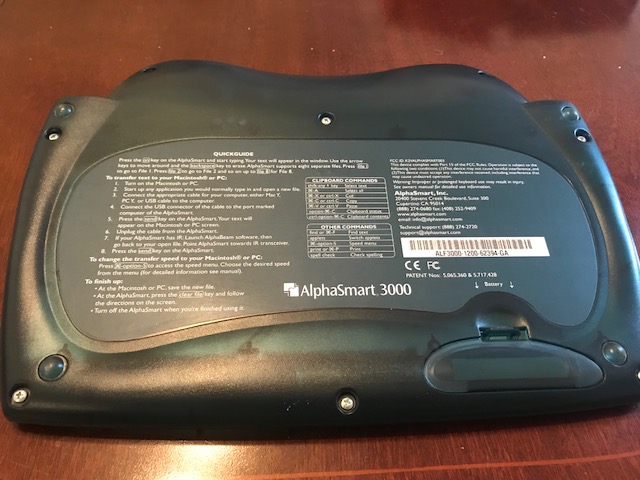 |
| Handy help guide on the base of the device |
So what do I use it for? Well, it's a text entry device, so typing on the go. The 3000 has been to Amsterdam twice and proved a boon each time. Okay, it's not as compact as a laptop and it's a one purpose device, but what more do I need? The battery life is not an issue, the storage is more than enough and the keyboard is far more comfortable to use than my Chromebook. It does for me very nicely.
That it's not sold today is a reflection of changes to the market. Ever since cheap (under £200) laptops became available, educational buyers have flocked to the more versatile option. That this plays to the big businesses like Google and Microsoft misses the point of having such devices. If all you want is text entry for classroom and homework use, then additional features just get in the way, but since the big corporations want you to use more of their features, of course they are going to up-sell.
Is there still a market for text entry devices like this in the age of cheap Windows/Chromebook laptops? Well, kinda. You see, if you want a no frills portable electronic typewriter, you are limited to the second hand AlphaSmart market or the Astrohaus Freewrite. This started as a crowd funded electronic typewriter called the Hemmingwrite, based on the practice Hemmingway used to write on the fly and not edit. The Freewrite is a far bigger device but with a proper Cherry-switched keyboard and an e-ink display. The battery life is far shorter and whilst you can connect via USB, they promote cloud services to send the files you create to your service of choice. It only holds three files but storage is much larger than the 3000. To be honest, it looks okay, the major problem being the price: £383 as of the last time I checked. That is a serious wodge of cash and for a one task only device, that is not justifiable to me. Yes, it gives you distraction free writing that a traditional laptop doesn't but at a price. Plus, its portability is suspect.
For me, and maybe others, since the AlphaSmarts on e-Bay always sell, these devices are certainly useful today and prove that just because the tech is old doesn't mean to say it no longer has a use. Yeah, it's a niche use, but compared to the Chromebook I have used for the last four years, the 3000 is much better at text entry and will continue to be used for as long as it lasts. After that, maybe another trip to e-Bay.
Tuesday, 7 November 2017
Films and thoughts
With a smidge of spare time recently, I have managed to catch up with a few of films that I didn't get to see whilst they had a cinema release (or didn't get a cinema release at all). Whilst they differ in genre and tone, they each highlight a different section of modern day film making that made me think.
The Mummy (2017)
First up, The Mummy, starring Tom Cruise and intending to launch the Universal Dark Universe franchise (Well, kinda, Dracula Untold in 2014 was supposed to launch the series but that was savaged upon release). Now, you'd expect the usual Tom Cruise affair here, toothy smile, charming wit, a relatable character. Well, no, you don't get any of those. As this is supposed to be a horror film, Cruise's character is a rough diamond, except he's not likeable at all. In fact, he's a bit of a dick. Even though there is an attempt to build a buddy comedy vibe at the beginning of the film, this falls incredibly flat, even with the final reveal at the end.
The rest of the cast is ok, if not forgettable with the exception of Russell Crowe. Oscar winner, all round good actor, this film gives him Dr Jekyll and Mr Hyde to play with and Jesus wept, it's bad. Not the Jekyll sections, he's passable, it's the Hyde appearance and the 'mockney' accent served with enough ham to start a deli counter that really stomp on any pretensions the film has.
Coupled with an overuse of CGI (which is a fault of many films these days) and a story/script that credits six individuals(!), The Mummy is a disappointing film that feels very much like a committee designed film with it's eyes focused on the Dark Universe series rather than telling a good tale on its own. That attitude seems to encompass a lot of films (and the series they are in/trying to start these days - the DC Universe suffers badly form this yet the Marvel Cinematic Universe seems so far to have avoided that trap, even after 17 ish films and counting.) which then leads to the next film I want to talk about.
Transformers: The Last Knight
Number five (5!) in the Transformers franchise, The Last Knight is a prime example of trying to keep a money making franchise going long after it should have been put down. However, when your series hits $1 billion is earnings each for films 3 and 4, the money men and the studio know that there be gold in them there hills. Or so you would think...
The Transformers series started off with a decent first film, successful enough to get a sequel. The following three earned more each time but were (to kindly put it) critically mauled. That didn't, however, hurt the box office takings and it was decided to have number 5 re-boot the series mythology. This would allow spin off films (Bumblebee is due next year) and also provide a foundation for several future films. All to enhance the bottom line of the studio and the toy company.
That didn't work with this film. In fact, The Last Knight seems to have proved that if you shovel enough crap at people, no matter how shiny it looks, they will get sick of it in the end.
Whilst I have seen films one to four, I had put off watching five as it just didn't interest me. But then one night, flicking through what to watch, there it was and I decided to give it a go. Hmmm...
Firstly, the negatives: the story is convoluted, boring and the film is far, fat too long, by atleast 40 minutes. Again, it's the mythology set up, because as they were trying to start it off again, they not only referenced the previous films, but then added new layers that didn't gel but had to be in there to set up the future entries (see the pattern?). Positives? There is more humour (and not the robot testicles of the 2nd film either) and the core of the film is decent enough. There is still too much confusing CGI and characters are paper thin (and that's the male characters, the women of the film are effectively place holders).
It tells you how much you are enjoying a film when the conversation whilst watching it centres on how well Alnwick Castle, Bamburgh and Newcastle are featured (the latter less so, possibly not at all, it's the blink and you'll miss it editing of a car chase). That and calling bullshit every time logic goes out of the window, which in a Transformers movie, is very common. If you liked the previous entries, this is a film you might enjoy (the box office for this entry was down over 40% from number 4, a big disappointment for all concerned). If you haven't seen any of the films, watch the first one and leave it there. If there is a 6th film, I doubt it very much I'll see it.
The Man From U.N.C.L.E.
From two franchise targeted films to a TV-originated big screen adaptation that ticks almost every box in the positive column and still wasn't successful. The Man from U.N.C.L.E. is an origin story that nails the period, style and charm of the TV show with two good choices as Solo and Kuryakin (Henry Cavill as Solo is superb). The cinematography has that early 60's colour saturation and the military geek in me went wild when they had a scene setting shot of what appeared to be HMS Hermes (but with the radar from Victorious) with Scimitars on deck. Yeah, I know it is only CGI but it was well done and not obvious - which is what CGI should be used for. The story is interesting and makes logical sense, the action is well staged and the comedy veers towards subtle rather than over the top.
Why wasn't is successful?
There seems to be two lines of thought, one where the film and its source material were too old fashioned, that no-one remembers the TV show so have no real desire to see a film. The other, that is was released too closely to another spy film, Mission Impossible: Rogue Nation (I should point out that that film was number 5 in that series and because they take their time and make these event films, the series is going strong, unlike the frequent, re-hashed releases of the Transformers series). I tend to fall in the latter camp. This is a good film and if you have the chance to watch it, please do. You can do far, far worse (see the above two entries). It didn't make enough at the box office so it will remain a lovely attempt at launching a franchise but one that remained focused on creating a good film first, a franchise second.
6 Days
Finally, a low budget re-telling of the Iranian Embassy Siege of 1981. This had a limited cinematic release and that's a shame as it's a rather decent film. Yes, it's quite slow and there are no flash/bang/wallop scenes as such, but that does not detract from the way the siege is portrayed. Filmed on location in London and having one of the SAS troopers as a technical adviser, the cast is uniformly great and the period is well presented. The final assault is well staged although lacks the pizzazz of a big-budget blockbuster, yet that makes it even better as to be honest, you could not make the early 1980's look glamourous if you tried. I remember it as being brown. Beige and brown.
Anyhoo, it you have access to a streaming service (I watched this on Netflix), give it a go. It has a tight 909 minute run time and deserves a viewing.
The Mummy (2017)
First up, The Mummy, starring Tom Cruise and intending to launch the Universal Dark Universe franchise (Well, kinda, Dracula Untold in 2014 was supposed to launch the series but that was savaged upon release). Now, you'd expect the usual Tom Cruise affair here, toothy smile, charming wit, a relatable character. Well, no, you don't get any of those. As this is supposed to be a horror film, Cruise's character is a rough diamond, except he's not likeable at all. In fact, he's a bit of a dick. Even though there is an attempt to build a buddy comedy vibe at the beginning of the film, this falls incredibly flat, even with the final reveal at the end.
The rest of the cast is ok, if not forgettable with the exception of Russell Crowe. Oscar winner, all round good actor, this film gives him Dr Jekyll and Mr Hyde to play with and Jesus wept, it's bad. Not the Jekyll sections, he's passable, it's the Hyde appearance and the 'mockney' accent served with enough ham to start a deli counter that really stomp on any pretensions the film has.
Coupled with an overuse of CGI (which is a fault of many films these days) and a story/script that credits six individuals(!), The Mummy is a disappointing film that feels very much like a committee designed film with it's eyes focused on the Dark Universe series rather than telling a good tale on its own. That attitude seems to encompass a lot of films (and the series they are in/trying to start these days - the DC Universe suffers badly form this yet the Marvel Cinematic Universe seems so far to have avoided that trap, even after 17 ish films and counting.) which then leads to the next film I want to talk about.
Transformers: The Last Knight
Number five (5!) in the Transformers franchise, The Last Knight is a prime example of trying to keep a money making franchise going long after it should have been put down. However, when your series hits $1 billion is earnings each for films 3 and 4, the money men and the studio know that there be gold in them there hills. Or so you would think...
The Transformers series started off with a decent first film, successful enough to get a sequel. The following three earned more each time but were (to kindly put it) critically mauled. That didn't, however, hurt the box office takings and it was decided to have number 5 re-boot the series mythology. This would allow spin off films (Bumblebee is due next year) and also provide a foundation for several future films. All to enhance the bottom line of the studio and the toy company.
That didn't work with this film. In fact, The Last Knight seems to have proved that if you shovel enough crap at people, no matter how shiny it looks, they will get sick of it in the end.
Whilst I have seen films one to four, I had put off watching five as it just didn't interest me. But then one night, flicking through what to watch, there it was and I decided to give it a go. Hmmm...
Firstly, the negatives: the story is convoluted, boring and the film is far, fat too long, by atleast 40 minutes. Again, it's the mythology set up, because as they were trying to start it off again, they not only referenced the previous films, but then added new layers that didn't gel but had to be in there to set up the future entries (see the pattern?). Positives? There is more humour (and not the robot testicles of the 2nd film either) and the core of the film is decent enough. There is still too much confusing CGI and characters are paper thin (and that's the male characters, the women of the film are effectively place holders).
It tells you how much you are enjoying a film when the conversation whilst watching it centres on how well Alnwick Castle, Bamburgh and Newcastle are featured (the latter less so, possibly not at all, it's the blink and you'll miss it editing of a car chase). That and calling bullshit every time logic goes out of the window, which in a Transformers movie, is very common. If you liked the previous entries, this is a film you might enjoy (the box office for this entry was down over 40% from number 4, a big disappointment for all concerned). If you haven't seen any of the films, watch the first one and leave it there. If there is a 6th film, I doubt it very much I'll see it.
The Man From U.N.C.L.E.
From two franchise targeted films to a TV-originated big screen adaptation that ticks almost every box in the positive column and still wasn't successful. The Man from U.N.C.L.E. is an origin story that nails the period, style and charm of the TV show with two good choices as Solo and Kuryakin (Henry Cavill as Solo is superb). The cinematography has that early 60's colour saturation and the military geek in me went wild when they had a scene setting shot of what appeared to be HMS Hermes (but with the radar from Victorious) with Scimitars on deck. Yeah, I know it is only CGI but it was well done and not obvious - which is what CGI should be used for. The story is interesting and makes logical sense, the action is well staged and the comedy veers towards subtle rather than over the top.
Why wasn't is successful?
There seems to be two lines of thought, one where the film and its source material were too old fashioned, that no-one remembers the TV show so have no real desire to see a film. The other, that is was released too closely to another spy film, Mission Impossible: Rogue Nation (I should point out that that film was number 5 in that series and because they take their time and make these event films, the series is going strong, unlike the frequent, re-hashed releases of the Transformers series). I tend to fall in the latter camp. This is a good film and if you have the chance to watch it, please do. You can do far, far worse (see the above two entries). It didn't make enough at the box office so it will remain a lovely attempt at launching a franchise but one that remained focused on creating a good film first, a franchise second.
6 Days
Finally, a low budget re-telling of the Iranian Embassy Siege of 1981. This had a limited cinematic release and that's a shame as it's a rather decent film. Yes, it's quite slow and there are no flash/bang/wallop scenes as such, but that does not detract from the way the siege is portrayed. Filmed on location in London and having one of the SAS troopers as a technical adviser, the cast is uniformly great and the period is well presented. The final assault is well staged although lacks the pizzazz of a big-budget blockbuster, yet that makes it even better as to be honest, you could not make the early 1980's look glamourous if you tried. I remember it as being brown. Beige and brown.
Anyhoo, it you have access to a streaming service (I watched this on Netflix), give it a go. It has a tight 909 minute run time and deserves a viewing.
Friday, 27 October 2017
More Computer musings...
Growing up in the 1980's and 90's and being interested in tech, his meant that I read voraciously about home computing. True, it is a topic that still interests me now but, compared to that period, the market today seems so... boring. By that, I mean that whilst there was a lack of standardisation, there was a vivacity that is lacking today. True, todays machines and software are infinitely more powerful and capable but at heart, they are pretty much the same. From different formats to weird designs, the computer market did suffer from beige box hell but you could still find some individuality. These days, it's black box hell with some neon strip lighting if you feel the need
As the years passed by, there were a handful of machines that appealed to me, either because of the way they looked and/or the functionality they offered. The following is a list of five machines that at some point, appeared on my wish list. I will add though that at no point have I ever owned these machines. I doubt I will as they are of their time and perhaps should remain there. Operating systems, however, do not follow that rule as my previous posts have noted. Having said that, if one of these machines was available, I'd give it a go just to see how much things have changed.
Amstrad PC 5286


If there was a fault, well two in be specific, they were the lack of shielding that scuppered the design when changes were made to electrical specifications and the speed of the bus connecting the motherboard components. However, for the latter, direct access expansion cards allowed new processor and RAM expansions to run without being slowed down by the motherboard.

As the years passed by, there were a handful of machines that appealed to me, either because of the way they looked and/or the functionality they offered. The following is a list of five machines that at some point, appeared on my wish list. I will add though that at no point have I ever owned these machines. I doubt I will as they are of their time and perhaps should remain there. Operating systems, however, do not follow that rule as my previous posts have noted. Having said that, if one of these machines was available, I'd give it a go just to see how much things have changed.
Amstrad PC 5286

First up, the Amstrad PC 5286. Why, you may ask? Well, I have always had a thing for tidy little desktop machines, designed from the ground up to do a job reasonably well without taking up half the floor or desk space in the room. This was a neat little machine that had enough power to work, 1Mb of Ram and a 40Mb hard drive, and a neat little case design that Amstrad used for several of its later PC ranges. Expandability was extremely limited, this machine was a sold as a straight forward package . I do recall that the monitors were horrible and the later 7xxx series were offered with a 10 inch VGA monitor that must have played hell with your eyes! This was a machine that could have seen me through most of my secondary school years but instead, we picked up a cheaper but much bigger LG Goldstar 286 that lasted a few years.
Apple PowerBook Duo 230
Now this machine covered two areas of personal computing, desktop and laptop, by way of a rather clever and tidy docking system. By day, a mild mannered, decently spec'd portable; by night, a decently spec'd desktop by the way of a companion dock.

Remember, this was long before the time of fast and secure remote working so the idea was valid back then. It compared well with buying multiple machines (At launch the Powerbook Duo was $2,160 - a corresponding Powerbook 140 was north of $1,600 and a Color Classic was another $1,400, though you needed to add the dock, monitor, keyboard and mouse for the Duo. The Duo combination was a one fits all solution, rather than a multi-device kludge). The Duo did its job rather well, a 33 Mhz Motorola 68030 processor, 4Mb of RAM and an 80Mb hard drive was not too bad a spec for a portable warrior. The dock added a full range of ports, room for an expansion slot, more video memory and a hard drive bay. Altogether, a practical set up and one that worked well. True, it was expensive (and the prime reason this was never on my reality based shopping list - but that can be said of so much Apple kit throughout the years!), but for early 1990's tech, it was rather good. It was probably the sub-notebook format that worked best for me and I eventually got into that format with the Asus eee-PC, which still works as a handy little Linux device to this day. The Duo, however, was the portable for me at the time. Before that, however...
Amstrad PPC 512
 Dialling back a few years, this was the machine on this list I came closest to being able to buy. Not that I did as the Amiga 500 was the computer of choice back then and, looking back, it would not have worked well. The PPC 512 was Amstrad's attempt at a luggable. I say luggable and not laptop as seriously, would you put this on your lap??? And which train/plane seat would you occupy? Admittedly, its size does allow it to sport a full sized keyboard and it can be powered by 10 (ten!!!) C-batteries, but the while thing is totally impractical.
Yet at the same time, it isn't. It was an eye opener back then and thirty years of advances make it ludicrous now, but I still like it. Why? Because it offered a chance of portable computing at a price that wasn't stratospheric. Okay, it was only a slight improvement on the likes of the Osborne 1 from several years prior but this was fully PC compatible, offered an MDA/CGA compatible monochrome screen and you could have two floppy drives. Aftermarket accessories included internal hard drives so there was a decent ecosystem around the machine. The 8Mhz NEC V30 processor did the job and there was a non-too shabby for the time 512Kb of RAM. And it looked cool in that 80's industrial plastic kind of way. Buying one today is relatively easy and cheap on ebay, the only downside being that they all seem to lack system disks. But still, not that tempting for me...
Acorn Risc PC
 |
| Monitor and accessories were extra (naturally) |
Amstrad PPC 512
Yet at the same time, it isn't. It was an eye opener back then and thirty years of advances make it ludicrous now, but I still like it. Why? Because it offered a chance of portable computing at a price that wasn't stratospheric. Okay, it was only a slight improvement on the likes of the Osborne 1 from several years prior but this was fully PC compatible, offered an MDA/CGA compatible monochrome screen and you could have two floppy drives. Aftermarket accessories included internal hard drives so there was a decent ecosystem around the machine. The 8Mhz NEC V30 processor did the job and there was a non-too shabby for the time 512Kb of RAM. And it looked cool in that 80's industrial plastic kind of way. Buying one today is relatively easy and cheap on ebay, the only downside being that they all seem to lack system disks. But still, not that tempting for me...
Acorn Risc PC
This one came with a pizza oven and the kitchen sink! Seriously, look at the pic below:
The Risc PC was the follow up to the Archimedes range and, for its time, offered a bang per buck that was hard to match. Using the (then) new StrongArm processors, the Risc PC was a bit of a powerhouse that had been carefully designed around slice based casing.
You see, each slice had space for a 3.5" and a 5.25" drive bay so slice one could handle your floppy drive and CD-ROM, slice two could take an additional hard drive and a tape back-up drive and so on. Each slice could also fit two podule expansions and were easily stack-able, sometime to the extreme. As you have seen above, at one show, a demo machine was set up with every bell and whistle they could think of, including a pizza oven and working tap and sink. Comedy value aside, the industrial design is superb and extremely forward thinking.
 |
| The full monty (including the kitchen sink!) |
 |
| The bog-standard casing |
 |
| The back end, showing podule expansion backplanes. |
By the time this machine came out, I was at the tail end of my Amiga phase and it wouldn't be too long before I joined the Windows PC brigade. It was priced too highly for what I needed and could afford so a cheaper generic PC was the order of the day instead.
Only a couple of re-sellers stock these today and prices are quite high for what you get. Buying one would be for novelty value only as Risc-OS has moved on since then but the physical design has an almost timeless quality and one that I think would work well today. It's just a shame that no-one else took this up.
Commodore Amiga 1200

Finally, we have the Amiga 1200. The last of the affordable Amiga range to be released before Commodore's demise, this was the machine that could, maybe, have saved the company if they had released it a couple of years earlier. Well, probably not saved, but at least let it have another shot in the mid-90's. As it was, company politics and some downright immoral behaviour by the company's management meant that it would have been a tough challenge no matter what the company had produced.
Similar in style to the Amiga 500 but with a more compact design, the 1200 had enough oomph to act as a basic but decent internet capable machine, even in the mid-90's. It was expandable and more than a few have been converted to tower configurations where the wealth of third-party add-ons in surprising.
It offered a hefty bump in power from the A500/A500 Plus range and demonstrated that with the tools and finance, Commodore's engineers could do the business. The less said about the management pushed A600 (the successor to the A500 range, the better).
However, the era of cheaper PC's was beginning and it wouldn't be long before Windows 95 ushered in a (relatively) user friendly experience on hardware that was much more capable (albeit more expensive but better value). The closest I came to getting one of these was when Escom bought out the remnants of Commodore and released an internet-access based pack. Alas, I was torn between this and the Risc-PC so settled on a PC (yeah, I know), and as it turned out, Escom was not long for this world anyway.
So there you have it, a short list of the computers that interested me back in the day. Like I said, I doubt I will ever buy any of these for use in the present day but that doesn't mean to say I haven't been a little bit busy on E-bay either, but more of that in the future.
Wednesday, 11 October 2017
Flight of the Bat - A Book Review

Hot off the presses (in 1963), Flight of the Bat is the second novel by Donald Gordon. His first, Star-raker, is on my reading pile so I'll come back to that in the future). Set in the early to mid 1960's (probably '63 as it is post Cuban missile crisis), the Soviets land a capsule via ICBM to each of the Western capitals (London, Washington DC, Paris and Bonn) daring them to send a response by a similar method within seven days, otherwise they expect surrender talks they blatantly have superior technology.
The novel sets out the Soviet superiority in missiles and defence technology in general. The West's missile replies are ineffective or shot down, a Polaris boat is lost in the Arctic and hope seems lost.
Except for the RAF who have managed to husband an aircraft programme (the Bat of the title), to the point where it is ready for service. From its description, it feels like a cross between the Valiant B2 Pathfinder and the TSR 2, though more the former than the latter. With two plucky pilots (one British, the other an American exchange officer) plus a bright young lady in the tech department, Flight of the Bat follows the reaction to the Soviet ultimatum and the sacrifices made for the mission to deliver the reply.
Now before I say anything else, the novel is of its time and it would be wrong to tear into it for that reason alone. Given its age, the novel does have one instance of racism from one main character that is quickly rebuked by another, but that is about it, unlike the Nevil Shute novel "In the Wet", which although one of my favourite aircraft related novels, does lay racist terms quite thickly. There is also smoking galore and whilst some of the technical details ring true, there is a lack of detail that modern day readers might find surprising given that public access to weapons technology information has been quite easy since the late 70's onwards.
Still, I will not be too harsh, it's a briskly written tale and rather enjoyable overall. There is a fault with the characterisation (almost stereotypical but then again, the British are terribly British, even when the character is American). When reading this, I was definitely reminded of the films of the period with their clipped, crisp pronunciation, the stiff upper lip and the stoic fatalism that seems to be an RAF entry requirement. At the same time, there is a techno-thriller vibe that feels very Tom Clancy and the combined spy trawler mission and flight to Moscow feel as if they are from a similar, Clancy-esq vein.
I first read this when I was at secondary school and somehow lost that copy. Replacing it cost a few pounds from Amazon and I am glad I have a copy again. If you have a fondness of Nevil Shute and his aviation novels (as stated before, In the Wet is superb), certainly give this a try.
Subscribe to:
Posts (Atom)