Five Years Later...
If 1988 was the year of talking up OS/2 as the next step(!) in PC operating systems, by 1993 the conversation had settled firmly on the future with Windows NT, and this issue of Personal Computer Magazine handily deals with that in their Pentium/Alpha face off given that DEC's new super chip could run Microsoft's power OS. If you want to know more about how NT came about, give Showstopper! by G. Pascal Zachary a read. It's a simple tale of folk being absolutely pummelled for the promise of stock options and pay outs whilst their personal lives are shredded all for the cause of "achievement." Yeah, well, that's a rant for another time...
Anyway, the news:
Compaq might have asked Intel to embargo all Pentium-related announcements until Compaq's own motherboard for the chip was ready for the prime time. Such shenanigans were denied but given that everyone else was having to use Intel-produced boards and Compaq wanted to shift boxes...
The battle for networking control was heating up with Novell Netware's pricing undercutting Microsoft's own Windows NT Advanced Server package, as well as PINning their hopes (you'll see) with their Processor Independent Netware (See!!!) initiative, which hoped to put Netware 4.0 on Alpha, PA-RISC and Sparc processors, as well as the then current Intel offering. Hey, it seemed to work out for the rest of the decade...
Meanwhile, AMD were spaffing 486 chips left, right and centre, handy since the 486 was the CPU of choice in the market. A court win against Intel regarding microcode infraction was also a plus point. At the same time, Intel were still litigating against all and sundry who tried to use AMD or Cyrix processors, with Twinhead (a prolific notebook manufacturer at the time), the latest victim of Intel's lawyerly legions.
Apple were planning to move the "look and feel" of the Mac GUI to Unix workstations in an attempt to... well, it wasn't exactly clear what they were doing. Fighting Microsoft in the Unix sphere? Attempting to garner support for their forthcoming PowerPC-based machines? Piss around because at this point the wheels are starting to wobble? Speaking of wheels, they had fallen off the MJN Technology bandwagon, with the direct PC seller's fall leaving 70 people out of work. The brand would rise again as part of the Granville Technology Group, alongside brands such as Colossus, Time and Tiny. Yep, them!
Coreldraw 4.0 was winging its way to UK users for the princely sum of £395, with Coreldraw 3 dropping to £149! Ah, kids, serious software used to cost serious money back in the day. Also costing real money was IBM's PS/1 Multimedia System - a 25MHz 386 rocking an 85Mb hard drive, Philips CD-ROM, Audio Spectrum 16 soundcard and a 256-colour SVGA display. The £1,340 they were asking for it included DOS, Windows, Works for Windows, and a tutorial CD-ROM. Canny shoppers could get a similar spec a little cheaper, and it was arguable whether a 386 would cut the mustard for much longer.

Word 6.0 (for DOS) was also due to meet the public, helping the marketing bods by matching version numbers with long time rival Wordperfect. Also due out by year end would be Word 6.0 for Windows, as well as a Mac version too. In more surprising news, Virgin (yes, them!) were planning to get into the PC hardware market, albeit using third party kit with a badge slapped on the box. And no, that's didn't work out either, pretty much in line with the commentary piece on page 47 - entering a mature market and thrashing the competition first time??? I mean, they had form, but this wasn't the airline market.

News analysis sections this month offered thoughts on possible competition for Microsoft as other companies try to leverage Windows applications with Unix and Macintosh - very much a storm in a teacup. VESA Local Bus standards were up next, or not as was then the case, with varying interpretations of what VL-bus actually meant doing the rounds. Another teacup-sized forecast as PCI was already fermenting nicely over at Intel, and that would prove far better suited to Pentium processors as they found their footing in 1994.

A proper 90's fascination up next and yes, it's the "what the fuck were they thinking" collision of the personal computer and television. Bill Gates had been demo-ing some marketing bollocks about tech permitting greater PC/TV integration and, well, it was a piss poor idea at the time, and truly didn't evolve until online connectivity could keep up with even basic video encoding standards. Given the current state of television and the streaming market, it's still ended up being a piss poor idea for those who create the content, as well as those who consume it.

Speaking of which, here comes the D! (Not that, you filthy minded buggers!). No, we're talking about ISDN (Integrated Services Digital Network), a way of guaranteeing two 64Kbps channels (and potential for up to 30 of them), at a time when your standard modem was giving 14.4Kbps, with forthcoming 19.2Kbps and 28.8Kbps specs and even (spoken in hushed tones), 56.5Kbps!!! You had to be there, kids, as well as being very patient. Although you could say the same today as you wait for the Satan-bating combination of cookie consent pop-ups and adverts to interrupt even the fastest of connections. The article does talk about ISDN's D channel (for flow control and error reporting, the B channels being the main data pipes), and also mentions the possibility of Broadband and 100Mbps. Fantasy for 1993 users, and maybe for more than a few 2024 ones as well, but the future looked bright, even if the then-present offering was still an expensive luxury - £400 for Basic Rate ISDN 2 (so 128Kbps) installation plus £84 per quarter line rental, but £3,025 for Primary Rate ISDN30 installation and £33.87 per quarter per channel line rental - and remember, you could have up to 30(!) channels! Now we know where Virgin Media get their pricing model from!
On to the reviews and before we get to the kit being covered, just a shout out to the headers for each piece. They are quite funny and I'll include them as I go. Hewlett Packard had a printer (Quite.a brainy type) that could do you 17 pages per minute at 600 dots per inch for £2,999 in the form of the Laserjet 4Si. For network use, the 4Si MX was yours for £4,449 with included Ethernet and Local talk cards, as well as Postscript, compatibility with ten networks OS's, optional Token Ring, and a parallel port for single user types. PCM declared this should become the standard in network printing.
Dell placed their new Dimension 486/25S on the line (Dell to be different), and priced at £1,025 for a 25Mhz 486, 8Mb of RAM, a 120Mb hard drive and local bus graphics, it was a rather nice machine. The £30 delivery charge gets a call out, and when you consider that equates to just over £60 in today's money, they're not wrong.
Microsoft wanted you to use their Mouse 2.0 (New moose in the hoose) but for £69 then, that was a lot of readies for your rodent, Quicken 2 for Windows (The Quicken wakes - one for Wyndham fans there) offered an excellent financial package for £59.95, and Norton Utilities 7.0 (Beautility and the beast) was another winner, both as a package and a title.
NEC's latest colour laptop, the Ultralite Versa 25C (Your Versa-tile friend) gained points for future-proofing, with a degree of modularity that would have been used to justify its £3,195 price tag. That and the lovely (for the time) 9.5" 256-colour TFT screen. Finally, low-cost document image processing software, Watermark Discovery (That's the OLE point), harks back to functionality that has long been subsumed into more general packages.

The cover stars are next and it's definitely more Pentium than Alpha-based. You get a long and highly detailed background as to why the Pentium chip is the Pentium, as well as the technology behind it. It's pieces like this that make these old magazines well worth reading, and it was certainly a school day after finishing those paragraphs. PCI is touched upon briefly (see above for my prior comment), as is whatever the P24T upgrade malarkey was (marketing tripe, mostly it seems, as people just upgraded the whole box as it would become clear that by 1994, a dedicated Pentium machine was the future), before we get to the high-end server products that Intel's latest was aimed at.

ICL's Teamserver F5 started at £7,500 for a good tower option, whereas Viglen's EX Pentium was a much more affordable server/desktop at ££4,949 as tested. Elonex went straight to the simple "Pentium" moniker, and for £8,100 as tested, they could keep it. DEC's Alpha-equipped AXP proved a competitive offering, at least spec wise, as no pricing was mentioned. Benchmarks are a pleasant surprise and the general feeling is that DEC have a capable machine on their hands. The final question about whether they could leverage Windows NT on their new box was soon answered - the market said "Meh," and stayed with Intel.

For those who have an accounting thing (Hey, I just test financial databases and associated logic! Those six years in finance were an aberration!), a round up of interviews with corporate types and how they handled LAN-based high-end DOS accounting packages could be of historical interest. As someone whose career has revolved around IBM i, there are some interesting connections here but it's a tad too dry, even for me.
A very definite period piece on the dangers of leasing equipment is an "oh, really?" read, given that times have changed, but the next sixteen pages really do confirm that the past is a different country: hard disks - what they are, how they work, and what to do when you run out of space, as well as other storage options. All that spinning rust...
The main group test gives word processors for both DOS and Windows a run out, and there are some truly memory-raking names present and correct, all the more so after I've just read this wonderful article on The Register about WordStar 7. Yes, I'm going to be trying that out ASAP! Back in '93, Lotus Ami Pro received the best in show gong for Windows, whilst Wordperfect 5.1 clinched it for DOS, although honourable mentions were given to Starwriter and WordStar.

The Platforms section, covering Unix, OS/2 and cross-platform issues takes a gander at NeXT's Intel port of NeXTSTEP. The pre-release version was handled by some loaned hardware that really missed the boat for the average user: 486DX2 66MHz, 16Mb RAM, 240Mb SCSI hard drive, and a 2Mb VRAM graphics adaptor - £3,500 plus £900 for the developer release of the OS. Even then, that didn't meet the suggested developer release spec from NeXT, which apparently needed 24Mb of RAM and 330Mb of drive space. It's an informative read but the conclusion does state that NeXT was competing at the high end of the workstation market, whilst also noting that some have said its real opponents are (the several years away) Microsoft's Cairo and IBM/Apple/HP's Taligent collaboration. As it turned out, Cairo never shipped although some elements appeared in Windows 95 (which won the consumer OS race with surprising ease), and Taligent fell apart. Our fruity friends then shat the bed with Copland and ended up buying NeXT in 1997, thus taking the "next step" on the journey to financial recovery.
Back into the real world and the first part (of two) of a series detailing networking Netware LANs to Unix does provoke a slight yawn from me (apologies), before Bob Walder casts a gimlet eye on the release version of Netware 4.0, comparing it as he does so to Microsoft's LAN Manager 2.2 and Banyan Vines 5.5. Do I need to spell out the conclusion, or can the 90's veterans in the room guess? Yep, Netware is the best, LAN Manager is good and improving, especially if you're already using Windows for Workgroups, and Vines 5.5 has issues with complexity and a monumentally crappy copy protection system (a dongle that proved "troublesome"), so loses any chance of a recommendation. As noted in the news section, Novell retaliated by dropping its prices, but as end users were increasingly becoming equipped with machines running Windows for Workgroups, the buy in was simple enough for Microsoft to leverage.

Back up options get a group test before we get to the tail end (a round up of Desktop Publishing books, anyone), but also this absolute classic from Richard Sarson under the training banner. Companies were being "delayered" of management, and this should bring about a change in recruiting practices as well as a move away from the idea of 40 years of progression before you get your pension. What makes this a fun commentary is the distance of thirty years and how much things haven't changed. You can see the full article ablve, but from actual experience, whatever "flat, competence-driven" structure companies might aim for, I can attest from my experience that deeds have not matched words, and that the vertical management culture is alive and well.
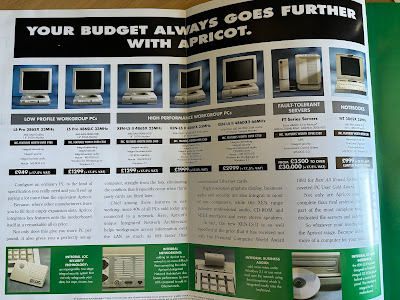
It's the adverts and we begin at the beginning, with Apricot tying to convince potential shoppers that they were good value. As much as I loved the Xen desktop case design (we had a one at Tanfield Comp for the careers advisor to use), I don't believe £949 ex VAT for a diskless 33MHz 386 was good value, network security or no. And £1,299 for a 25MHz 486 was, as we shall see, a tad over the odds too.

Now here's something more than a little strange! Apple with multi-page adverts! Indeed! This was at a point where the fruity fiends were pushing what was left of the 680x0-series range before the big move to PowerPC, and more importantly, highlight the benefits of using a Macintosh over Windows (something that the arrival of Windows 95 would begin to change very quickly). Much like logic puzzles beloved by adventure games and films, Apple poses this as a three part process: Macs weren't affordable, Macs were only for graphics, and Macs were not compatible. Here's their guide (with commentary) to the answers.
The Mac isn't affordable:
The LCIII 4/80 was only £1,150 ex VAT! A bargain! Well, for a Mac, pretty much. Three years prior, and that amount wouldn't have gotten you the box, never mind a display! That LCIII rocked a 25MHz 68030 and could also be found in its civilian guise as the Performa 450. But check out that Classic II - £695 ex VAT! It also had a 68030 but clocked at a lower 16MHz and on a cheaper/slower 16-bit bus. Still, the 4/80 configuration was a good budget option, yet one can't help but feel that the 9-inch 512x342 display was a step too far down the ladder. There were added benefits (networking and audio), so arguably, Apple weren't horribly wrong here, except maybe asking if you should buy one for the office, or the home, or both? That's a lot of saving up, and they didn't even have the benefit of cancelling Netflix subs to help out back then...
The Mac is only for graphics:
There's lots of professional packages for Mac users, and you can easily do whatever you can on a PC but also on a Mac. And no, that's not sarcasm. What should be noted is the focus on their being a Mac for whatever purpose. In all, 17 models. Now, let's be clear, that was quite restrained compared to what would happen over the next four years - Apple spattered the market with conflicting ranges and multiple configurations within those ranges. Just a quick check of a 1996 Mac mag makes for migraine inducing complexity, so maybe the next MoYY post will check that out. But as for 1993, there were (just) 17, which was still a worrying sign of things to come.
The Mac isn't compatible:
Fair play, they were good for network connectivity, they could read MS-DOS floppies, and they could run MS-DOS programs via an emulator. Job done!
But not quite: there's some summer specials (four, on top of the 17 models mentioned above), and it's here that the messaging stumbles slightly. The only "special" that received coverage in the previous pages was the LCIII at that £1,150 price point. The cheapest option was the LCII at £850, which sounds good until you realise the model had been discontinued a couple of months earlier. A great upselling chance for the LCIII, perchance? That Centris 610 with a Personal Laserwriter NTR as a package for £2,795... What was that about affordable? The last "special" is a doozy, and also one of the most desirable combo's ever created (IMHO). The Powerbook Duo, all in for £2,495. Effectively an LCIII in portable form, the concept was neat but very expensive for the benefits it offered.

Bless them, but IBM were trying with the aid of the Pink Panther. Here's an NEC ad from a few pages prior, and you can see the asking price for their 25MHz 486 was competitive, and to be honest, of the two, I prefer the aesthetic of the PS/ValuePoint range, but horses for courses.
Nicely placed following the Alpha/Pentium dust up, this DEC advert targets the server end of the market, and I'm sorry, but adding "just" before those prices is an... interesting choice.
P&P were a dealer who were gunning for Compaq fans with these two offers, and that ProLinea for £999 ex is really good for the time, as is that bundle price including Microsoft's best offerings.
Time Computer Systems Ltd. next and some duality there. That colour Amstrad laptop was good value at that price, but compared to the latest offerings from other manufacturers, was bulky, so definitely belonging to the previous generation of portable technology, whilst that IBM bundle is another good value option, though that 386 model for under a grand was an exercise in false economy - the 486 was at the grand-ish level and would only get cheaper.
Not that that would stop the likes of Wearnes, whose 386SX-25 at £649 ex VAT was more for the budget conscious rather than anyone looking ahead a year or two. Good price on the 486SX-25 mind...
Nationwide Direct were slinging out 386 and 486's from IBM, Compaq and, yep, Alan, and Gawd help them, still trying to flog both the 7000-series and the Mega PC. The 7386 would do you a reasonable if un-expandable desktop, but trying to flog the 7286, even with that games pack? No. No, no, no! Same would go for the Mega PC. At least their dealer price for the IBM ValuePoint range makes them even more attractive, the 486 mentioned above was only £899 ex!
 |
| The Pen Pad: pointless, but I still wanted one. |
Last, but not least, is Thripplewoods with some intriguing goods for sale. First up has to be Amstrad's Pen Pad PDA 600, the lower cost option for those who couldn't reach the heady heights (or public humiliation) of Apple's Newton. I've never seen on in the flesh but contemporary reviews were lukewarm at best, and those of a social climbing nature would probably have been better off with a Newton!
 |
| Another pointless piece of kit, still wanted one. |
Moving passed the sextet of fax machines (you have to be of an age...), it's the MagicNote that steals the show. A word processor in a laptop form, it's something that would have appealed to my gadget freak side even though it was pricey for something Amstrad's own NC100/200 range of portables could have achieved. But hey, considering these days Freewrite ask for around £400 for effectively an e-ink typewriter...
Next time, the return of The Mac (that's a hint, that is...)


