Showing posts with label Atari. Show all posts

Sunday, 22 December 2024

Game Guide to the Atari Jaguar by Karl Morris - Book Review

Blimey! Four years since I reviewed the first books I'd ordered from Zafinn Books. Time flies and all that, but here we are with their latest publication, a guide (and love letter writ large) to Atari Corporation's final piece of gaming hardware, the Jaaaaaaaaaaaag! Aka Jagwahr, for our North American readers. 


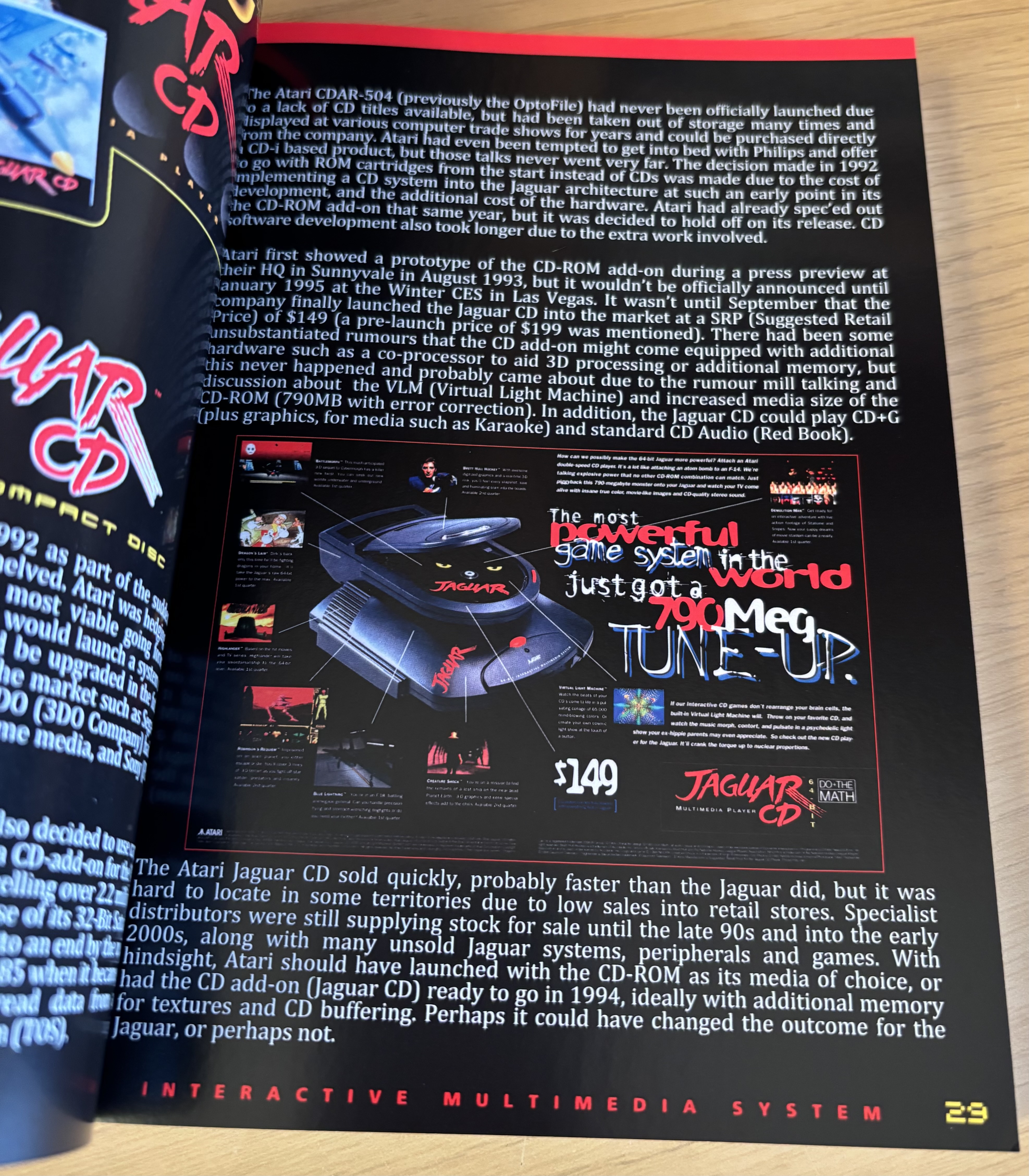
The last time I featured the Jaguar was a review of Boris Kretzinger's highly readable history of the console and its fate due to the ultimate demise of Atari. In this tome, the title says it all, with a complete guide to all of the officially released titles that graced the machine. Of course, a little introduction doesn't hurt, so the first thirty-ish pages gives you a potted history of the console, a bit of focus on hardware and accessories, as well as the joyousness that is the Virtual Light Machine. Then we get to the games. 


As with the previous Lynx volume, each title receives a two page spread, comprising of a half page of text description, a screenshot (framed in a good old CRT TV this time), and a quartet of scores from the author for Graphics, Sounds, Playability, and Overall. These are subjective and, whilst you may disagree with some of them, the stinkers really are stinkers... (looking at you, Club Drive!). The other page offers an image of the title/loading screen, the box art, and a factoid linked to the game in question. These are highly informative, and where Mr Morris quotes sales figures, it's really surprising as to just how low some of those numbers were. Yeah, I get it, this was before the true mass market of the 32-bit generation, and the Jag itself was a sales disappointment/flop, but wow! And no, I ain't telling you any of them, you'll have to buy the book. 


There's numerous Jag-related adverts dotted around too, and for fans of the financial side of video games history, pages 76 and 77 show internal Atari documents detailing costs and payments for various titles. Hugely interesting when combined with some of those sales figures...

A quartet of interviews (Doug Engel, - Battle Sphere, James Boulton - Retro HQ, Rich Whitehouse - BigPEmu, and Lawrence Staveley - Reboot-Games) follow the games guide, with a page of Jag-related resources and some more artwork/design docs to finish off this 220-plus page effort. 


Combined with Kretzinger's history, Zafinn's latest offers Jaguar fans and video games enthusiasts alike the perfect combo on this 64-bit wonder, and I'd be lying if I said i wasn't thinking about firing up Atari 50 or an emulator and re-visiting some of the rather better titles the Jag had to offer. For the hell of it, I think a dip into Club Drive may be in order too. Can't have nice things all of the time, you know! 


Game Guide to the Atari Jaguar is another fine release from Zafinn Books and kudos to author Karl Morris for putting this together. Maybe we might see 5200 or 7800 themed guides in the future? (Which would be cool, I would certainly buy them, but we are getting in to the niche side of Atari now. Still, shy bairns and all that...)

You can buy the Game Guide to the Atari Jaguar directly from Zafinn Books here, as well as follow them via the following social tags:

Bluesky - @zafinnbooks.bsky.social
X - @zafinnbooks

Friday, 21 April 2023

Clipped Claws by Boris Kretzinger - Book Review

The Atari Jaguar was the last throw of the dice for Atari v3.0. You know, the one the Tramiel's ran for a decade or so, scoring hugely well with the original ST and then slowly screwing it up as the competition, and computer market itself, changed. Returning to Atari's (v2.0 - the Warner year's, as opposed to v1.0 - the Nolan years) gaming roots, the '64-bit" Jaguar (calm down, we all know it's not that simple!) launched with high hopes and tragic prospects. For the first time, combining freely available information along with interviews, chats and conversations from over forty individuals with links to the machine, Boris Kretzinger has written the story of the Jag. In this self-published (and free) pdf, the question is though, has he "done the math?"

Version 3 of Atari was always a contradictory creation. Never cash rich, it had at least a fighting spirit that certainly kept fans (and a few wavering converts) happy as it tackled the new 16-bit computer market. If you ever get a chance to read Karl Morris' excellent "We Love Atari" duo (especially the second volume), or Jamie Lendino's sublime "Faster Than Light", you'll know exactly why Tramiel and sons failed. Further evidence is amply provided in this publication.

What Mr Kretzinger has done is investigate, research and compile a variety of sources to give a highly detailed, blow by blow account (and conclusion) of what happened when Atari tried to re-enter the home console market after blowing several years worth of effort and cash with increasingly re-hashed computer products, combined with some absolutely bone-headed business decisions. 

Searing as it is deep, the narrative here covers everything you need to know, from press interviews (I do recall the Edge ones from the time and still have pdf copies of the magazines now), to the recollections of those who coded, sold or just enjoyed the games on the more-powerful than you'd think box.

Some of the tales presented here have more than a hint of tragedy about them: the sales figures for some of the most well-received/well-remembered titles are dire, as is the emphasis on spending money where it would do no good (VR anyone?), but you, gentle reader, also have to remember that this was the company that mostly sat on the ST with little or no improvements (aside from announcing kit that never appeared), as well as the one that screwed their US dealership connections into the dust.

Overall, this is a well written book. Maybe another editing pass to correct the odd typo, but nothing else stands out, leaving Clipped Claws as the must-read single volume on the Atari Jaguar, as well as a highly informative look at Atari themselves as the company slid towards the abyss. The abundance of footnotes is also greatly appreciated for further reading. I can also add that, if the author ever thinks of getting a physical copy published, I'd be more than happy to buy it.

You can pick up a copy of Clipped Claws from the Internet Archive here, and I would recommend the pdf version over any other, purely based on my reading experience. You can also follow the author on Twitter here.

Saturday, 2 April 2022

Adventure by Jamie Lendino - Book Review

As promised some months ago, I bought myself another of Jamie Lendino's books. Adventure focuses on the Atari VCS/2600 and the halcyon early days of the home console story. And whilst that story invariably contains the details of the US-centric Great Videogames Crash, Lendino writes, as he did with Faster Than Light and Breakout, from his personal point of view as an owner of the hardware and many of the games. 

An aside for UK readers: If you're a person of a certain vintage (i.e. my age), the Atari VCS/2600 was a machine that you knew people had but you never really wanted one yourself. And before you light the torches and sharpen the pitchforks, let me explain. By the mid to late 1980's, the UK videogames market was pretty much sown up by the 8-bit home micros. Consoles were a thing, but that was because they were the cheapest options in your Mam's Freeman's catalogue. Sure, you could get an Amstrad CPC 464 or a ZX Spectrum but they were triple figure sums (albeit available for a low weekly payment), but something like a 2600 seemed to hover around the £40-50 mark and that meant it had the twin negatives of being cheap and the games looked worse than the most basic of Spectrum fayre. This did you no favours when the subject came up with your school friends.

The thing is, this was a disservice to the 2600. The base hardware was closing in to being a decade old and, for a lot of cash strapped families at the time, even the low weekly payments from a catalogue couldn't disguise the fact that the "low cost" micros were out of many people's reach. But if you had a 2600, the lack of playground boasting aside, you still got to play some cracking games, even if you were using a machine that dare not speak its name. With that, back to the review.

Structurally, the book is divided in to nine chronological sections: Beginnings, Open Worlds, Invasion, ICBM's, Pitfall, Empire, Assault, Gravity and Endgame. For each section, you get an overview of what was happening with Atari and the games market in general, then a curated selection of games from that time where Mr Lendino focuses on the most noteworthy titles. And by that, I mean good and bad, though he does refrain from having too many stinkers, a good call considering the shovelware that hit the 2600 in its middle years. 

Each game is given space to breathe and even if the 2600 was not your favourite system (or if you've never owned one at all), you will find Lendino's passion and enthusiasm contagious. Once I had finished the book, I fired up the Evercade to get a better idea on some of the titles mentioned in this book. And yes, whilst time has in no way been kind to them, either graphically or sonically, the gameplay shone through in titles such as the titular Adventure, Asteroids and Missile Command. I was left with a sense of wonder as to how developers managed to get such nuanced control schemes out of what was effectively a one button joystick, and a wry smile was raised when the author related the lottery of getting a good or bad title from the bargain bins in the years after the Crash, something that chimes in very well with buying budget titles for the CPC or Spectrum, and a point very nicely noted in Stuart Ashen's book. No matter what the system, or the country, that experience of the lucky dip of budget gaming seems to have been very similar.

There are screenshots, one per featured title, but no colour. Unlike his previous books, there isn't a companion piece from another publisher on my shelves at the moment, although the Atari 2600/7800 Compendium from Bitmap Books could be a very good contender. No doubt at some point, I'll have to get my hands on a copy. Where other images are used, these are clearly reproduced with no issues present. 

The bibliography takes up nearly five pages and quite a few are contemporaneous to the period of the 2600's time of the market. There are many of these I wouldn't mind reading, so there are more titles for the ever growing wish list.

This is yet another enjoyable title from the author and one that should be in anyone's Atari or videogame history library. Is this book just for fans of the 2600? No, of course not. It's an important look at the state of gaming on one of gaming's great machines. No, it wasn't powerful, or at least seen as powerful once the 1980's came along and, like some many computer/games companies throughout the history of the genre, the upper management were clueless (a judgement made with the benefit of hindsight, but they totally mis-understood the creative nature of videogames), but without the 2600, the world of gaming would be a very different place. 

At this point, I would like to say that Mr Lendino only has one other book out that is on my list, but that would be a lie. As of mid-March 2022, he has a new tome, Starflight, which looks at the heady days of DOS gaming from 1987 to 1994. That will be my next purchase, as I loved reading about the type of games that you could only get on the PC back in the day. I mean, I didn't have a PC. When a colour Amstrad 1512 cost two to three times what a CPC cost, there was no chance of that at all. But that's for another time. 

You can buy Adventure from Amazon here, and follow the author on Twitter here

Saturday, 26 March 2022

Once Upon Atari by Howard Scott Warshaw - Book Review

Howard Scott Warshaw had two successful titles under his belt at Atari before he took on a project that would later became the "accepted" cause of the Great Videogame Crash of 1983/84 (but only if you're in the USA - it didn't have that much of an effect elsewhere), the infamous E.T. This book, written by Warshaw himself, details not only his time at Atari but also his presence at the dig at Alamogordo in New Mexico back in 2014 that saw the popular gaming urban legend (that of excess E.T. cartridges being buried in the desert) proven true. Here, then, is his tale of working for Atari and what Warshaw did both before and after those rock and roll years.


It's quite easy to criticise some memoirs as there is the inclination to treat the words of the author with more than a little scepticism. After all, surely memoirs are written to big up the author and minimise criticism? In this case, no, not at all. What you get here is a warts and all recollection of how Warshaw came to be employed at Atari, create a stone-cold classic for his first game, and then demonstrate that rare ability to create a movie tie in title that actually homaged the source and not ruin it. That game, by the way, was Raiders of the Lost Ark. It was when he accepted the challenge of developing a title based on E.T in five (yes, count 'em, five) weeks that things went a bit sour.

Warshaw tells an engaging tale, of how he ended up at Atari, how he handled the development process of E.T. and of how he thought it went wrong. There is honesty, self awareness and humility, as well as a sense of confidence developed from life experience. That life experience was never that smooth, and Warshaw displays complete acceptance of his actions, both where things were good and bad. Above all though, there is humour, and his word puns are sublime. Well, I think they are, but many, many others might disagree. After all, there are two types of people in the world, those who love word play and those who don't. The third type should read this book to find out for themselves... 

The story itself is told in a roughly chronological order, with most chapters beginning with the author at the Alamogordo dig. It's a handy framing device that works well. He does take detours away from the main story every now and again, but they're informative little tidbits and, where necessary, he explains technical issues with aclarity. Warshaw also gets quite philosophical at times and this makes the book an even better read. His journey is your window into how Atari functioned and how, even to this day, working in the industry can affect people, and not usually in good ways. 

There are only a few photographs present, but these are contemporaneous to Warhaw's time at Atari or the Alamogordo dig. Some might want more imagery but those present do what they need to and I have no problems there.

As for the subtitle, that is addressed as the story unfolds. I agree with the author that, prior to the widespread use of the Internet, E.T. was a minor historical footnote. Since then, it's regularly topped "worst games" lists but that is to detract from Warshaw's achievement. A shipped title in five weeks (with associated burnout) that sold over a million copies. Was it the reason for the US videogames market collapse? Or were there other issues at hand? I'm not going to spoil it for you here, but there are many reasons for what occurred and to blame it on one particular title would be to ignore issues with the wider market and the people who ran the key companies at the time. 


This is yet another great addition to my videogames related library, and one that any fan of "not-quite original" Atari (post Bushnell, pre-crash) should have on their shelves. It would also suit anyone wanting to see how the industry has developed (or not) since those very early years. If you want to read more from Warshaw, he's had a regular column in Wireframe magazine for a while now which are well worth a read. You can pick up a copy of Once Upon Atari at Amazon here or order it from your local bookstore. You can also follow the author on Twitter here

Sunday, 20 February 2022

Game Guide to the Atari Lynx - Book Review

When Zafinn Books announced they were going to release a book on the Atari Lynx, this immediately caught my attention. I never owned a Lynx back in the day, having to be merely content to gaze over screenshots of Blue Lightning and Gates of Zendocon in CVG magazine. However, it's always been on my list of systems I'd try to own but never fully justified the price of acquiring one second hand. With the release of two Atari Lynx-themed cartridges on the Evercade, this latest release from Zafinn Books scratched an itch and I ordered it as quickly as I could. 

This Game Guide follows the same physical format of Zafinn's previous release, 50 Great Atari ST Games You Have To Play (reviewed here). The 220 pages contained within this book are divided into several sections, all of which are presented in a clean and colourful manner. 

To begin with, we get the history of the Atari Lynx. From the initial craze of handheld gaming to Epyx's creation of the original hardware, Atari's acquisition of that and the naming of the Lynx, then ending with how the handheld faired against the competition at the time, this is an informative and interesting pocket history. There are additional sections on hardware and accessories, then a quick game guide listing all 71 official Atari-released Lynx titles. 

It is after the quick guide that you get the reviews. Each one gets two pages. The first page of each entry has a half page of review text above a screenshot framed by an Atari Lynx II border. The second page includes a shot of the game's title screen, its box art and a score box, rating the game's graphics, sound, playability, overall score, a thumbs up/down/neutral rating and a scarcity description. That's quite a lot but as with the previous ST book, each entry is clear and precise. The reviews themselves are funny and packed with info. Interspaced with the reviews are pages containing adverts for the Lynx and its titles from various countries. 

Following the reviews is a page on the games that nearly made it to release, and a page of games that were released after the Lynx was removed from the market. The latter titles were still available to buy at the time of this book's publication. 

The final fifteen or so pages are dedicated to Lynx resources. There are interviews with LX Rudis, who worked for Epyx and Atari on the Lynx's audio hardware, Igor from Atarigamer.com, two pages on new ways to play Lynx titles (the Evercade and Analogue Pocket get a look in here), and chats with James Boulton (RetroHQ.co.uk), Carl Forhan (Songbird Productions), and Peter Mortimer (Telegames UK). Two further pages are given over to independent developers, Luchs-Soft and Yatsuna Games being name checked, then finally we get a half page of web resources and a half page of credits.

And yet there is more, as there were a couple of stickers included and a reprint of the Atari Lynx Hint Book, containing hints, tips, cheats and Easter eggs for various Lynx titles. This guide also contains details of the Lynx hardware and some frequently asked questions. It was provided free of charge with the Game Guide and is a lovely touch. 

As you can tell, this is a packed tome and really is the best single printed resource currently available on the Atari Lynx. The story of the Lynx is well told (I am further intrigued as to what went on between Atari and DIP, whose handheld computer featured quite prominently in Terminator 2), and I think that this book is a fantastic piece of work, so well done to Zafinn Books. Having already purchased We Love Atari volumes 1 and 2 (reviewed here), it is pleasing to see that there are further Atari-themed titles planned: Game Guides for the ST and the Jaguar! Looks like two more books for the gaming library coming up!

You can check out Zafinn Book's range of titles here and, and buy the Game Guide to the Atari Lynx here. You can also follow Zafinn Books on Twitter here.

Friday, 14 January 2022

Faster Than Light by Jamie Lendino - Book Review

After reading the excellent Breakout by Jamie Lendino, it did not take me long to order the spiritual follow up, Faster Than Light. With a title that references both a successful software developer for the ST and the perceived increase in performance compared to the then existing 8-bit machines, Faster Than Light charts the story of Atari's last great computer range, from both the personal point of view of the author and in the general sense of the 16-bit home computer market of the period.

The presentation in Faster Than Light differs from Breakout in that the author takes a more chronological path through the history of the ST, mixing in serious and leisure software in between the history, rather than having separate sections. It's also refreshing to see an international approach to the story. Indeed, by 1990, the ST was pretty much out of the US market but elsewhere, in particular Germany and the UK, the ST maintained a respectable market share right up until the end of Atari's computing endeavours.

I found this another well-written book by Lendino. The main body is well researched and extremely readable, and I found the later sections on emulators, mods and further resources of be very valuable. These also highlight the more international base of ST users, something that was missing from Breakout as that was quite a US focused tale.

One thing that is constant throughout the telling is the attitude of Atari to the computer business. As noted in several other volumes I have on the subject, Atari had a good history of products but a complete lack of ability in releasing them on time, marketing them or improving them in a timely manner. The same could be said about Commodore, but at least they didn't screw over dealers with the purchase of a network of stores. There again, Atari and Commodore were so locked up in the battle between themselves, they almost completely ignored the slow but steady rise of the x86 PC as the true winner of the home computer battle. Lendino captures a sense of loss and regret very well as an owner of the ST at the time. I recall similar feelings when Commodore shuffled of the mortal coil.

In a repeat of what I found with Breakout, Faster Than Light acts as a superb companion piece to another excellent tome, Zafinn Books' 50 Atari ST Games You Have To Play, which I reviewed here last January. This gives you a history of the ST platform, guides to emulators and a list of 50 games you need to experience on the format - but in full colour and with more screenshots. As with the Breakout/Atari - A Visual History combination, the sum of the pairing is greater than the individual parts. Yes, you can buy one and have an excellent resource on a classic home computer, but buy both and you have a more well-rounded and inclusive view of the ST. Checking Zafinn Book's website, a new edition of this book is due out later in 2022.

You can pick up a copy of Faster Than Light on Amazon here and follow the author on Twitter here. The author has two more books about classic videogaming, Attract Mode which focuses on the rise and fall of coin-ops, and Adventure, which details the story of the Atari 2600. I have no doubt that these will be joining my growing library as the year progresses and that there will be reviews as and when that happens. 

Friday, 10 December 2021

Breakout by Jamie Lendino - Book Review

Over the last couple of years, I have found a new appreciation for all things Atari - from the original VCS/2600 days, through to the re-born Atari's 16 and 32-bit computers, and even the much-maligned but ever so tempting Jaguar. In that time, I have picked up some very good games (via the Evercade handheld) and books (We Love Atari, Atari - a Visual History, 50 Atari ST Games You Have To Play) on the subject. But I wanted more. Tomes with different approaches, styles and yes, obviously, content. After finishing Greyfox Book's Visual History, I set out to locate other sources and very quickly found this: Breakout - How Atari 8-bit Computers Defined A Generation by Jamie Lendino.

This is, in one sense, a very personal tale as the author grew up with Atari 8-bit computers, ran a bulletin board on them and rediscovered the joys of owning an Atari 8-bit by rebuilding some of his collection in recent years. That personal connection pervades Breakout and reinforces the enthusiasm with which the author speaks of Atari. It's that enthusiasm which carries you along as you read through the three sections of this well-written tome. 

The first gives you the author's background and his formative years with Atari's 8-bit range, an in-depth tour of the 8-bit range's history, the high points and the lows (what was it with computer company management in the 1980's? Bill Herd's excellent Back into the Storm describes similar ineptitude at Commodore), as well as the kit that you could buy at the time. 

That fold in the back cover was caused by an unexpected feline intervention.

The core of the book details the games, with over one hundred titles covered in a section that takes up well over a third of the book. Here, you will find seminal arcade conversions, original titles, unreleased prototypes and maybe some games that history has mostly forgotten for the right reasons. These contain lovely snippets of info and touch on some of the weirder titles. There are screenshots (sadly not in colour) but they are clear enough, as are the images and photographs dotted around the book.

The final section deals with the modern (as of 2017) approach to Atari's 8-bit wonders. From emulation, collecting, modding (love the laptop, by the way) to the alive and kicking Atari community, you'll find a lot of still relevant information here if you fancy taking the plunge into the format. You'll also find a handy list of pertinent publications, and I will be tracking down copies of the ones I don't already own.

Breakout is a wonderful history of the Atari 8-bit range of machines, from both the author's perspective and its place in the US market. On it's own, it is a great book but, and hear me out, it is even better when read alongside Atari - a Visual History. Why? Because that similarly excellent volume is in colour and, where they crossover, you have a wonderful brace of resources for many Atari 8-bit titles. Inadvertently, these are superb companion pieces. 

You can purchase Breakout from Amazon, either as a paperback or a Kindle e-book. You can follow the author on Twitter, where you can find out more about his writing (he has a long career in tech writing). You can also find out about his other books here, which I intend to purchase in the new year. Expect reviews as and when. And, if you like the idea of having two great books on the Atari's 8-bit range, you can find out more about Greyfox Books here

Monday, 25 January 2021

50 ST Games you have to play - Book Review

"50 ST Games you have to play" by Karl Morris is the latest release from Zafinn Books and, as the title states, gives you a list of ST games that you have to play (in the author's opinion). It is not just that as you can probably tell from the cover. It is also a celebration marking the 35th anniversary of the ST range (1985-2020) as well. Unlike the two previous coffee table-style Atari-themed volumes from Zafinn Books (reviewed here), 50ST (that's what I'll be calling it for the rest of this review) is a 220-page A5 book of predictably high print quality and good production values. A couple of stickers were also included with the book.

Priced at €35 including postage (about £32 depending on the conversion rate), this may seem a little steep to some but, as with the "We Love Atari" books, this is a small scale independent publisher focussing on a niche market and when you consider the cost of postage (€7.50), I don't think the price is too high at all when you consider what you get.  

Of course, if this were just the author's 50 favourite games, it would be an interesting read, finding out why each particular game made it onto the list, but also a pretty boring one. After all, that could get quite monotonous for fifty titles. However, this book is not just a list of games. Oh no. It's much more than that.

After a touching dedication on the first page, we start with a 36-page potted history of the Atari ST, from its creation and initial success, to the faltering of the early 1990's and its final removal from the market. There is also a lovely list of the 26(!) models that were announced, some of which that made it to the market, and some that rightly (or wrongly) didn't. You'll find a deeper history in volume 2 of "We Love Atari" but, from 50ST's perspective, this section gives the reader everything they need to know about the ST. Having said that, you really should buy that twin volume set as and when you can.

Next up is the introduction to the games, and the author uses this section to talk about the very earliest titles released for the system as well as how he played each title before including it within this tome. Following on from the earliest titles, the rest of the selection is grouped by genre: arcade conversions, strategy, adventure, unique games, shoot 'em ups, simulations and sports. As you can see from the pictures below, each entry is divided into sections. First up, we have the game's title, developer, publisher and the year of release. We get a half page of text describing the game and why the author has chosen it for the list. There is a review box, where the author has put a nice graphic in to state how long you'd need to play that game to get a good idea how the game plays, a graphic denoting the author's determination of the title's learning curve, and then a four column review score made up of graphics, sound, playability and an overall rating. A screenshot of the game framed in an Atari SC1435 monitor round off that page.

First page of a game's entry - apologies for the reflection.

The second page gives you a half page screen shot of the game's title/loading screen, a quarter page image of the box art, and finally an "Interesting Things" boxout with fun facts and tidbits about that game. A nice touch here is that the second page is framed in the style of the GEM desktop. 

Second page of a game's entry - less shiny.

Between the games, there are ad breaks - pages showing the advertising posters of some of the titles featured. We also get smaller sections on honourable mentions, recommendations, deeper delves in particular genres and a two page piece by Jeff Minter, which is a great little bonus. The final section of the book covers how to emulate the ST on modern day systems, as well as a reprint of an article the author published on his own website about the ST's sound chip, the Yamaha YM-2149, and some great promotional pictures of the various computers Atari launched during the ST's reign.

As you can probably tell from the above, this is quite a densely packed book and in truth, it does take a bit of reading if you indulge in the time to savour the contents. The relaxed style of writing suits the topic brilliantly and the presentation is clear and easy to follow. The author's passion for the ST and the games he has highlighted is clear to see, and the quality of 50ST matches that of his earlier books.

As for the games chosen, well, that's his personal choice but I will say that it's a varied selection and, having played quite a few of them back in my Amiga days, I'd agree with a lot of his choices. Of the ones I have not played, it has awakened an interest in giving them a go. Certainly, memories were brought back  by the screenshots and descriptions. One of the joys of this book is that most of these games also had Amiga versions (some also had Archimedes conversions too). Even if you weren't an ST owner back in the day, you'll still find plenty of interest here from the heyday of 16/32-bit home computers. 

I also enjoyed the section on emulation, as this is pretty much the quickest, cheapest and easiest way you can experience the joys of the ST today, much as it is with the Amiga. Unlike the ST sadly, legal Amiga emulation is quite simple and easy. Same with RISC OS, where the OS is now open-source and just a free download away. 

There is only one (very slight) criticism of note - there is an apology stuck to the inside back cover of the book about typo's and yes, I did note a couple that the author had not commented upon within his apology. However, these in no way spoil the book and I am sure that future print runs will correct those in due course. I don't wish to be seen throwing stones as regular readers of this blog will have noticed the odd boo-boo and I quite like this glass house as it is... :-)

50ST is another great release from Zafinn Books and the author is to be congratulated on an entertaining combination of games and accompanying articles. Not only a great standalone volume for ST fans and fans of that era of home computing, this is a fantastic companion piece to the "We Love Atari' duo. Highly recommended.

You can purchase this fine book here.

Friday, 18 December 2020

We Love Atari Volumes 1 and 2 - Book Review

More retro videogames and computing shenanigans now with a review of the two volume set "We Love Atari", written by Karl Morris and published by Zafinn Books. These two volumes cover the products, prototypes and the story of Atari from its founding in 1972 to its demise as a hardware vendor in 1996. 

What a lovely pair... of books

Now I'll make an admission here. I have only ever owned one piece of genuine Atari hardware, a Jaguar that I picked up from Game back in 2002/3 when they sold a load of remainder stock of Jag's and Lynx handhelds over the Christmas period. That's not to say I didn't want Atari consoles or computers back in the day, especially the Jaguar when it was first released, and some of the higher end ST's (the TT and Falcon especially). As it was, I was an Amiga kid back then though I did have a couple of friends who had ST's and I thought the Atari's were pretty cool. 

This set of tomes caught my attention after a perusal through the book reviews section of retrovideogamer.co.uk and, after following the publisher on Twitter, thought these were definitely worth a read. As they are self-published and in a niche market, they aren't particularly cheap - the two book set coming in at €105 (about £97.51 at the time of purchase) including postage. There is the option to buy them separately at €60 a piece but let's be honest here, it's a two volume set for a reason. 

A rather nice selection of stickers

Upon receipt, opening the very well prepared packaging revealed a hefty pair of 21.5cm by 21.5cm softback books, a nice collection of Atari themed stickers and a lovely handwritten card from the author. It's a nice touch.

Unexpected and rather nice.

Volume One then, and this starts in 1972 and ends in 1984 when Warner Communications sold Atari's consumer electronics and home computing divisions to Jack Tramiel. This is very much a visually led volume and whilst there is plenty to read, the focus here tends to drift towards the look of the arcade machines, the advertising and early visual history of the games that made Atari the powerhouse it was. Through the 285 pages, you'll see classic titles, concepts that were never released and get a real feel as to how the company saw itself in it's youthful years. You'll also get a hint as to what was to bring the company to its knees in the 1980's.

Another Atari idea that didn't work out

Volume Two picks up after the crash of '83 and the struggles Atari had to remain in business. There is more text in the 291 pages of this volume and those who like the picture heavy first tome may be disappointed but, for me, this is where the core of the Atari story lies. You get the fight to release a 16-bit computer onto the market, the success that followed, the even more outlandish ideas that did not come to pass and the decline into obscurity as Atari lost its way into becoming a one horse show (which they then shot out back). This is an engaging tale and for those who lived through the 16-bit computer era, is an essential one to read. It's not overly in-depth though, but the bibliography at the back of each volume has some highly recommended reading. 

Over both books, the author's easily readable prose does the job it needs to, with personal interjections and thoughts where it is felt necessary. There is also an impish sense of humour on some of the picture captions that raised a smile and a chuckle.

A great little 8-bit computer

When I think of the Atari from my formative years, I remember the 5200 and 7800 consoles being pushed as Nintendo and Sega grew their market share in the UK. I remember the almost endless variations of the 520ST, STM, STFM, STE etc, but in reality, there weren't that many. I remember the Mega ST and TT, two desktop computers that defined what a powerful computer of the period should look like, at least to me. To this day, the TT remains the second best looking desktop I have ever seen (the Amiga 3000 is third and the Acorn RiscPC is first. You are welcome to disagree, but you'll be wrong... :-)) This is despite the "off-centre" design both looking funky and making the OCD side of my brain freak out at the same time. I also remember looking at the Lynx and wishing I could afford one. Same with the Jaguar, even though compared to its rivals, the Jag was much, much cheaper. Then we have the Falcon, the home computer that was unrivaled (even the Amiga 1200 was a poor second) though that price tag did it no favours. Nor did the lack of advertising or support from Atari themselves. This is all before I mention the portable ST's and the prototypes. For those, well, you'll just have to read the books. 

This is how computers should look!

Overall, these are two wonderful volumes on a period of video game and computing history that does not get much love in the more mainstream market. I enjoyed the telling and greatly expanded my knowledge of Atari in its various forms up until 1996, even with the inevitable sadness that comes with knowing that those in control of Atari (and, in the same sense, Commodore) had great products and knew how to run a business to a degree, but they had zero understanding of who their users were and what made their products great.

As you can tell, I really liked these books and I hope that there will be more reprints in the future (my copies were from the 4th reprint) as these books deserve to be on any video game/computing aficionados bookshelf. The author wanted to fill a gap in his own bookshelf with publications about Atari that begged to be picked up and perused at leisure. He has achieved that and more with two indispensable volumes that are well worth the investment. You can find out more about Zafinn books here, as well as on Twitter, where you can see some news about their latest publication, "50 ST games you have to play". That's definitely on the "to buy" list!