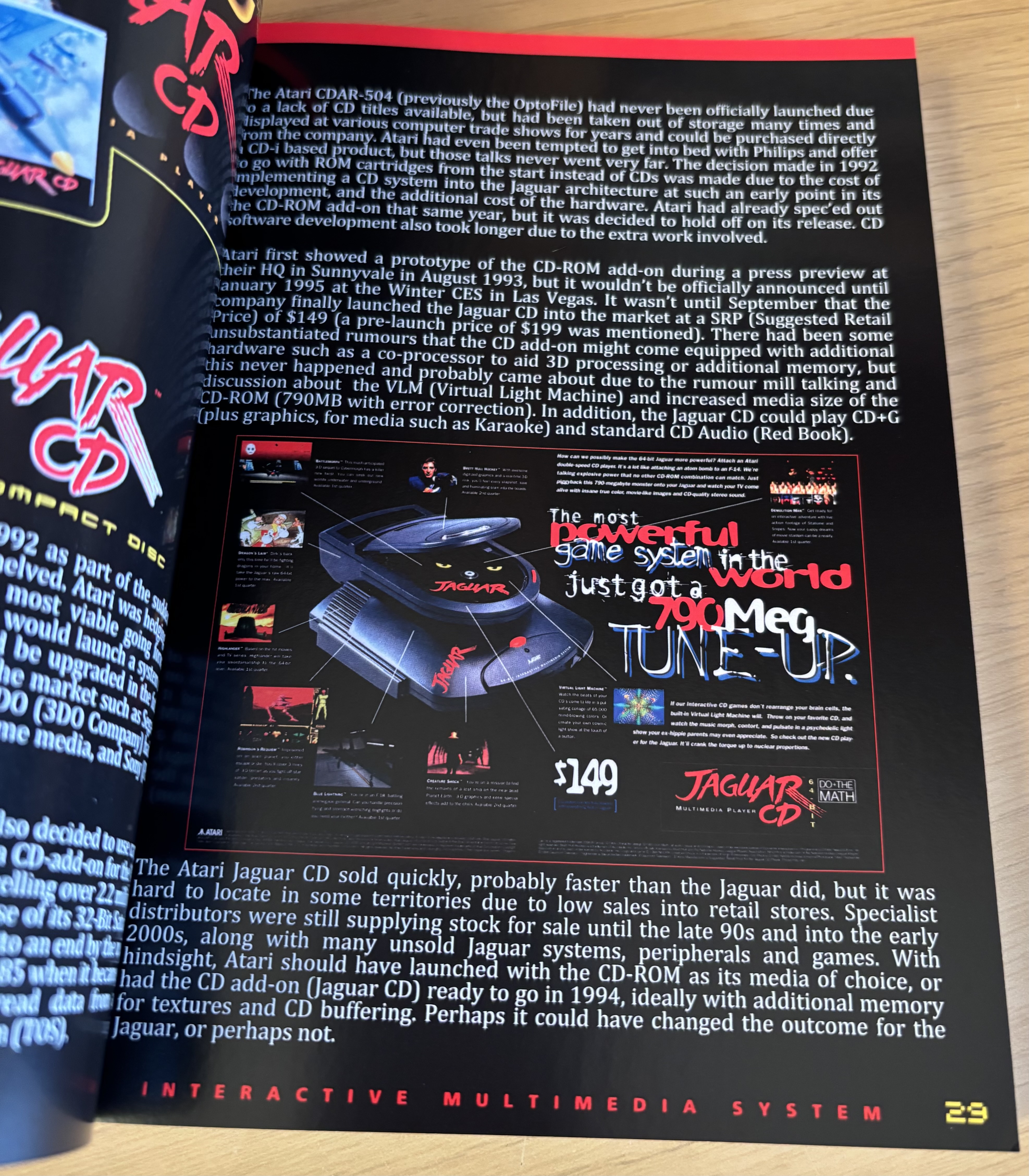
Sunday, 22 December 2024
Game Guide to the Atari Jaguar by Karl Morris - Book Review
Sunday, 20 February 2022
Game Guide to the Atari Lynx - Book Review
When Zafinn Books announced they were going to release a book on the Atari Lynx, this immediately caught my attention. I never owned a Lynx back in the day, having to be merely content to gaze over screenshots of Blue Lightning and Gates of Zendocon in CVG magazine. However, it's always been on my list of systems I'd try to own but never fully justified the price of acquiring one second hand. With the release of two Atari Lynx-themed cartridges on the Evercade, this latest release from Zafinn Books scratched an itch and I ordered it as quickly as I could.
This Game Guide follows the same physical format of Zafinn's previous release, 50 Great Atari ST Games You Have To Play (reviewed here). The 220 pages contained within this book are divided into several sections, all of which are presented in a clean and colourful manner.
To begin with, we get the history of the Atari Lynx. From the initial craze of handheld gaming to Epyx's creation of the original hardware, Atari's acquisition of that and the naming of the Lynx, then ending with how the handheld faired against the competition at the time, this is an informative and interesting pocket history. There are additional sections on hardware and accessories, then a quick game guide listing all 71 official Atari-released Lynx titles.
It is after the quick guide that you get the reviews. Each one gets two pages. The first page of each entry has a half page of review text above a screenshot framed by an Atari Lynx II border. The second page includes a shot of the game's title screen, its box art and a score box, rating the game's graphics, sound, playability, overall score, a thumbs up/down/neutral rating and a scarcity description. That's quite a lot but as with the previous ST book, each entry is clear and precise. The reviews themselves are funny and packed with info. Interspaced with the reviews are pages containing adverts for the Lynx and its titles from various countries.
Following the reviews is a page on the games that nearly made it to release, and a page of games that were released after the Lynx was removed from the market. The latter titles were still available to buy at the time of this book's publication.
The final fifteen or so pages are dedicated to Lynx resources. There are interviews with LX Rudis, who worked for Epyx and Atari on the Lynx's audio hardware, Igor from Atarigamer.com, two pages on new ways to play Lynx titles (the Evercade and Analogue Pocket get a look in here), and chats with James Boulton (RetroHQ.co.uk), Carl Forhan (Songbird Productions), and Peter Mortimer (Telegames UK). Two further pages are given over to independent developers, Luchs-Soft and Yatsuna Games being name checked, then finally we get a half page of web resources and a half page of credits.
And yet there is more, as there were a couple of stickers included and a reprint of the Atari Lynx Hint Book, containing hints, tips, cheats and Easter eggs for various Lynx titles. This guide also contains details of the Lynx hardware and some frequently asked questions. It was provided free of charge with the Game Guide and is a lovely touch.
As you can tell, this is a packed tome and really is the best single printed resource currently available on the Atari Lynx. The story of the Lynx is well told (I am further intrigued as to what went on between Atari and DIP, whose handheld computer featured quite prominently in Terminator 2), and I think that this book is a fantastic piece of work, so well done to Zafinn Books. Having already purchased We Love Atari volumes 1 and 2 (reviewed here), it is pleasing to see that there are further Atari-themed titles planned: Game Guides for the ST and the Jaguar! Looks like two more books for the gaming library coming up!
You can check out Zafinn Book's range of titles here and, and buy the Game Guide to the Atari Lynx here. You can also follow Zafinn Books on Twitter here.
Monday, 25 January 2021
50 ST Games you have to play - Book Review
"50 ST Games you have to play" by Karl Morris is the latest release from Zafinn Books and, as the title states, gives you a list of ST games that you have to play (in the author's opinion). It is not just that as you can probably tell from the cover. It is also a celebration marking the 35th anniversary of the ST range (1985-2020) as well. Unlike the two previous coffee table-style Atari-themed volumes from Zafinn Books (reviewed here), 50ST (that's what I'll be calling it for the rest of this review) is a 220-page A5 book of predictably high print quality and good production values. A couple of stickers were also included with the book.
Priced at €35 including postage (about £32 depending on the conversion rate), this may seem a little steep to some but, as with the "We Love Atari" books, this is a small scale independent publisher focussing on a niche market and when you consider the cost of postage (€7.50), I don't think the price is too high at all when you consider what you get.
Of course, if this were just the author's 50 favourite games, it would be an interesting read, finding out why each particular game made it onto the list, but also a pretty boring one. After all, that could get quite monotonous for fifty titles. However, this book is not just a list of games. Oh no. It's much more than that.
After a touching dedication on the first page, we start with a 36-page potted history of the Atari ST, from its creation and initial success, to the faltering of the early 1990's and its final removal from the market. There is also a lovely list of the 26(!) models that were announced, some of which that made it to the market, and some that rightly (or wrongly) didn't. You'll find a deeper history in volume 2 of "We Love Atari" but, from 50ST's perspective, this section gives the reader everything they need to know about the ST. Having said that, you really should buy that twin volume set as and when you can.
Next up is the introduction to the games, and the author uses this section to talk about the very earliest titles released for the system as well as how he played each title before including it within this tome. Following on from the earliest titles, the rest of the selection is grouped by genre: arcade conversions, strategy, adventure, unique games, shoot 'em ups, simulations and sports. As you can see from the pictures below, each entry is divided into sections. First up, we have the game's title, developer, publisher and the year of release. We get a half page of text describing the game and why the author has chosen it for the list. There is a review box, where the author has put a nice graphic in to state how long you'd need to play that game to get a good idea how the game plays, a graphic denoting the author's determination of the title's learning curve, and then a four column review score made up of graphics, sound, playability and an overall rating. A screenshot of the game framed in an Atari SC1435 monitor round off that page.
![]() |
| First page of a game's entry - apologies for the reflection. |
The second page gives you a half page screen shot of the game's title/loading screen, a quarter page image of the box art, and finally an "Interesting Things" boxout with fun facts and tidbits about that game. A nice touch here is that the second page is framed in the style of the GEM desktop.
![]() |
| Second page of a game's entry - less shiny. |
Between the games, there are ad breaks - pages showing the advertising posters of some of the titles featured. We also get smaller sections on honourable mentions, recommendations, deeper delves in particular genres and a two page piece by Jeff Minter, which is a great little bonus. The final section of the book covers how to emulate the ST on modern day systems, as well as a reprint of an article the author published on his own website about the ST's sound chip, the Yamaha YM-2149, and some great promotional pictures of the various computers Atari launched during the ST's reign.
As you can probably tell from the above, this is quite a densely packed book and in truth, it does take a bit of reading if you indulge in the time to savour the contents. The relaxed style of writing suits the topic brilliantly and the presentation is clear and easy to follow. The author's passion for the ST and the games he has highlighted is clear to see, and the quality of 50ST matches that of his earlier books.
As for the games chosen, well, that's his personal choice but I will say that it's a varied selection and, having played quite a few of them back in my Amiga days, I'd agree with a lot of his choices. Of the ones I have not played, it has awakened an interest in giving them a go. Certainly, memories were brought back by the screenshots and descriptions. One of the joys of this book is that most of these games also had Amiga versions (some also had Archimedes conversions too). Even if you weren't an ST owner back in the day, you'll still find plenty of interest here from the heyday of 16/32-bit home computers.
I also enjoyed the section on emulation, as this is pretty much the quickest, cheapest and easiest way you can experience the joys of the ST today, much as it is with the Amiga. Unlike the ST sadly, legal Amiga emulation is quite simple and easy. Same with RISC OS, where the OS is now open-source and just a free download away.
There is only one (very slight) criticism of note - there is an apology stuck to the inside back cover of the book about typo's and yes, I did note a couple that the author had not commented upon within his apology. However, these in no way spoil the book and I am sure that future print runs will correct those in due course. I don't wish to be seen throwing stones as regular readers of this blog will have noticed the odd boo-boo and I quite like this glass house as it is... :-)
50ST is another great release from Zafinn Books and the author is to be congratulated on an entertaining combination of games and accompanying articles. Not only a great standalone volume for ST fans and fans of that era of home computing, this is a fantastic companion piece to the "We Love Atari' duo. Highly recommended.
You can purchase this fine book here.
Friday, 18 December 2020
We Love Atari Volumes 1 and 2 - Book Review
More retro videogames and computing shenanigans now with a review of the two volume set "We Love Atari", written by Karl Morris and published by Zafinn Books. These two volumes cover the products, prototypes and the story of Atari from its founding in 1972 to its demise as a hardware vendor in 1996.
![]() |
| What a lovely pair... of books |
Now I'll make an admission here. I have only ever owned one piece of genuine Atari hardware, a Jaguar that I picked up from Game back in 2002/3 when they sold a load of remainder stock of Jag's and Lynx handhelds over the Christmas period. That's not to say I didn't want Atari consoles or computers back in the day, especially the Jaguar when it was first released, and some of the higher end ST's (the TT and Falcon especially). As it was, I was an Amiga kid back then though I did have a couple of friends who had ST's and I thought the Atari's were pretty cool.
This set of tomes caught my attention after a perusal through the book reviews section of retrovideogamer.co.uk and, after following the publisher on Twitter, thought these were definitely worth a read. As they are self-published and in a niche market, they aren't particularly cheap - the two book set coming in at €105 (about £97.51 at the time of purchase) including postage. There is the option to buy them separately at €60 a piece but let's be honest here, it's a two volume set for a reason.
![]() |
| A rather nice selection of stickers |
Upon receipt, opening the very well prepared packaging revealed a hefty pair of 21.5cm by 21.5cm softback books, a nice collection of Atari themed stickers and a lovely handwritten card from the author. It's a nice touch.
![]() |
| Unexpected and rather nice. |
Volume One then, and this starts in 1972 and ends in 1984 when Warner Communications sold Atari's consumer electronics and home computing divisions to Jack Tramiel. This is very much a visually led volume and whilst there is plenty to read, the focus here tends to drift towards the look of the arcade machines, the advertising and early visual history of the games that made Atari the powerhouse it was. Through the 285 pages, you'll see classic titles, concepts that were never released and get a real feel as to how the company saw itself in it's youthful years. You'll also get a hint as to what was to bring the company to its knees in the 1980's.
![]() |
| Another Atari idea that didn't work out |
Volume Two picks up after the crash of '83 and the struggles Atari had to remain in business. There is more text in the 291 pages of this volume and those who like the picture heavy first tome may be disappointed but, for me, this is where the core of the Atari story lies. You get the fight to release a 16-bit computer onto the market, the success that followed, the even more outlandish ideas that did not come to pass and the decline into obscurity as Atari lost its way into becoming a one horse show (which they then shot out back). This is an engaging tale and for those who lived through the 16-bit computer era, is an essential one to read. It's not overly in-depth though, but the bibliography at the back of each volume has some highly recommended reading.
Over both books, the author's easily readable prose does the job it needs to, with personal interjections and thoughts where it is felt necessary. There is also an impish sense of humour on some of the picture captions that raised a smile and a chuckle.
![]() |
| A great little 8-bit computer |
When I think of the Atari from my formative years, I remember the 5200 and 7800 consoles being pushed as Nintendo and Sega grew their market share in the UK. I remember the almost endless variations of the 520ST, STM, STFM, STE etc, but in reality, there weren't that many. I remember the Mega ST and TT, two desktop computers that defined what a powerful computer of the period should look like, at least to me. To this day, the TT remains the second best looking desktop I have ever seen (the Amiga 3000 is third and the Acorn RiscPC is first. You are welcome to disagree, but you'll be wrong... :-)) This is despite the "off-centre" design both looking funky and making the OCD side of my brain freak out at the same time. I also remember looking at the Lynx and wishing I could afford one. Same with the Jaguar, even though compared to its rivals, the Jag was much, much cheaper. Then we have the Falcon, the home computer that was unrivaled (even the Amiga 1200 was a poor second) though that price tag did it no favours. Nor did the lack of advertising or support from Atari themselves. This is all before I mention the portable ST's and the prototypes. For those, well, you'll just have to read the books.
![]() |
| This is how computers should look! |
Overall, these are two wonderful volumes on a period of video game and computing history that does not get much love in the more mainstream market. I enjoyed the telling and greatly expanded my knowledge of Atari in its various forms up until 1996, even with the inevitable sadness that comes with knowing that those in control of Atari (and, in the same sense, Commodore) had great products and knew how to run a business to a degree, but they had zero understanding of who their users were and what made their products great.
As you can tell, I really liked these books and I hope that there will be more reprints in the future (my copies were from the 4th reprint) as these books deserve to be on any video game/computing aficionados bookshelf. The author wanted to fill a gap in his own bookshelf with publications about Atari that begged to be picked up and perused at leisure. He has achieved that and more with two indispensable volumes that are well worth the investment. You can find out more about Zafinn books here, as well as on Twitter, where you can see some news about their latest publication, "50 ST games you have to play". That's definitely on the "to buy" list!