Showing posts with label What Personal Computer. Show all posts

Saturday, 17 February 2024

Magazines of Yesteryear - What Personal Computer? Issue 14 - September 1990

The last issue of What Personal Computer? I looked at carried the news of Amstrad's latest attempt to become relevant with a 286 in late 1991. That didn't work out too well for them, but what about the company that began the whole x86/DOS shenanigans in the first place? In the September 1990 issue, Big Blue provided an answer to the question: what PC do you sell to the average consumer?. Well, they thought they did, but at least it got a cover photo. And yes, kids, computers were both as beige and as downright ugly back then too. 

The main news item was rapidly decreasing PC prices. Elonex were knocking £200 off their 386V/33 (a 33MHz 386 system as if you couldn't tell, featuring the EISA (Extended Industry Standard Architecture) bus - an open competitor to IBM's more strictly controlled MCA (Micro Channel Architecture) bus), taking the headline price down to £2,295 ex VAT for the 40Mb HD mono model. Similarly, their 286 40Mb VGA colour system was down to £1,145 ex, and the 386SX equivalent comes in at a "mere £1,395." Mere, they say? Olivetti took £100 off both their PCS86 and PCS286 ranges, whilst Gandlake (1990's computing equivalent to Accrington "Who are they?" Stanley) priced their entry 286 at £899, a £96 cut.

In other news, DR-DOS was hitting version 5, adding additional memory management for those 640/384Kb blues, as well as a disk cacheing ability to improve disk access times. A new release of MS-DOS was rumoured but the report notes that it probably wasn't going to be called MS-DOS 5. Oh, what little faith yea had in imaginative marketing types... MS-DOS 5 would land in June 1991. Apple also gets a mention in the news - a new model rumoured to be called the Classic, which did in fact hit the market in October 1990.

The first feature we get to is the Bunch Test, this month comparing laser printers under £2,000. You may snigger at the back, but in 1990, that was budget level. The winner was the Panasonic KX-P4420, rocking a £1,395 price tag, quick performance and extra fonts. It only emulated a LaserJet (the then-defacto standard for laser printers), and was a tad chunky, but was otherwise good enough to take the crown. 

The cover star is next, and it really does look nasty. Expansion by additional slices can work (the pinnacle of which was Acorn's Risc PC in 1994), but here it just looks clunky. That second, 5.25" floppy, looks like it'd be blocked by the keyboard on smaller desks, yet the 3.5" drive, for all of its weird angular looks, defined IBM's aesthetic of the period, and I still kind of like the cut of its jib - just not the box it's attached to. As for the rest of the hardware, this home-targeted machine was merely average. A 10MHz 286, 3.5" 1.44Mb floppy, a 30Mb hard drive and VGA graphics. However, the negatives outweighed even these slight benefits. Standard RAM was 512Kb, although you could buy a board with an extra 512Kb to experience the joys of that 640/384Kb split. Two proprietary slots (IBM, proprietary? I'm shocked, I tell you, shocked!), could handle a modem and a joystick/audio card, but if you needed 16-bit ISA slots, an additional expansion box could be purchased. No tools were needed for fitting said box, but as it followed the design footprint of the base unit, full length cards were excluded. The final verdict? To quote the boxout, "If you know enough about computers to read this mag, you know enough to leave the PS/1 alone." Ouch! It didn't help that UK pricing wasn't confirmed either, and the recently launched Amstrad PC2286 could give you a larger hard drive and monitor (14" instead of 12" - back in those CRT days, the extra inches often counted), for around a grand excluding the Chancellor's cut.  

A feature on the NeXT machine posits that next-gen PC's will probably look like the NeXT Cube, as well as offering a new GUI-based operating system. A complete package offered 8Mb of RAM, a 40Mb hard drive, 17" Mega Pixel (their words, not mine) display and a 230Mb capacity optical drive for £6,495. At that price, the GUI may be wondrous, but Macs were cheaper (well, some were), and Acorn had RISC OS on its £649 A3000. 

286 workstations go head to head on page 54, with Mitac and Compaq both trying to justify why you should spend £1,399 and £1,895 respectively. They're mostly evenly specc'd - the Mitac edges out the Compaq with its 12.5MHz chip (as opposed to 12MHz), and it's extended VGA display options (800x600). It's a smidge faster than the Compaq but the latter has the option of up to 13Mb of RAM - at a price, of course - £2,730 on top of the base config. The reviewer does note that corporate buyers would go for the Compaq name, but as he's not a large corporation, he'd go for the Mitac, and I can't say I blame him. 

CAD packages receive a round up (EasyCAD 2 for the win), before we reach the reviews section, the most notable of which is the Sygnos 68 LCD monitor. For £799, you got an 8 x 6 inch mono VGA (black on white or white on black) display. Whilst very restful on the eyes for text entry, ghosting made it marginal for anything else, but the review notes that it is recommended to pregnant women worried about CRT display radiation. Yes, that was.a thing. and it wasn't until 1992 that the Swedish Govermnent legislated for the maximum amount of radiation a person could experience at half a metre from the display - MPR II was your friend. A preview of the next issue promised a trio of 386's and a round up of accountancy packages, Woohoo, I near nobody cry.

As is expected, we now come to the adverts, and it's relatively slim pickings as WPC? was not the tree destroyer that PCW or Computer Shopper were. Diamond Computers are the first major advertiser, offering A500 trade ins for Amiga 2000's. The new A3000 was also on sale, but starting at £2,499, it was a niche machine for most. Page 14 continues the Commodore interest with a double spread on their PC Starter Packs. You could save up to £300 on one - naturally, that was the most expensive PC30 model. The small print points out that the PC30 was £1,199 ex VAT (£1,378.85 inclusive) for a colour VGA 286, and the main blurb about getting sorted for less than £500 was for the 8088 powered mono dual floppy PC10 at £499 ex, (£573.85 inc). 

MBC were selling 8088-powered hard drive equipped VGA models for £845 inclusive, 286's for £995 and a 16MHz 386 for £1,245. These had tiny hard drives though, so extra money was needed to get up to 40Mb, but MBC were a rarity in advertising VAT inclusive prices. 

Time Computers were shifting Amstrads, Olivettis and Tandons. As noted above, Amstrad's 2286 was a budget wonder. The 12' High-Res VGA colour option sneaked under a grand ex VAT, and the PC1640's replacement, the 2086, could give you proper VGA colour for three figures including the Treasury's take. The pesky hard drive issue was sorted by this point, but the damage to Alan's reputation was done.

Page 68 offered an ad from American Research Corporation of Croydon, Surrey. A 386SX laptop, it boats of "a complete business partner, ergonomically designed, weighing a slim 15.4lbs." To borrow from Senor Inigo Montoya, they kept using those words but I do not think they mean what ARC think they mean. Looking at the pic, "slim" and "ergonomic" seem to be doing as much heavy lifting as that NFL player. 

Silica make an appearance with Atari's ABC PC compatible. Sadly, the headline £899 (ex VAT) for a 30Mb and EGA toting 286 fails to point out that the EGA is mono. Colour takes the price up to £999 ex, whilst the Turbo model with SVGA adaptor, monitor and fast disk controller is a much more considerable £1,299 ex. What Atari should have been doing at this point was try to rescue the ST from its fate, but no, they pissed around with DOS compatibles and the Portfolio (Silica add on page 85 - a terrific little handheld for the price, by the way, but not really a core product for Team Tramiel) instead. The same comment could be aimed at Commodore as well.


If you were really flush, however, you could grab yourself a 486. G-Com Computers offered a good selection of PC's - that 286 wasn't bad even considering the added cost of colour VGA, the 386's provided more power with the caveat that really there was nothing much yet the typical user could take advantage of, but that 486... £2,995 ex for a mono system. You were paying for the power, most surely, but it was just for bragging rights.  

What this issue demonstrates, especially when compared to the last PCW post, is that the DOS PC market was evolving. Sure, it wasn't totally out of the mid-80's business machine category just yet, but it was getting there, a point easily made by the presence of VGA graphics on machines costing way less than a grand inclusive. Hard drives and faster processors would rocket up the price, but a key element of the DOS machine - the display - was now capable of standing against the more home orientated 16-bit competition. 

It would take another year before the 286 hit the mass market, and by then, a grand in cash would buy you a 286 with VGA,  hard drive, and with a smidge left over for a sound card. Compare and contrast to the Amiga and ST - both were still cruising off the glory days of the 68000 and a TV. Arguments over operating systems would continue (and worthy of some consideration), but the point I am making here is that what might have seemed like a completely outclassed business only machine in 1987 was, by late 1990, developing into the supreme home computer format. Combine that progress with the frankly crazy corporate attitudes of Commodore and Atari to their homegrown formats, and it wouldn't take much for those who were looking for the best thing in computer games to gravitate towards the PC. 

Next time, a journey further back into the mists of UK computing journalism, with a look at an issue of Personal Computer News, a weekly publication from the early to mid 1980's. 

Sunday, 8 October 2023

Magazines of Yesteryear - What Personal Computer Issue 29 - December 1991

The tail end of 1991 and Brian Adams had finally been dethroned from his sixteen week domination of the UK singles chart. City Slickers, The Fisher King and Point Break gobbled up cash at the cinemas, whilst on the goggle box, Murder Most Horrid, Noel's House Party and the forgotten gem that was Dark Season kept those indoors entertained. Meanwhile, Amstrad was trying to make a comeback. 

SPOILERS!

Hitting the shelves in mid-November, the December issue of What Personal Computer from EMAP displayed Amstrad's latest and greatest on its cover with a headline that wasn't exactly flattering. Features on DR-DOS 6, Publisher for Windows and how to PostScript your printer may have appealed, but Alan's latest baby was front and centre.

A side note first and one of the funny things about picking up old computing magazines is that researching them is a bit hit and miss. EMAP at one point published numerous video games titles as well as more serious computer related ones, but could I hell find out much about WPC. For a title that had, as of this issue, an ABC figure of 42,318, it is a sad situation that it is almost lost in history. Sure, people remember Computer and Video Games, but mention of their serious output is surprisingly rare.

£999 for a multimedia PC? A bargain! 

Anyway, onto the news, and the main piece concerned the arrival of big name word processors to Windows, this being a time that DOS still ruled. Windows 3 was making in-roads though, and this was further evidence that the times they were a-changing. Seikosha were dipping their toes into the low-cost laser market - their OP 104 was released at just £904, whilst Philips were launching a range of multi-media PC's - the 20MHz 386SX model at £2,499 would be available in the first half of 1992 (4MB RAM, 80MD HD and SVGA graphics), but those too impatient to wait could have a 40MB 286 model for £999 (which also included Wing Commander). Remember that price...

Arguably yes. History says not.

It was also the time of Comdex Fall, the report of which crowed about Apple's new Powerbooks, IBM's continued delay of OS/2 version 2 and a colour Dell 386 laptop for under £3,000! In Shop Talk, Diamond Computer Services had opened a new shop on Tottenham Court Road. Diamond were a common advertiser with their superhero themed Captain Diamond persona, and Tottenham Court Road was, at one point, the place to go for tech in London. It had dulled a little by the time I managed to wander down it in early '98, but back then, retail was still king.

What can I say? It was the 90's.

A fascinating piece talks about the future of Intel. the rise of Unix, the ACE (Advanced Computing Environment) consortium - Wiki entry here, and the threat posed by Sun and their SPARC chip. Ah, the 90's - if only you'd known that Wintel was unbeatable, at least for that decade. The arrival of the Internet and the changing means with which people interacted with computing technology would mess up/make things interesting as the new millennium arrived. With thirty years hindsight, little did they know...

As befits a December issue, "Oh, no there isn't!"

Anyway, to the cover story and just plain Alan (he would be knighted in 2000), was trying his luck with a new range of machines to recapture the glory days of his budget PC empire. The 5000-series used a tiny case in the same style as its previous 4386 "executive" desktop, designed to be a simple unit you plugged in and never opened. Although it lacked spare drive bays, it wasn't entirely expansion free - two half-length 16-bit slots promised not very much - and if you got the 1MB model, zero free SIMM slots, but what else did you need? The 0.29 dot pitch VGA monitor could handle 800x600 rather well, and it worked, albeit a tad more slowly than other similarly specc'd 286's. The problem was the price. £999. If you recall, Philips would happily drop a multi-media equipped 286 on you for that. Amstrad was no longer cheap and cheerful. A competing machine from Chipset (who are they???) would give you Super VGA with a 1MB Trident card capable of 1024x768 for £899. Another clone manufacturer was Atomstyle, whose colour VGA option came in at just £715. It had room for two 5.25" drives, four spare SIPP memory slots and a free 16-bit card slot, as well as two 8-bit slots if you needed them. Things didn't get better for Amstrad either. 

Nope, you could buy better for less.

A couple of pages on there is the 5286 Games Pack review. Taking the compact desktop as before, switching the monitor to a slightly lower quality one and packing in speakers, a joystick and three games, this was an £899 package that, as the reviewer put it, was decent for someone who couldn't be bothered but you could find better DOS-based value elsewhere. Against the Commodore Amiga upgraded to match the features included, it was decent, although not spectacular, value. It should also be considered that both the A500 and the 286 processor were rapidly approaching obsolescence. What was interesting about the software pack is that as time passed, the same bundle would be attached to other Amstrad models in a manner that suggested that they massively overestimated demand at the time. Needless to say, the 5286 Games Pack bundle was quickly discounted and would end up being something of a missed opportunity. 


Moving on, we have a bench test of communications software featuring some of the best 90's tech names you've can imagine. SmartCom III, Trans-Send (see what they did there) and DynaComm (surely an evil corporation with that name?) fight it out with the more mundane Datatalk 4, WinComm and Relay Gold 5 (a 70's tribute act if ever there was one) in getting users on to bulletin boards and multi-user dungeons. Such an innocent time.

Por favor?

DR-DOS 6 gets a five star review for being better than MS-DOS 5, in a repeat of how DR-DOS 5 was miles ahead of MS-DOS 4.01, although that particular Microsoft product was indeed terrible. However, questions over compatibility when running alongside Windows 3.1 remained and MS were nasty bastards/legitimate hard-headed business people - delete as applicable. It was only ever going to end one way. 

A review of the Canon Ion RC-260 digital camera is an interesting read. For £490, you got a fun little camera that could take up to fifty images and store them on tiny 2 inch floppy drives (not the same format as the 2-inch floppy's Zenith tried flogging with their laptops) that cost £5.10 each. You could preview your images on your TV, save them to your PC (using the £496 connection kit), and then re-use the storage. As a review, it lacks details on the sensor and battery life (tiny lead-acid unit, a sure sign of the times), but the reviewer really does like it. They do recommend saving the images to VHS cassette via your TV rather than on your PC as a full 50 images when de-compressed onto your hard drive would take up 60MB! Thinking of the price, the reviewer states that if you are struggling to justify the cost for professional desktop publishing purposes then knowing the kid'll love it should clinch it for you. Wait! What? £500 (that's over a grand today!) for something to hand to the kids to play with??? 

The author remembers that children are given mobile phones that can cost a similar amount these days. Shakes fist at clouds then returns to laptop.

One final regular feature before we get to the adverts is the Consultancy section. Companies could apply for £1,000 of free consultancy regarding IT equipment and be featured in the magazine. Only the first £1,000 was free and at £100 per hour, that could get quite pricey. Still, makes an interesting read about a fabrics company that got shafted by a supplier and how a definite lack of knowledge damaged the company. Reading between the lines, it looked like the consultancy form used by the magazine was a) going to have a decent payday considering the mess they found and b) earning their pay rather well.

As for the rest of the mag, the back contains various hardware and software review directories, a yellow page small ads section and 16-page pink section devoted to shareware. Anyway, now it's onto the fun stuff - the adverts!

Multiplex - but do they include an operating system?

Amstrad have a page dedicated to their 20MHz 4386SX (4MB RAM, 80MB hard drive) - £1,699 ex VAT for the colour model, £1,499 ex VAT for the mono model. Leaving aside the minuscule 10" display and the small case, Multiplex a few pages on could sell you a 386 SX 25MHz with 4MB/115MB for ££1,099 ex. You got both 3.5" and 5.25" floppies too, but possibly not DOS or Windows (ad doesn't say and doesn't give prices either but say add on an extra £100 ex as this was the time that many companies advertised headline prices without an OS to make offers look even cheaper - and yes, it was a shitty way of doing things). The case would be much bigger, but so would the monitor at 14'. If you wanted to spend the same amount as Amstrad wanted you to, then for £1,699 ex VAT, Multiplex would give you a big box 486 DX 25MHz with 115MB of hard drive storage and 8MB of RAM. Sure, adding an OS would bump that up but it just shows how... misguided Amstrad's attempts were at this point. 

Amstrad do include the OS but at that price, they bloody ought to!

Commodore were still trying to flog DOS PC's, rather that focussing on what should have been their core product, the Amiga. A top tier 486 model would set you back over three grand exclusive of VAT, a 286 portable came in at £1,199, and their base 16MHz 286 cost a lowly £689. 

Time was a reseller of note for most of the 90's, and their business-focused advert neatly shows that the 286 was the budget processor of choice - £600-£700 ex for branded machines, whereas if you had a grand upwards, the 386 was your best bet. Portables were also a thing, and a budget Sanyo 286 for £849 wasn't bad. 

Don't care if the printer is free, I still don't want it.

Evesham Micros were venturing into their own range of desktops, but would still sell you Amstrad and Olivetti desktops. Not sure how popular a single floppy drive 12' mono monitor equipped 5086 for £399 inclusive was, but hey, you got a cheap dot matrix printer thrown in. Whether you'd want the trash that was the Amstrad DMP3160 is another question. Even for 1991, this was a terrible package. You could get discounted 2000-Series Amstrads which seemed decent, until you realised that the 086 models are obsolete and the 286/386 range come with DOS 4.01. And as for that twin drive PC1640 EGA model for £349 inclusive, well, as a retro fan, hell yeah. As a sober adult, not a chance in hell, even then. 

These are NOT the bargains you're looking for.

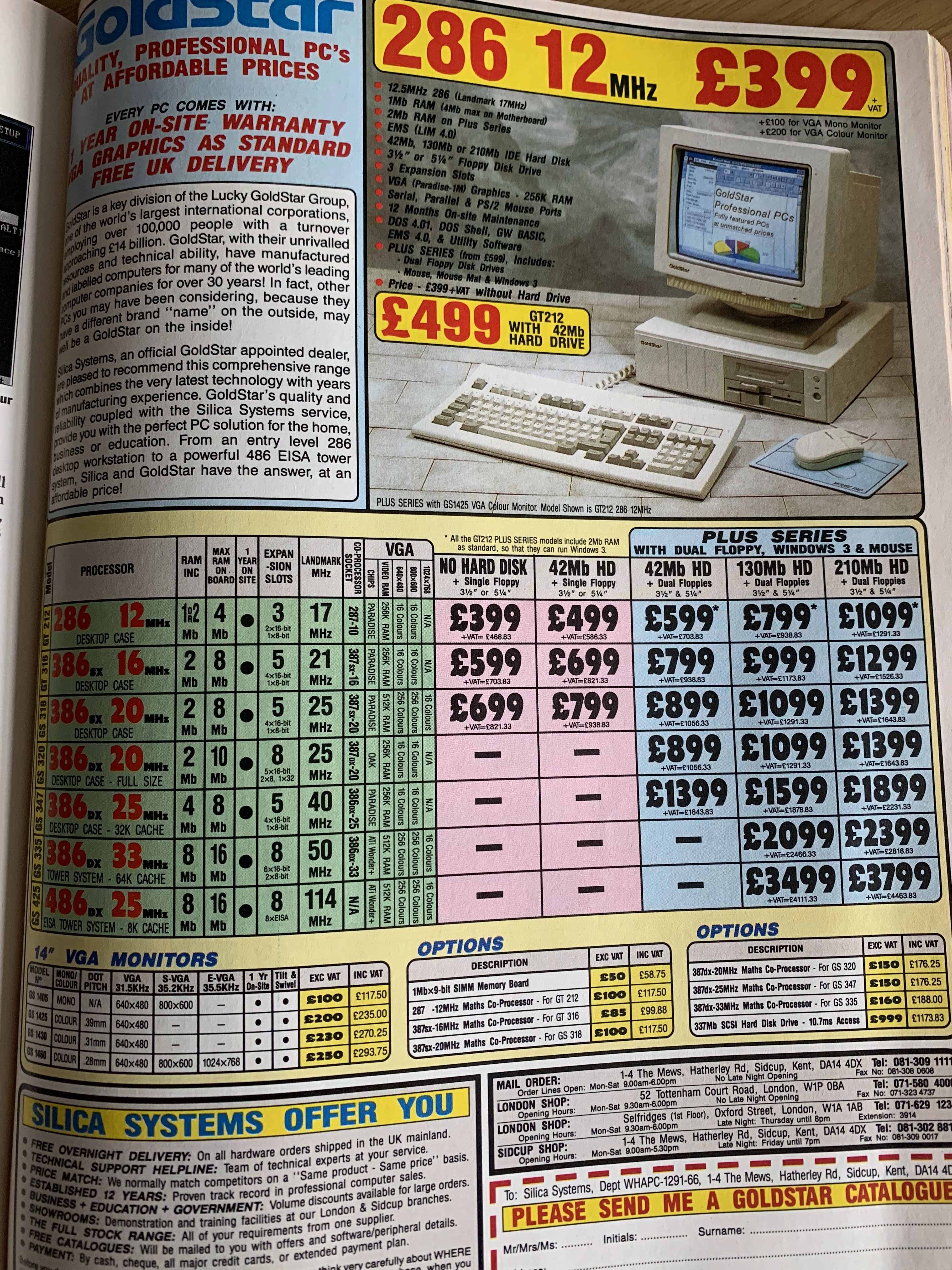
Silica Systems (an almost constant presence in the ST and Amiga Format publications amongst others), had the Goldstar range on show (Lucky Goldstar is now better known as LG). They might look cheap (and to be fair, they were decent value), but those prices exclude the monitor. Still, a secondhand GT-212 model was my first DOS machine and it was a good little runner.  Silica also had some portables on show, and I still like the idea of that PC XT notebook, even if adult me realises it would have been an ergonomic and practical nightmare to use. 

They may include the OS, but screens are extra.

I so wanted one of these - even if they were shite.

So there we have What Personal Computer. An issue that's at that slightly awkward point in PC history where the 286 was just starting to fade away as the 386 muscled into the sub £1,000 market. There are still the old '086 holdovers but their days were numbered, as were those of Amstrad. It would take another five years or so before they retired their computing range (the Pentium P75-powered PV/TV combo Integra range was I think their final attempt), but the days of selling via dealers were ending. Direct was the way forward, and price conscious clone makers were leading the way. Alongside the 386, Windows was becoming the default means of interacting with your PC - DOS was still the OS, but Windows was getting there. Wherever there was.

But what if you didn't want the kludge that was the DOS/Windows mash up? There was always the Mac, but that's for another time.