Showing posts with label Naval History. Show all posts

Friday, 2 December 2022

From Julietts to Yasens by Alejandro A. Vilches Alarcon - Book Review

From Julietts to Yasens is one of the latest titles from Helion & Co's superlative Europe@War range and covers the design, development and operational history of Soviet cruise missile submarines from 1958 to 2022. This may be considered a somewhat niche topic but as someone who grew up reading the likes of The Hunt For Red October and Red Storm Rising, I've always been fascinated by Cold War submarines and, in particular, those of the Soviet Navy.

Coming in at 88 pages (excluding the covers), From Julietts to Yasens takes the reader through the early days of the Soviet Navy's attempts to get a workable cruise missile submarine into service. The Whiskey-class were a worthy (if of dubious safety) first attempt, and the follow up Juliett-class something entirely more capable - although I do wonder exactly how loud these boats were with all of that flow noise! Function definitely dictated form. As for the nuclear-powered Echo-class, well, improvements abounded, in a technical sense if not in safety.

The follow-up Echo II was again more capable, before there was the slight detour with the Papa-class. I say class, it was just one boat, nicknamed the "Golden Fish" due to its cost. The Charlie-class were a return to common sense (and sensible budgeting) before the behemoths that were (and still are) the Oscar-class became the byword in cruise missile submarine design. Finally, there is a brief note on the current situation with the Yasen-class SSGN's.

For each class, there is a design history coupled with an operational history. Weapons and potential opponents are also discussed. Patrols are detailed as well as upgrades and, more tellingly, accidents. By any standards, the accident rate in the cruise missile sub fleet was disconcertingly high - the list for the Echo-class takes up a whole page. More serious incidents are given greater detail - the K431 incident in 1985 being the most serious Cold War event, but the loss of the Kursk (for entirely different reasons) is also included too. There is balance to the writing and I cannot find fault with the author's point of view.

I think that this is most pertinent takeaway from this book. Yes, the Soviet Union managed to field such vessels and with a variety of technological firsts, but the safety record of the fleet was a major concern. That should not take away the sense of achievement that should be rightly felt at the level of technological progress, but questions should have been asked (and should continue to be asked) about whether it was worth the price in cold hard coin, environmental damage and the effect on people's lives. That being said, the idea of a cruise missile submarine force to deal with enemy carrier fleets was a distinctly Soviet endeavour and thankfully, outside the realms of fiction or war-games, one that has never been tested in reality. 

This comment may seem like a cut and paste job from another Helion & Co review but once again there are plenty of contemporary photographs, as well as maps, diagrams, tables and the ever high quality plate section occupying the centre pages. Given the paucity of imagery in the numerous publications I already have on the subject of Soviet submarines, this book is a worthy addition to the library on that point alone.

As a fan of Cold War submarine warfare, From Julietts to Yasens is a fantastic guide to a uniquely Soviet technological enterprise and one that should be on your shelves if you are interested in Cold War naval history. There is also plenty of detail in here to add any amount of flavour to those who wish to game the use of these vessels. 

You can pick up a copy of From Julietts to Yasens directly from Helion & Co here or from their trade stand at various shows across the UK. Keep an eye on their social media links for future news about attendance. 

Friday, 25 November 2022

The Hunt for the Storozhevoy by Michael Fredholm von Essen - Book Review

The Hunt for Red October remains, over thirty years since its release (anyone feeling old yet?), one of the best submarine films of all time and one of the more intelligent of the genre. A peerless cast (accepting a Scots-accented Lithuanian), great effects, sparkling script and John McTiernan's taut direction combine to make it a must-watch even today. The book that inspired it, Tom Clancy's first novel, epitomised the popular 1980's and 90's genre of the techno-thriller. As with all good fiction, it was based on a grain of truth (one grain only, Vasily). This is where Helion & Co strike again courtesy of Professor Michael Fredholm von Essen. 

This is one of Helion's more slender volumes at 52 pages excluding the covers, but that is not to say its brevity is a negative. The book itself is effectively divided into two sections: the mutiny, and then the connection with the Swedish Intelligence Community, which in the case of this story, is extremely pertinent as they were a key source of information about the events that occurred. As always, there are many excellent photographs, colour plates, maps and tables galore. 

The story itself is quite a tale, worthy of the best of the 1980's techno-thriller writers. After convincing some of the crew of the Storozhevoy that all was not well with the Soviet leadership, Captain Third Rank Valeriy Sablin initiated a mutiny, the aim of which was to spread a new revolution amongst the Soviet Navy. That was, no matter your point of view, quite an ambitious undertaking, which says a great deal about Sablin's personality and state of mind.

Still, once the ship was under his control, he ordered it out into the Baltic, starting a chase that involved several pursuing surface ships, and attacks by Yak-28 tactical bombers and Tu-16 bombers. Add in a couple of friendly fire incidents and this had the making of a tragic foul up of Benny Hill proportions (period joke, geddit?). Except it nearly became one of the worst crises of the Cold War as one flight of Tu-16's were ordered to launch a missile strike that included the use of the special protocol to employ a nuclear weapon. 

Aircraft Nerd Alert! I do like a good old Yak!

You see, if Sablin had been on any old ship of the Baltic Fleet, the response might not have been so heavy handed, but the Storozhevoy was a very new ship - not quite two years had passed since its commissioning. That meant it was equipped with the latest and greatest Soviet kit for its assigned role and there was no way that could make it to the West. That assumption, by the way, very much highlights the paranoid nature that was prevalent in the Soviet Union's higher military and political leadership throughout the Cold War. They neither knew no cared that dissent of the kind that had driven Sablin to act existed.

Fortunately for the wider global population, the missile strike was never launched and the ship returned to port with the obvious consequences for Sablin. The incident was hushed up as much as possible but, thanks to the SIGINT (signals intelligence) and HUMINT (human intelligence) abilities of the Swedes, the incident was picked up and their records have been used for this superlative account.

Despite much enjoyment from reading the likes of Clancy (the early days, not the right wing textbooks his later tomes became - controversial, maybe, but he wore his politics on his sleeve and got more than a little "preachy" shall we say, especially as a counter to the Clinton years), the real world inspiration for his debut novel is much more engaging and fascinating. Mis-guided politics, hubris and desperation all combined to permit a series of events that very nearly altered the nature of the Cold War irrevocably. Some may find this an interesting divergence point for a game, others a detailed and timely reminder of how even "monolithic" entities are in fact no such thing. In either case, The Hunt for the Storozhevoy is an excellent read and one that is definitely worth your time.

You can buy The Hunt for the Storozhevoy directly from the Helion & Co website here or, if you check out their social media links, pick up a copy in person at the various shows they attend. The next one of these will be the Battleground Show in Stockton tomorrow.

Saturday, 25 June 2022

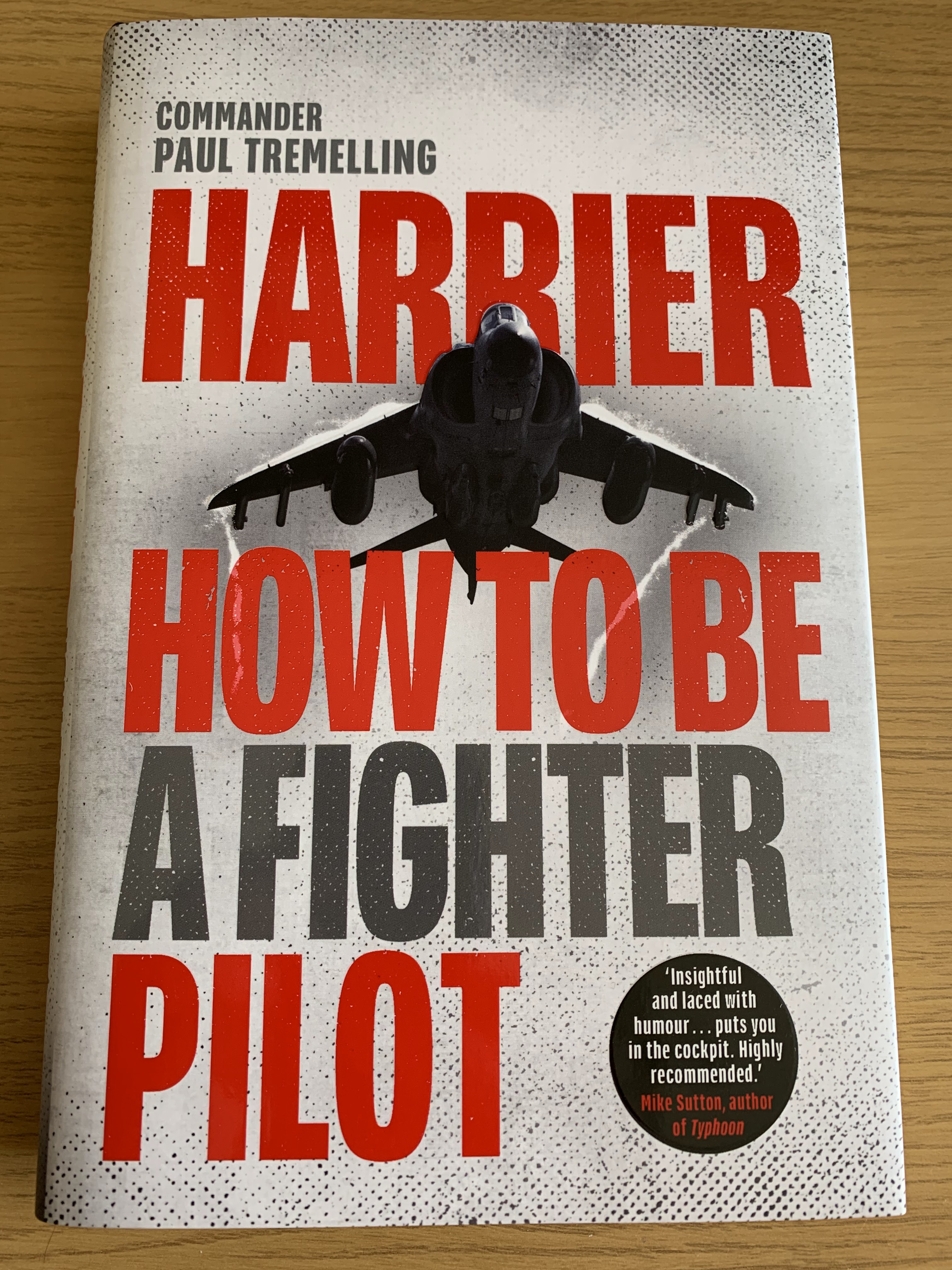
Harrier (How to be a fighter pilot) by Commander Paul Tremelling - Book Review

I have been quite the fan of the "... Boys" series of books from Grub Street Publishing. From Harriers to Meteors, Shackletons to Jaguars, this is a range of rather interesting tomes covering the escapades of those that flew and supported these aircraft when they were in service. There is, however, a lack of more modern coverage. Naturally when it comes to aircraft still in service, you don't want too much being said about them, but as time passes and, in the case of the British armed forces, they homogenise into a fleet of just two fast combat jet types, there are opportunities for pilots of write about their experiences in aircraft that left service not even a decade ago. And this is where Commander Paul Tremelling comes in.


Like most books on the subject, this begins with a potted autobiography about where the author came from, what lit the fires that led to him becoming a pilot and how he achieved that goal. In some recollections, this can be quite dry, though a few can be funny. However this is the first one that I have read that can genuinely be described as hilarious. The author's voice is there from the get go and his humour is spot on. I draw attention to his use of footnotes (especially page 18) and the opportunities they permit to reinforce points as well as make the reader laugh. Whilst becoming a fast jet pilot in the Royal Navy is a serious undertaking, it doesn't have to mean it's boring one and, as demonstrated here, it wasn't for Cmdr Tremelling. 

The structure is pretty much chronological and neatly details the process that the author went through to reach the pinnacle of Royal Navy flying before moving to the RAF and then spending some time with the US Navy on exchange. What you'll notice with each chapter is the sub-heading, giving the reader an update as to where the author was at the time and the level of alcohol consumption undertaken. It's certainly different and adds even more character to the telling of the author's career. It's not all fun and games though, and there is a streak of seriousness that extends to the author's recollections of flying combat missions.

I do like the in-cover artwork.

As the author was a Sea Harrier FA2 pilot, air to air combat gets covered a lot and this book will give you a much greater understanding of what that is like, especially with trips to Red Flag and dealing with the RAF's Tornado F3's. There's some gentle (and not so gentle) ribbing of others, although there is always respect where warranted. I did love the footnote on page 152 where the author comments on the Russian AA-10 Alamo C air to air missile variants as being "fruity little tinkers."

Those with an interest in combat flying will throughly enjoy this book, as will those who want to know what it was like to be a pilot in both the RN and RAF around the turn of the century - and yes, still getting used to saying that and it not referring to the beginning of the 20th century! Wargamers might get something out of this, depending on how realistic you want to make your games (and if the rules will let you do that - hint: if they don't, then change the rules to make them fit), but on the whole, this is a funny yet informative look at a period of British military aviation that begins with the improvements of the 1990's and ends with the promise (since mostly fulfilled), of a renaissance in British aircraft carrier aviation. You can buy this book at the usual places.

Saturday, 14 May 2022

Handbrake! by Mariano Sciaroni and Alejandro Amendolara - Book Review

Handbrake! is the latest release in Helion & Co's increasing Latin America@War range and covers the use of the Dassault Super Etendard by the Argentinian Navy in the 1982 Falklands/Malvinas War. Written by Mariano Sciaroni and Alejandro Amendolara, this 102-page tome aims to bring forth the relatively little-known story of the Super Etendard from its initial introduction into Argentinian Navy service, its use in the 1982 conflict, and finally to the decades of service after the war that kept the Argentinian Navy involved in carrier operations.

The usual Helion & Co quality is on display when you first open the book. There is a quick preface followed by a forward by Roberto Curilovic, callsign "Toro" (Bull), who flew the mission the led to the sinking of the Atlantic Conveyor. 

The main body of the book begins with a description of the Super Etendard and the AM39 Exocet anti-ship missile. We then get a brief history of the Second Naval Fighter and Attack Squadron up to it's formation with the Super Etendard, before the book takes us on a quick side step to the first half of April, where clear descriptions are given about how tactics were put in place to attack a missile defended target, as well as those countermeasures to try and defend against a missile attack.

Subsequent sections are written in a chronological order, the squadron's deployment south, the initial missions, and then highly detailed descriptions of the attacks on HMS Sheffield and the SS Atlantic Conveyor. There are interlinked chapters on the changing tactics as the war progressed, as well as the final attack on the Task Force that led to perhaps the most controversial (certainly from an Argentinian perspective) event of the naval campaign: the claimed strike against HMS Invincible. After that, there is the withdrawal of the squadron and the aircraft's post-war career to the modern day. 

As befits a Helion & Co publication, there are numerous maps, diagrams and photographs, almost all contemporary and from private collections. The art in the centre of the book is also of high quality and useful for future reference. 

This is another well-written history and one that shows the challenges, spirit and courage of the Argentinian pilots and their support crews. A great deal of research has been undertaken here along with numerous interviews of those who experienced the conflict. Very much like the history told in other books in this series (I have reviewed two previous books by Mr Sciaroni here), it is a tale of professionals trying to achieve the military aims (driven by political leadership) in circumstances that were less than conducive to success. The fact that, with some help, they managed to get four of the five aircraft in to a war and prosecute attacks without any formal training on the missile system itself speaks volumes. There is a camaraderie on display that feels so familiar if you have read about pilots during wartime from any nation, and something that is mirrored in their British opposites (check out David Morgan's Hostile Skies, Jerry Pook's RAF Harrier Ground Attack, Falklands and Sharkey Ward's Sea Harrier over the Falklands for a British view of air operations. The first two I have read and enjoyed, and I still need to pick up a copy of Ward's book). Of particular interest in Handbrake! was the efforts of Captain Jorge Colombo, an officer willing to push as hard as he could to protect his men whilst still trying to get the job done, despite the potential consequences for his career. 

Handbrake! is a timely history that provides a window on the men and aircraft that taxed the British Task Force so much. It also demonstrates how precarious the countermeasures were to the danger of low level anti-ship missile strikes and the wider implications that could have ensued if the ballon had gone up in Europe in the 1980's. It is another excellent addition to the Latin America@War series and should be on the bookshelves of anyone with an interest in the period or post-WW2 naval combat in general. You can pick up a copy from Helion & Co here

Friday, 8 April 2022

How To Build An Aircraft Carrier by Chris Terrill - Book Review

Sometimes, I just shouldn't be left in charge of a gift card when perusing the shelves of Waterstones. That's how I ended up buying this tome from Chris Terrill. How to Build an Aircraft Carrier is not an actual how to guide (though you could do worse than pick up Airfix's re-release of HMS Victorious in 1/600 scale) but the tale of how HMS Queen Elizabeth went from shipyard to first operational cruise from the viewpoint of her first captain and crew. 

Let me say that I really, really wanted to like this book. However, whilst there are some strong points in its favour, there are several that detract from what could have been an excellent look at both the Royal Navy's new flagship and the people who choose to serve within its ranks.

The good stuff first, and Terrill captures the experience of serving in the Royal Navy tremendously well, from both a professional perspective and the more relaxed occasions. There are some good stories told here about individual crew members, highlighting the changes in the service over the last couple of decades and how inclusive it tries to be. Call me cynical, but there is a recruiting pitch in here somewhere. 

In all seriousness though, the core story is one that is worth telling and Terrill goes good work here. You get to know the individuals he focuses on well and they are at the heart of the story. That leads to the first problem I have with this book: the dialogue.

I get that this is aimed at the casual reader, and I completely understand that some dramatic licence is required when portraying events, but at times (though certainly not always), the dialogue the author relates sounds completely implausible coming from various speakers. It's not exactly condescending but there is a lot of explanation left to the dialogue that, for example, you know two pilots would never say to each other. Don't get me wrong, it's not that bad most of time time but on occasion, the false tone hits you like a hammer and really detracts from the flow and believability. 

The same can be said for the comparisons the author makes. When describing something and saying it is the equivalent of powering Swindon, that's great if you know roughly how big Swindon is. I don't, although I was on better ground with Aberdeen. However, those comparisons become meaningless when the author doesn't get the technical details right, and this is where my main complaint lies.

There's not much in the way of huge clangers, but the multiple smaller errors add up. It begins with calling HMS Dragon a frigate, and then quoting tech specs twice about the F35, one figure being 200mph higher than the other. The statement that Jutland was a British victory lacks even a scintilla of nuance, and when the author states the carrier's radar can detect a tennis ball-sized object travelling at supersonic speeds at 2 miles, eyebrows are raised. BAe System's website states that ability at 25km. My favourite is the GPMG that fires "7.92x57 Mauser ammunition." This from an author who was embedded with Royal Marines in Afghanistan. 

There is also the political angle, which has dated slightly/been taken over by events, but crucially is delivered with all of the subtlety of a Tom Clancy novel, i.e. none at all.

You might be thinking I am being a little harsh here. You might be thinking that, as this book is aimed at the general public rather than naval aficionados, the author should be cut some slack when it comes to the technical stuff. In my humble opinion, no. If you want to write a book about how the crew of the Royal Navy's largest surface warship managed to get from the dock to completing trials, you need to get the technical stuff right, because if that side is lacking, what does that say about the personal dimension?

It's sad because Terrill puts across the human story very well and that's what kept me going. However, the cack-handed dialogue and the factual inaccuracies spoil it to the point where I can't recommend it whole-heartedly. You will learn some stuff here, there is no denying that, but it's one of those books where it's also best to have your phone/tablet to hand in order to verify what the author is saying is actually true. A shame then, but such was the risk when being let loose with a gift card. It may have been better as a cheaper paperback purchase.

You can buy How to Build an Aircraft Carrier from the usual high street and online stores.

Friday, 3 September 2021

US Battleship Conversion Projects 1942-1965 - Book Review

Alongside being a sci-fi buff and videogamer, I also have an interest in military history. Predominantly post WW2 but hey, I'll read up on any period just to learn stuff. This also extends to the "what if?" category. One of the reasons I enjoyed D.K. Brown's quintet was reading about the design process for vessels that never touched the water, especially in the Cold War period. Today, I'd like to introduce you to a book that, whilst the original ships did serve (and kept coming back into service), looks at the plans cooked up to keep them relevant in that same period. Written by Wayne Scarpaci, this volume tells the tale of the many simple, crazy and downright loony projects that were discussed to retain the value in specific ships launched during the Second World War. 


The front third of the book is taken up by introductions: a background to the conversion of US capital ships, an introduction to the third generation of US capital ships and then a guide to the various missile programs from the mid-1940's to the 1960's. These range from ballistic missiles (Jupiter, Poseidon, Polaris etc), cruise missiles (Triton, Regulus, Rigel etc), surface to air missiles (Little Joe, Lark, Zeus, the "Bumblebee" missiles - Terrier, Tartar, Talos, Typhon etc) and anti-submarine rockets (ASROC). Each weapon system gets a decent biography, tech specs and some good photographs. Where contemporary diagrams are used, these are of varying quality but that's due to the condition of the original, not the quality of this publication.


The majority of the rest of the book is taken up with projects relating to the following classes of vessels - Iowa-class BB's (battleship), Alaska-class CB's (large cruiser) and the South Dakota/North Carolina/Colorado and New Mexico-class BB's (battleship). The Iowa's get the largest section but that's because they were given the most attention, especially in the 1950's.

Each project entry gets a suitable bio and description plus commentary where needed. The commentary demonstrates that the author knows of which he speaks. They also get line drawings of the proposed layout and artwork. Yes. I really must mention the artwork. Painted by the author himself, each piece is very well done, showing the project if it had reached service and, in some, "what if" aircraft and ships that also never reached fruition. It's the art that really brings the book to life. The book ends with a couple of appendices containing timelines and the like.

But what about the projects themselves?

Sticking to the Iowa-class, these were varied and more than a little nuts sounding. Because the Iowa's were big ships and missile systems took up a ton a space, the majority of these projects focused on adding SAM's and various surface to surface systems. From multiple Jupiter silo's to a frankly bonkers suggestion for a missile monitor (1 x Jupiter launcher with 12 missiles, 4 x twin Talos launchers with 400 missiles and 12 x Tarter launchers with 2400 missiles - and then we have the electronics fit to support that layout - a total of 54 radar sets!). As the author notes, this was not practical...


Ideas for converting the battleships to aircraft carriers or assault ships foundered, mostly because of the hull design and the crew numbers needed to maintain the ship. It is also noted that the BB's were designed to be one thing and one thing only, battleships. That was what they were good at and hurling 16-inch shells was a speciality that kept seeing the type return to service, culminating in something like a diet-monitor concept with the 1980's fit of Tomahawks and Harpoons, but that is way outside of the scope of this book.

The author has written a great treatise on the lengths the US Navy went to justify the retention of the large calibre gun ships after the Second World War. They offered space and weight allowance to fit "modern" weapons and whilst the BB's never saw a conversion during the period covered by this tome, the US Navy did convert some heavy cruisers to missile ships with varying (if expensive) degrees of success.

You can buy this book on Amazon and it's reasonably priced too. It provides a great deal to ponder if early Cold War naval history is your thing and could be a handy reference if you ever wanted to bring "what if" ships to a wargaming table. 

Friday, 30 July 2021

British Naval Shipbuilding - The D K Brown Quintet book review

If, like me, you're a fan of historical wargaming, you may sometimes ask yourself why a particular nation ended up fielding the equipment it did. From the poor sod in a foxhole given a rifle of questionable value to a pilot flying the most cutting edge aircraft their nation's aerospace industry can produce (and still be of questionable value), there are reasons as to why what made it into service actually got there. After all, it can take years from initial idea to service entry and factors technological, political and financial will all have had an effect on what eventually enters service. 


This is even more evident when it comes to ships, where design and construction of a class of vessel can take decades and even a single ship can take a dozen years or longer (e.g. HMS Ark Royal, R09, ordered 1942, commissioned 1955. Although an outlier as war and technological innovations delayed construction, many recent equipment projects seem to think of a decade as just the planning stage...) So what does it take to design warships?

In the case of the Royal Navy, you have this quintet of tomes from D K Brown (along with George Moore in the final volume). Brown was a naval architect whose career peaked as Deputy Chief Naval Architect of the Royal Corps of Naval Constructors by the time he retired in 1988. Before passing away in 2008, he wrote these five volumes covering ship construction for the Royal Navy from 1815 to 2002. The five titles in the series are as follows:

Before the Ironclad - Warship Design and Development 1815 to 1860

Warrior to Dreadnought - Warship Design and Development 1860 to 1905

The Grand Fleet - Warship Design and Development 1906 to 1922

Nelson to Vanguard - Warship Design and Development 1923 to 1945

Rebuilding the Royal Navy - Warship Design Since 1945

Each volume is well laid out and illustrated with plates, photographs, diagrams and illustrations. There are tables galore and, whilst it can get a little technical, the presentation and style of writing is clear enough to make even the most complicated of topics understandable to the layperson. The author's own knowledge of ship construction is very much to the fore and he does comment quite frequently with observations and asides to give additional depth to the main text. 


What is apparent when reading these books in order is the struggle those leading the Royal Navy had in ensuring that they had the best ships to complete the politically assigned tasks given them whilst also maintaining a superiority over potential enemies and not bankrupting the nation at the same time. The sheer amount of experimentation, especially in the period 1860 to 1900, betrays the image of a service bound to tradition (as in the Nelsonian manner). Indeed, there was a self-awareness that whilst the ships that entered service looked impressive, there was a growing and incessant belief that maybe, just maybe, they would not meet their own self-imposed standards in battle.


What Brown does is bring into focus the construction of ships (and boats after 1900, can't forget the submersibles) of all types. From the largest battleships to the dinkiest of escorts and miscellaneous craft, each gets a history, both technical and in the wider sense of operational requirement and use. That is not to say you'll get full service histories or class details. These books are strictly technically orientated. 

For me, the most interesting volumes are the fourth and fifth, covering the post First World War to the turn of the century. Volume four covers the build up of the fleet that fought in the Second World War and although the mythical ships of the 1920's and 30's merely get a mention, the pace of development of the ships that actually served is well covered. I am not entirely sure of his assertation that the Vanguard could have handled something like the Yamato but hey, he was a ship designer and I am just a mere wargamer. Besides, it would make an interesting battle for a Saturday afternoon... Volume five is where it really becomes interesting for me, as this was the period where money was really tight, technology was advancing faster than the construction programs could keep up, and there were paper designs galore for the Royal Navy. From the numerous carrier and cruiser projects that money would never have been made available for (never mind the cost of crewing them), to the fanciful ideas to replace the Type 42's (a bigger class, Type 43 with either double ended Sea Darts and a helicopter platform midships or an enhanced vessel with it's own flight of Sea Harriers!), there was much innovative thinking, just not a great deal of actual construction due to monetary and political considerations. Still what was built was enough to fulfil the political demands of the UK government, from the Falklands War to the Armilla patrol, the Gulf War and beyond. 


For wargamers, this quintet will provide not only understanding as to why your playing with the particular toys on the table you are but can also be used to provide a bit more verisimilitude to your games. After all, historical wargaming should include a little bit of history and you will find a great deal of that (from a technical point of view) here. It also helps hat the author adds some comparisons to foreign ships at various points.

As the volumes are clearly defined in chronological terms, wargamers have an easy choice to make so as to fit their period. Each volume is a superb reference on why specific ships were built for the Royal Navy. However, I feel that the collection should be read as a whole so you gain an understanding not only of the technological developments through the years but also the political and financial pressures that forced construction and service limitations on the Navy. 

Finding physical copies of these books was a bit of a chore, from Waterstones to wargames shows and even the Postscript book catalogue service. The price you'll pay will also vary. However, if you have a large screen tablet, you can often pick up some of these volumes on Kindle for just a few pounds. If you're a naval buff or wargamer (or both!), I heartily recommend you get your hands on these.

Thursday, 18 March 2021

A Focus on the Falklands from Helion & Company

Helion & Company do a lovely range of military histories under the @War banner. I've reviewed their four volume set on the Iran-Iraq War in the Middle East@War series, and over the last year or so, picked up two volumes written by Mariano Sciaroni (translated by Andy Smith who gets an author credit on the second book) in Helion's Latin America@War series. Both books are worthy of attention.


A Carrier at Risk was published in 2019 and I believe I picked up at a wargaming show shortly after its release. This book covers Argentinian carrier operations and the anti-submarine ops conducted against the Royal Navy during the Falklands/Malvinas War of 1982. At the time, I rather enjoyed it and found it extremely enlightening because it was a rare look at the "other" side in that conflict. 


At 72-pages, it is long enough to tell the story without padding and there are plenty of photographs and maps to support the text, along with excellent artwork by Javier 'Javo' Ruberto. The author begins with the attempted carrier strike against the British Fleet on the 1st of May, followed by the sinking of the Belgrano. There is then a section detailing the basics of anti-submarine warfare that covers enough to give even the lay-person a good understanding, before detailing the forces arrayed against each other. The core of the book covers the period from the 3rd to the 8th of May and the activities of the Argentinian anti-sub forces compared to the Royal Navy's operations. The author writes well and tells an engaging tale evenly. This approach is supported by the resources he has consulted, including many war diaries and reports of proceedings of the vessels during the conflict. Overall, this is a lovely stand alone volume that covers a section of the conflict that, as far as I can tell, has not received any attention elsewhere outside of personal memoirs. 


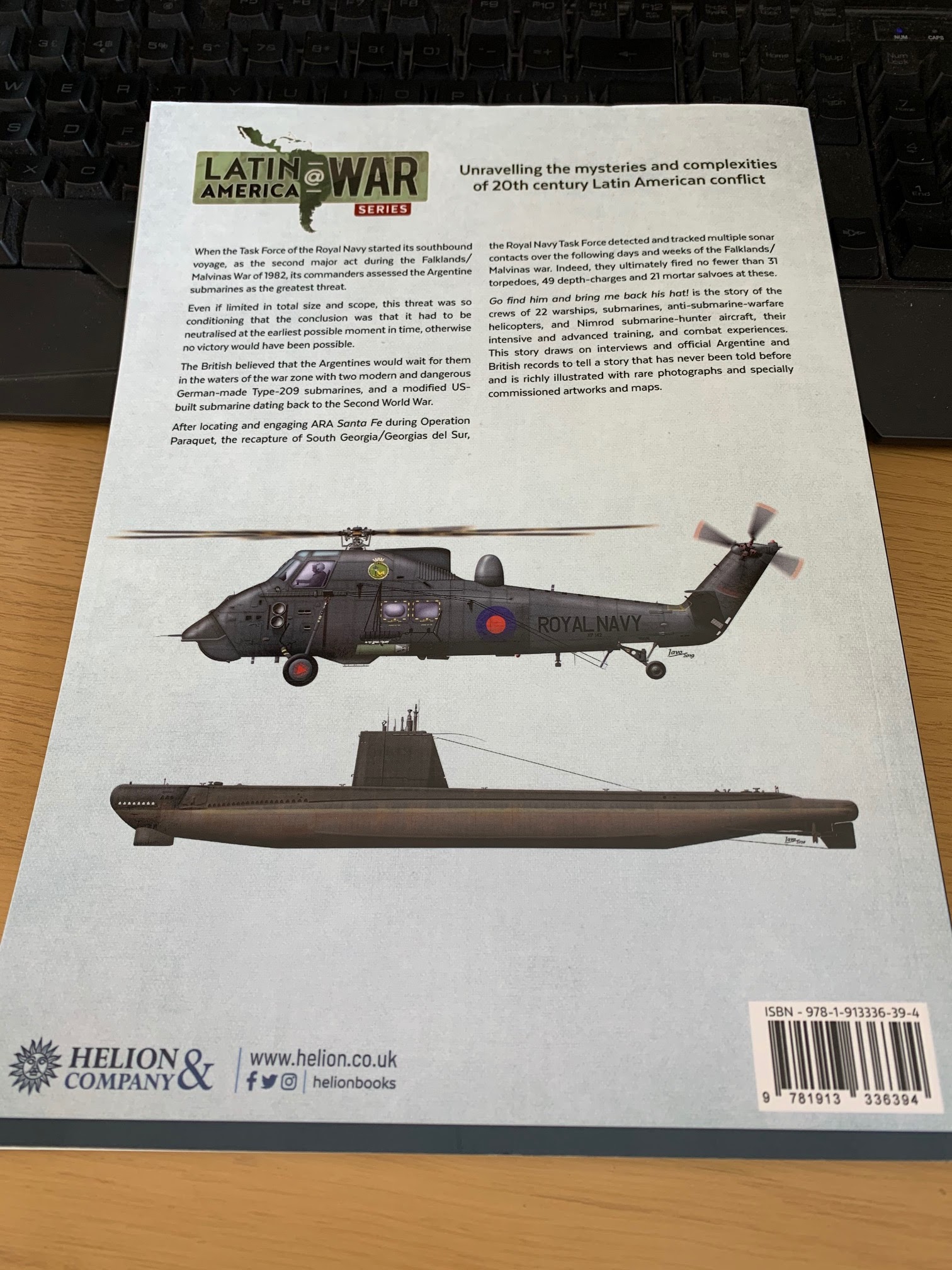
However, Mr Sciaroni has not stopped there and has had an accompanying volume published at the end of 2020: "Go Find Him and Bring Me Back His Hat". This 72-page book covers the Royal Navy's anti-submarine campaign of the same conflict as well as the Argentinian submarine ops of the same period. Once again, the author has had the benefit of both interviews with key personnel of the conflict (including the captain of the San Luis) as well as access to official diaries and reports of proceedings. Maps, photographs and artwork are of the same calibre as the prior release. 


Starting off with a focus on the pre-war/early war activities of HMS Superb, we then move to a highly readable description of the forces used before the core of the book. The tale of the Santa Fe gets seven pages before we move onto the activities of both British and Argentinian forces on the 1st, 5th, and 11th of May. There is a separate chapter on the San Luis from the 8th of May to the end of the conflict.


This is another highly educational tome that combines perfectly with the author's earlier book. For fans of Cold War history, these give you a great insight into how opposing forces fought using weapons and technology that was either old and worked in a limited way, or new and not very reliable. That is something that really brings the bravery of those on both sides of the conflict to the fore. Neither side was really prepared for the conflict that followed the invasion and it shows in both the lack of knowledge and preparation, as well as the reliance on kit that was at best iffy and at worst, a liability. Indeed, having read other books on the conflict (including Jerry Pook's all too honest contribution), it seems to be that success favoured the side whose kit was the last to go unserviceable. What is also evident from these two volumes is that when reading about any conflict, it is vital to cover all of the combatants. Sciaroni does that very well here and as such, I highly recommend these books if they of your period or interest. These books will also being a ton of detail and realism to any Falklands naval game you may want to put on the table.

For those who wish to know more, there is also a Q & A style conversation with the author on YouTube due to be broadcast at 4pm UK time on the 19th March. Use this link here to check that out. I know I shall be.

Saturday, 20 February 2021

Turret Versus Broadside - Book Review

Turret Versus Broadside - An Anatomy of British Naval Prestige, Revolution and Disaster, 1860-1870 to give its full title was a book pointed out to me in an email from my mate Andy. He's on the Helion & Company mailing list and thought this book might be for me, questioning whether it was too early a period for my interest. Not at all was my reply and an order was quickly made. The author, Howard J. Fuller, has written a studious tome concerning the ten year period from the launch of the first iron-hulled frigate, HMS Warrior, to the loss of the masted turret ship HMS Captain. Beginning with the loss of the Captain and then going back to tell the tale of how and why the Captain came about, Fuller has written an engaging and thoughtful narrative about how the introduction of new technologies, changing international politics and personal rivalries culminated in the loss of nearly 500 lives.


There appears to be an almost unshakable belief that during the 19th Century, the Royal Navy ruled supreme, supporting a Pax Britannica that encouraged peaceful trade, led the fight against the slave trade and kept Britain at the height of its powers. That may be a very comforting idea, what with 150 years plus of nostalgia and pride, but it's really not that simple. In fact, Pax Britannica could be considered a jingoistic throwback because there was anything but Pax for a great deal of that century for neither Britannia nor many other countries.

Coming off the shambles that was the Crimean War, the Royal Navy found itself in a bit of a mess. Well supplied forts and an enemy that didn't venture out for a traditional Nelson-esque naval battle had deprived the senior service of widespread glory. Following that conflict, the traditional rivalry with it's erstwhile ally France had re-ignited and the launch of the latter's La Gloire, the first ocean-going ironclad, led to a naval race for ironclad ships. 


Alongside ironclads, which were a response to the experiences of the Crimean War, you also had the invention of turrets, the first being patented by Captain Cowper Phipps Coles in 1859. He saw the advantages of the turret over the broadside and wanted this to be proven in an actual ship. This smacked straight into opposition from Edward Reed (Chief Constructor of the Royal Navy 1863-1870) and Robert Spencer Robertson (Controller of the Navy 1861-1871), both of whom were heavily invested in the broadside design for ironclads.

But wait, as a man once said, there's more.

The American Civil War introduced the Monitor to the world and provided a powerfully defensive ship for ports and coastal areas, but one that was not suitable for ocean-travel. The thought of conflict between the US and Britain, so easily talked about in the early years of the 1860's quickly changed when it was seen that the Monitor and its descendants could prevent the Royal Navy from it's traditional method of war fighting and even threaten the security of Canada via the Great Lakes and the St. Lawrence Seaway.

The increase in naval firepower brought round by huge smoothbore cannon and the latest in rifled muzzle-loaders also threatened the ironclads, as these guns could pierce the thickest of armour then floating. This led to pressure for increasing the size of ships - bigger guns, heavier armour, more complete armour protection and the continued idea of pitting ships against forts, which again had even bigger guns, all combined to worry the "public" about the strength of the navy. Indeed, the contrasting priorities of wooden sailing ships for empire policing, steam powered ironclads for fleet action and Monitor type vessels for attacking forts/port defence such as Cronstadt all led to a worrying increase in naval expenditure. It didn't help that singular, massively expensive ships like the Warrior were, at the same time, both wonderfully public displays of the strength of the Royal Navy and prime examples of how behind the times the service appeared to be, especially compared to other nations. 

This was not helped by the continued battle between the publicly owned shipyards and private ship builders. The former were seen as a traditional source of national power, the latter as profit-seeking wastrels. "Public" opinion, as expressed in letters to the newspapers and journals of the day (most notably the Times of London), was not inclined to see the Navy suffer for want of private profit. That these private yards were building ships for foreign orders seen as superior to those being built for the Royal Navy did not help matters either.

The need to cover the cost of the Navy also revealed the strains of Empire - would the "mother country" pay up or would she demand the constituent parts pay their fair share? And you may have noticed my use of the word "Public". That too, was another strain on the government, with the Reform Act of 1867 initially not only doubling the electorate, but also backfiring in 1868 when the Conservative government that formulated the act was voted out. The "Public" as it were, was a small part of the population but it's voice was heard to great, if not positive, effect.

The above it must be said, is mostly background, as the core of this book is the battle that Coles undertook to get a turreted ship designed and built. I'll not go into too much detail, but the political battles between Coles and the recalcitrant duo of Reed and Robinson were both private (within the confines of the Admiralty) and public (The Times and other publications), acrimonious and bitter. The two establishment figures come across as the villains of the piece, wedded to their existing designs for ships, deflecting criticism for not attempting to use turrets, especially after the Monitor appeared, and more concerned about private gain, be in money (Reed) or power (Robinson). The latter's attempt to gain control of ship building within the Royal Navy and to rubbish any private ship building was shocking even to contemporaries and together, they loaded the die against Coles when he came to design and have built (in a private yard) the Captain. 

The conclusion of this book is, in my opinion, fair to both sides and quite ironic. Despite the fears of falling behind other powers, the Royal Navy after 1870 had the Devastation building, a turreted, steam-powered ship that ended the argument between turrets and broadsides for good. It had also lost France as an enemy for at least a generation, that nation having suffered defeat at the hands of Prussia and having proven that, despite it's powerful navy, that service could do nothing against von Moltke's army.

Turret Versus Broadsides then is a book well worth reading if this period is your thing. It's very readable, engaging and well researched, shining a light on a period little discussed, but one with huge ramifications for naval and political developments for the rest of the 19th Century, As the author notes, by the time the court martial regarding the loss of the Captain had finished, British supremacy could be guaranteed for that generation, but not much longer.

You can buy Turret Versus Broadside direct from the publisher here. If you are a naval wargamer then Tumbling Dice do a rather decent HMS Captain in their 1/2400 Victorian naval range - you can order the Captain via this link here.