Wednesday, 10 November 2021

From Gamers Magazine - Issue Two Review

It's a lovely feeling when something you've been looking forward to finally arrives in the post. I experienced that last week when a well padded envelope arrived containing the second issue of From Gamers Magazine. The was timely as they currently have a Kickstarter running to fund a third issue, which is something I have already supported (backer number 2), and I was looking forward to seeing if they could repeat the quality of the first issue in the second. I need not have worried.

As always, the cover is the first thing you see, and this issues sees an excellent portrayal of Raz from Psychonauts, a smaller copy of which is also supplied. There was also a hand-written thank you note included which was another nice touch. We have 54 pages (including covers) and a mix of features, interviews, reviews and a few adverts, not overly many, and the one for Platform Players certainly caught my attention.

Features wise, there is a lovely four page piece on the evolution of the point and click adventure that covers ten seminal titles in the genre. This is a great introduction to the subject and (old game mechanics aside), you'd be well served by playing all of the games included. By the way, if that genre is to your taste, check out my review of Bitmap Books "The Art of Point and Click Adventures" here. Next up comes an interview with Nathan Hamley of Headware Games, who talks about his next release, Chasing Static. This looks like an intriguing Wales-set PS1 style horror title and one that I'll be looking out for. From the interview alone, I've already purchased his first title, Guard Duty, so am looking forward to playing that. There's an interview with Josh Hallaran, who talks about 8-Bit Adventures 2, then Super Mario 64 gets a once over, focusing on the environments that helped make that title one of the best games of all time. 

A well-opined piece on Rockstar's effect on game design from the starting point of GTA III follows, then there's a good article on Elden Ring. The cover feature, detailing the history of Psychonauts and the travails of it's creation gets eight pages and what a cracking piece this is. The artwork matches the subject brilliantly and this is definitely a well-deserved cover story. Baldurs Gate gets a three page preview, followed by a nice personal piece on Final Fantasy XIV. 

There are double page reviews of Scarlet Nexus, The legend of Zelda: Skyward Sword HD, Cris Tales, Psychonauts 2 and No More Heroes 3. As per the first issue, plenty of screenshots and, having played Scarlet Nexus and Psychonauts 2, I will say that I found the reviews fair in their treatment. 

The last article in the magazine is a guide to books every gamer should have on their shelves. Of the eight titles highlighted, I have three and, from this piece, will be getting at least another two, so for me, this was a great guide to find.

From Gamers Magazine Issue 2 has continued the fine sense of quality from Issue 1. From the artwork to the writing, I can find neither anything to complain about nor improvements to suggest. Hats off to the team behind the mag, each and everyone of you should be very proud to have created such a brilliant magazine. It is, in truth, a rarity. A multi-format magazine that is open to covering any topic in gaming. I also like how they are extremely open to new writers, as well as established ones - very much keeping to the ethos of its title. I know I am looking forward to issue 3 and beyond.

Speaking of issue 3, that is still in the Kickstarter funding stage. At the time this post goes up, they're on 82% with ten days to go. You can find out more information here, and I also urge you to check out their website here, where you can buy physical copies of issue 2 and pdf copies of issue 1 and 2. Give it a gander and, if you like what you see, support the team for the next issue.

Friday, 5 November 2021

Back Into The Storm - Book Review

Bil Herd worked for Commodore from 1983 to 1986. During that time, he was the lead hardware engineer on the TED range to computers (that became the Plus/4 when the hardware finally saw release) and the C128, Commodore's last 8-bit micro. Alongside Margaret G. Morabito (author of the Vintage Commodore 128 Personal Computer Handbook), Herd has recorded the details of his time at Commodore in this Amazon-published tome: Back Into The Storm.

Let me start off this review by stating that even if your interest in computing does not cover the period of Herd's employment, you really should get hold of a copy of this brilliant book. Why? Because it's not just about who did what and why, nor the struggles and challenges of launching a new range of home micro's in a seriously short period of time. No, this book is also about what driven individuals achieved whilst coping with the pressures of often ludicrous goals and the dangers of middle-management (in any corporate structure). It also portrays a company that was successful at what it did, even if the "suits" never understood why (hint, it has a lot to do with the people who work for you). 

Along the way, you find out exactly how passionate people were in problem solving and how the "work hard/party hard" mentality could, in some exceptional circumstances, deliver results far beyond initial expectations. That is not to say that this atmosphere was healthy in the long run. Indeed, Herd's recollections of long periods sleeping under a desk, continuous shifts and grabbing a beer and food wherever and whenever he could sounds like a recipe for burnout and ill-health. Hell, it probably is if that becomes the standard work ethic. However, for Herd, that behaviour was almost like a drug in itself - he thrived off the adrenalin and the stress. 

Truly, the early to mid-1980's were a different time, but some things never change (a bit like war, really - that's for all you Fallout fans) and it's the common thread of middle management that binds many of Herd's tales in this book. He has an in-built cynicism of managerial positions that exist purely to benefit the holder of that position. As long as the ladder-climber gets noticed/avoids responsibility/has been seen to have had their say, then it's pretty much a "screw everyone else" mentality, and the conflicts that Herd fought against that are funny to read now, though I am not sure how much fun they were when he was actively involved thirty-five years ago. Speaking from personal experience, I have had a few choice moments throughout my working life so far, the pinnacle to date was having to explain to a middle manager in words of one syllable or less why an ISA (Individual Savings Account - a UK savings product) couldn't have joint account holders. There's a clue there somewhere... ( and yes, I did keep my job...)

Another area that Herd covers is the decline in management ability and direction in Commodore after Jack Tramiel left the company. Many words have been written about Irving Gould and the numerous Chief Exec's who together turned a profitable and successful company in to a basket case, but one thing you get from this book is that after the events of 1984, Commodore really did lose the plot. Stories of marketing that didn't sync with the efforts of the engineers (the 512k expansion possibilities of the C128) and the sheer idiocy of the top bosses (the Commodore LCD) are almost too stupid for repetition. Yet repeated they should be, and they are in this book. In the case of the LCD, perhaps that's a good thing. I don't need another excuse to spend money on old tech. :-).

This is an easy to read book, with Herd's voice front and centre throughout. He is a sympathetic narrator, making it straight forward to understand the engineering challenges (and solutions) that he and his colleagues faced and devised. There is very much a sense of camaraderie within the engineering teams and the overall impression is that there were very clever and capable people fighting against the technology of the time as well as the unintended (and sometimes deliberate) interventions of others in order to deliver successful (from an engineering, if not a market perspective) products. Relayed with humour and self-deprecation, this book is a brilliant look at the hey-day of 8-bit computing.

Back Into The Storm is well worth your time if you are into retro-computing. As noted above, even if you're not, it's an excellent window into how stuff got done at Commodore back in the mid 1980's, with lessons that remain pertinent to this day. This superb tome is available from Amazon, either as a print on demand paperback or as a Kindle purchase. The POD copy is a good quality and takes up a well-deserved place in my growing library of titles about home computing of the 1980's and 90's. Check it out here.

Wednesday, 3 November 2021

From Vultures to Vampires: Volume One 1995 - 2004 - Book Review

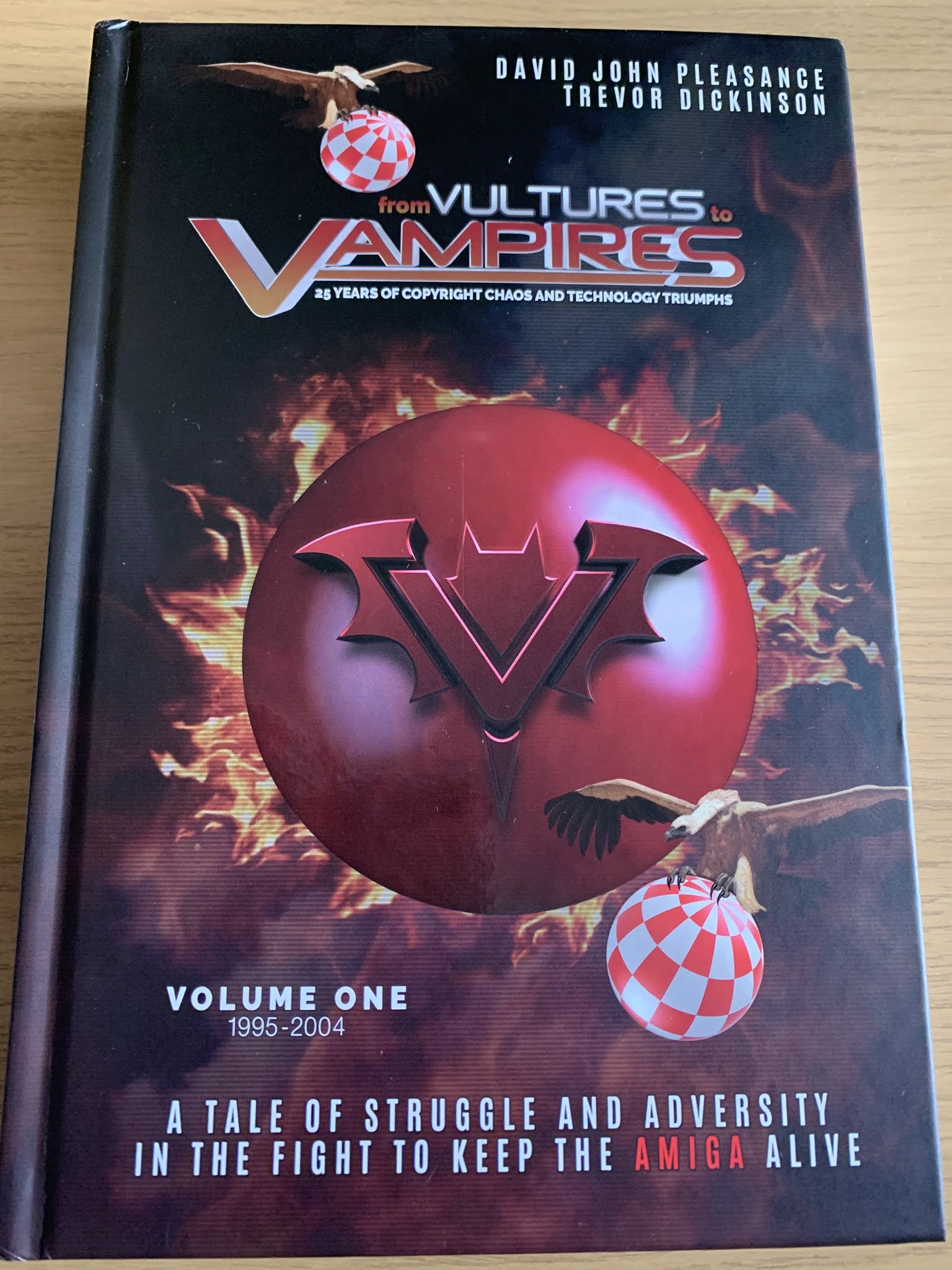
Some readers may remember that I reviewed David Pleasance's worthy tome about his time at Commodore way back in June 2020. Shortly after that, he launched a Kickstarter campaign to follow up the Amiga story after the demise of Commodore in 1994. Co-written with Trevor Dickinson of A-Eon fame, this would be a definitive history of what happened next. However, it became clear that there was too much content for a single volume and an additional request was made to backers to fund a second volume. After some unexpected delays caused by the global pandemic, the first volume arrived on my door step a couple of weeks ago. 

Covering the period 1995 to 2004, what Pleasance and Dickinson have achieved is to make sense of the often convoluted tale of just how screwed up the Amiga scene became after Commodore's almost inevitable implosion. Indeed, gentle reader, never has such a telling of the complete shit show that was the post-Commodore Amiga ownership been published, and we still have volume two to look forward to. Now, to be fair, the nine years covered here contain the worst of the story, or so you would think. They are the most active years, but anyone familiar with the Amiga over the last decade will know that the course of the OS and hardware has not exactly been smooth. From "white knight" investment from Escom, to the frankly desperate tale of the Gateway period and whatever the fuck the Amiga Inc thing thought it was, every nook and cranny of the Amiga's journey post Big-C to 2004 is covered here. 

Reading this book brought back a lot of memories from the period. I was an avid A500 user and, by 1994, was trying to figure out how to afford an A1200. The demise of Commodore put that idea on hold and even when Escom achieved the no-mean feat of restarting the production of the A1200, the new, higher price of £399 was too much for me to afford, even if they were readily available in the new Escom shop in Stanley. Sadly, I was also too late to pick up a fire-sale machine when the company went bust. 

The reason for this bon-mot is to emphasise that even in 1995/6, there was still a market for a machine like the A1200. Sure, it was dated tech and, compared to PC's of the period, vastly underpowered, but machines could still be sold. What happened after Escom demonstrated the strengths of the Amiga platform and the many, many weaknesses of those who tried to control it. Basically, the idea of a relatively cheap home computer disappeared as an almost steady stream of corporate purchasers tried to monetise the powerful and useful operating system without understanding or supporting the original user base. The same user base that, even as the years passed, maintained faith in the platform although it started to decline as the lack of direction took its toll. Look at the circulation of Amiga Format (as reported by the ABC in the UK) over the 1990's: Jan-June '92 - 161,256 copies per month. July-December '93 - 142,326 copies. July-December '95 - 60,008. Those are pretty decent numbers considering Commodore was long gone by then.

However, by the time we enter the Gateway/Amiga Inc period, circulation was down to 22,175 (July-Dec 97) and by the last issue in May 2000 (for July-Dec '99), they were selling only 11,146 copies per month. This (admittedly unscientific) observation provides evidence of the market decline even as each new owner of the Amiga fucked about with their various half-baked and under-funded plans. Talk about wasting an opportunity.

Of course, by the mid-1990's, the home computer market was transitioning to the more powerful (and expensive, although becoming more affordable) PC, and video gaming had seen the introduction of the revolutionary PlayStation and Saturn. Unless a company had really deep pockets, there was little scope for a repeat of the Amiga's early success. Hell, at that point, even Apple was struggling to survive, having had some truly bizarre and disastrous business decisions foisted upon them by execs who clearly didn't understand why their particular machine was popular. As with the Amiga and ST, the then executive management never really saw past the idea of the computers being a commodity and that led to poor choices and alienation of the users.

Anyhoo, after that diversion...

The tome itself is of high quality and the paper stock shows off the contemporary photographs, illustrations and screenshots well. As for research, the two author's have tried to speak to as many of the people involved in this period as they could. Some declined to comment but overall, there is a sense of fairness about the coverage and nobody has been subject to a "hit-job", at least as far as I can tell. 

The book takes a chronological view of the period but, as is unavoidable with such a twisted and winding story, there are sections that repeat information, just to give context to the next stage. This makes sense and is really only limited to the odd paragraph here and there. Other than that, I found no issues with either the style or tone of the prose. Given that it only takes the story up to 2004, I am really looking forward to the second volume when it is released and I highly recommend this first volume. If there is only one take away from this story, it's that executive management really did not have a clue about users. That outlook did for Atari, it did for Commodore (and every successor company covered in this tome) and nearly did for Apple. Anyway, there you have From Vultures to Vampires Volume One, a well written and comprehensive history of the first nine years of the Amiga post-Commodore. 

You can order a copy of volume one directly from David Pleasance here, as well as pre-order volume two. Copies can also be ordered from Amazon and, in the UK, WH Smith.

Saturday, 30 October 2021

E1M1 Magazine - Issues 7 to 9 review

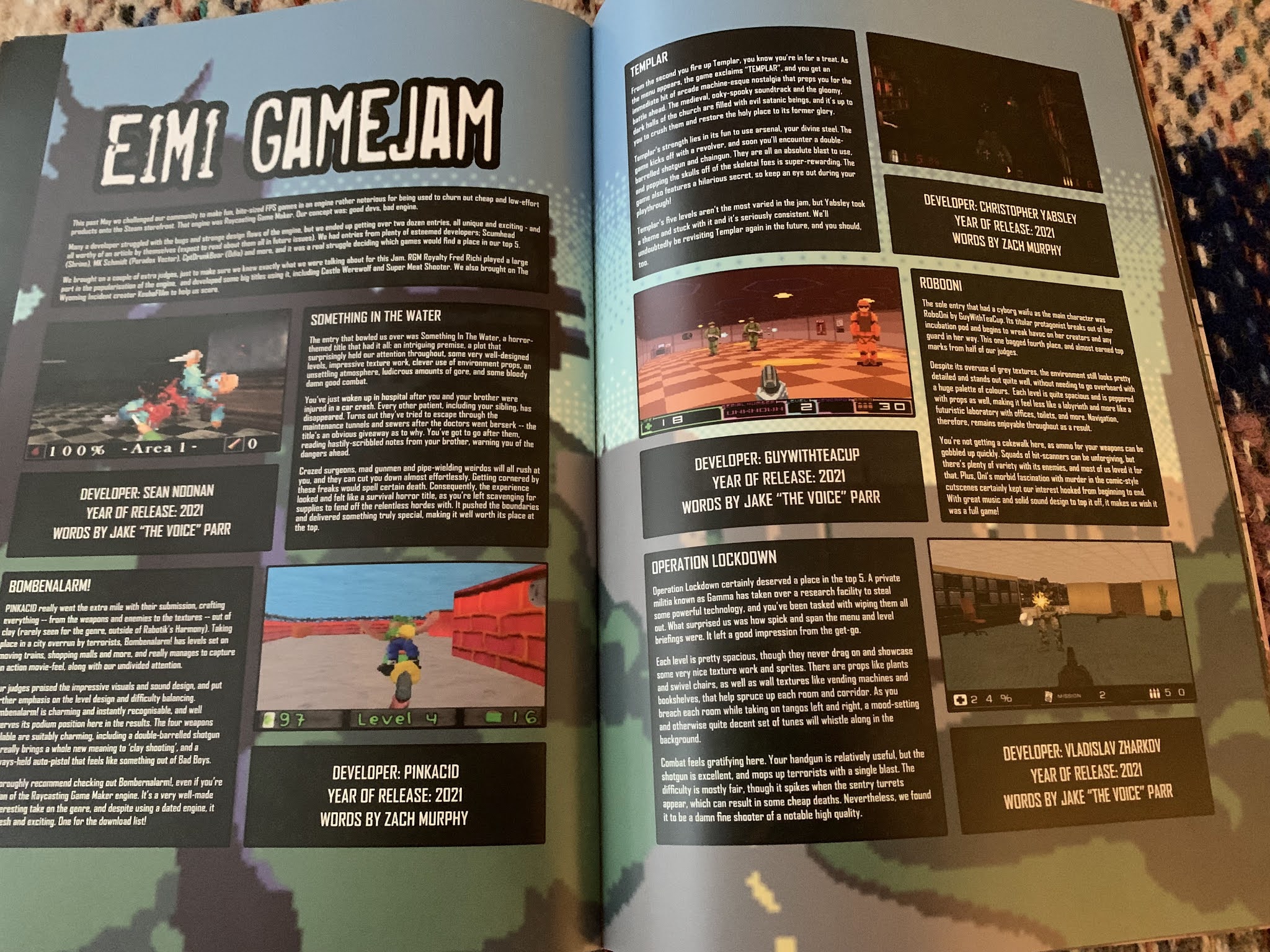
E1M is back for another triple issue batch that continues to demonstrate the rude health of the first person shooter genre and the variety found therein. Following a third successful Kickstarter, it didn't seem like long at all before the latest three issues were at my door, very neatly packaged and sent via special delivery. 

As with the previous issues, the cover artwork is the first thing that greets you and once again, they have excelled themselves. Each issue is 72-pages in length (including the covers) and the stock used is of high quality, with a lovely sheen and a smooth finish. 

The talented team behind the magazine.

Content-wise, there are the usual sections: previews, mods, rail shooters, retro, reviews, features and interviews. The quality fo the writing is high and each issue feels like something you'd be happy to purchase from a newsagent, it's that professional. There are a few adverts in each mag, though these do not overwhelm the content. These are for YouTubers, magazines and forthcoming games, which is nice to see. 

Speaking of games, this is where you get a proper idea of how healthy and varied the FPS market is. In total, you get 66 previews, an astounding number of forthcoming titles, some of which are from solo-devs, others by teams, all packed full of promise. I have no doubt that these will keep the reviewers busy over the next couple of years in E1M1 Towers. I know I'll be adding a few to my Steam Wishlist for future reference. As for reviews, between the retro and new games sections, there are over 60 titles covered, from the usual PC fare to PlayStation and Gameboy Advance shooters. I may even give Daikatana another go based on the retro review in issue 7 - that was a game that I really tried to like back in the day but it never gelled. 

I also liked the sections on mods and it was interesting seeing how creative that community is, and the interviews are varied and informative, as was the "how to" on making a Doom map in issue 8. Truly, this is one of the best written and content filled of the "semi-professional" (and that is not meant in any negative sense) videogames magazines that have cropped up over the last couple of years.

It would be remiss of me to fail to mention the artwork that adorns the interior of the magazines. Used to separate out some of the various sections, these are excellent showcases for their respective creators. Some have a distinct line of humour, but all have specific styles and are well-suited to the videogame genre so well celebrated here.

What more can I say about these three issues? They are a great read and show that the team are learning and developing as they push out more batches to supporters. I am a fan of the three issue batch idea and I am looking forward to the next Kickstarter for issues 10 to 12. As for issues 7 to 9, they shall take up their rightful place alongside the first six. Slowly but surely, there is a comprehensive resource on period and contemporary first person shooters being built up, something that can be referenced in years to come. 

You can find out more about E1M1 here, purchase digital and physical issues, as well as sign up for email notifications to hear about the other content the team are producing.

Friday, 22 October 2021

Lift Off by Eric Berger - Book Review

Elon Musk is a divisive figure but it can't be denied that he's been quite the force for change over the last twenty plus years. From the creation of PayPal to the success of Tesla, he has achieved his self-set goals, and there is no greater symbol of that level of achievement than SpaceX. However, each one of those successes is a result of more than just Musk's effort. Indeed, each is based on the hard work and determination of many, usually unrecognised (outside of their niche areas of expertise) individuals. "Lift Off", by Eric Berger, sets out to bring a bit more recognition to those behind the foundation of SpaceX and the tale of that company's early years.


Berger is the Senior Space Editor at tech web site Ars Technica and for this book, his first, he has managed to snag interviews and recollections from pretty much everyone involved in the formative period of SpaceX's existence, Musk included. That much is obvious by the presence of the billionaire's name in the subtitle. But is this a subjective view of the start of the the company that has shaken the industry to such an extent that it now holds half(!) of the global launch market? Or is this a fawning piece of flummery that avoids upsetting the man with a famously fickle Twitter feed?

Lift Off divides itself between the four flights that finally launched SpaceX on it's successful path to accepted rocket company (Musk famously said he'd reach orbit by the third) and the background to the launches - the development of the Merlin engine, the convoluted route to using Kwajalein Atoll as the launch site, the need to sell rocket launches to ensure the company could be a going concern, the creation of a new facility in Texas, the eight week struggle after flight three to get a fourth, last ditch attempt onto the pad, and a chapter on what came next.

Berger writes well, with an engaging style that captures the drama of SpaceX's start up. The research is impeccable and where there are differences in recollections, this is duly noted and all views are included. After all, time does fade the memory somewhat. There is some humour in there too but the core tale is about achieving the ambitious goal set by Musk, backed by a large portion of his own personal fortune. 


Musk comes across as a high intelligent (he has been described as always being the smartest guy in the room), driven individual. This book doesn't give an overly glowing portrayal of Musk, though he was interviewed for it, but neither does it criticise the negative side of working for such a leader.

You see, Musk recruited who he believed were the brightest and the best, usually just out of education, and wanted these people to be as driven as he was. This means that the hours were long and personal lives were sacrificed. One individual has a daughter who hated Musk for stealing her daddy from her. Another missed out on both of their children's teenage years because of working for SpaceX. This is a repetitive thread throughout the book and whilst it is justified by those involved in it by the achievement of getting an orbital rocket launched, to my mind, it feel like an excuse. There again, it's also a personality thing and, at the end of the day, a personal choice. It feels wrong to me but then I am a tad cynical.

Berger weaves a good narrative tale that, at its base level, is a one of triumph over adversity even if the human cost is at a degree some would find unacceptable. Whether you adhere to the belief that the goal is worth the sacrifice or whether you just think a job is a job, what you will find in Lift Off is an informative read as to how SpaceX got to the point where they could start achieving the aims Musk set way back in 2002.

I still find what SpaceX does thrilling to watch, be it the simultaneous landing of two Falcon 9's after a Falcon Heavy launch, or the repeated (and finally successful) launches of the Starship SN prototypes. Just the idea of launching and landing a rocket still feels like something out of Thunderbirds. What Eric Berger's book does is provide some acknowledgement to those those who struggled to make that vision a reality, to give names and voices to those who really did the hard work under the conducting gaze of Musk. That is what makes Lift Off an essential read. 

Lift Off is available at all the usual bookshops and online retailers.

Saturday, 16 October 2021

Was That Film Really That Bad??? - Resident Evil: Afterlife

Or, as it should be called, Resident Evil: The one where they gave up trying and just copied everything from other, better films. Yes, gentle reader, another Resident Evil film but take heart, we're in the back half now and there's only two more to go. Wor Paul returns as writer, director and co-producer in this 2010 release and, to be honest, it shows. Oh dear Lord, does it show. But is the film really that bad???


You'll be wanting the plot which, given this a Res Evil film, is about as thin as cheap bog roll. Oh, it starts off reasonably well, Tokyo before the T-virus spreads, then cuts to four years after the devastation, with Alice (Milla Jovovich) and her clones attacking Umbrella's HQ in Tokyo. She fights Wesker (Shawn Roberts), who injects her with an anti-virus that removes her powers and narrowly escapes a bomb that destroys the HQ and all of her clones. She survives a plane crash (no idea how) that apparently kills Wesker. Six months later, she's flying up to Alaska in a two seat prop plane, looking for the survivors in a mysterious place called Arcadia and completing a video diary of her search. She doesn't find the town but she does find a load of abandoned aircraft and a wild Claire Redfield (Ali Larter), who has been tagged with a red spider implant on her chest. Alice removes this and together they travel to Los Angeles where they find a bunch of survivors in a city centre prison surrounded by legions of the undead. We get an introduction to the survivors and the last prisoner there, Chris Redfield (Wentworth Miller). It turns out that Arcadia is an Umbrella ship and they've been harvesting the living for experiments. The undead breach the prison, the survivors make it to the ship, Alice and co fight Wesker and the film ends with the people held on the ship being released just in time for a mind controlled Jill Valentine to arrive with load of Umbrella VTOL's ready to take on Alice. 

You can't have an RE film without these bad boys. Sadly.

Now you've read that, you don't have to watch 97 minutes of uninspired, cheap looking, copycat action that doesn't have an original bone in its body. After a small, brief (relative) rise in quality in Res Evil: Extinction, we're back to the by the numbers nonsense of Wor Paul. It can look good at times, the opening scene in Tokyo before the T-virus escapes is not bad, all slow motion rain and shit, but once that's out of the way, we have another Alice monologue recapping the events of the first three films and every other trope the series has used so far. However, it's not just the repetition of the in-series tics that grate. Oh no. Wor Paul has been trawling through his DVD collection looking for stuff to "homage."

Agent Smith, I mean, Wesker, I presume.

The Matrix first and the attack on Umbrella's Tokyo HQ, doing a very poor rendition of the Lobby gunfight, with obvious wire work and shitty CGI. The Alice clones are all ninja'd up, with throwing stars that highlight another pointless film-making aspect - this was filmed in 3D so expect lots of slow motion objects heading directly at the camera. Robert's Wesker is a take on Agent Smith, with growly voice, Desert Eagle and emotionless delivery, though he gets to rock the "Neo" look at the back end of the film. They've also activated the infinite ammo cheat in this movie, seeing as it's full-auto ahoy and never a mag change to be seen - indeed, the Alice clones each seem to have about 900 rounds per 30-round mag. Oh, and that wire work - there is one part where Alice jumps into the air, loses all forward momentum and flips without in place. I know it's sci-fi but for fuck's sake, can we at least has some physics in the room, or just help Milla when her wire rig gets tangled, cos that's what it looks like - an outtake. Naturally, things don't get much better.

Like Trinity in Revelations, but two of them... twice as good? No!

As the film has already "homaged" the shit out of the Matrix series (there's a water filled slow motion fight in a shower room that copies several fights across that trilogy and the use of bullet time is both horribly naff to watch and ignores physics on a whole different level to previous RE films), it shouldn't be a surprise that the middle half of the film seems to want to similarly "homage" the Aliens films; from direct quotes ("No offence. None taken") and claustrophobic survival against an external threat, to swimming creatures, proving that nothing sacred from the wandering scriptwriting pen of Wor Paul.

Homage, my ring piece!

Speaking of scriptwriting, the plot makes little sense. There are gaps in logic so big you could drive the good ship Arcadia though them. How does Alice survive the crash when she no longer has her powers. How can she fly to Alaska then to LA as the film shows that it's all one flight? Who is the video diary for? How does she keep the camera battery charged? How...how...how... There are so many questions about how this world continues to exist considering that the ecosphere is dead, there's no replacements for any consumables used and the undead are everywhere. I understand that there will be sites out there with people explaining the convoluted answers to many of these questions but let's be honest here, the Resident Evil films have never been strong on internal logic and world-building. And that's before we get to Alice's coin-filled shotgun. You don't have to know much about ballistics to see that it's a shit idea that exists only to look and sound cool when she uses it. 

This is bullet time... apparently

Of course, you might not care and just want to watch a film with less intellectual activity than the undead in it. It certainly won't be for the characters who are walking stereotypes. You don't care what happens to them. People do stuff for no reason nor explanation: it's just to make the action look cool. Even Jovovich looks bored. At least she gets to speak using her natural voice - Miller has a husky whisper that screams for someone to give him a Strepsil. As for the rest of the cast, they turn up and act to varying degrees, but between Wor Paul's script and direction, the only comfort I feel is that, like previous entries, the cast were paid. Take the money and run people, it's at least gonna pay the bills.

Oh dear...

Production values are dire too, with the roof scenes obviously studio  bound, the CGI being passable at best and downright Warehouse 13-style bad at worst - Alice's swing from the roof top a fine example of the Dr Malcolm declaration  just because they could doesn't mean they should, and the bullet time effects, as already mentioned, are embarrassing. Where as the Wachowski siblings (and the rest of the crew) were pushing technology and film-making to deliver something people had never seen before, Wor Paul thinks a rendering farm will suffice to match that passion. No. Just no. Scenes are shot to highlight the 3D effect, which is great and all but that fad died out years ago, and there is far too much slow motion crap going on. Honestly, if they'd played the film at normal speed, the whole thing might have lasted an hour! That would have been to the benefit of the people who have watched this.

Superhero landing way before Deadpool did it...

Truth be told, this is a filler of a film, ditching the clones from the previous entry and setting up a fifth movie. Given a final box office take of $300m from a $60m budget, that was inevitable and in 2012, said follow up arrived. However, because there is no characterisation beyond cool looking jumps and snarky remarks, Afterlife can't even claim to the the "Empire" of the series. At least with the second Star Wars film, it played with the format to drive the story forward whilst giving fans the characters and action they wanted. Instead, RE: Afterlife is another nonsensical wank fest from Wor Paul that made some people a ton of cash but seriously wastes the audiences time. As with previous entries in the series, yes, it really is that bad.

And since it's so bad, here are some bonus screenshots just for you, you lucky, lucky people...

Agent Smith, I mean Wesker, with his Deagle.


It looks worse in motion. 

The first of many 3D (magic) moments.

It really does look worse in motion.

Zombie on the right has either gone full Thriller or bad Tommy Cooper, I can't tell which.


Friday, 8 October 2021

Archive Magazine - Volume 25.4 Review

It's been a while since Archive 25.3 landed and I was waiting with much anticipation for the next issue to arrive. Happily, it did so in the middle of last week so, having written little about my favourite non-mainstream OS for a while, thought it worth giving the latest issue a review.


Well packaged as usual, the first thing you notice is the rather lovely photograph of a sunset that occupies the cover alongside the contents page. As you can see from the image above, there is a lot in the latest issue which is well worth reading. The range and breadth of contributions really do make this a fantastic example of a user-generated publication and one that is great at informing, educating and entertaining the reader. Hmmm, that has a certain ring to it. 

The article on graphical coding with Python is well worth your time if you're getting to grips with this language in RISC OS, the introduction to UCDebug is a good intro into debugging tools, and the Bookmarks piece has links to three very interesting dev videos. Andy Marks (of RISCOSbits fame) demonstrates three different virtual desktop apps, USB audio gets an informative piece and there is even a small letters page. The regular sections are also up to their usual high standard.

However, there are a couple of articles I do want to comment on, as well as the future plans the editor has revealed. 

Firstly, the brace of hardware pieces. There's one on the TiX Duet from RISC OS Computers and then a comparison review between the FOURtress from RISCOSbits and the 4te from RISC OS Computers. It's especially heartening to see two budget machines in the RISC OS market that can cater for both new and existing users as well as a more bespoke machine that offers maximum flexibility. 


The Duet (you'll need to scroll down that page) is a truly niche machine, a combination of a Titanium board and the PC motherboard of your choice. You decide the spec and the price, but the end result is one that can provide a RISC OS and Windows system in one desktop. This is not a machine for everyone, but that it exists is a good thing. It offers flexibility and freedom, as well as a simple space saving solution for those who don't have acres for a computer set up. The piece on the Duet in Archive does a very good job of explaining how the system works and its benefits, as well as detailing the process of actually obtaining one. Very interesting and highly informative.

The comparison review between the FOURtress and the 4te was of equal, if not greater, interest to me as these computers occupy the lower end of the RISC OS hardware market. Short of building your own desktop using a Raspberry Pi and suitable case, these are two of the simplest and most straight forward ways of getting your hands on a RISC OS system. The piece includes a benchmarks table, price breakdowns, and pros and cons of each system. In a sense, neither is "better" than the other - they both meet the same market requirement but from different companies. I don't "need" a new RISC OS machine at the moment, though I do "want" one (damn my adult sensibilities!) and either machine would fit the bill. What was great to see were the screenshots of the supplied software, something that neither company seems to list on their websites. Knowing what ships with the machine could make it easier for potential buyers to decide upon a purchase. As it stands, either machine will get you started out of the box, though there are add-on packs for (various unlisted) commercial software and AMCOG games from RISCOSbits. The 4te website has a section set aside for software but that's currently empty. 

Kudos then for having the review piece for each machine. I do hope there will be a Pinebok (formerly known as Armbok) review because if the hardware is still available, I would like to see how it works as a RISC OS machine. Yep, still hankering after a portable RISC OS computer... 

Also of note in this issue are the thoughts and plans of Gavin, the editor. You'll find these starting on page 36 and I do like where he wants to take the magazine. The two points he discusses in this issue are the change in software used to produce the mag (although still keeping it RISC OS based) and a planned increase in size. He notes that he had three more articles that could have been included in this issue so wants to move away from the stapled format (which limits the page count to 56) and move to a bound format, thus permitting an increase in page count. This is great news and shows that even though RISC OS remains a relatively niche operating system, it still has a vibrant user base. Couple that with readily available hardware and "good-to-go" software bundles, and it feels to me that there is a great deal of life in RISC OS yet. There are two more ideas on the way, alongside a survey, to be announced in the next issue.

All in all, Archive remains a great magazine and one that any RISC OS user will benefit from reading. It's also extremely promising that improvements and expansion are planned. I know I will be re-subscribing when the time comes.

Check out the Archive magazine website here if you'd like to know more about this essential RISC OS-based publication.