Wednesday, 8 December 2021

Switch Player - Magazine Review

Regular readers may recall my review of Ninety Fresh back in August and how much I enjoyed that magazine. Since then, I have acquired the first three issues and backed the fifth, which arrived a few weeks back and continues the high quality Nintendo-centric approach of the previous editions. There is no doubt that when the next Kickstarter arrives next year for issue six, I'll be backing that without delay. Some of you may also remember I mentioned Ninety Media's other regular publication, Switch Player. Well, I eventually got round to buying the latest issue, number 58. 


And it's just so god-damned cute! I mean look at it, especially in comparison to the full size Ninety Fresh! This is an A5 publication, 60 pages in length and in full colour. For £3.49 per issue plus postage, that's not too shabby at all. There is a subscription service available as well but I will cover how you can support Switch Player later on in the post.

So, a handy little magazine, reminding me of the old Commando comics (are they even still a thing?), that gives a great first impression. It looks and feels professional and given it's now approaching issue 60, a successful one too. Again, more on that later.

Content-wise, the cover gives a handy hint at the ten pages handed over to Pokemon, but not before an editorial piece on the difficulty in path-finding in Metroid Dread and the ability to get lost in even the most well-designed of games, plus a potential solution. After Pokemon, there is a three page report on the EGX show, a single page dedicated to Gaming Ruminations (on the topic of difficulty vs enjoying gaming), and then a feature on Shin Megami Tensei, a gaming series I had never even heard of before so it was good to learn something new. The last piece before the reviews is a two pager on the Switch Player Tournament, where four of the crew competed at playing Gang Beasts. Imagine a competitive version of Couch Potato that SFX used to run in years gone by.

Ah, the reviews section. This takes up twenty-six pages (and they had to drop a couple of smaller reviews to get the features in!) and offers well-written opinions on Metroid Dread, Epistory - Typing Chronicles, Tetris Effect: Connected, Super Monkey Ball Banana Mania, Disco Elysium The Final Cut, Castlevania Advance Collection, A Night At The Races, Droneridge, Youtubers Life 2, A Little Golf Journey, Death's Gambit: Afterlife, Staxel, Pandaball and The Long Gate. Phew! That's a lot! Reviews are scored out of five stars, with half stars being permitted and a handy guide at the start of the review section defining what each of the scores equates to. 

The last few pages of the magazine are given over to a two page look at the Switch OLED model, two pages on "A Moment in Switchstory" (detailing the events of previous Octobers since the Switch launched) and finally a lovely retrospective on the astounding Golf Story, which got a review back in Switch Player Issue 9. Was it really that long ago? The back cover closes off the issue with an advert from Premium Edition Games.

In a sense, I kind of knew what to expect from Switch Player when I ordered this copy - after all, it was from the same stable as Ninety Fresh. What I did not expect was to find was such a packed, informative little magazine, perfect for carrying round with your Switch to read when you've ran down your favourite handheld's battery. It really is a great magazine and long may it continue.

So now to the important bit. If you like the idea of this magazine and want to buy a copy, you can do that here. However, if you want to set up what is in effect a recurring subscription, head over to Patreon and check out the levels of support there. From a basic £1 per month for a digital pdf copy, through £4 for a physical copy including second-class postage and then upwards, with different levels of support gaining different benefits, this is the best way to secure a copy of the magazine and ensure it continues. I have signed up and am looking forward to future issues - the next one will focus on Grand Theft Auto, so should be a canny one. As the only monthly print Nintendo Switch magazine, Switch Player occupies an important niche in the still extant physical magazine market. No, you'll never see it on newsagents shelves, but that doesn't matter, as you will be directly supporting the writers and artists who produce this professional work - just like the teams behind Ninety Fresh, Amiga Addict, Amiga Future, From Gamers Magazine, Sega Mania, E1M1 and others. As you will note if you check out the magazine tag on my blog, I am a big fan of the printed word and Switch Player joins the ranks of those I am supporting. If you're a Switch player (see what I did there), I recommend you do so too.

Friday, 3 December 2021

The Sega Mega Drive and Genesis Encyclopedia by Chris Scullion - Book Review

SCULLION!!! We need to have words!

Why? The Animaniacs entry - factoid - Youtube video - that's all I'm saying but I will tell you that I had that bloody song stuck in my head for days afterwards! Anyhoo, back to the book review.

The Sega Mega Drive and Genesis Encyclopedia is the latest entry in what looks like turning out to be an annual series of well-written and crafted platform specific guides to the games that were released on them. The NES and SNES volumes were the first two (reviewed here), and this Mega Drive/Genesis tome marks the third entry to the series. The author has announced that 2022 will see the N64 edition, then another four, unannounced volumes are due with an annual cadence thereafter. Oh, and that's not to forget the platform gaming book due out early next year as well. Between these and the author's day job at VGC, I am surprised he doesn't sleep with a keyboard melded to his fingertips and ice packs strapped to his wrists - won't somebody think of the tendons?

All joking aside, I have suffered from tenosynovitis long ago that led to six months off work so I salute whatever Mr Scullion does to keep himself writing. It is not just the amount that astounds though. Nope, there is also the quality of his output and, with what could be described as almost machine-like regularity, he's done it again. The book is a corker.

The Sega Mega Drive and Genesis Encyclopedia follows the template of the previous books in the series. Each game gets at least a quarter page (some get a half page but due to the sheer number of titles covered, there isn't space for full page entries) which neatly describes the game in question with some snarky asides thrown in there for variety. These are funny and more than a couple had me laughing out loud, much to the consternation of my good lady and the cat. The tone of the entries is something to note as well - the author is passionate about videogames and he wants that passion to shine through in his writing. Whether you read this linearly or just jump around the entries at will, you'll never be less than entertained and informed. You also get a little trivia note for each game so consider this a fair warning: when he says check something out on YouTube, be aware that you might have to deal with the musical consequences for much longer than you think... Each game also gets a screenshot as well.

Were it just the Mega Drive/Genesis that were being covered, all would be tickets-boo, but no, Yer Man Scullion has taken things further by including sections covering the libraries of the Sega 32X and the Mega CD/Sega CD. This makes this encyclopedia a truly one-stop shop for any fan of Sega's 16-bit wonder. Having said that, I have still backed the Mega Book Collection from Greyfox Books that is currently live on Kickstarter. I reviewed their Atari - a Visual History recently and I wanted to see a different take on the same subject. Plus, you can never have too many books...

One of the nice things Mr Scullion does when releasing a book is to get a limited number of  copies for signing so you could order directly from him. This was the course I took and I'm very happy with copy number 24 of 100. He also included a lovely typed (but hand-signed) thank you note, explaining the journey for this volume and the forthcoming N64 one. 

So, there you have it. Another brilliant entry in the series and one that you can buy directly from the publisher here, or from Amazon here. You can follow the author on Twitter here and he has his own blog here. Will I be buying his future books when they hit the shelves? Of course, ear worm YouTube songs and all!

Friday, 26 November 2021

The Secret History of Mac Gaming by Richard Moss - Book Review

Apple Macs don't do gaming. Such has been the refrain for many a year and that has only really changed as iOS has cross-pollinated with the Mac platform as well as Apple's focus with Apple Arcade. But that initial statement isn't actually true. In fact, it never has been, and I can prove it by telling you about Richard Moss' bulging tome on the subject.

Initially published by the crowd-funding site Unbound, this new, expanded edition of The Secret History of Mac Gaming comes courtesy of Bitmap Books. I've reviewed a couple of their titles before and those didn't disappoint. Neither does this one.

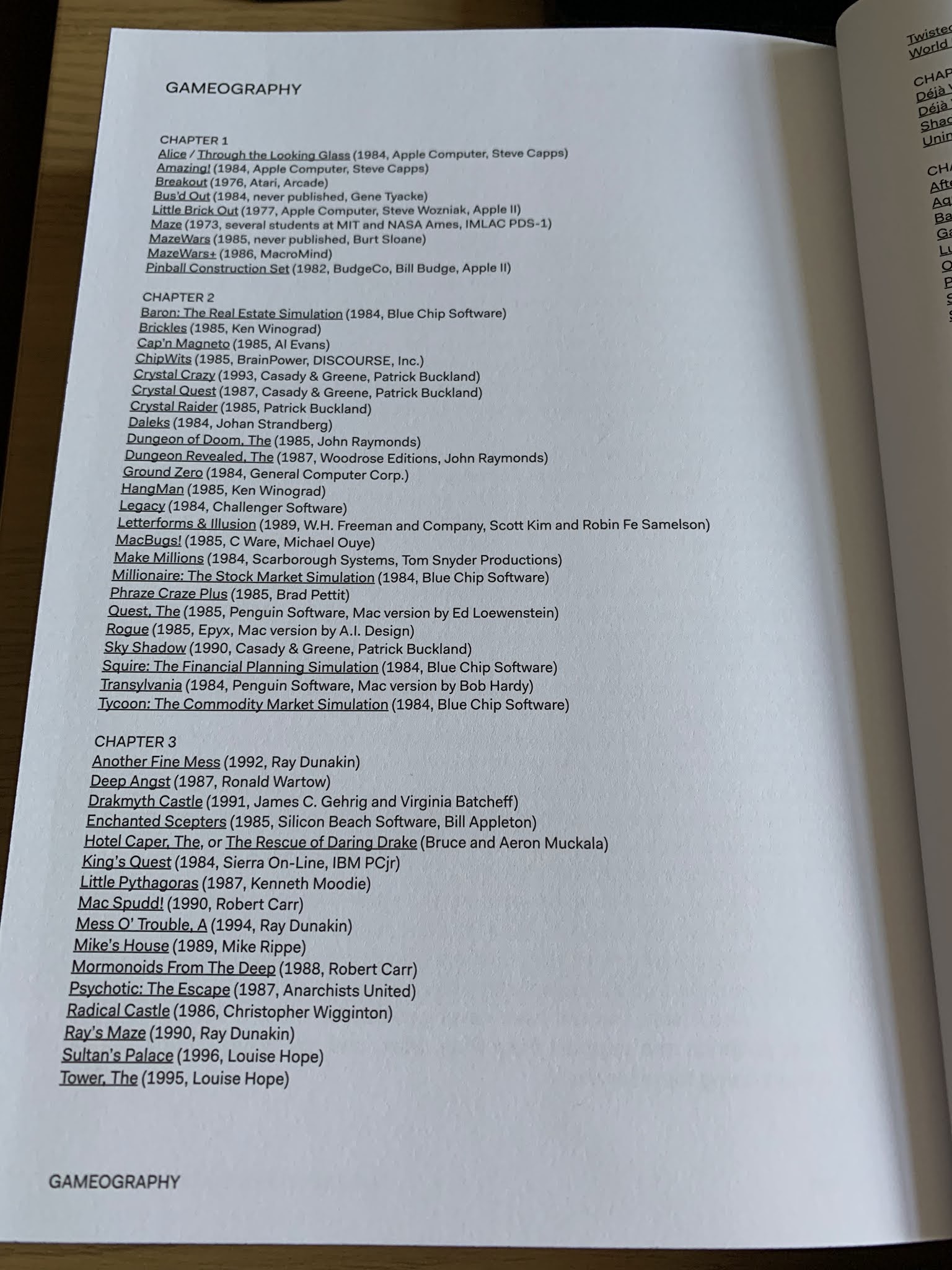
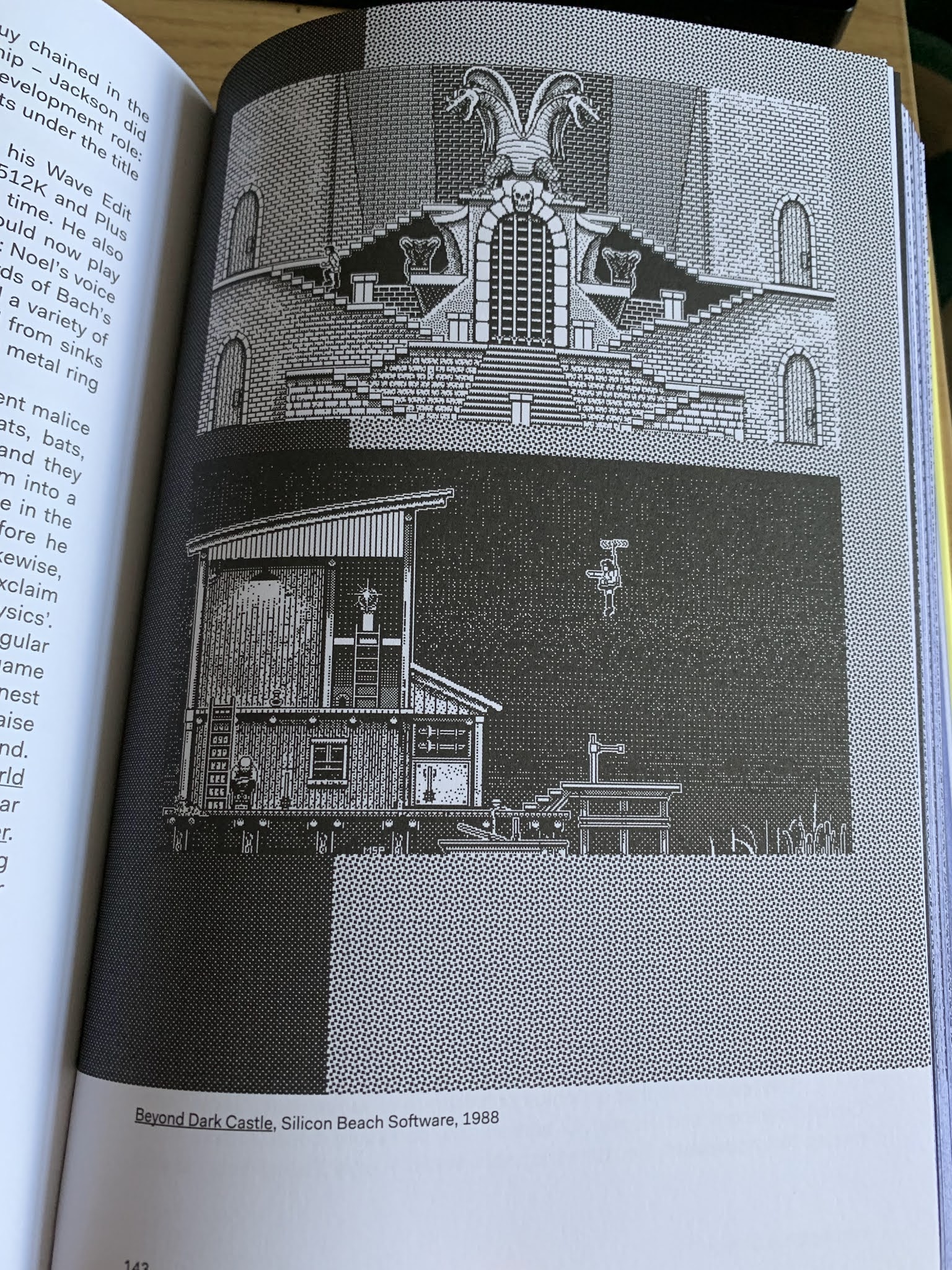
This is a compact book with a stunning design - the contrast of colours, the loving recreated original Mac on the front and back, and the striking purple fore-edges, all give this book a style of its own. It's also quite dense, with only four blank pages out of the 482 present. There are plenty of screenshots but what you'll mostly get is text, split into twenty seven chapters. These are preceded by a timeline from 1984 to 2000 (the period the book covers) detailing key moments in Mac gaming history, a foreword by Graeme Devine (co-founder of Trilobyte, creators of 7th Guest amongst other titles) and an introduction by the author. At the back of the book, there is an afterword by Craig Fryer (an Apple Evangelist, who also provides two chapters), an acknowledgement from the author and a gameography, detailing all of the titles included in each chapter. In between each chapter are small pieces of art in the mono-Mac style which are a nice touch.

The chapters themselves initially cover the early history of the Mac before moving onto the different genres that made it to the format. The topics move on to include shareware, Fryer's role in being a Mac Evangelist, and individual chapters on key companies that made a mark on the Mac gaming scene. What is evident in each chapter is the level of research Moss has undertaken to tell this story. The sheer number of interviews to cover the subject is amazing, the effort to contact individuals and follow up on them, some after over thirty-five years since their involvement in their games, is stunning. All the while, the games remain front and centre, and around 350 titles are name checked. Some merely get a mention, others get a full deep dive as they relate directly to the telling of the Mac's gaming history. In any case, that Gameography at the back of the book is invaluable. 

The tale of Mac gaming is a rollercoaster ride, through the hard times and the good (thank you, Mr Slim), of Apple blowing hot and cold over gaming, and of Apple itself nearly imploding in the mid-1990's, which had a corresponding effect on the Mac gaming ecosystem. The passion of developers and company owners is plain to see, and there is more than a little luck involved for many. Some managed to make a living out of their hobby, others just got beer and pizza money - but hey, their games paid for beer and pizza! Above all, the book gives life to a period of computer gaming that will never be repeated. The industry has changed, as has technology - the cost of development, distribution methods, marketing, customer feedback - all have changed, some not for the better, and yes, this book harks back to a different time but at no point does it become maudlin. No, the author weaves the narrative easily to encompass the highs and lows of Mac gaming to the end of the 20th century and he does it in an engaging and very readable manner. 

I would say there are highlights but that would be disingenuous. The book itself is consistently great though, as a fan of obscure and seen-as-failed consoles. the chapter on the Bandai Pippin was particularly tremendous and as for the stories of the shareware community... well, as you'll see at the end of this review, it is to be expanded upon. It was also nice to see the focus wasn't entirely in the US, even if it was the primary Mac market.

Is it perfect? Not quite. There is one niggle (just one niggle only, Vasily - I watched Hunt for Red October recently) and that is page 251. In the print copy I have, it doesn't exist, instead being replaced by a repeat of page 281. I love flight sims but that is a bit too much F/A-18 Hornet 3.0 for my liking. Fortunately, when you buy a print copy of a book from Bitmap, they send you a download of a pdf copy too and that had the missing page so nothing was lost.

I missed this book when it was funding on Unbound and am pleased Bitmap books have given it a re-print. This is an essential and entertaining read for anyone interested in computer gaming in the 1980's and 90's, even if the Mac wasn't your computer of choice. I cannot recommend this book enough, it has to be in your gaming reference library.

And yet there is more.

Richard Moss has a second book which has reached its funding goal on Unbound.com. Shareware Heroes covers the rise of independent developers who used a unique business model to not only keep their game creation dreams alive but created indie games that commercial publishers wouldn't touch. It's at the final design stage and, based on how great I think The Secret History of Mac Gaming is, I have pledged my support for a copy when it hopefully gets published in August 2022 (global situation depending). 

You can buy The Secret History of Mac Gaming from Bitmap Books here although it is now out of stock until April 2022 (shows how popular it is) and check out Shareware Heroes here. You can also follow the author on Twitter.

Tuesday, 23 November 2021

Battlegroup! by Jim Storr - Book Review

Yes, I can hardly believe it, a wargaming post (sarcasm alert)! This time, a review of one of Helion & Co's latest releases, Battlegroup! The Lessons of the Unfought Battles of the Cold War by Jim Storr. A former British Army infantry officer of 25 years service, graduate of the Army Staff College, Camberley and professor of war studies at the Norwegian Military Academy, the author's background promises much for this title.


However, it is not just the author's career that lends itself to this book. Along with his late brother (a Territorial infantry officer), he fought over 200 battles on the table over a period of many years, refining and honing tactics, rules and procedures to determine how events could unfold in the real world. Alongside that, he has also self-translated two German-language texts by Erik Middeldorf, who served in the Wehrmacht and published his work in 1957. Combined with a wide range of other sources, personal communication and experience, the author has tried to tackle the question of what could have happened if the balloon had gone up in the 1980's.


The book is divided into four parts: Setting the Scene, Land Forces, Tactics, and Lessons. Setting the Scene prepares the reader in the geography and the location of the forces that would face each other there, a guide to the individual armies, total deployment numbers and the like, and details the approach the author has taken in reaching his conclusions - here we get an explanation as to how the two hundred plus games were used to generate the supporting evidence to the author's line of thought. It must be noted here that the primary goal of each game was NOT to win. Instead, it was to achieve a set aim or goal. The author reinforces this difference a number of times, highlighting the difference between what we games players do and what he and his brother were trying to achieve.

The largest single section of the book is Land Forces, and it is here that the author's knowledge, background and experiences come to the fore. In turn, he discusses the various branches of the land forces in central Europe. The use of reconnaissance, armour, infantry and anti-tank forces, engineers and artillery, the medical/supply and transport services, and finally, the use of battlegroups, brigades and divisions. Not really a spoiler, but it is in this section that you will find the author's most contentious views. The idea of what makes an effective tank, the effectiveness of well sited anti-tank forces and just what is the point of an IFV are just some of the topics well covered and whilst there will be dissenting games players out there (either with a points-based army that has served them well or a doctrinally/TOE correct force), it should again be noted that the arguments are put forward logically and are something that I for one would like to see trialled on a table with the rest of our particular group.


Tactics takes up most of the back half of the book and looks at defensive and offensive operations, along with air support and the issue of fighting in woods, built up areas and at night. Again, some of the arguments may not be to your liking but they are discussed persuasively and with great clarity. 

Lessons brings everything together, with a hypothetical September 1987 conflict and some observations and conclusions. I'll not detail these here because you'll need to follow the author's line of argument. To do that, you'll need to buy this book. 

And buy it, you should. This is an essential look at the latter years of the Cold War in Europe and provides a level of insight that I have yet to see bettered. Throughout there are diagrams and tables to illustrate and inform, and I defy any historical wargamer of this period not to gain something from a perusal of this work. True, not everyone will agree with the author but that is to miss the point. This is a carefully argued and evidenced volume on what might have happened if the Cold War had kicked off. It makes damning reading for those with pre-conceived notions but it does (and this is the key point) make you think. Rather than just blindly following abstract rules, this invaluable book pushes the reader to question their own approach to wargaming of that period as well as the accepted historical views of the forces, tactics and strategies concerned. It really is that much of an essential purchase.

Battlegroup! can be purchased directly from the Helion & Co website here.

Saturday, 20 November 2021

Archive Magazine - Volume 25.5 Review

Arriving fairly shortly after volume 25.4, 25.5 is the penultimate edition for the year and a bit of a news-packed issue, having been printed just before the London show which took place on the 30th of October. Also included in the magazine was an A5 flier to remind me my subscription was due to expire after the next issue (25.6) and listing the ways of renewing the subscription. So, what do we get for this issue?

The Newsdesk occupies its usual place, reporting on Cloverleaf's new Filer, the new Cloverleaf distro that was promised as part of their Kickstarter campaign, and the announcement of two RISC OS shows for 2022 - the Wakefield show (23rd April, which I am hoping to attend) and the RISC OS eXperience show (14th May) in the Netherlands. The Haunted Tower Hotel is the latest release from AMCOG Games, there is an extended edition of Acorn: A World in Pixels (already ordered that one) and a new WIMP programming book from Chris Dewhurst. There is more but you get the idea. And that doesn't include the actual London show announcements either!

The first article is a cracking piece by Jeroen Vermeulen on porting Python games into BBC Basic. Very much a "how to" and packed with detail and tips, this will be a boon for anyone with similar plans and you'd do well to have this six page resource to hand if that kind of project takes your fancy. Andy Marks reviews DeskWatcher, an application to remotely control one RISC OS desktop from another, highlighting features such as screen recording, file sharing, multiple connections and the like. It's a good review and is very honest about the benefits, limitations and foibles of the software.

Meet ArmBob is a great introduction to Bob, an interpreted language for object-orientated programming if that is your sort of thing. I found it interesting. "What? Me a programmer?" is a humourous look at an old utility being revisited by someone who is adamant they are not a programmer. Uh-huh :-)

Also included is a guide to updating NetSurf, adding a reset switch to a 4te desktop and a handy step by step process of getting Gmail to play nicely with Pluto and Hermes. The second part of the USB Audio series is as interesting as the first (as in highly) and there are three entries in the letters page. PC Bits focuses on the joy(!?) that is the Windows Blue Screen of Death and a quick comment as to why the author hasn't upgraded to Windows 11 yet, whilst Mac Matters add a note on sharing Mac screens on RISC OS and file mapping. Code Burp takes a look at image saturation, and Acorn Retro is its usual fun smorgasbord of 8-bit gaming wonder.

That is still not all in this issue, with a full page advert from Cloverleaf about their new RISC OS Distro and the now regular half-page from RISCOSbits with their London show offers on the FOURtress range of desktops. Speaking of which, the London show news...

What a show for announcements it was! Considering the size of the RISC OS market, it is extremely heartening to see about multiple pages given over to the show news. RISC OS Developments gets 4/5th of a page (web browser Iris, new TCP/IP stack for wider testing and Pinboard 2.0), RISCOSbits gets a full page (new LapDock option for single board computer users, Mini ITX board), R-Comp gets 3/4th of a page (Pi400 Plus kit, software updates for Messenger Pro and Fireworkz Pro) and finally RISC OS Open with a 2/5th of a page (updated DDE and new pdf version of the RISC OS 5 User Guide). It is really pleasing to see such a level of commercial activity.

Finally, the editor concludes his two-parter on the future of Archive, with a note on making the magazine more visually appealing and updating the website. Both initiatives are worthy and I look forward to seeing how they develop. 

What is clear from this issue of Archive is that there is a real sense pf positivity about the RISC OS user base and the magazine itself. There are promising developments ahoy and I would certainly like to see the magazine grow in size (and readership) if at all possible. I have no horse in the race between the different bindings and am happy to see the presentation evolve whichever way is chosen. As it stands, if you're a RISC OS user then Archive magazine remains an essential purchase and I will be certainly be renewing my subscription before volume 25.6 hits the doormat. That also reminds me, the Archive Archived DVD/USB Stick is due in early December. That's something I'll definitely be picking up.

You can find out more about this excellent magazine by visiting archivemag.co.uk. You can also follow the magazine on Twitter.

Wednesday, 17 November 2021

Unofficial Atari: a Visual History - Book Review

Glorious. That's the first thing I thought when I opened this carefully packaged tome from Greyfox Books. The black and purple cover shot through with vivid neon wallops your eyes as you take in this well crafted book. This 229 x 152 x 30mm celebration of the Atari 8-bit range of computers is both stylish and hefty, tipping the scales at 1.23kg, but what a book it is. Over four hundred pages covering 162 third-party games, with artwork, interviews and features galore, reading it made me realise that, as a child in the 1980's, I had missed out on a computing legend.

You see, the first computer my parents ever bought was a Commodore VIC-20. The was replaced by an Amstrad CPC 464 before that too became destined for the back of the cupboard due to the rise of the 16-bit generation. During that time, I experienced the Spectrum (via friends) and the BBC Micro (via school), but Atari's range passed me by. This book, in its own way, remedies that.

Its heart lies in the games and each one is treat fairly and with love. A two-page entry per title, one whole page in dedicated to the box art, with the other split between a quarter page of text and a monitor-boxed screenshot. The background of the pages is formed from another, magnified, screenshot. Doyle provides most of the text, although some is provided by the developers themselves, courtesy of interviews contributed by others. Each entry is easy to read and detailed, providing insights and recommendations as to whether you should play each game. Even where the game has a poor reputation, it is still given respect here. The paper stock is perfect for showing off the imagery and yes, as you can see below, it is a tad shiny!

Interspacing the groups of entries are in-depth interviews with developers of the time, profiles on software houses and features on the actual hardware. Each covers unique areas of the Atari 8-bit era and gives greater meaning to what it was like to be an owner of these not-quite mainstream machines (from a UK market perspective at least). At the back of the book is a section on emulation and how you can sample these games today on modern hardware. I have had a bit of a dabble myself and I know there are quite a few games mentioned in here that I'll certainly be playing in the future. 

As this is a visual history, alongside the game art and screenshots, you'll also find period advertising and some frankly gorgeous hardware photography. True, a lot of the kit was beige, but as I have said before, there is something about 1980's computer hardware design that is both dated and timeless, and that is never more clear here. I love it.

Greyfox Books is a small operation but there is no question as to the quality of the publication you are buying. If you're an Atari fan then this must be an essential purchase for you. I know my copy will sit beside the two volume "We Love Atari" set from Zafinn Books that I reviewed here.

Much like idesine's Acorn: A World in Pixels (reviewed here), Unofficial Atari is a love letter to a long vanished era of home computing and computer gaming. A chunky love letter, to be sure, but one that, much like the BBC Micro in idesine's book, the Atari 8-bit range deserves. Check out Greyfox Books here and, if you can, pick of a copy of Unofficial Atari. I highly doubt you'll be disappointed.

P.S. It was announced a few days ago that Greyfox are to launch a Kickstarter for the Mega Book Collection, a visual history of the Sega Mega Drive, 32X and Mega CD. That should be something impressive to keep an eye out for when it goes live.

Friday, 12 November 2021

The Making of Tomb Raider by Daryl Baxter - Book Review

It really is hard to believe that Tomb Raider was released 25 years ago. Initially on the Sega Saturn, it soon made its way to the PC and Sony's PlayStation, where it set up shop for years to come. This timely tome (tomb? Sorry!) by Daryl Baxter details the creation of the first two games as told by those who were there, a high quality oral history of the challenges and successes faced by the original team behind Tomb Raider.

Physically, this is another cracking release from Pen & Sword, and adds nicely to their growing range of videogames-themed publications (I reviewed two of these, the NES and SNES Encyclopedia's by Chris Scullion here). With a list price of £25.00, I have no complaints about what you actually get to hold in your hands.

Baxter takes a chronological view, beginning with the early days of CORE Design and the initial idea/pitch that led to Tomb Raider. From these early days grew a multimedia figure, one that eschewed the traditional male-centric idea of an action character, and one that also gelled nicely with the "Cool Britannia" era of the mid-90's, something the author uses to anchor the tale.

Each step of the story is told in the words of the original team members and their voices shine through with each anecdote. From these, several things become very clear: 1) there was an immense amount of pressure and crunch involved, 2) these were passionate people who did suffer during that process and 3) the 1990's were a very different place compared to today. I mean, smoking indoors for a start!

Where this book excels is providing multiple accounts of the same event, such as the departure of Toby Gard and the change in processes between the first and second game. With regards to the former, whilst there is some concern as to the money he lost out on, I couldn't help but think that, at the end of the day, if your mental health is suffering then maybe it is time to leave. It's all fine and well having (or be seen to have) a great work ethic, but self-care is, ultimately, key, and it made quite painful reading about how the achievement of getting the first two TR games out was seen as enough to counter the effect that the months preceding each title's launch had on several of the team. As noted in my review of "Back into the Storm", that suits some people very well but not all, and I speak as someone who has burned themselves out in a previous job role. It is a credit to the author that this subject is covered even handedly, without judgement, and letting the reader make their own mind up.

There are many, many screenshots included of both titles and they look brilliant. I'm not sure what post-processing was done to get them to look that good (if any), but they compliment to text beautifully. This continues to some of the original design documents that were kindly provided. The balance of text and art is about right, and it's a nice change to see slightly larger than usual text in such a book. It certainly made it easier to read for my poor eyes, I can tell you.

What we have here is a detailed and very personal look at how a relatively unknown development studio transitioned from a 16-bit game factory to a developer that redefined action titles in the 1990's. They launched a character/brand/IP (I hate those two last terms, but you know what I mean) that not only led to nearly 20 games but also three (soon to be four) films and merch spinoffs galore. By hearing the story in their own words, you not only gain an understanding as to how the games were created, but also how games development changed through that pivotal period of videogames history. The Making of Tomb Raider is a brilliant celebration of the creation of this series and is another fine addition to my videogames library. It should be one for yours too.

You can buy The Making of Tomb Raider directly from Pen & Sword here or order it from the usual online and physical book shops.