Saturday, 22 July 2023

From Vultures to Vampires Volume Two by David John Pleasance and Trevor Dickinson - Book Review

Three years since the original Kickstarter for a singular book under the name of From Vultures to Vampires was successfully funded to the tune of £42,813 from 1005 backers (number 317 myself) on 19th July 2020, and two and half years since the need for a second book was announced, volume two has finally started to arrive in the hands of backers of the extended project. After such a long period of time, it was a relief to finally get this book, as well as have hopes raised about the third volume. When that one arrives, there will be a review and a "Notes on a Kickstarter" piece with thoughts and comments about the project as a whole. That one is going to be... interesting... In the meantime, was this one worth the wait?

A 24x16x2-ish cm hardback, first impressions are positive, and there is a quality feel to the cover and paper stock within. Total page count is 288, but there is some filler in there too. 

Following on from volume one's coverage of the post Commodore years of 1995 to 2004, we kick off straight away with 2005, each of the following chapters taking the journey on a year at a time until the conclusion in June 2010 and the Vintage Computer Fair at Bletchley. A final section provides an explanation of what happened to the Commodore name, as well as the C64/A500 Mini projects. 

It's mostly well written, with only a couple of occasions where another light editing pass might have removed the odd instance of repetition. The narrative does, however, take a tangent at times - the page and a bit used to talk about the son of Pentti Kouri (with a photo of him) has nothing to do with the actual story and shouldn't have been included at all. 

There are plenty of photographs too, and I think too many, considering this volume was described as necessary due to sheer amount of content (as was the upcoming third volume when it was announced). Do we really need a mugshot of every almost every person mentioned in the text, especially when they're a one line mention? Do we really need a picture of a CDi? Or Trevor's multiple (and in one case, Frankenstein-like) computer collection? And the logos? They're also on the back cover!

This building is of only passing interest, and we really don't need a picture of it.

It feels like padding, what with 275 pages of actual content, and that's down from the 360 total/336 actual content split of volume one. It'll be interesting to see where volume three comes in at, but the inclusion of the ads at the back of this one, including two pages for the ill-fated Amiga Global Alliance project, adds to the impression that, with better planning, two volumes could have been more than enough. 

Anyway, for the price I paid - £17.50 plus £7 p&p (with actual postage only costing £2.99 so a raised eyebrow there too (I didn't realise I was paying e-Bay postage prices...) - I'm reasonably happy with what I received. Not with the timescale (that's for the later post), but they got copies out there in the end. Here's hoping for volume 3.

Not really need in this book - no slight to CDi fans either

David Pleasance has a website where you can buy both the first and second volumes. Not wanting to appear too waspish (moi, darling?), but the actual front page hasn't been updated since mid-2022, as he only talks about two volumes and a possible July 2022 shipping date for the book I'm looking at here. Click on volume 2 in the shop and it has an estimated July 2021 availability(!). As of KS update #42 (12th May 2023), David would happily take your money via Paypal Friends and Family (it's the fee, you know), for a direct order. Uh-huh... Both currently available volumes are priced at £35 for the physical copies, £15 for the e-books. It is up to you, gentle reader, to decide if that represents good value. If I were approaching as an interested potential buyer now, I'd baulk at the idea of dropping £42 per physical copy (including postage). As for £15 per e-book, not for me, and there is a whole cannery to open when it comes to e-book pricing anyway. 

So, a good read? Mostly. Would I recommend? If you can get a copy cheap enough, maybe. The travails of the campaign have soured more than a few backers (as evidenced in the comments section on Kickstarter), and my thoughts on the project will follow after reviewing volume three. For now, it's a qualified recommendation at best. You will learn stuff, it compliments the first volume very well, and they have delivered a decent read. How they have delivered that, dear hearts, is a question for another time. 

Friday, 7 July 2023

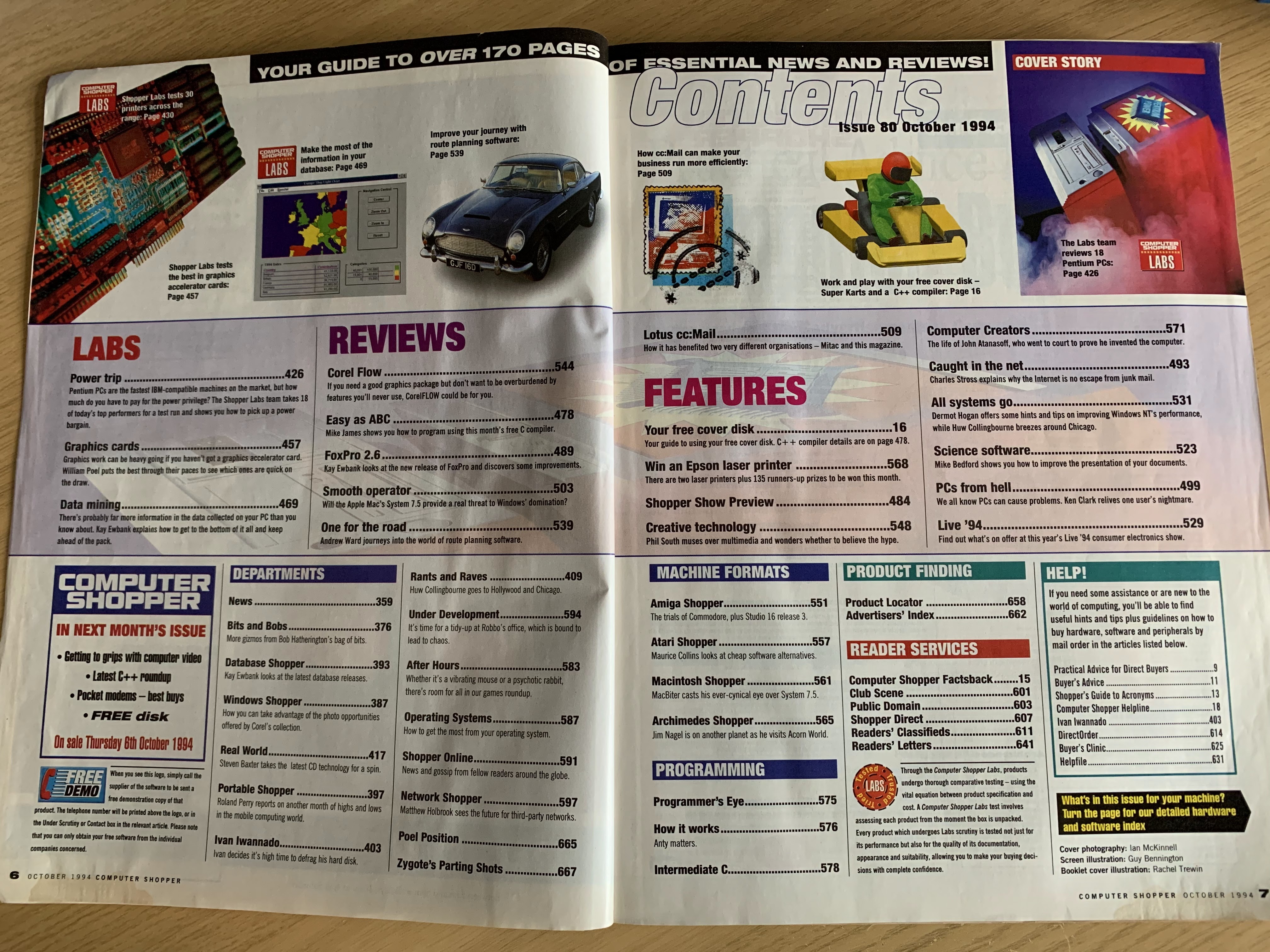
Magazines of Yesteryear - Computer Shopper Issue 80 - October 1994

It's another magazine of yesteryear and this time we're travelling to October 1994 (by issue date, the publication date was early September) and issue 80 Computer Shopper.

The magazine has grown, now coming in at 670 pages, and you have to feel for the posties of the 90's and how their poor backs faired when lugging multiple copies of this around. As for contents, we have a Pentium 90 group test (for a bargain price, but we'll see about that), graphics cards, a decent rage of software being rated, as well as the good old machine reference guide, still in place even if the pickings were increasingly slim for the non-DOS formats. That was to be expected considering Atari had abandoned the computer scene for one last crack of the whip at consoles, and Commodore had imploded earlier in the year. Acorn was still kicking out (the Risc PC (swoon) had arrived in April), and Apple was still Apple - although resellers such as Crown Computer Products Direct were offloading older stock at frankly silly prices - an original Mac LC 2/40 for £199 ex VAT!

Contents - some interesting stuff here.

The format specific list - and check out that circulation figure bottom right - 134k plus! 

In the news was Apple's announcement of licensing its System 7 OS to other hardware manufacturers. This they certainly did, and in my best (imaginary) Morgan Freeman voice, it did not end up being a good idea. Microsoft settled a four year anti-trust investigation (the what if's abound if Gates hadn't folded), Compaq pushes into retail (Dixons, Currys, John Lewis and PC World), and London's underground would soon be getting fifty multimedia information kiosks to supply up to date travel information to travellers. This truly was the future, or so it seemed at the time. 

From the group test, and interestingly, a section at the bottom about the actual company.

Now that's a group test specification table!

The big group test is for Pentium 90-powered machines at a budget price. This, gentle reader, depends on your definition of "budget" - and when it came to the then hot new processor, you started at £1,895 ex VAT and went upwards. These were high spec machines for the time, most coming with 16MB of RAM and a 15 or 17" monitor. Except for Lowland (£2,897 ex) and Dotlink (£2,085 ex), who cheaped out with a 14" screen. Tight basta...

These machines were also supplied with PCI or VLB (VESA Local Bus) graphics cards, and a round up of some of the latest models reveals a) they were varied in pricing - £110 to £599 ex, b) these were serious productivity tools - the 3D graphics cards race was still a while off, and c) they were pretty much maxed out at a resolution of 1,280x1,024, although a couple could handle virtual desktops of up to 2,048x1,536 at 256 colours. The key thing here was that getting a monitor to ably handle such resolutions was probably going to cost you as much, if not more, as the card. Taxan Ergovision monitors were being handled by dealers for around £339 and £669 ex for 15 and 17" varieties respectively. 

Don't be tempted. Not for one minute!

For the format specific stuff, Amiga Shopper is still going, as is Atari Shopper. Jim Nagel hosts the Archimedes Shopper column, while the legendary MacBiter keeps an eye on Macintosh Shopper. His column was one of the main reasons to buy Shopper, and his look at System 7.5 will have you chuckling away even after nearly thirty years. 

Elonex were another decent manufacturer lost to the mists of time.

To the adverts now and this was a time when the PC market was in rude health prior to the consolidation and mass market changes that were to come as the decade progressed. Manufacturers offered machines directly and via dealers, so let's have a look at what you could have bought back in 1994.

Discounted Apples - and no, not worth it either.

First thing you realise is that anything less than a 25MHz 486 SX is dead in the water. Aside from a couple of really cheap laptops (and laptops were coming to the fore even then), there isn't a 386 to be found outside of a Morgan Computers or (in this issue) Crown Direct ad - the latter had a monitor-less Amstrad PC4386 for £299 ex. If you were in the market for a current spec PC, the 486 was your starting point.

The Gateway 2000 opener...

MJN's in return

Gateway 2000's price list compared to...

... MJN's - totally different, obviously.

Naturally, competition was fierce, and this led to some unfortunate coincidences. Take Gateway 2000, once seen as a true competitor to Dell, it leads with a fold out insert featuring Sherlock Holmes. Their ads were often high quality narrative productions, having the machines front and centre of course. Prices aren't too bad either, and a 486 DX2-66 Family PC could be had for £1,299 ex. Pentiums were much more pricey. But what is this? MJN have also gone for a Holmes run (not apologising for that at all), and theirs is laid out in a very "similar" way, albeit with cheaper pricing. Hmmm. Other then-famous names in the market included Elonex, Viglen, Watford Electronics and Byte Direct, the latter of which was eventually purchased by PC World. 

A cracking little laptop, that Contra Aero.

As for laptops, Toshiba and Compaq were the dealer's favourites, although the pair of Olivetti machines looked pretty tasty, and I still love the colour of that Echos model (see below). What is really noticeable is that technology has advanced, and while these machines still have a weight issue (and that's mostly a battery thing), their prices are now, certainly at the lower end of the market, commensurate with their desktop cousins. Check out the Toshiba TC1900S - 486 SX at 25MHz, 4MB RAM, 120MB hard drive, 9.5" screen, internal floppy, DOS 6.22 and weighing under 6.5lbs - all for £829 ex. Now the Viglen Contender desktop - 486 SX at 25MHz, 4MB RAM, 240MB hard drive, DOS 6.22 and Win 3.11, plus a 14" monitor - £799 ex. Admittedly, there were cheaper manufacturers - Time could do the same spec with a Mitac branded machine for £699 - but that's not my point. What had changed was that laptops could now get very close to desktop pricing within the limits of the form factor. Colour screens and faster chips added much more, but on one level, the laptop was getting there. 

Laptop progression - that T1900S is pretty tasty for the price. 

The Viglen Contender range - could have been's...

This was the high point of the Win/DOS combination before the might of Windows 95 changed the perception of the PC for the general consumer. That and putting the Pentium processor front and centre when it came to sales. It also wouldn't be long before 3D graphics cards started to show up. This is about the time in the PC's history that I feel most nostalgic about - and yes, I am aware that nostalgia can tint those glasses in a spectacular way, but PC's at this point were both cool, moderately accessible but also still requiring some technical knowledge to get things to work. Old man shouting at clouds here, but I sometimes do miss playing about with interrupts and HIMEM.SYS.

Anyway, that's two for Shopper, so next time, I'll have a look at a more "scholarly" title. Well, Personal Computer World, but since it described itself as a journal, it's the posh one compared to Shopper. I will leave you with the advert of the Olivetti Echos. Still a looker after all these years...

Saturday, 24 June 2023

Magazines of Yesteryear - Computer Shopper Issue 40 - June 1991

The summer of 1991 - what a time to be alive! If you were a kid, you had the joys of listening to "Do The Bartman" and "The Stonk" (Jesus F-ing wept), while adults got all concerned by Color Me Badd singing "I Want To Sex You Up' - truly a more innocent time. Cinema screens were playing the likes of Highlander II (yep, it really was that bad), Misery and the Alan Rickman classic, Robin Hood: Prince of Thieves. But you're not here for that malarkey. You're here to see what really cool stuff Computer Shopper 40 had in store. Well, like Color Me Badd, they had SX on the brain.

Like the computers of the time, even the magazine is beige.

386SX, but SX nonetheless (much cleaner than any 16/32-bit joke I could think of...), with thirteen of the chunky blighters lined up to demonstrate what super cool technological beasts they were. Being Computer Shopper though meant there was much, much more, with some Smalltalk before getting you SQL-ing. Oh-err missus! Maybe not so innocent a time...

Before we get to the contents, let us first consider the publication itself. It cost a measly 99p, which works out at around £2.15 today - for 400 (count 'em) pages! Okay, it's not all editorial content - this is Shopper after all, and there are adverts a plenty (the first 110 pages almost completely so), but a lot has changed in thirty years. Speaking of which...

Contents page including the oh-so handy format specific list.

1991 was the year the 386 processor really hit the mainstream as the older 286 became pretty much the "budget" processor option and the rise of Windows 3.0 (priced at £80 by some PC manufacturers because not everyone supplied their machines with Windows as standard. Not yet anyway.) demanded a 386 for a truly (then modern) GUI (Graphical User Interface) experience - fans of the Mac, ST, Amiga and Archimedes can rightly laugh until it hurts at this point. Incidentally, those systems were catered for with specific columns for their machines and, in this particular issue, a piece on expanding the Amiga. In a nice touch, there's a reference guide so you can see which articles may relate to your format of choice. 

My, how newsagents have changed...

Starting with the news (page 112 onwards), the first big piece is about Psion's upmarket handheld, the HC. These were a return to speciality market's rather than the consumer one, and they did pretty well as you'd expect from Psion of the time. Amstrad's decision to cease manufacturing of the by then venerable PC1512 and 1640 models, as well as discount the backside of the ill-fated 2000-series meant there were many a bargain available for canny shoppers. Dell offering of a compact 486 raised some eyebrows, as did the price (£2,799 ex VAT), although they had discounted the existing 486-based 425TE from £8,099 to £5,549 ex. so that's alright then... Mannesmann Tally announced cheaper colour printing, with a Thermal Transfer Printer for under £2k!!! I'll have two, thank you, whilst IBM UK were upset at profits warnings after the sales failure of the PS/1 and 2 ranges. Shame. 

Oh, and before I forget, the subscription card is distinctly of its time...

Sandwiched between the news and the notebook group test is a page on Hewlett Packard's latest portable handheld computer, the 95LX. With built in Lotus 1-2-3 and an almost CGA compatible screen, this pint-sized pocket wonder could last for up to 60 hours, which was handy, as by the time you'd bought the device (£449) and the additional extras, (another £350 or so), you'd have precious little cash left for batteries. Still, it was a fantastic little gizmo. 

Good old specification table.

The big group test covers the 386SX portable market, with thirteen machines come under the microscope. Remember Arche? ITS? Ness? Reeves? Nope. Nor should you, as these companies are long gone. Back in '91, they would sell you a variation on the laptop theme with piss-poor ergonomics and shite battery lives, but they were reasonably powerful and they could be moved around without inducing a hernia. Honestly, if you've never lugged an Amstrad PPC, you've never lived! The cheapest rocked up at £1,499, the most expensive at £3,395. Weight for most hovered around the 6-7lbs mark, screens reaching 8 inches in the diagonal and with resolutions set firmly at 640x480. Claimed battery lives were between two and six hours. DOS 3.3 or 4.01 was the standard OS, while some also included Windows - and remember, this is Windows at VGA resolution on an 8 inch passive matrix screen. What a time to have shares in an opticians!

When an 8086 could (just) about see you through the day.

Speaking of which, here is a feature on Virtuality, a British-designed VR system that found brief success both in arcades and on TV (Cyberzone, hosted by Craig Charles - and yes, it's as period as you can guess), before disappearing into the mists of time, leaving only vague recollections and a generation of people with permanent eye strain - more so than the laptop users.

If at first you don't succeed, try, try (and 30 plus years later), keep trying again!

The rest of the mag is a mix of articles and adverts (see the contents page above), so lets see what the latter have to offer. 

1991 was still the time of dealers and resellers, and 'Puters was having a great time flogging Amstrads and Olivettis to one and all. As you can see, the venerable 8086 was still an option, with a single drive mono display model coming in at £365 ex VAT. The "portable" (cough!) PPC ranges were still around, as were clearance PC1640's, although the price on application notice seems more of a warning sign than anything else. Noticeably, an equivalent Olivetti machine, the PCS 86, was about a hundred quid more, and thus the appeal of Alan's kit can be surmised - unless it was the much-maligned 2000 series, whose special offer prices here are rather tasty (and yes, by this point, they had sorted the reliability issues out... mostly). Of course, whether you wanted an 8086 machine in 1991 was a different question - Windows 3 was a thing and 3.1 was just round the corner. Also of note is the price of printers - your basic 9-pin dot matrix item could be had for just over a ton, but if you wanted a laser printer, well, they cost more than the computer you'd be using it with! Base models around £700, but after that, a grand plus was the minimum. 

Don't laugh! In 1991, a 16MHz 286 would see you right. Not sure about the  £2k plus 486 mentioned on the right mind...

Ah, Reeves, selling direct to the customer, and with non too shabby prices either. Your base machine was a 286 running at 12MHz, although that really was the bottom end of the market by then, and if you wanted Super VGA colour graphics (1024x768 tech fans), it could be yours for £799 ex VAT. Being a PC, if you wanted the monitor to actually support that resolution and not bugger your eyes up, that added two hundred quid to the total. 386's in SX flavours could be had for just under a grand, but after that, the sky was the limit. A CD equipped 386SX 20MHz creeps in at £1,699 - and no, I don't see why you'd buy it with a mono monitor either. 


Here's Viglen, who became a prominent manufacturer until purchased by Amstrad much later on in the decade. Their prices weren't too daft, although they really did fancy those tiny desktop cases on the lower end machines. 


Watford Electronics, familiar to many for their general range of computing goodies, were prolific with their Aries range of machines - and again, although the prices are not silly, offering an EGA option in 1991 was stupid, especially when the difference in price between that and VGA was only £50.

I miss the green adverts of Watford Electronics. 

Computers By Post was another dealer, also selling software too, and it's here you'll see a big change compared to the way things are (mostly) done today. Every piece of software cost money back then (unless if was public domain or the introductory shareware version) and prices are... eye-opening. You'd like Word for Windows? £254 please. The latest version of Lotus 1-2-3 (a spreadsheet for those too young to remember)? £298. However, it is their cataloguing of software that really makes me shake my head. There is no way Autoroute (map and direction software) should be in the leisure category. No way at all!!! Still, you had the comfort that none of the packages sold here were those filthy grey imports from overseas...

Local software for local people, there'll be no trouble here!

This was very much a transitional period in the PC world. The older 8086 machines were on their way out as the 286 careened through the sweet spot of affordability (£500-£1,000) before its inevitable demise. A new processor generation, the shiny 386 was about to hold sway, albeit for barely two years, before the 486 stomped itself on the market. Similarly, the alternative formats were slowly fading, as both Atari and Commodore struggled to get their next generation machines to market - the Falcon was a 68030 beast but priced accordingly even as the parent company fizzled back into the console market before carking it, whereas Commodore finally boosted the Amiga with the A1200/A4000 and the AGA chipset, arguably two years too late and anyway, the corporate behaviour of the exec team was going to catch up with the once global behemoth eventually. The Mac, well, Apple were about to pull a Classic (see what I did there?), rehashing eight year old tech into budget machines, although their long term prospects were hampered by the end of the roadmap for the 680x0 processor architecture (which they neatly avoided), and an increasingly stale operating system (which they didn't, at least not until far worse events were to hammer the company). Acorn? Well, they had the new ARM 3 chip, the forthcoming ARM250 (a system on a chip design long before the concept became popular) and would, by some magic of accounting, stay with the computing world until 1998. 

Fin

I leave you then with the final page of Shopper 40. Naturally, this is Zygote and the sublime "Great Moments in Computing" by Croucher and Evans. There has never been a better way to close an issue of any computing magazine. 

Next time: Shopper 80 and October 1994!

Monday, 12 June 2023

Why have you bought that tat? - Computing magazines, purpose and posts

As someone with an interest in history, the importance of primary sources, contemporary to the events of which they describe, cannot be overstated. The same can, should and will be said (by me) for the history of computing.

MacUser(s) always wanted to show off!

I have an interest in the topic, one that stretches from the earliest years to about the beginning of the 2010's. Over the last few years, I've managed to acquire a selection of pdf's for magazines such as Acorn User, Amiga Format, The One, a decent range of Computer and Video Games, and so forth. However, an area that remains somewhat incomplete is the UK general computing genre. 

You can, for instance, collect quite a few Personal Computer World pdf's from Archive.org, and many an enterprising eBayer will sell you DVD's with these collated for a few quid. The pdf collection of Personal Computer News, a fortnightly mag from the early to mid 1980's is a treasure trove of machines, news and reviews. The thing is, that without access to these long out of print titles, much of that history would be lost. The problem is actually worse for the period that most fascinates me, the mid 80's to mid-90's.

Over this ten year period, the 16, 26 (good old Archie) and 32-bit machines arrived and, in the end, became dominant in the form of the Windows PC and Mac (albeit with the latter having a torrid time). Yet whilst there are any number of format specific mags available in pdf collections, the likes of Computer Shopper are almost totally missing, and neither love, money or entreaties of personal fealty will get you an early PC Pro. And as for 1990's PC Format, jog on, bonny people. 

You DO NOT want to know the postage on these two batches!

Still, through the joys of eBay, I have managed to create a collection of What Micro and Which Computer from the 80-90's period, as well as a smattering of PCW's that aren't around as pdf's. As much as I would love a full collection of period PCW or PC Pro's, the Holy Grail remains Computer Shopper. I have issue 4, covered here, and recently picked up issues 40 (June 1991) and 80 (October 1994).

Why, you may ask? Well, much like contemporary sources serve any historical wargamer well (hearing it in the words of those who were there gives, at the very least, flavour to the period, never mind facts, opinions and the like), for the history of computing in the UK, the equivalent of these primary sources are the magazines of the time. 

Let me demonstrate with a couple of photographs. Below you will see the three physical issues of Computer Shopper I own, as well as the eleven PCW's. Note how they change, oldest at the bottom of their respective piles - they get bigger, and in the case of Shopper, much bigger!

What a difference six years makes.

Are you surprised? It did advertise itself as a journal...

I'll cover these changes in greater details in future posts, but what I'd like to point out is that the computer scene back in the early 1990's was an absolute riot of manufacturers, suppliers and resellers. The sheer variety of kit and software available is mind boggling, especially when compared to the mature, staid and much changed, online dominated market now. 

Without physical copies of these magazines, there is little online evidence, aside from the odd image an wikipedia entry, that this even happened. Having written a piece that should be published later this year on Amstrad's attempts at gaming-focused PC's, it would have been extremely difficult to research such an article without having some of the paper issues of mags long past. Similarly, you get a feel for the period. Going back further than the 90's, you'd think the 8-bit UK computer market in the early 80's was a three way between Amstrad, Commodore and Sinclair (alphabetical order to annoy at least some of the fans) with a few failed formats like the Enterprise, Ace and Lynx. Except it wasn't - it was the Wild West, with scare stories of Japanese competitors (this being the time of the fear of Far Eastern superiority in high tech industries) driving editorials in Personal Computer News, alongside reports of Sinclair's prickly nature, the omnipotency of CP/M, and the constant news reports of computer companies being torn a new one by the Advertising Standards Agency. This is stuff is long forgotten yet is key to understanding why things happened the way they did - and how commentators back then failed to realise how much the US market would drive the home computer revolution in to the 90's - seriously, once the IBM Compatible ensconced itself as the defacto home computer in the States, everybody else's (excluding Apple, eventually), time would be limited. 

As a source of information, be it news, reviews or opinion pieces, or imagery (especially adverts - what have we lost with the decline of print ads - looking at you, Gateway 2000 and MJN - you'll see why when we get to the Shopper 80!), these are a goldmine and, in my humble opinion, should be preserved however possible. 

It's not just the general computing publications either. MacUser, of which I own three issues, is another, and there may be a piece about 1995 coming at some point, as that was the year that things started to fall apart for our fruity little tinkers in Cupertino - as far as hardware goes. The OS was looking very tired against the behemoth that would become Windows 95, and Apple were already half way up the creek when it came to sorting a replacement. 

Similarly, this wonderful screenshot from an Acorn User issue in 1992 and the last paragraph talking about the benefits of getting an A3010 over an Amiga A500 or A500 Plus... as a valid comment, not really, as flavour, hell yes!

The comment in column two: meow, pussycat, MEOW!

Anyway, long post short (too late!), there will be a new series of occasional posts looking at specific issues of computer magazines past, starting with Shopper 40. Much like "Was That Film Really That Bad', they'll happen as and when, but as you can see from the pictures above, there are a few editions to get through... and maybe more if eBay continues to be a friend...

If you're more into video games coverage, check out the Out of Print Archive here, who have a cracking (and growing collection) of high quality magazines scans. 

Saturday, 3 June 2023

Homebrew Game Development and the Extra Lives of Consoles by Robin Wilde - Book Review

What, you may ask, does it mean when someone describes a video game as a homebrew development? Well, here is the perfect volume for you as Robin Wilde provides not only the answer to that question, but also an in-depth history to that little talked about corner of the video games industry where, officially, these titles don't exist.


Throughout the 170 pages or so of yet another top quality White Owl publication, Wilde takes the reader by the hand and explains exactly what homebrew games are, where they come from and why they are an important part of video games culture. He breaks their history up into four periods, a pre-history (1950's to about 1980), the First Open Period (roughly 1980-91), the Closed Period (1991 to 2004) and the Second Open Period (2004 onwards), each period defined by the technology that was released to market, it's accessibility and its complexity. 


And there is some complexity, evidenced by the introduction that takes up the first twenty or so pages. This is a subject that requires explanation with subtlety and nuance, and demands the reader pay attention. Sure, the later chapters featuring specific titles for the various platforms do feel like your usual games round up, but don't let the format of this tome fool you - there are some very hefty points of discussion included. 

Where specific titles are covered, there is a balance to the criticism provided, as these games are unofficial in nature. That talented developers, both professional and amateur, have managed to achieve so much with many an older console format is to be applauded, and Wilde does that very well indeed. The added benefit here is that the reader can check out these games themselves, and so judge whether the author's points are valid with their own experience. 

When it comes to the consoles, there is little left uncovered, as not only do the familiar favourites of the NES, SNES, Mega Drive, PC Engine and others of similar vintage warrant inclusion, but handhelds and less successful home machines (Jaguar, 3DO and Neo Geo) also make an appearance. Indeed, the homebrew scene around the various models of Game Boy is huge, pushing the technical boundaries of the hardware in a way very similar to the manner in which demoscene coders pushed the 16-bit home computers. 


There's a focus on the tools used within the scene, as well as the hardware that really failed yet still garnered some attention - the Tiger Game.com, the Bandai Wonderswan and the Gizmondo all appear. The inclusion of the Cybiko was a blast from the past - Phones 4u tried to sell these some twenty years ago and they were as popular as you'd expect - plus the profit margin on them was terrible. 

The author discusses the changes to the scene as the years have passed, as machines became more powerful and the use of 3D graphics hit the mainstream market. This culminates in the chapter detailing the PS3, Xbox 360 and Wii, and the potential decline in homebrew efforts for later consoles. 


Fortunately, this book doesn't end on a low, as the final two chapters look at what the steps you can take if you want to make your own homebrew games, as well as the possible future of the scene. Some useful footnotes and bibliography add to the resources for potential 'brewers.

Once again, White Owl have published a well written and timely tome on a niche but very interesting subject within the wider scope of video games. If your interests lie in Indie/Homebrew development, there is much to interest you here. If you're a complete novice on the subject, I can think of no better place to start. As always, you can pick up a copy of this excellent guide at most physical bookshops (or get them to order it in), as well as the usual online sources and direct from the publisher here. You can follow the author on Twitter here. 

Saturday, 27 May 2023

Dreamcast: Year Two by Andrew J Dickinson - Book Review

As the saying goes, good things come to those that wait, a refrain your humble scribe hopes is true when volumes two and three of From Vultures to Vampires eventually make their way into the hands of more than patient Kickstarter backers, but that's a tale for another time. Today, we're going to have a look at another long awaited publication that overshot its original estimated publication date by well over a year and a half. What went wrong?

Actually, it's more a case of what went right, as the editor/author of this project found himself Lost in a Cult (sorry, had to do it!), and that award-winning independent publishing group have gone from strength to strength since the very first volume of their journal, [lock-on]. Naturally, paid work should take precedence over a personal project (games, bills, eating, you know, the essentials of life), but Andrew was very conscientious in keeping backers updated as to why Year Two was delayed, and the end result does not disappoint.

Rocking in at over 180 pages (compared to the 110 of Year One), this A5 book is a monument to what is arguably the best second year software catalogue of any console. It's also a reminder that, whilst the games selection on the Dreamcast was a thing of beauty, the financials of Sega themselves were a bit of a nightmare, and by the end of the 128-bit wonder's sophomore year, Dreamcast production had finished. 

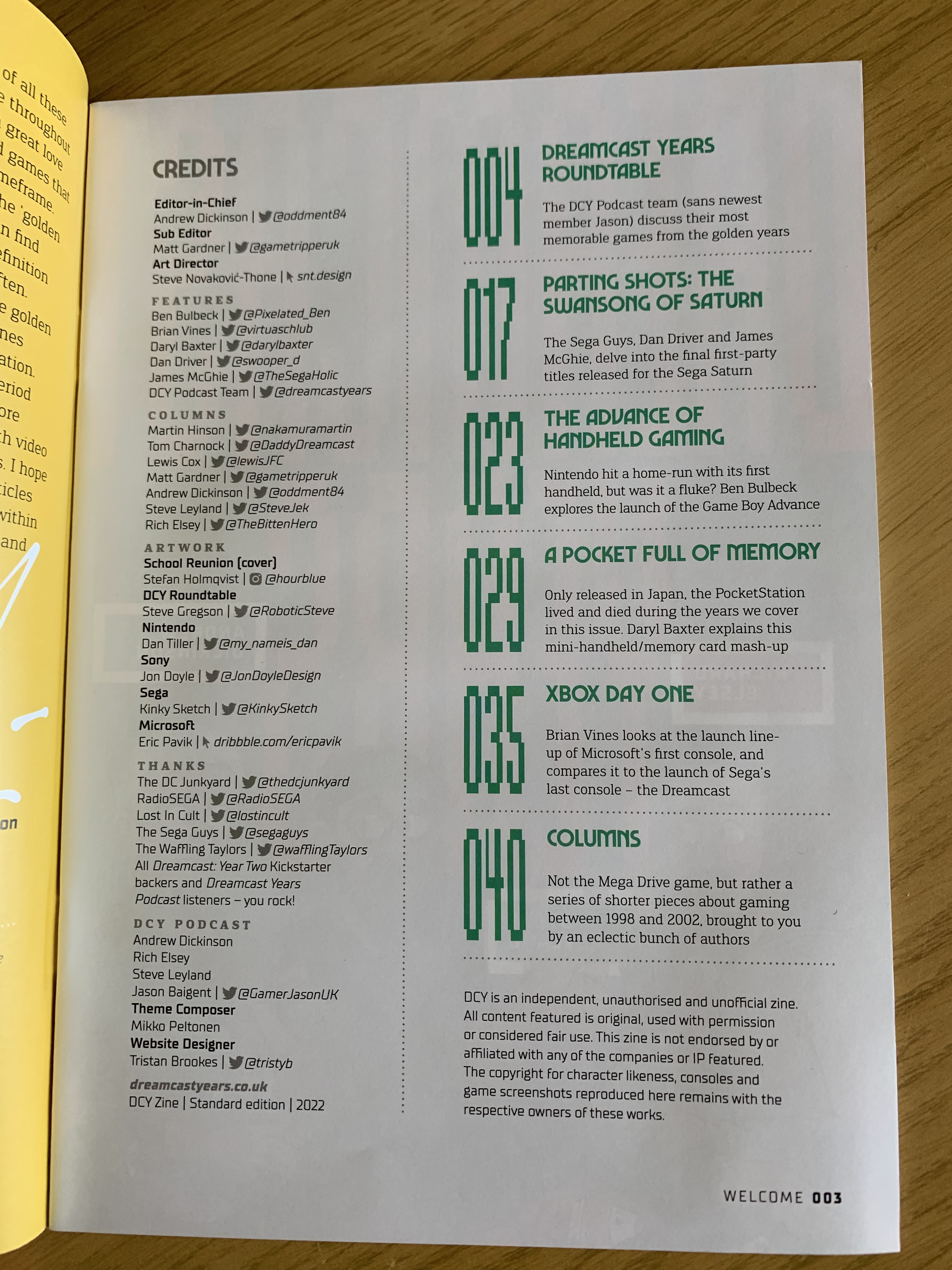
Featuring contributions by a number of names familiar to the retro scene, Dreamcast: Year Two begins with a walkthrough of that tumultuous year and a rather neat synergy with the five stages of grief. Then come the interviews: again, there are some familiar names and all have some interesting comments to make. A quartet of features take the reader to near the half way point before we get to the really fun stuff: the games.

If you look at the contents page above, you'll see many a famous Dreamcast titles in there, including two of my all time favourites: Metropolis Street Racer and Fur Fighters - honestly, the latter, despite its funky controls, is one of the best third person shooters ever made. The highlight is the piece on Spirit of Speed 1937, as well as an interview with the managing director of the studio responsible for the game. Widely regarded as terrible (some consider it one of the worst games ever made), its inclusion here is a lovely rebalancing, not putting it on a pedestal, but providing a re-appraisal that considers the good points the game has too. 

There are many screenshots included, as well as original artwork for some of the featured titles, interviews and the like. Production quality is high and, overall, this is a worthy follow up to Year One, and one can but hope that a Year Three Kickstarter is not too far away.

Speaking of Kickstarter, as a backer, there were also some more goodies too - postcards of the artwork, a couple of bookmarks, a sticker, and a DCY booklet centred on a period of gaming from 1998 to 2002. Five features and a round of of opinion pieces, this is a nice add on and well worth a read.

So there we are then - better late than never and definitely worth the wait, Dreamcast: Year Two continues the fine work in Year One and promises a cracking finale for Year Three - if only to see Headhunter get some more love - truly a classic of its time. You can follow the author on Twitter here and, although he may not have any further copies of Year Two for sale (he reckoned they'd be gone by the beginning of June), you never know, Lost in Cult might be persuaded to support a reprinted single volume once the series is complete... I mean, when you're Operations Director, you have to have some say, surely? ;-)

In any case, although much has been written about the Dreamcast and it's library over the years, this worthy tome adds yet further flavour to the machine's history and is highly recommended to all. Andrew and every single contributor to the book should be congratulated on a job very well done!

Saturday, 13 May 2023

Defending Rodinu - Volume 2 by Krzysztof Dabrowski - Book Review

Here we are with volume two of Defending Rodinu, this time continuing the story from 1961 to 1991, and this is where things get more interesting as technological and organisation developments both aid and hinder the air defence of the Soviet Union. 


The first chapter gives a run down of the PVO (Soviet Air Defence Force), its organisation and the surveillance, control and early warning systems it employed. Chapter two focuses on the developments in surface to air and anti-ballistic missile technology throughout the period covered - the amount of effort put into fielding highly advanced technology for the time is impressive, despite the obvious effects such spending would have on the wider Soviet economy - but that's a tale for another time. 


Chapter three covers the aircraft pushed into service and the various missile systems they used. As a military aviation enthusiast, I do like the design of early jets, and the range of Soviet machines do, at least for me, have a certain je ne sais quoi. From the svelte Sukhoi Su-11 to the more sedate looking Yakolev Yak-25, there are some striking looking aircraft here. The purposeful Yak-28 gets some love, as does the incomparable (and might fine) Tupolev Tu-128 - now that is how you build a long-range interceptor!

Chapters four and five cover polar and border intercepts, whilst chapter six proves that there is nothing new in this world as the Soviets dealt with many a balloon incursion long before it became fashionable to shoot down the things using an almost priceless F-22 and an expensive AIM-9X. 


Chapter seven is a more sombre read, taking on the subject of airline intercepts and, of course, covering the infamous shoot down of KAL Flight 007 in 1983. There were other intercepts, but none ended in the tragedy that engulfed that Korean Air Lines 747. 

Chapter eight is all about the defections that the service suffered, nine features the successful shoot downs of valid targets, whilst ten highlights possibly the most absurd missed interception of the Cold War, Mathias Rust's jolly boys day out to Moscow. It wasn't the only light aircraft shenanigans, as you'll find out here. The final chapter relates the closing period of the Cold War.


There are a couple of appendices: Commander of the PVO between 1945 and 1991, and a chronological list of the PVO's aerial victories, of which there were many more than I expected. 

As always with a Helion & Co publication, there are numerous photographs, maps and diagrams, all of which are high quality - taking into account the nature of the original imagery and its age, whilst the central artwork section has some lovely profiles of the aircraft featured within. For those who, in the best traditions of the Federal Network infomercials, want to know more, there is a cracking bibliography to investigate too. 

In the same vein as volume one, this is a well written, highly informative and interesting look at how the Soviet Union approached air defence through the Cold War. With plenty to read, look at and follow up on, they're a very worthy pair on the subject, and of much benefit to history fans and those who may wish to put something on the table. You can buy this (and the preceding volume) directly from Helion and Co here, as well as follow the publisher on Twitter here.