![]() |
| £399 plus VAT for a Classic - still not a bargain. |
![]() |
| Don't forget to add VAT to these prices at 17.5% |
![]() |
| £399 plus VAT for a Classic - still not a bargain. |
![]() |
| Don't forget to add VAT to these prices at 17.5% |
The tail end of 1991 and Brian Adams had finally been dethroned from his sixteen week domination of the UK singles chart. City Slickers, The Fisher King and Point Break gobbled up cash at the cinemas, whilst on the goggle box, Murder Most Horrid, Noel's House Party and the forgotten gem that was Dark Season kept those indoors entertained. Meanwhile, Amstrad was trying to make a comeback.
![]() |
| SPOILERS! |
Hitting the shelves in mid-November, the December issue of What Personal Computer from EMAP displayed Amstrad's latest and greatest on its cover with a headline that wasn't exactly flattering. Features on DR-DOS 6, Publisher for Windows and how to PostScript your printer may have appealed, but Alan's latest baby was front and centre.
A side note first and one of the funny things about picking up old computing magazines is that researching them is a bit hit and miss. EMAP at one point published numerous video games titles as well as more serious computer related ones, but could I hell find out much about WPC. For a title that had, as of this issue, an ABC figure of 42,318, it is a sad situation that it is almost lost in history. Sure, people remember Computer and Video Games, but mention of their serious output is surprisingly rare.
![]() |
| £999 for a multimedia PC? A bargain! |
Anyway, onto the news, and the main piece concerned the arrival of big name word processors to Windows, this being a time that DOS still ruled. Windows 3 was making in-roads though, and this was further evidence that the times they were a-changing. Seikosha were dipping their toes into the low-cost laser market - their OP 104 was released at just £904, whilst Philips were launching a range of multi-media PC's - the 20MHz 386SX model at £2,499 would be available in the first half of 1992 (4MB RAM, 80MD HD and SVGA graphics), but those too impatient to wait could have a 40MB 286 model for £999 (which also included Wing Commander). Remember that price...
![]() |
| Arguably yes. History says not. |
It was also the time of Comdex Fall, the report of which crowed about Apple's new Powerbooks, IBM's continued delay of OS/2 version 2 and a colour Dell 386 laptop for under £3,000! In Shop Talk, Diamond Computer Services had opened a new shop on Tottenham Court Road. Diamond were a common advertiser with their superhero themed Captain Diamond persona, and Tottenham Court Road was, at one point, the place to go for tech in London. It had dulled a little by the time I managed to wander down it in early '98, but back then, retail was still king.
![]() |
| What can I say? It was the 90's. |
A fascinating piece talks about the future of Intel. the rise of Unix, the ACE (Advanced Computing Environment) consortium - Wiki entry here, and the threat posed by Sun and their SPARC chip. Ah, the 90's - if only you'd known that Wintel was unbeatable, at least for that decade. The arrival of the Internet and the changing means with which people interacted with computing technology would mess up/make things interesting as the new millennium arrived. With thirty years hindsight, little did they know...
![]() |
| As befits a December issue, "Oh, no there isn't!" |
Anyway, to the cover story and just plain Alan (he would be knighted in 2000), was trying his luck with a new range of machines to recapture the glory days of his budget PC empire. The 5000-series used a tiny case in the same style as its previous 4386 "executive" desktop, designed to be a simple unit you plugged in and never opened. Although it lacked spare drive bays, it wasn't entirely expansion free - two half-length 16-bit slots promised not very much - and if you got the 1MB model, zero free SIMM slots, but what else did you need? The 0.29 dot pitch VGA monitor could handle 800x600 rather well, and it worked, albeit a tad more slowly than other similarly specc'd 286's. The problem was the price. £999. If you recall, Philips would happily drop a multi-media equipped 286 on you for that. Amstrad was no longer cheap and cheerful. A competing machine from Chipset (who are they???) would give you Super VGA with a 1MB Trident card capable of 1024x768 for £899. Another clone manufacturer was Atomstyle, whose colour VGA option came in at just £715. It had room for two 5.25" drives, four spare SIPP memory slots and a free 16-bit card slot, as well as two 8-bit slots if you needed them. Things didn't get better for Amstrad either.
![]() |
| Nope, you could buy better for less. |
A couple of pages on there is the 5286 Games Pack review. Taking the compact desktop as before, switching the monitor to a slightly lower quality one and packing in speakers, a joystick and three games, this was an £899 package that, as the reviewer put it, was decent for someone who couldn't be bothered but you could find better DOS-based value elsewhere. Against the Commodore Amiga upgraded to match the features included, it was decent, although not spectacular, value. It should also be considered that both the A500 and the 286 processor were rapidly approaching obsolescence. What was interesting about the software pack is that as time passed, the same bundle would be attached to other Amstrad models in a manner that suggested that they massively overestimated demand at the time. Needless to say, the 5286 Games Pack bundle was quickly discounted and would end up being something of a missed opportunity.
![]() |
Moving on, we have a bench test of communications software featuring some of the best 90's tech names you've can imagine. SmartCom III, Trans-Send (see what they did there) and DynaComm (surely an evil corporation with that name?) fight it out with the more mundane Datatalk 4, WinComm and Relay Gold 5 (a 70's tribute act if ever there was one) in getting users on to bulletin boards and multi-user dungeons. Such an innocent time.
![]() |
| Por favor? |
DR-DOS 6 gets a five star review for being better than MS-DOS 5, in a repeat of how DR-DOS 5 was miles ahead of MS-DOS 4.01, although that particular Microsoft product was indeed terrible. However, questions over compatibility when running alongside Windows 3.1 remained and MS were nasty bastards/legitimate hard-headed business people - delete as applicable. It was only ever going to end one way.
A review of the Canon Ion RC-260 digital camera is an interesting read. For £490, you got a fun little camera that could take up to fifty images and store them on tiny 2 inch floppy drives (not the same format as the 2-inch floppy's Zenith tried flogging with their laptops) that cost £5.10 each. You could preview your images on your TV, save them to your PC (using the £496 connection kit), and then re-use the storage. As a review, it lacks details on the sensor and battery life (tiny lead-acid unit, a sure sign of the times), but the reviewer really does like it. They do recommend saving the images to VHS cassette via your TV rather than on your PC as a full 50 images when de-compressed onto your hard drive would take up 60MB! Thinking of the price, the reviewer states that if you are struggling to justify the cost for professional desktop publishing purposes then knowing the kid'll love it should clinch it for you. Wait! What? £500 (that's over a grand today!) for something to hand to the kids to play with???
The author remembers that children are given mobile phones that can cost a similar amount these days. Shakes fist at clouds then returns to laptop.
One final regular feature before we get to the adverts is the Consultancy section. Companies could apply for £1,000 of free consultancy regarding IT equipment and be featured in the magazine. Only the first £1,000 was free and at £100 per hour, that could get quite pricey. Still, makes an interesting read about a fabrics company that got shafted by a supplier and how a definite lack of knowledge damaged the company. Reading between the lines, it looked like the consultancy form used by the magazine was a) going to have a decent payday considering the mess they found and b) earning their pay rather well.
As for the rest of the mag, the back contains various hardware and software review directories, a yellow page small ads section and 16-page pink section devoted to shareware. Anyway, now it's onto the fun stuff - the adverts!
![]() |
| Multiplex - but do they include an operating system? |
Amstrad have a page dedicated to their 20MHz 4386SX (4MB RAM, 80MB hard drive) - £1,699 ex VAT for the colour model, £1,499 ex VAT for the mono model. Leaving aside the minuscule 10" display and the small case, Multiplex a few pages on could sell you a 386 SX 25MHz with 4MB/115MB for ££1,099 ex. You got both 3.5" and 5.25" floppies too, but possibly not DOS or Windows (ad doesn't say and doesn't give prices either but say add on an extra £100 ex as this was the time that many companies advertised headline prices without an OS to make offers look even cheaper - and yes, it was a shitty way of doing things). The case would be much bigger, but so would the monitor at 14'. If you wanted to spend the same amount as Amstrad wanted you to, then for £1,699 ex VAT, Multiplex would give you a big box 486 DX 25MHz with 115MB of hard drive storage and 8MB of RAM. Sure, adding an OS would bump that up but it just shows how... misguided Amstrad's attempts were at this point.
![]() |
| Amstrad do include the OS but at that price, they bloody ought to! |
Commodore were still trying to flog DOS PC's, rather that focussing on what should have been their core product, the Amiga. A top tier 486 model would set you back over three grand exclusive of VAT, a 286 portable came in at £1,199, and their base 16MHz 286 cost a lowly £689.
Time was a reseller of note for most of the 90's, and their business-focused advert neatly shows that the 286 was the budget processor of choice - £600-£700 ex for branded machines, whereas if you had a grand upwards, the 386 was your best bet. Portables were also a thing, and a budget Sanyo 286 for £849 wasn't bad.
![]() |
| Don't care if the printer is free, I still don't want it. |
Evesham Micros were venturing into their own range of desktops, but would still sell you Amstrad and Olivetti desktops. Not sure how popular a single floppy drive 12' mono monitor equipped 5086 for £399 inclusive was, but hey, you got a cheap dot matrix printer thrown in. Whether you'd want the trash that was the Amstrad DMP3160 is another question. Even for 1991, this was a terrible package. You could get discounted 2000-Series Amstrads which seemed decent, until you realised that the 086 models are obsolete and the 286/386 range come with DOS 4.01. And as for that twin drive PC1640 EGA model for £349 inclusive, well, as a retro fan, hell yeah. As a sober adult, not a chance in hell, even then.
![]() |
| These are NOT the bargains you're looking for. |
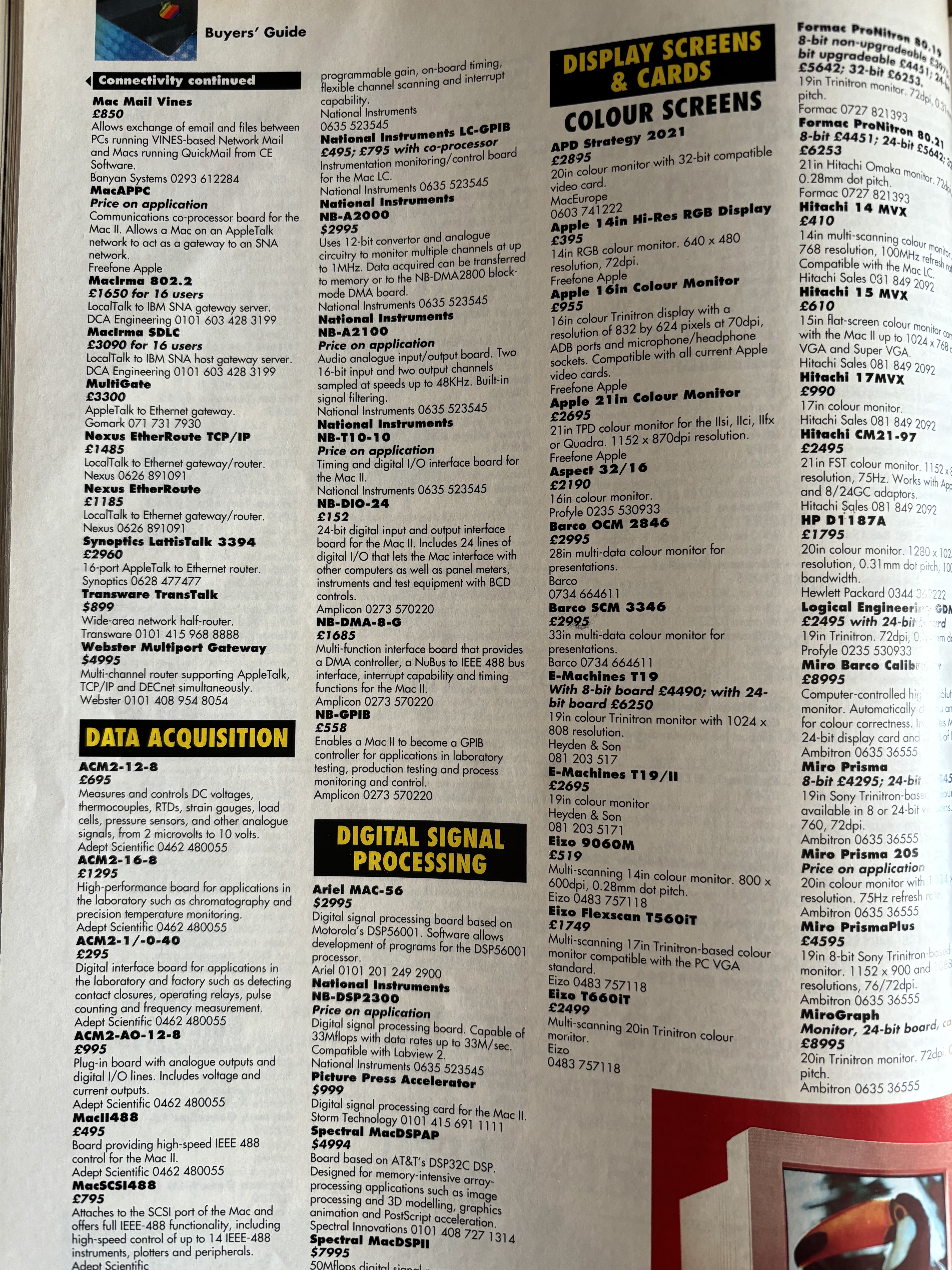
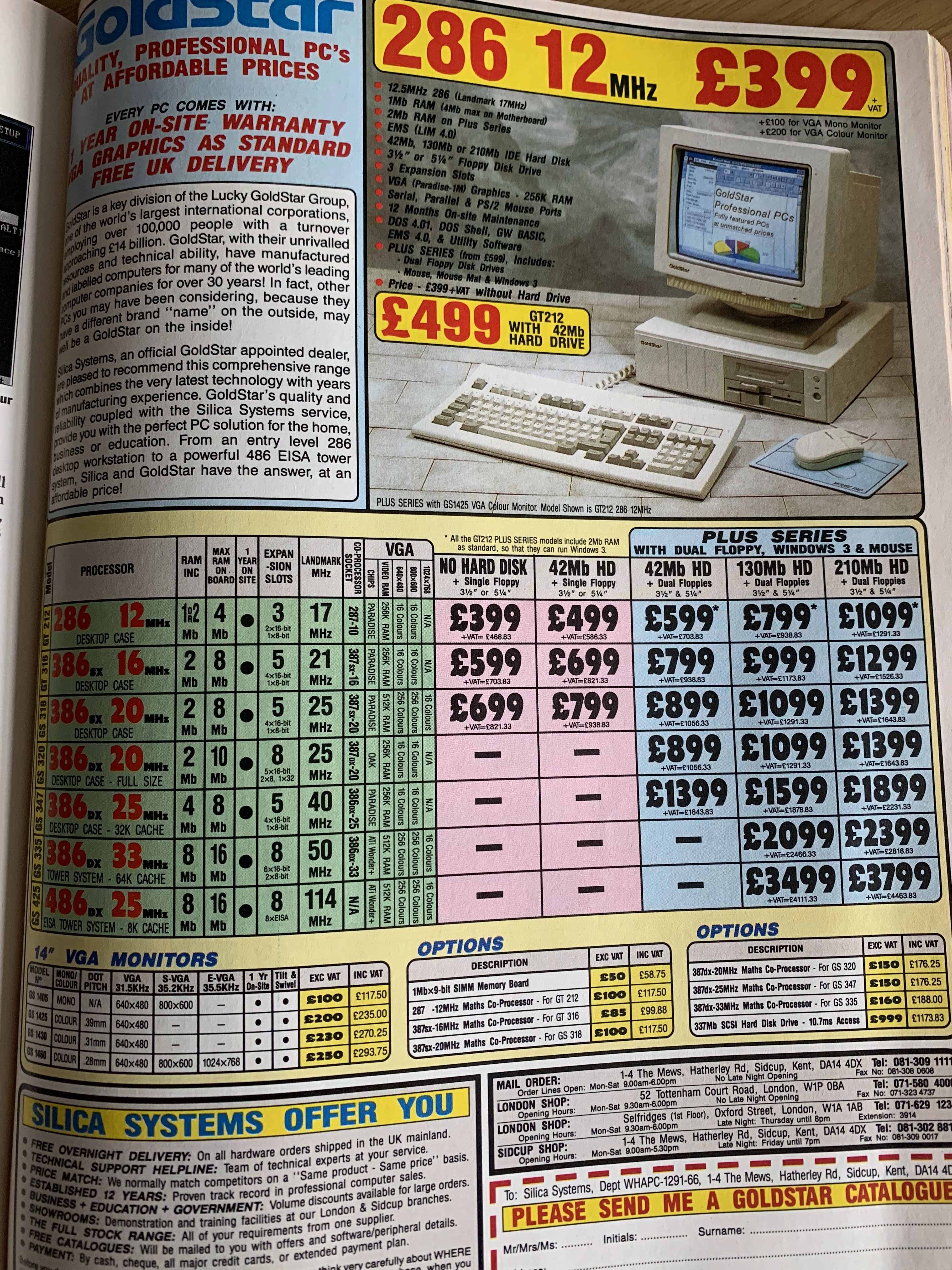
Silica Systems (an almost constant presence in the ST and Amiga Format publications amongst others), had the Goldstar range on show (Lucky Goldstar is now better known as LG). They might look cheap (and to be fair, they were decent value), but those prices exclude the monitor. Still, a secondhand GT-212 model was my first DOS machine and it was a good little runner. Silica also had some portables on show, and I still like the idea of that PC XT notebook, even if adult me realises it would have been an ergonomic and practical nightmare to use.
![]() |
| They may include the OS, but screens are extra. |
![]() |
| I so wanted one of these - even if they were shite. |
So there we have What Personal Computer. An issue that's at that slightly awkward point in PC history where the 286 was just starting to fade away as the 386 muscled into the sub £1,000 market. There are still the old '086 holdovers but their days were numbered, as were those of Amstrad. It would take another five years or so before they retired their computing range (the Pentium P75-powered PV/TV combo Integra range was I think their final attempt), but the days of selling via dealers were ending. Direct was the way forward, and price conscious clone makers were leading the way. Alongside the 386, Windows was becoming the default means of interacting with your PC - DOS was still the OS, but Windows was getting there. Wherever there was.
But what if you didn't want the kludge that was the DOS/Windows mash up? There was always the Mac, but that's for another time.
Video games and violence, that old chestnut, eh? A favourite of tabloids and politicians throughout the last five decades or so, numerous studies have shown that there is no causal link between playing a video game and committing violent acts. There are age restrictions in place to protect children, yet every now and again, the same old tropes get wheeled out because someone who has little or no experience of playing video games thinks a five minute session in Doom will turn you both psychotic and into an expert at wielding firearms. It will do neither, but nor is gaming all about violence, and this is where James Batchelor's volume from White Owl Press comes in, highlighting The Best Non-Violent Video Games.
Over 160 or so pages, Mr Batchelor (a long standing video games journalist) provides us with a guide to just a handful of the many non-violent gaming titles that are out there. I say just a handful, yet over three hundred are featured out of nearly 4000(!) suitable games (at the time of writing) that the author has collated in the research for his Non-Violent Game of the Day blog and X(Twitter) account. One thing is sure - whilst you may find familiar favourites included in this volume, it's more than likely you'll think of a game he hasn't included - PS2 flight adventure sim Sky Odyssey springs to mind - but having said that, it is also certain that you'll discover more than a few new games to try from this collection.
As befits the subject, the foreword is supplied by John Romero, indelibly linked to violent video games through his design role at id Software and the likes of Wolfenstein 3D, Doom and Quake amongst others, and raises some very fine points. There is a brief note on what qualifies as a non-violent video game before we move on to the main section and the games proper. Readers of previous White Owl publications will know the layout by now - two games per page (entry size varies but the format doesn't change), details on who developed and published the title, its year of release and its platform availability. Every entry also includes a screenshot, and the write up provides not only a description of the game but also fun snippets and details on any follow ups. Each one is interesting and written in an entertaining yet informative style. placing a lovely focus on the appreciation the author has for the genre of non-violent video games.
![]() |
| Everybody's Gone To The Rapture - aka Tantobie on a Sunday afternoon. |
Starting with Pong because, well, it's Pong and it's definitely non-violent, the rest of the entries are in alphabetical order. There are some familiar personal favourites: Forza Horizon, Dear Esther, Loom and PowerWash Simulator, as well as titles that I had maybe seen and thought "oh, they look good" and many that had just plain passed me by. From Townscaper to Lake, Before I Forget to Heaven's Vault, I now have a revitalised list of titles to get round to.
Mixing big studio efforts with small scale Indie releases, VR extravaganza's with now lost mobile games, this volume is a treasure trove of information and recommendations that will not only suit interested parents but also gamers in general. The Best Non-Violent Video Games is yet another superb publication from White Owl and reinforces the concept that games do not have to be violent to be supremely enjoyable or worthwhile.
You can pick up a copy direct from the publisher here, or at the usual online and physical book shops. I got my copy from Forbidden Planet in Newcastle, who also stock a decent range to Bitmap Books titles too.
Much like birthdays, Mr Scullion's "Gaming Encyclopedia Emporium" (otherwise known as the White Owl imprint of Pen and Sword Books), makes its annual appearance to deposit yet more gaming history on suspecting (if they'd pre-ordered it) members of the general public. Indeed, it was on this weekend last year (well, 20th September 2022) that I posted a review of his excellent N64 volume, so for the 2023 edition of "What's Scullion been up to?", we tackle his unofficial guide to Sega's final home console: the Dreamcast.
Ah, DC, you sweet little plastic and metal box of joy. Born from Sega's internal politics, killed by the very market it sought to compete in, this was a games machine that spanned the changing of the guard. Four controller ports for local multiplayer, compact design that would practically hide on a shelf (keeping one side open for that fan), yet also packing a built in modem for online play and internet connectivity, as well as the Visual Memory Unit that promised (but kinda failed to deliver) new gameplay wonders. There were, however, wonders in its gaming library - and it wasn't that huge a library either...
This latest book from Mr Scullion is a tad thicker than usual, taking as it does a look at the over 600 titles released for the Dreamcast. This is a worthwhile decision as it provides the reader with a one stop shop for all games Dreamcast. You might think you know about the various visual novels that Japan experienced, but Chris has had to experience all of them. You must buy this now just to help him afford the therapy! Truly, the section on Japan-only releases is... well... "interesting'... shall we say.
Given the extra coverage, you might expect there to be fewer single page entries, but no, plenty of titles get that full page loving. From the obvious (Virtual Fighter 3TB, Jet Set Radio and Sonic Adventure(s) 1 and 2), to the more eclectic (Alone in the Dark, Ducati World Racing Challenge and The Nomad Soul), the depth and richness of the Dreamcast's library is lovingly handled by the author. The ever-present additional facts are cherries on the top. And yes, there are bad jokes too, but hey, it wouldn't the same without them!
![]() |
| A classic in my humble opinion. |
For me, the most educational part was the Japanese-only section, and whilst I have never played a "visual novel" (cough, 'onest, Guv'nor, cough!), I feel as if its a genre that perhaps will remain outside of my in-depth experience. I'm not saying never, but, well, yeah...
![]() |
| The soundtrack for this game remains immense even today |
As the Dreamcast is one of my favourite consoles of all time (both hardware and the library), flicking through these pages brought back many a memory from 20-plus years ago. The first time I got to ride the motorcycle in Headhunter, the awe at seeing London in all of its glory in Metropolis Street Racer, and the sheer amount of visual gags in Fur Fighters - good times were had, although they weren't all positive - the control malarkey with Starlancer, the not-so-simple (yet marvellously fun and addictive) joys of Toy Commander and, perhaps the ultimate achievement for me at the time, completing Shadowman for the second time but seeing it as its best, not through the fuzzy filter of the N64.
![]() |
| I loved/hated this game back in the day. |
However, this tome is more than just a memory-fest for those of a certain age. This is a valuable guide to how seriously good the Dreamcast's legacy is. The last of the "traditional" home consoles that begged you the gather friends for some four player Powerstone, the first of the "next-gen" home consoles that allowed you to play against friends across the world (citation needed, but that's how I see it), the Dreamcast had pretty much something for everyone. It wasn't enough at the time, but at least this excellent and informative encyclopedia allows you to experience the glory that was Sega's 128-bit swansong.
You can follow the author on X/Twitter/that old social media company that died in 2023 (@scully1888), and pick up a copy of this excellent volume direct from the publisher here. It's also available from the usual online and physical bookstores too.
It is said that you should "Never judge a book by its cover" yet when it comes to science fiction novels, particularly those published from the 1960's to the 1980's, the cover was one of their stand out features. In this lavishly illustrated tome, Adam Rowe showcases some of the best of 1970's SF art.
Over its more than 220 pages, the author takes us on a journey through the various Science Fiction sub-genres using the medium of artwork and featuring some of the most famous names to contribute to the form. Each section gets a write up, artist biography or commentary on their work, as well as well-considered criticism. A side benefit for me was relearning about the many SF authors of the period covered, then diving online to find physical (or much cheaper digital) copies of their works. Seriously, some original paperbacks go for silly money! And as for a Spacebase 2000! I lost my original copy years ago, and yet even at close to £50, I'm still tempted to pick up a second hand one...
A foreward from Vincent Di Fate (an artist of some note himself), sets the scene perfectly, that this is a scholarly work, one that draws the reader into its subject and aims to mesmerise you with the frankly stunning imagery included. From the lived-in SF of Chris Foss, to some of the more abstract work of Don Ivan Punchatz, and the disturbing visions of Philippe Caza, there really is something that will appeal to everyone, such is the variety provided by science fiction. There is great educational value here too, and I admit to having spent a considerable amount of time searching online for more work by many of the included artists. To throw out another cliche, I don't know art but I know what I like, and it turns out I like a lot more SF art that I was aware of. For that realisation, Mr Rowe, thank you.
This is a deliberately short review, and one that will let the pictures do the talking. If art or SF is your thing, then Worlds Beyond Time needs to be on your bookshelf. I cannot find a single flaw with this volume. Check out the author's link tree here, containing lists of where to buy this fantastic book as well as their social media presence. In the meantime, here are some pictures to whet your appetite...
A quartet of TWATS met last Saturday for one of our semi-regular gaming sessions, which once again saw me back in the chair (two games running, Temporary Unpaid Chief TWAT! Two!) for a bit of nautical naughtiness and a return to Shipwreck, a ruleset we have used twice before. However, instead of the usual plastic snap kits (and I'd worked on the Type-054A stats especially), we were using Steve's rather tasty little collection of Soviet and Royal Navy ships.
![]() |
| In the blue corner, the Royaaallllll Naaaayyyveeeeee! |
As usual, this was an umpire-led game (a daunting task requiring much support from a Singleton or two, a tasty little malt), with Admiral Andy donning his No. 3 dress, whilst Shaun and Steve began rattling off the Soviet National Anthem in true Red October (the film) style. The aim of the game was simple. The British, comprising of the Invincible (damaged so no flight operations), a Type 42 (the Sheffield), two T22's (Broadsword and Battleaxe) and a Type 21 (Amazon), had to get to the far end of the table. To stop them, the Soviets had the Slava, a Sovremmeny and two Krivak II's. Would the plucky British get away with it, or would the Soviets find the sunrays of freedom cheering them on?
![]() |
| In a different blue corner, the Soviet Military Maritime Fleeeeeet! |
Steve and Shaun decided from the get go to split their forces, Steve taking the Sov and a Krivak II, Shaun the Slava and the other Krivak. Aiming for a pincer movement, Steve decided to approach with radars on but, as was apparent by the distance on the table, nothing was detected. A couple of movement turns saw the opposing forces approach each other, and it during movement turn 4 that Andy detected the Sov. A double movement turn (with the agreement of the players) saw the second ship of Steve's flotilla detected by the British.
![]() |
| A naval Rorke's Drift: them horns look dangerous... |
It was only during movement turn 6 that Steve's group detected the Sheffield and Battleaxe. Being a cautious type, Steve launched two SS-N-22 Sunburns at the Sheffield, a sensible choice given the Sea Dart present. Now we were into combat turns.
Andy went loud with his radars and Steve's ships were painted. Battleaxe launched a pair of Exocets at the Krivak, whilst Broadsword had two at the Sov. The second combat turn saw the Sheffield down one of the Sunburns, yet it wasn't all one way as three of the Exocets were shot down by the Soviets. Combat turn three saw a brace of Sea Darts deal with the errant Sunburn, whilst a trio of SA-N-7's handled the final Exocet.
![]() |
| Vampires, Vampires, Vampires! |
Back to movement now and it was it was radars-a-go-go with everyone detecting each other. Steve decided more shots were in order so launched all four SS-N-14's from the Krivak II against the Invincible as the Sov lofted four Sunburn's at the Sheffield. Shaun, on the other hand, decided that he was sick of the top weight on the Slava. He fired all sixteen SS-N-12's at the Invincible. It was almost an afterthought for his Krivak II to shoot two '14's at Battleaxe and two at Amazon. Andy's response was to fire his remaining Exocets, a pair at each of the enemy vessels.
![]() |
| Shaun turning to engage the British |
Needless to say, the following few minutes of play decided the afternoon.
Invincible and Sheffield engaged the incoming from Steve, shooting down one from each missile group. To the south, the Slava tackled the incoming Exocets and downed three out of four.
![]() |
| Are 16(!) SS-N-12's overkill? |
The next round of fire took out the last of the Exocets targeting Shaun's duo, whilst Steve managed to shoot down three of his incoming. As for the British defence, Sea Darts accounted for another two of Steve's missiles, leaving Sheffield and the Invincible to face off against a pair of missiles each.
![]() |
| One or two may have slipped through the defensive screen... eek! |
With the incoming down to very short range, and a single Exocet that didn't bother the Soviet defences too much (CIWS shot), it was all on the British to survive the onslaught. Amazon was targeted by two missiles, and shot one down with Sea Wolf before handily avoiding the final one via its EW capabilities. Sheffield was less lucky, taking a direct hit and receiving heavy damage. The two Type-22's were untouched, which was handy as they would have to deal with the after effects of the barrage against Invincible. Of the final 13 missiles, two were hit by Phalanx fire, three were decoyed by chaff, and six succumbed to EW. Even then, of the two that hit, the first impact only caused light damage. Could the pride of the Royal Navy survive to fight another turn? Shaun's dice rolling said no. The final hit was catastrophic, sinking the carrier and effectively ending the game. With more SAM's and bigger guns, the Soviets ruled the table and it was time to retire to the bar and sample that Singleton (again).
![]() |
| I'm not saying it was an inadequate reply but... |
This was a fun game and it was enjoyed by all, despite two of the players knowing very little about floaty boats of this period. The North Atlantic setting was a nice change and, given the end result, demonstrated that quantity (of big SSM's) has a quality all of its own. I mean, sure, you'd not shoot off everything from a Slava in real life (especially the one or two missiles with added buckets of sunshine), but it was a good example of how under-gunned so to speak an RN surface action group could against a Slava. If that hadn't of been there, they would have had a better chance. Maybe a thought for a future play through when we return to Shipwreck some day.
Once again, many thanks to Stanley Masonic for the use of the bar. Sadly, our regular victualler was on holiday (the very cheek!) so samples of Cooplands finest was our back up.