Saturday, 3 February 2024

Supercade - A Visual History of the Videogame Age 1971-1984 by Van Burnham - Book Review

Now this is a coffee table book and a half. First published in 2001, Supercade: A Visual History of the Videogame Age 1971-1984 (hearby just called Supercade 1, for as Yoda said, there is another), aims to address the requirement for demonstrating the aesthetic beauty of videogames as well as its evolution. Over 440+ pages, Van Burnham and a gaggle of contributors lay out the history of the art form as well as the hardware and characters between 1971 and 1984. And it is stunning.

Seriously, this is an art book first and foremost, with full pages dedicated to photography and screen grabs. Artwork pops off the page, and what would now be considered archaic graphical resolutions are celebrated in luxuriously high detail. Indeed, on my first read through, I pretty much ignored the text and looked at the (very) pretty pictures. But there is more to Supercade 1 than just the eye candy. Oh, much, much more...

As Maria told the von Trapp children, the beginning is a very good place to start, and this they do in Supercade 1. From the foreword by the late Ralph H. Baer, the history lesson begins at Brookhaven National Labs with Tennis for Two before moving on to MIT. It is this grounding in the very early history of computer entertainment and the intertwining of imagery and historical research that makes Supercade 1 a perfect introduction to videogames, what they started out as and how they evolved in their formative years. Every entry is well researched and written in an easy style. Tear yourself away from the visual feast and you will learn stuff too.

You heard the but coming, didn't you?

Yes, but only a little one. This is a US-centric tome and, to be honest, that's understandable. Due to the coverage of arcades, there is a hefty dose of Japanese titles, but only two pieces of Japanese home hardware: Sega's SG-1000 (giving useful context to who Sega were before their 16-bit glory days) and Nintendo's Famicom because, well, obviously! But what about everyone else? You do get the ZX Spectrum. I am not going to deny its obvious importance to the UK gaming scene, and the ZX81 did see a US release as the Timex 1000, but where are the others? The Amstrad CPC? The BBC Micro?? The Grundy NewBrain??? Honestly, some people! ;-)

In truth, it is rather churlish of me to complain too much - this is a visual history of videogames and the early days were heavily driven by US and Japanese companies. There is only so much you can include in a book this size (remember, it's a hefty beast at nearly 450 pages), and what it does cover, it covers extremely well. There are certainly many other resources for those who want to look from a UK/European perspective, and when all is said and done, most of the titles mentioned in Supercade are, at worst, genre classics, and at best, defining examples of the art form. 

Supercade 1 is a superlative feast for the eyes (and the brain) on a subject that, although covered in various guises over the years, really deserved the coffee table treatment, and it sure has received that here. While it is currently sold out at the US-based webshop here, have a Google and you may pick it up from an online retailer for not stupid money. This is the perfect coffee table book about video games, and one that deserves to be on yours. if you don't have a coffee table, buy one or, if you must, place this book carefully on a sturdy bookshelf. 

Saturday, 20 January 2024

Magazines of Yesteryear - Personal Computer World Volume 10 Number 8 - August 1987

Regular readers may recall an August 2023 post featuring the October 1987 issue of Personal Computer World, and might be wondering why I'm returning to the same publication and the same year so soon. Well, good people, it's because of the cover star of this particular issue and the amount of time it took to get my hands on it. 

This, dear reader, was the dog's back in the day. 

Yes, it's the first look at the Acorn Archimedes, packing in Acorn's ARM processor for a desktop costing less than £1,000. There's other stuff too, but as a massive Acorn/RISC OS fan, I've always wanted a copy of this issue and, after several abortive eBay attempts (including one crapping out at north of £20), I managed this example for a tenner. So let's have a look a what's inside. 

It's not all Acorn, by any means, and the review of Atari's PC raises more than just eyebrows, while Psion's Organiser II gets a full airing. There's software tests and the usual columns, and a very intriguing look at the Transputer. Hmmm...

It took a couple more years but the OS did improve. 

News was a bit slow that month so we're straight into the Acorn review. A pre-production machine, this wasn't entirely representative of the final hardware but was good enough to run some tests on, and by 'eck as like, it were fast! As Mr Pountain evangelised, "the A500 [the designation of this development system] felt like the fastest computer I have ever used, by a considerable margin." And so it was, capable of blitzing through anything you'd care to through at it (mostly synthetic benchmarks here), and all for under a grand exclusive of VAT. Yes, the base A305 (single floppy, 512k RAM) was £799, and a colour monitor added another £200. You could cheap out with a green mono monitor for just £50 but why limit this technicolour beast in such a manner? A 1MB model was £875 sans display, while the more expandable 1MB A410 (with a hard disk controller but no actual HD) took you up to £1,399. For the true power user, an fully decked out A440 (4MB RAM, 20MB HD) would take £2,299 from your wallet. Well, way more, as a monitor and VAT would see that total reach nearly £2,900! There again, an IBM AT from your average dealer was north of three grand, and a hard drive equipped Mac SE was about same price as the A440. Of course, not everything was as expensive, and it was Atari that now stepped up to the DOS wicket to see what they could offer against the value-packed Amstrad clones. 

Could this have been a go-er?  No. It couldn't.

A chance of death, it seems, as their rather flimsy (and "relatively mediocre") machine had an unshielded and unprotected power supply. Take the hint, buyers, DO NOT open this machine. Not that you could do much with it once you have dared to take the cover off as there were neither expansion slots nor drive expansion options (despite some labelling that hinted otherwise), but you could upgrade the memory to 640k (from the base 512k), as well as add an 8087 maths co-processor. The socket for the latter was under the power supply, so perhaps not then... 

Many Bothans PCW staff died bring us this information...

It's not all doom and gloom for the Atari - its graphics capabilities were rather good for the time, stretching from MDA to EGA. Yep, the presence of 256kb of video RAM meant 16-colour 640x350 was just a connection away! That sounds sarky, but this machine (albeit with a mono monitor) could have been yours for £499 VAT inclusive. In other words, a cheaper headline price than Amstrad's popular PC1512. However, that had space for three expansion cards, and adding a hard drive card was relatively easy. You pays your money and all that jazz, but a single drive PC even in 1987 was just too limiting.

Allegedly the most fun you could have one handed back in 1987...

The other big review this issue is for the Psion Organiser II, a nifty little handheld computer that I wrote about for Pixel Addict magazine in issue 8. It's a cracking little device which could do the job it needed to back in the day, albeit with a keypad that took some getting used to. It's well liked here and it was a success for Psion at the time.

There has to be a "What If...?" out there about this, surely? 

The feature on the Transputer is something else though. Promising a breakthrough in computing power beyond the contemporary constraints of processor technology, it offered super-computer levels of floating point power and easily scalable parallel processing shenanigans. There were issues though, primarily the lack of a mainstream operating system (and by default bugger all software), and a question of who would need such power. The author notes that a Z80 was more than enough to handle a word processor on Amstrad's PCW8256, though they go on to say that in the future, animated graphics would need the power, as well as a Hollywood director to make the game. He jests but...

GEM Desktop Publisher got the thumbs up (good enough for the asking price of £295 ex VAT), whilst a round up of dBase compilers would be of use to someone... somewhere... As will the piece on the then recently announced OS/2 from Microsoft. It was never destined to end well, but the conclusion at the end of the piece deserves its own screenshot.

OS/2 success and 640k... Indeed...

Guild of Thieves received an alright verdict in the Screentest section, and gamers were also catered for in Program File, where an Adventure Creator was detailed over 16(!) pages of code in very small text and varying degrees of contrast. It gave me a headache just glancing over it.

And they blamed porn for blindness in the 80's...

To the adverts now and DOS PC's were pretty much split into two camps - the XT level 8086/8088/NEC V20 machines that gave you a basic PC starting from about £450 ex VAT before heading up north of a grand. The more you paid, the better you got, with a mono hard drive offering to be had for not quite four figures including VAT. If you wanted EGA graphics though, add another £400 plus on top. The other camp was the AT spec of machines - 286 processors, high density floppy drives and EGA colour if you so desired. Hi-Voltage would sell you an SBC-branded 286 with a 30MB hard drive and an EGA colour monitor for £2,199 ex VAT! You could get cheaper, but not by much, and this pretty much explains the success of the ST and the newly introduced Amiga 500. If you wanted an actual IBM PC, Compumart had the real deal XT starting from £1,100 for a mono machine, whilst your new-fangled AT with a colour display was £3,170! At least they included a keyboard, mouse and DOS for that. Sheesh!

Danger! Danger! Hi-Voltage! 

"Portables" were a thing as the ad for Toshiba machines demonstrates below. Not sure if they were practical enough, but hey, you could tote around your work computer if you so wanted to (and if you had the muscles). Compaq was also an option, as were several other clone manufacturers, but most followed the luggable concept with built-in CRT displays rather than a portable as we would know it. 

They could be carried... with some effort. 

As Acorn were star of the cover show, they decided to advertise their wares with what can only be described as a... marketing choice...? I get it, they went for the Greek connection, but when you have a machine that offered graphical capabilities beyond its contemporaries, a mono advert does seem kinda weird. 

Could they not even afford a colour ad? Probably not...

Apple does something a little different, with a splash of colour for their logo if nothing else. There again, with Mac prices back then, did it really matter? ATT Peripherals Corporation had the Mac Plus at £1,550 ex VAT, a dual floppy SE for £1,875, and fully pimped out SE with 20MB hard drive for £2,450 ex. You may think pricey, yet only slightly more expensive than the monitor-less Apricot Xen 386 below it - but check out the addition of an EGA card and display. An additional £924 on top of the £2,350 for the desktop! Unlike the Mac though, the use cases for a 386 in 1987 were pretty extreme, thus balance was restored to the Mac/PC price comparison. Before we leave ATT though, have a gander at the DTP package. As a sign of how things changed between then and even the beginning of the following decade, a DOS-based DTP bundle including a 286 machine with a Canon laser printer was £4,300 ex VAT. Trick it out with colour and a 386 and you were looking at nearly seven grand! You'd have kept Nigel Lawson happy though, with VAT at 15%...

For a price, you cheeky sod, for a price...

For the next Magazines of Yesteryear, I think a change of decade (just) is in order. We shall jump forward to 1990 and a rather more slender publication. I shall leave you with some more of the ads - starting with ATT Corporation Ltd... (and a final question of Atari that I don't think shlud be asked in polite conversation...)

Not AT&T, obviously.


Other formats were available. 

Your cheapest business dot matrix printer: £444 ex VAT!


Can they be "hotlines" if there's only one?

I mean, it's a question...

Saturday, 13 January 2024

Every Hazard and Fatigue by Joshua Provan - Book Review

When it comes to military history, I find it does me good to read a book on a subject I know next to nothing about. A cynic might suggest I should do the same in my professional life but I do know my CCFA's from my SYSTABS, and my KTYPES from my KSPAR6's... Mostly ;-). Anyway, at the Battleground show last November, I picked up a copy of Andy and Jim's book, Khalsa! (reviewed here) from the Helion & Co stand, as well as this little gem by Joshua Provan. Having read and thoroughly enjoyed his 2022 effort, Bullocks, Grain, and Good Madeira (reviewed here), I had an inkling that his treatment of the Siege of Pensacola in 1781 would be worthy of perusal. I was not to be disappointed. 


West Florida wasn't exactly the centre of Britain's struggle in North America but it was of some importance. With Spain joining the conflict on the side of the rebellious Americans and the French, it placed additional strain on British (and their allies) resources. Over some 200 pages, Mr Provan weaves a tale worthy of your time, even if to most it is a fairly forgotten vignette amongst the many more famous events that defined the conflict.


There are twelve chapters in total, along with orders of battle for each side. The opening sections introduce us to the Spanish, British and Allied Nations, with much attention placed on the latter whose importance was both recognised and, at times, unwanted given the difference in cultures. The author takes an even approach to all, supported by numerous contemporary letters and illustrations. 


After discussing the terrain and the locale, as well as the events that preceded the actual siege, we are then given four chapters that provide a day by day account of the struggle. Highly detailed, clearly organised, and with a pleasing narrative style, Mr Provan paints an evocative picture of siege warfare at a time when gentlemanly conduct was seen as a prerogative. It was not an easy fight, yet standards were held high even after the British surrendered, albeit not to everyone's satisfaction.


There are maps and imagery aplenty, and the central section with the colour plates will be of great use to those wishing to re-enact the struggle on a table top, as will the orders of battle. As always with Helion & Co publications, the bibliography included at the end of the book will provide a great deal of follow up reading if you're enamoured with this treatment of the siege. 


With highly readable prose and a narrative structure that builds to a dynamic conclusion, Every Hazard and Fatigue is another great release from Helion and a fantastic effort from Mr Provan, suitable for readers no matter their level of existing knowledge. If the American War of Independence/Revolutionary War is your thing, you'll do yourself a great favour in picking up a copy from Helion & Co here. It is also an essential purchase if you want to bring Pensacola to your wargaming table. The American War of Independence/Revolutionary War is not a period I have read much about (outside of a few more general texts), but having been spurred on by this volume, I dare say some further, more in-depth reading is required. I can give no higher praise. 

Saturday, 23 December 2023

Magazines of Yesteryear - Computer Shopper Issue 73 - March 1994

This is more like it. Nobody wants a skinny computer magazine. They want great big back breaking telephone directory-style periodicals that not only inform and entertain, but can also be used in self-defence, either to hit someone with or to stop small calibre bullets. This, gentle reader, is the pinnacle of such publications - the one, the only, Computer Shopper (UK). 

It's early 1994 and to all intents and purposes, the 386 is dead, long live the 486! The Pentium is faltering onto the stage albeit at prices that would make your eyes water, while portables are now most definitely mainstream as evidenced by the group test advertised on the front cover, pitting 21 of the mobile(ish) wonders against each other with a starting price of £799. But what else does this fine 600 page(!) issue have in store?

Quite a bit. The notebook test is front and centre but there are also group tests of presentation software and accelerator cards for Windows. Features cover music software, computers and the cops, and Super Computers. Don't get all excited though, the article merely discusses the architectural changes that were on offer and how they might affect future high performance computing. The usual departments are present and correct, as well as the format specific Shopper columns for Mac, Amiga, ST and Archimedes. 

I keep reading the second story as Kenco...

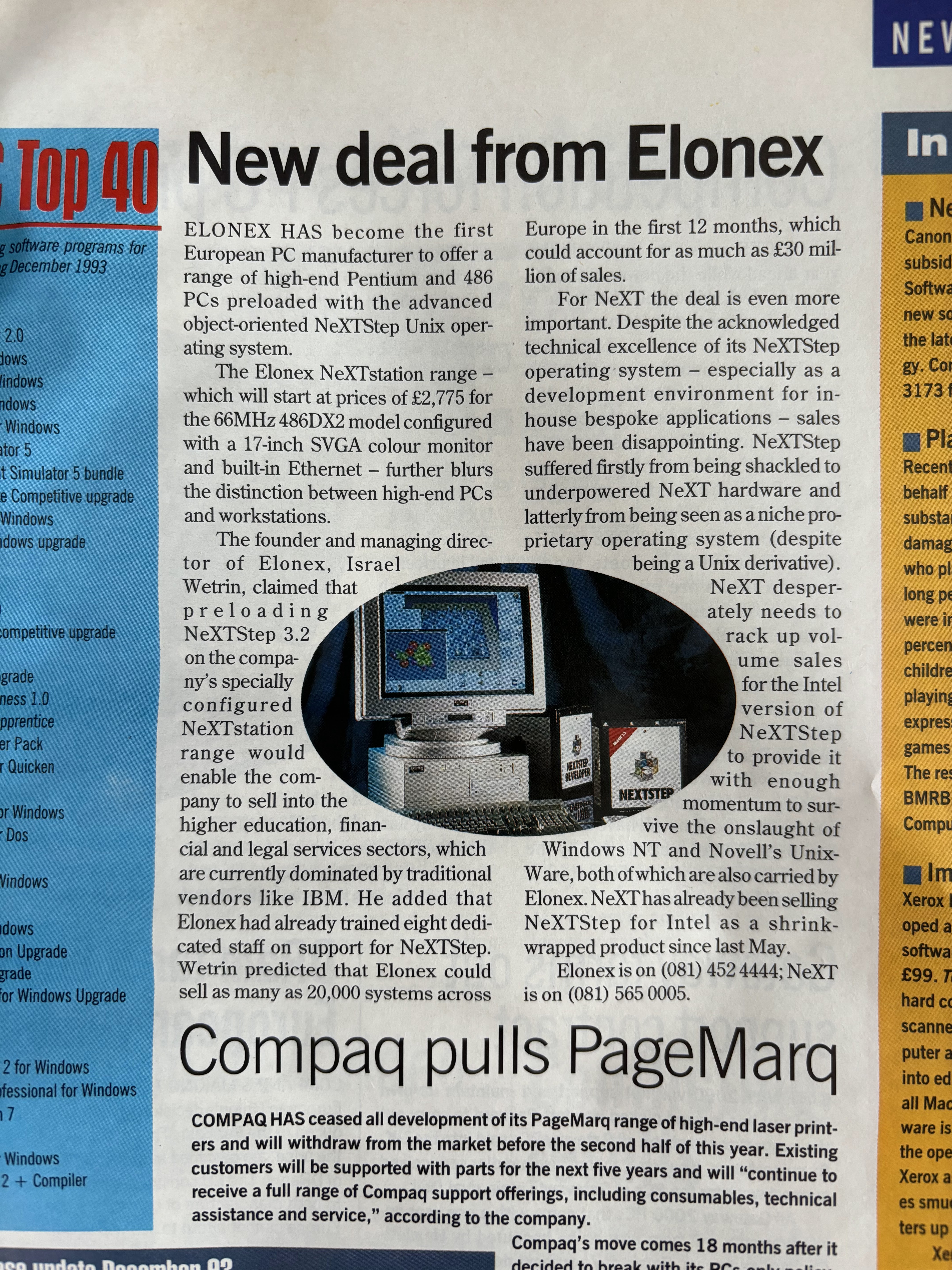
The first news piece reports an autumn release for Chicago. Aka Windows 4 (and eventually Windows 95), this replacement for 3.1 and Windows for Workgroups would see the big M put on its best razzle dazzle to hammer home the point that Windows PC's were for everyone. In other news, Elonex (remember them before they became a purveyor of cheap electronic trash before finally going bust?) were getting into the NeXTStep market with workstations running NeXTStep 3.2. A bold move (with even more bold sales targets of 20,000 machines across Europe in the first twelve months), it's no spoiler to say that it wasn't the success that they thought it would be. Two years later, Apple would buy NeXT to form the basis of what would become Mac OS X.
Speaking of Apple, they were about to launch their eWorld service. A gated community back in the early days of the web, it is the pricing structure that amuses more than anything else. For $8.95 per month, Apple would give you two free hours of use, with each subsequent hour costing $4.95. The very thought of paying by the hour to use the web! The past is a different country and all that...

Finally, there's news that Olivetti will become the sole European distributor of AT&T's EO 440 tablet. Larger than an Apple Newton (and that's saying something), this 10.8 x 7.1 x 0.9 inch device would set you back £1,999 then but at least offered a 7.5 inch mono display and a built in 14.4 modem. 

EO, EO, work on the move with the built-in modem.

To the cover group test and the rise of the truly useful portable PC. They do highlight the Amstrad alternatives (the NC200  being a handy desktop companion, although my preference was always for the NC100 as noted here), and you didn't need to spend megabucks on mobile productivity. In this group, only two machines managed to make it under the all important psychological £1,000 ex VAT barrier - the 386XL-powered Triumph Adler Walkstation 3/25 XL at £799, and the Mitac 4020F at £999. That £200 difference is telling, as the Mitac rocks a 25MHz 486 SX, double the RAM of the TA to 4MB whilst each pack an 85MB hard drive and mono display. Indeed, the Mitac gets the best buy. Other names you might reacll from the period include Watford Electronics with their Aries Perfecta 3300NB, AST's Bravo NB Color, Canon's BN22 BJ notebook with built in printer (those were the days, my friends), and Compaq's Contura 4/25C - still a lovely looking lappy!. 

Handy company info included - and a helpful review layout. 

Hewlett Packard, Olivertti, Panasonic, IBM and Toshiba are other big names here, with big prices to match. Most of these machines include DOS (a couple don't, wanting something like £65 to £99 extra but they'll chuck in a mouse and Windows too), but even the budget TA includes DOS and Win as standard. Only four have 386 processors, the rest coming with a variety of Intel, Cyrix or Texas Instruments 486's. A couple offer 2MB of RAM, the rest provide 4MB, whilst mass storage ranges from 85MB to 200MB, the sole exception being HP's Omnibook 425 which has 10MB of flash storage. And as for colour, well, you'd need a good credit card or deep pockets - the cheapest dual-scan display is the Watford Perfecta's and that machine comes in at £1,500. Active matrix (faster refresh rate, little ghosting and far more vibrant) is epitomised by the Enta NB 6500T for £2,350, and they wanted another £99 for DOS and Windows!

The Shopper columns were always worth a read, and this issue proves no less entertaining. Amiga Shopper looks at Deluxe Music 2.0, coupled with a report on an Amiga party in Topeka Kansas, featuring the team from NewTek. If you remember Babylon 5 or seaQuest DSV, you'll know what their software could do. A Silica advert on the page opposite details the then current Amiga range and just how little you could spend to get an A600 for (if you actually wanted one). £189 for the base machine was really cheap, your bog-standard A1200 was £299 but with many more upgrade options, and the A4000 could be yours for £899, although a more usable configuration would be £999 - and then the monitor on top. You could buy a similarly spec'd Mac LC III for less. That's how competitive Commodore weren't by this point. Oh, and the CD32 was £289. Nice try, Commodore, but the Sony PlayStation would arrive in Japan that December and would easily demonstrate its superior technical chops. 

Atari Shopper talks about the benefits of adding 8MB to an STE (more for use as a Ram disk than anything else), as well as talking about Geneva, a multi-tasking upgrade for Tos, whilst Archimedes Shopper looks at new Archie game Spheres of Chaos and a round up of news. 

The Viglen range - they could have been Contenders... (badum tss!)

It is, however, Macintosh Shopper that is the highlight. MacBiter casts a jaundiced eye over the announcement that Apple would move to the Power PC architecture. To say the author was a tad cynical about Apple's behaviour would be an understatement but he also had a point. No matter how much ill-will you had towards the fruity tinkers in Cupertino, you usually ended up shelling out for their kit anyway. And so it would prove...

Compaq Contura bottom left - a snazzy looking laptop, and the CDS to its right.

As this is Shopper though, it is the adverts that take up most of the page count, as well as providing a handy guide to the state of the DOS/Windows market of the time. 

As noted above, the 486 rules, with only a few hardy box sellers shipping 386 desktops (although 386 laptops are a tad more common). Reeves would happily sell you a 40MHz 386 SX with 2 meg of RAM and a 125MB hard drive for £539 ex. That doesn't include an operating system though. Watford Electronics would do you a similar 2 meg machine with a 170MB hard drive and a software budle for £735 ex. 

Amstrad were still (just) in the market. Time Computer Systems offered a 486SX 25MHz model (4/214MB) for £897 ex VAT, which isn't bad but demonstrates that the once prolific budget box builder was now priced alongside almost every other clone maker out there. Hell, Time were clearing out IBM stock, with a 486 25MHz SX 2/85MB for £699 ex. Alongside IBM were the Ambra range of machines - Ambra being a consumer mail order focused spin off from IBM. Their Sprinta II range was competitively priced too - that ever so familiar 25MHz 486 with a 100MB hard drive for £799. 

They look different, but they are from the same company.

As you can tell, the 386 was your very budget option and very poor value for money considering the benefits of the 486, all the more so when you considered Multimedia! It was the future and there were numerous deals on adding CD-ROM drives. Compaq's Presario CDS625 all-in-one promised a tidy little set up (minus much in the way of expansion options) for £1,375, and it seemed to be that if you were canny enough, a CD-equipped 486 could be yours for just under a grand but really you needed to budget between £1k and 1.5K to get the most balanced set up. 

Toshiba were still masters of the laptop market, featuring prominently with resellers, and even one or two of the latter were offering Macs - LC II's and 475's took care of the lower end of the market for £528 to £849 ex VAT from Novatech, while the more capable Quadra 610 and 650's allowed you to depart with a grand plus of your hard earned cash without a bother.

At this point, Amstrad were way off their game. 

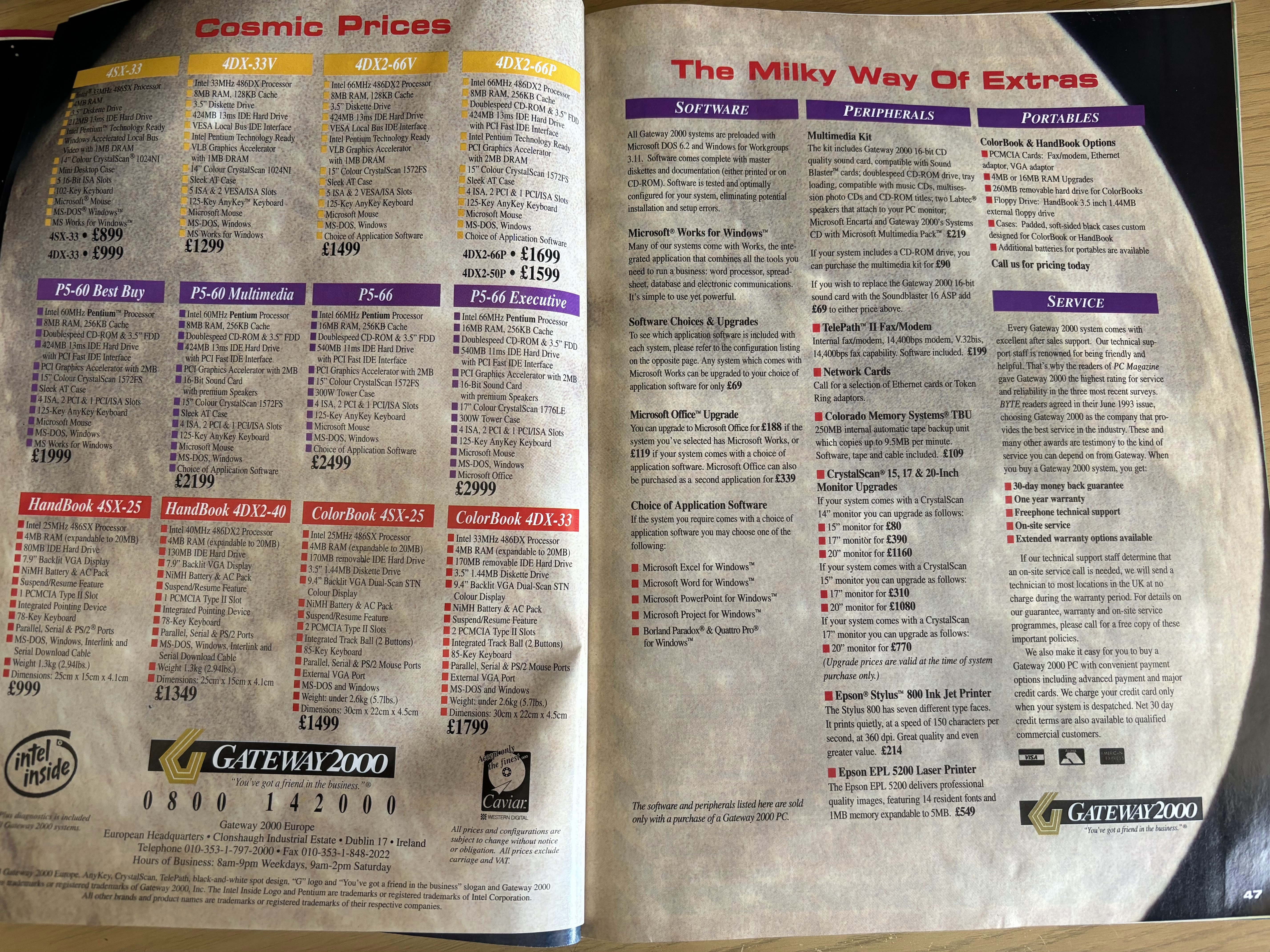
Gateway was plugging its range of machines too - base 486SX 33MHz for £899, Pentium 60 for £1,999 and their non-too shabby looking Handbook 486 for £999. It's a canny looking portable. 

Another dinky little laptop there.

Is that a Lunar Gateway ad? NASA joke for you there, folks. 

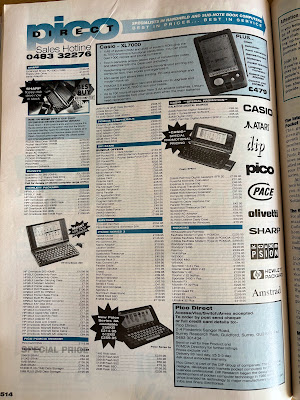
Dabs Press were another popular reseller, and tucked away in their listing was the Amstrad Mega PC for £425 - by this point more a curio than a worthy PC/console hybrid. They did, however, offer a decent range of handhelds, and by those I mean Psions and the like. So too did Pico Direct, a retailer who made handhelds their speciality and offered a ton of difference devices. 
Computer Shopper issue 73 shows the DOS/Windows PC at the pinnacle of its 486 journey. There were a growing number of resellers stocking big brands, and there were even more small box builders eager to eke out the thinnest of profit margins, yet it was also the time of decline for the traditional manufacturers too. The likes of Amstrad and IBM were slowly disengaging from the market, becoming just one of many names out there. As for the other computing formats, Atari was wasting away trying to support the Jaguar console and Acorn were making all the right noises but the wider changes to the PC market (multimedia and increasing power at decreasing prices) meant that its glory days were behind it. Apple was looking good, but the approaching launch of Windows 95 and the impression of PC superiority would hurt the company, almost as badly as the cack-handed corporate leadership and the on-going failure to modernise the OS. And as for Commodore, just three months after the publication date of this issue, ol'chicken lips would be bankrupt. 

Against Amstrad, Olivetti's machines had a certain sense of style.

It's always interesting looking at these old magazines. When taken as a whole, they not only inform you of what was happening at the time, but also add flavour to what you learn. Issue 73 was another cracking edition of the then most popular UK computing magazine, but for the next visit to yesteryear, we'll be heading back to the time of the launch of one of my favourite computer formats...

In the meantime, have a great festive/holiday period! I shall be back with more blogging shenanigans in the new year. 

Saturday, 16 December 2023

Khalsa! by Andrew Copestake and James Main - Book Review

A recent release from Helion & Co's Helion Wargames series, Khalsa! aims to guide the wargamer along the path of enlightenment to putting soldiers on the table for the Anglo-Sikh Wars of 1845-46 and 1848-49. This isn't a ruleset per se, but it does offer more than the usual "this happened here" run through (essential as that is for historical wargaming). Is it any good though?


Before we continue, cards on the table. I have known Andy for more than 25 years, Jim even longer, and I count them both as very good friends. We have laughed (The Breakfast Pasty Business, The Veggie Burger Vignette - trashy detective novels in the making there!), cried (that two day show on the Yorkshire Coast) and gone through other less noteworthy (but no less funny) shenanigans involving wargames, wargames shows and the odd pint or two over the years. Does this colour my review? I hope not. Neither gent has had sight of this piece before posting, nor have they had any input to it. In addition, I purchased my copy via the Helion and Co website using my own funds.


With that in mind, what do you get for your £29.95? Well, the usual high quality Helion publication coming in at just over 180 pages and in full colour. Aside from the introduction, acknowledgements and timeline, there are eight chapters and three appendices, all finished off with a handy glossary. 

Chapter One provides the reader with an introduction to the rise of the Khalsa, their geographical reach, the types of troops they used, and the composition of the forces they fielded, mercenaries and all. There is more than enough helpful guidance on how they could be portrayed on the table. As is only correct, further historical information can be found in the sources quoted in Appendix A, three pages of which cover additional reading. 

Chapter Two brings us the forces of the Honourable East India Company (not a Ronseal title if you've read much about the corporate entity itself). Again, units and formations are covered, as are notable personages, and how they too could be applied to a game. 


Chapter Three is where the real wargaming fun begins with the battles of the First Anglo-Sikh War. Each action is given maps, orders of battle, and notes on gaming them. Photography of tabletop battles abound, and there is also the occasional illustration from 19th Century sources too (not contemporaneous but suitably period).

Chapter Four covers the Sieges of Multan and Herbert Edwardes' Campaign, before the fifth settles on Sir Hugh Gough's time in the sun from 1848-49. At this point, the commentary deserves a mention. There is little evidence of bias against either side, and where the British were poorly led, they paid the price accordingly. Some battles were close run things, others more accidental in nature, yet their portrayal here should give fine succour to those without even the flimsiest of prior knowledge. And again, if you'd like to know more, Appendix A is very much your friend. 


The Sixth chapter focuses on the colours and uniforms of the various forces, handy for the seventh chapter where a painting guide details the process of putting soldiers of the period onto the table. Each step is concisely written with accompanying imagery, and even my limited painting skills could follow the clarity provided here. 

The final chapter is where the true wargaming potential of the period is scrutinised. Tactics and what ifs set things off, but there are suggestions for the use of umpires (big fan of that approach personally), scenarios (both historical and fictional) as well as amendments that can be applied to a selection of commonly used rulesets for the period. As a side note, when the period was put on the table as a demo game at the recent Battleground Show in Stockton, the terrain modifications listed here were a very useful addition. 

Of the appendices, we have talked of A (ever so useful, I cannot state that enough - if you're partaking in historical wargaming, reading up on the period is essential). B is a suggested list of figures suppliers, whilst C provides several pages of Army lists, noting types of troops and the percentage each provided to the armies of the period. 


I have mentioned the imagery already but it must be said that between both authors' collections and those photographs supplied by Colin Ashton, there is more than enough lead eye candy for even the most cynical of gamers. 

That's it, and a fine publication it is too. There is the odd issue - mainly imagery placement. The black text over an image containing a black flag on page 37 is probably the most egregious example, and that joke on page 19 is possibly too obvious. OK, I am stretching here, but to be fair to the authors, I'd have been terribly disappointed if it hadn't have been made at some point!

Overall, this is another fine Helion & Co publication and one that deserves your attention if the period appeals. Well written, highly informative and a cracking starting point for those wishing to dive into the subject with little or no knowledge (or maybe just as a refresher), you can pick up a copy direct from the publisher here. As a bonus for me, next time we put this period on the table, I might actually know what's going on!