Sunday, 7 April 2024

Magazines of Yesteryear - Personal Computer World Volume 5 Number 11 - November 1982

42. A simple number. Possibly the answer to something. But also the number of years since this issue of Personal Computer World was published and, gentle reader, the past was a very different country. And that's before we get to the cover star of this issue, Digital's Rainbow.

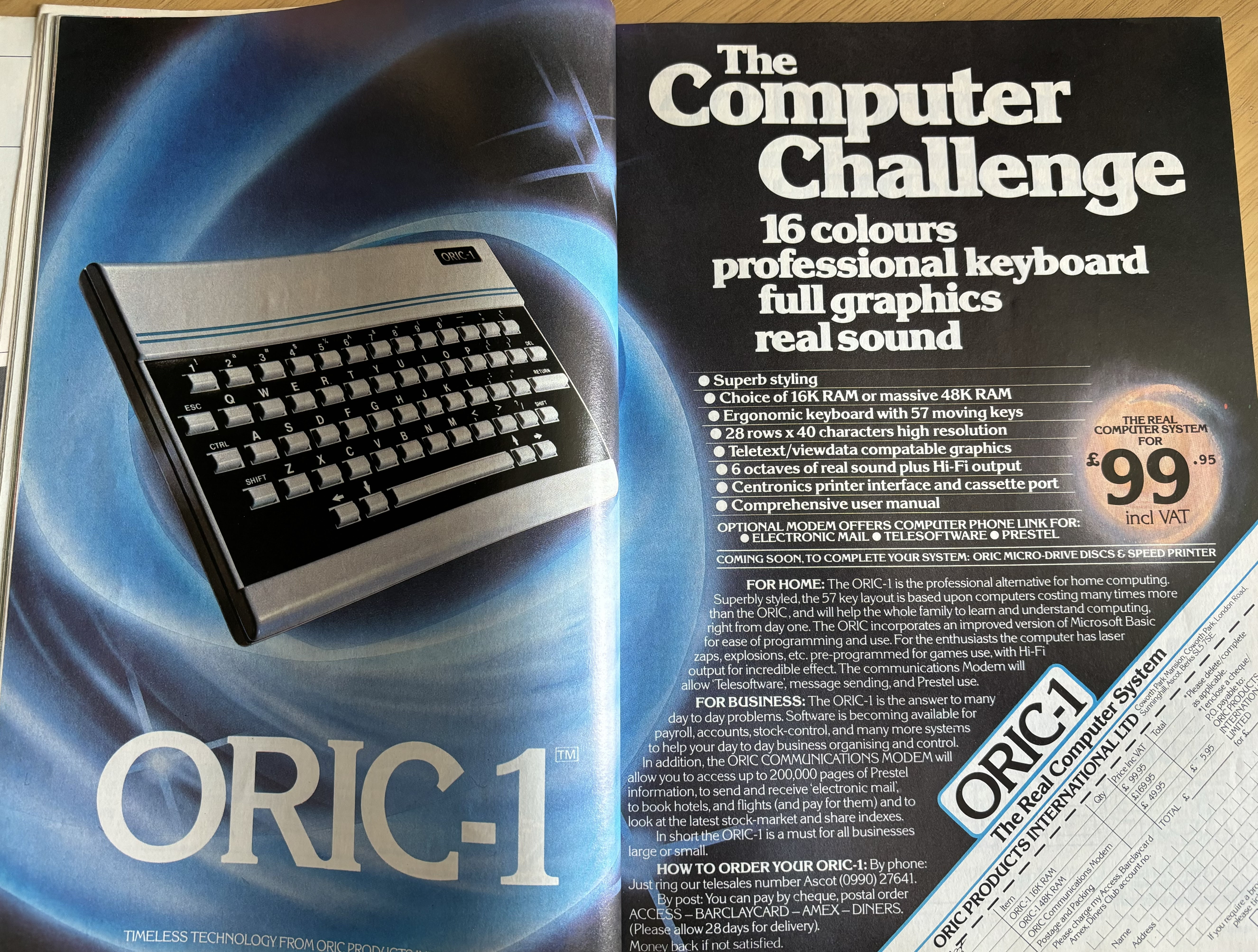
Guy Kewney kicks us off with the news, and it's smiles all round as Acorn seem to have banished their backlog of BBC Micro orders. Huzzah, tea, biscuits, and all that jazz. Then you read what Mr Kewney has actually written and he is bitingly caustic at the shambles Acorn have been responsible for. New ROM versions that cause incompatibilities and unhappy user groups are just two of the headaches Acorn are now dealing with and there is very much a sense of "I told you so" emanating from the pen of the news desk. Sinclair are in fighting form trying to get their wares in to Primary schools, there is news of a new machine called the Oric, there is some confusion as to the nature of the then-unreleased but much promised Sinclair Microdrive, and what can only be described as "you couldn't make this up" reporting on Osborne. 


There are more new machines coming to market - Camputer's Lynx promises another 8-bit wonder, while Espon's HX20 is the portable computer that did. Regular readers will know my affection for the much later Amstrad NC100 (as well as the Alphasmart 3000 and Cambridge Z88), so I really want someone to bring the form factor into the 2020's, and I do not mean the over-priced Freewrite Alpha. 

Once past the latest happenings, Peter Rodwell ponders developments in the growing fight between MS-DOS and CP/M, whilst Martin Banks regales with tales of predictions in the computer industry and why he is wary to make his own. There's some interesting stuff here. The description of Clive Sinclair launching the Spectrum in the US - "Clive was a man with a reputation, to the US financial men, for a flair in design and danger in manufacturing" is brilliantly apt, and comments on Apple and Commodore are equally illuminating. The former has coasted for too long on the Apple II, the III isn't cutting the mustard and although it has a fantastic international distribution set up, if the company falters, it could be the target for a Japanese takeover - remember that back then, the Japanese were considered the competitors to beat when it came to microelectronics. As for Commodore, its issue was that it didn't have that great of a US base - it's European operations were bankrolling the operation. Once again, a potential Japanese offer could see the company off. Mr Banks closes with the statement that the apparent leaders of the personal computer market in the future would be IBM and DEC. As predictions go, that seemed likely at that point in time, but the advent of the 68000-powered Mac and Amiga would delay any collapse of either Apple or Commodore (but both would suffer for a variety of reasons as they entered the 90's), and the advent of the "clone" IBM compatible would topple the idea that the hardware producing companies mattered. 

There is a report on the 5th PCW show, and very period it looks too. With 47,000 attendees, it was another smashing success and featured 210 exhibitors. Although Apple wasn't there, both Sinclair and Acorn had set up "villages", DEC had their Rainbow (see below for the preview), Professional and DECmate II, Commodore were showing off their new "64", and Jupiter and Camputers were proud their Ace and Lynx respectively. It was a profitable show too: Dragon claimed 275 sales of the Dragon 32 machine, and NewBrain dished out a similar amount. 

Given the current fashion for all things A.I., the feature on using Artificial Intelligence to cheat your way out of algebra homework feels more than a little quaint, but at least there is a type in listing to get you started. 
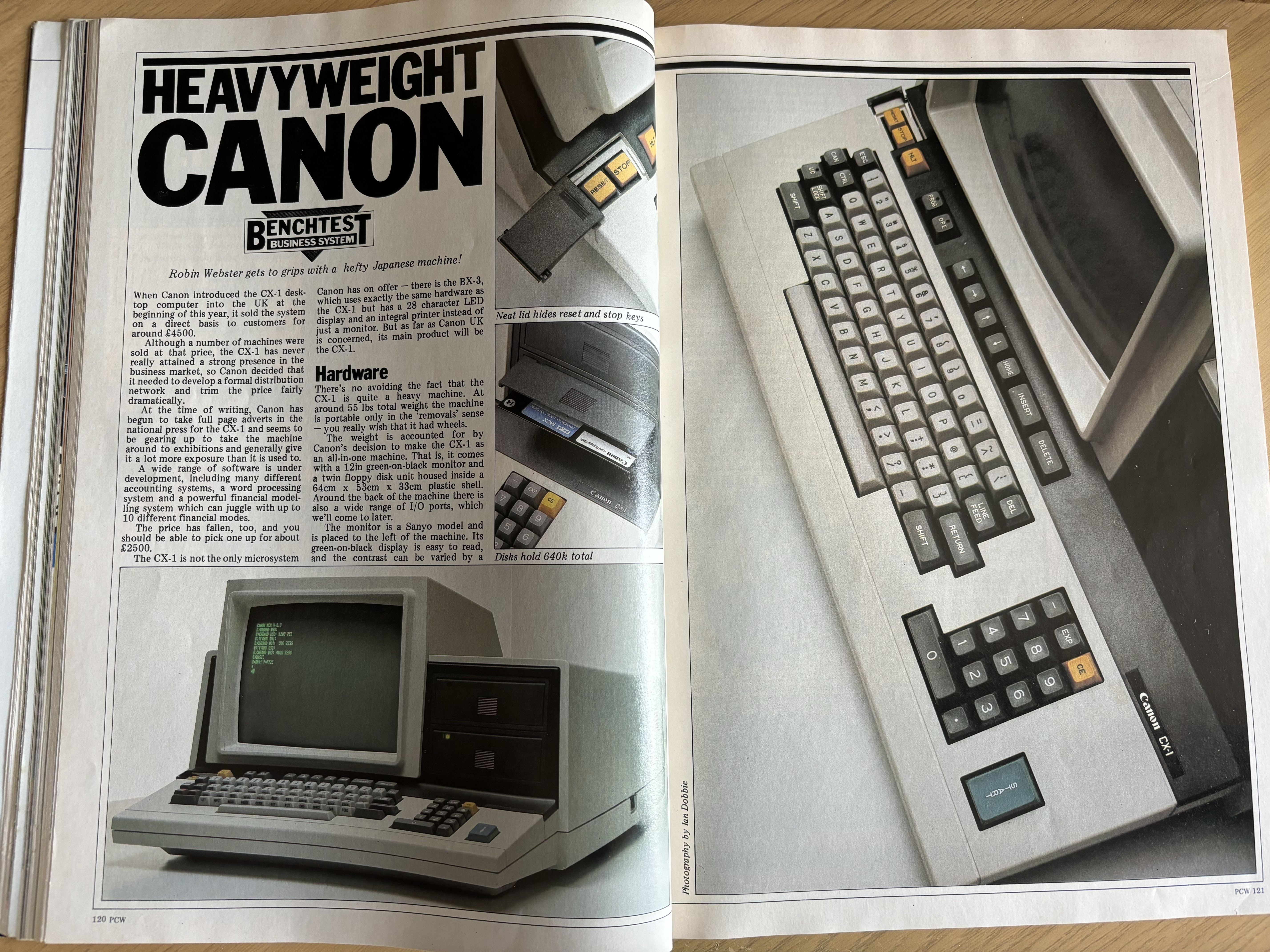
Canon provide the first hardware test for this issue with their CX-1, and it's a behemoth! Coming in at 55lbs(!), it would take up a fair amount of desk space and a disproportionate amount of your bank balance. Initially launching at £4,500, it was, by now, a tad more sensibly priced at just £2,500. That's alright then. An all-in-one with a 12-inch green on black monitor and dual floppy drives, the unit measures 64cm x 53cm x 33cm. There's no real graphics mode for the Canon, and although the display can handle 80 columns by 24 lines, the bottom two lines are used for the command display area. The two disk drives are 320k capacity and there are storage expansion options, with external 8-inch floppies and a 30Mb hard drive option. A Motorola 6809 running at 4MHz offers only mediocre performance but this definitely feels like a case of steady as she goes. You can fit up to 128kb of RAM, 32kb of which is used by the system, and there's 4kb of ROM too. If you fancied getting into the Canon action, that two and a half grand did include the maximum memory allocation. Adding extras like CIS Cobol (£190) or UCSD Pascal (£400) would prevent the bank balance from recovering too much. 

The just looks silly.

DEC's Rainbow is up next, but only in a preview. Although the monitor looks small, it really is a 12-inch CRT just with a huge housing, and looking teensy on top of that massive base unit. The display can handle 80 columns with a hassle, and a software option can take you up to 132, but that's eyestrain territory for any length of time. There are, however, graphics modes - 320x240 with 16 colours, or 800x240 with four colours from a palette of eight. The disk storage is funky - there are two drives, each handling two floppies at a time. As each disk can hold 409.6kb, that's over 800kb per drive. Impressive for the time, as is the option for a 5Mb Winchester disk. Similarly impressive is the CPU set up - the Rainbow contains both a Z80 and an 8088. Both share the supplied 64kb of RAM, with expansions for 128 and 192kb, taking the maximum amount to 256kb. To control all of this is the hybrid operating system CP/M 86/80. All of this costs a pretty penny, and as you can guess, adding extras quickly takes the price into the stratosphere. Still, it would have done whatever you wanted it to do and it was cheaper than an IBM PC.

And still more functionality than a Freewrite Alpha.

It's portable time with Hewlett Packard, its HP-75C comes under the gaze of Dick Pountain, and although it would not become "the ultimate status symbol among the technologically inclined", it was a supremely powerful portable computer at a price (£728) that took it out of means of many. With 16kb (expandable to 24kb) of RAM, 48kb of ROM and using magnetic cards for storage (1.3kb per card), it was another step closer to Pountain's ultimate goal of a "pocket sized personal database cum calculator cum word processor cum communications station". It just needed another couple of decades to really get there. 
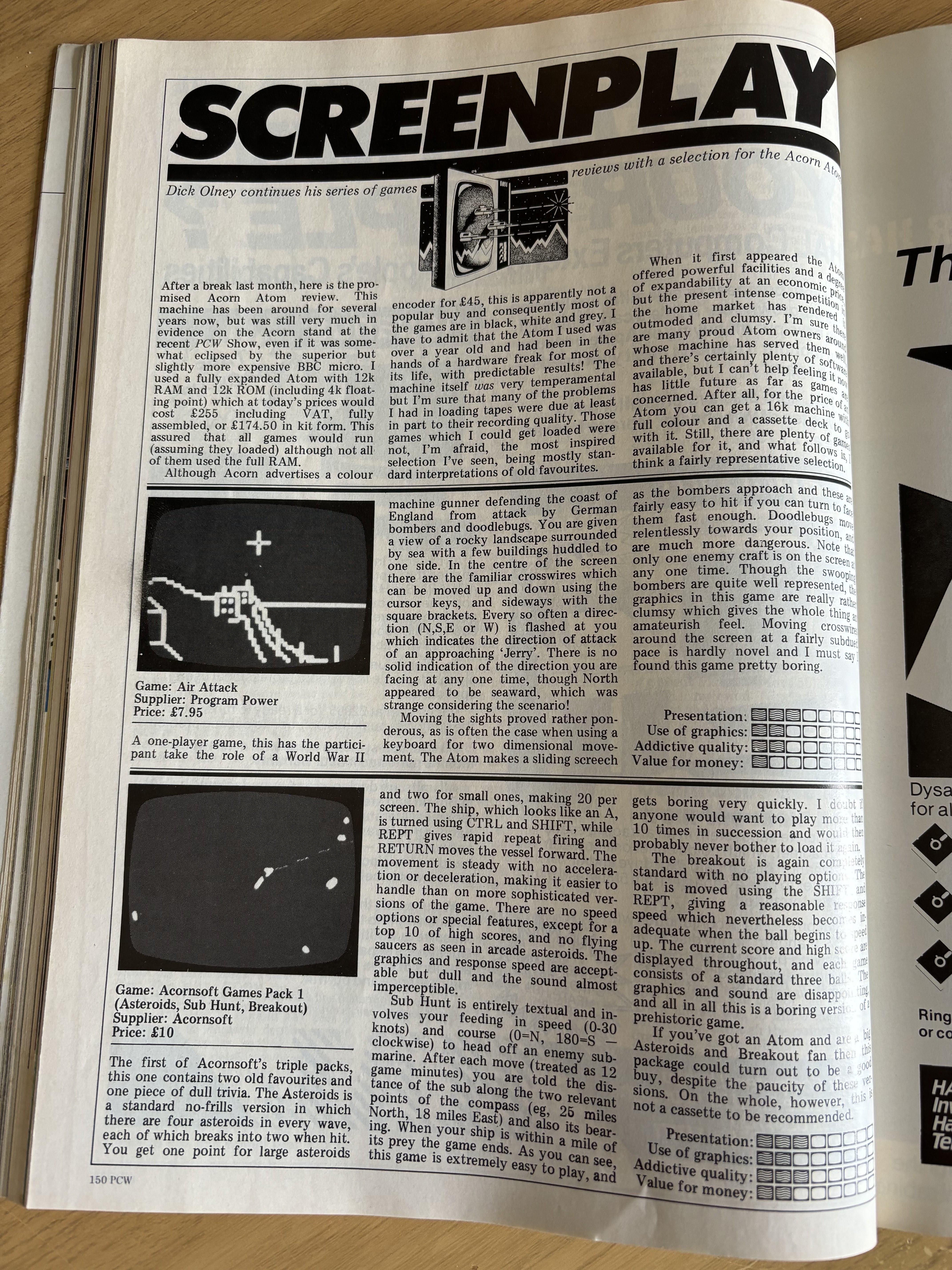
Screenplay takes a gander at the Acorn Atom's range of games - eight in total, the best of which seems to be the Acornsoft Games Pack II, and even that scores just slightly above average. 
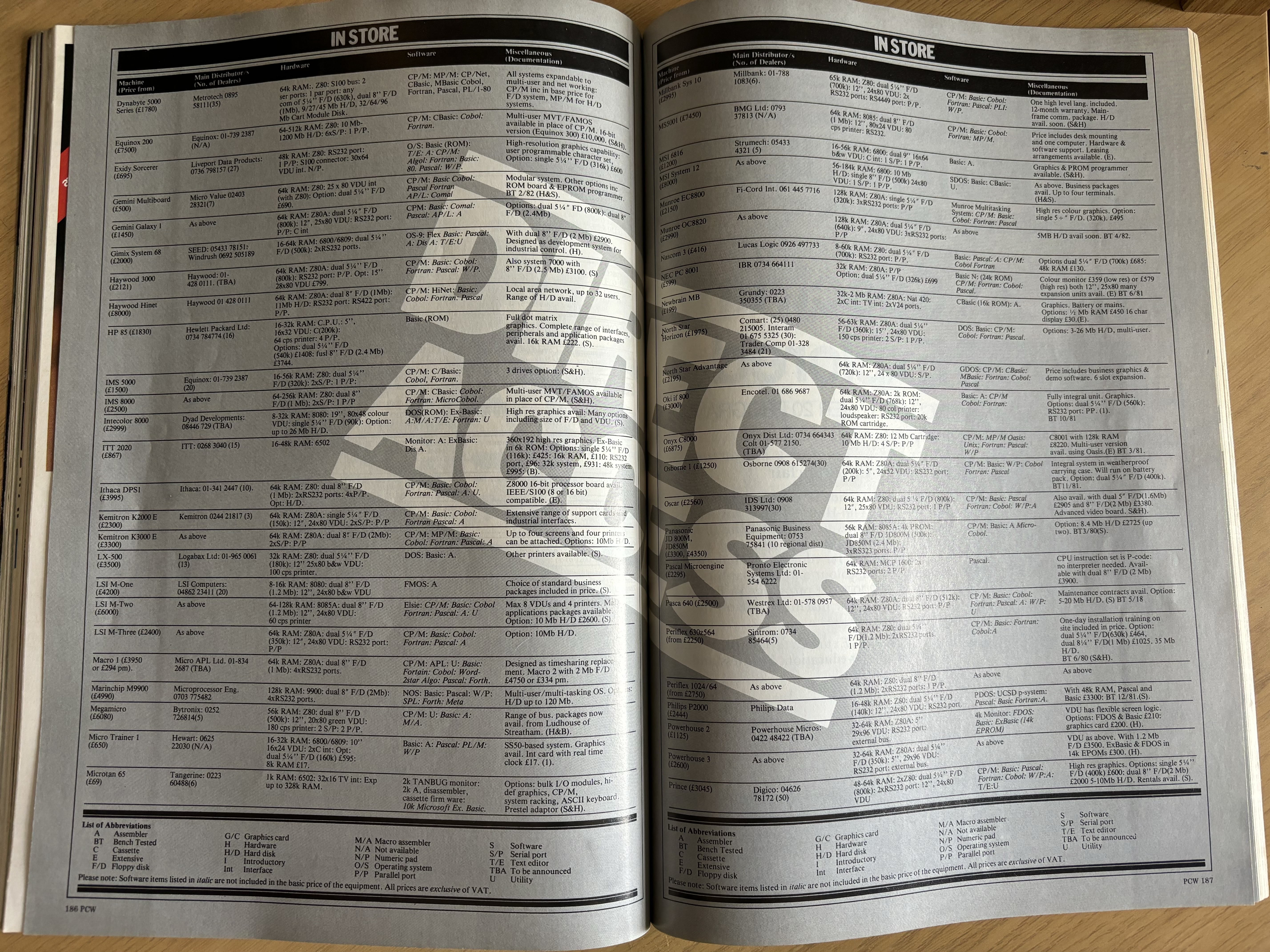
The In Store section provides a handy guide to the range of machines available to the potential purchaser - and my word there are a lot! Six(!) pages of ready-made computers, plus another page of single board offerings. 

To the adverts now and, in a departure from the usual, just check these out.

There is a lot to digest here.

'Cos everyone loves a game of Mastermind, yeah?

That 700-series has serious 70's vibe, but that 500-series vibe would make a comeback.

Condescending, much?

"Professional" keyboard... yeah, right!

Well played, Sinclair, well played...

Me thinks the Spectrum is writing un-cashable cheques here...

Beeeeb!

They did have the Advertising Standards Authority back then, surely?

With very good reason, Newbrain, very good reason!

This ad was buried towards the back of the mag - it feels like they didn't care even then.

Phew! In 1982, it wasn't a question of finding a computer to buy, it was which one of the many to choose from. If you think the market looked crowded then, there was more to come, and of all of these formats, only the Spectrum, Commodore 64 and Beeb would see much success passed 1985. All the rest would be gone or retired for better specified alternatives. It was also the time of national computer retailers, and Laskeys promised to see you right:

Home users could also top up their software collection at Maplin, as well as 0% interest for computer hardware purchases. Mind you, credit would have been useful for the games too - £25 then is about £85 now!


Spectrum were another potential source of cool kit, but unlike Maplin, their headline prices excluded VAT, so they only appeared cheaper when they were actually pretty much par for the course. That is more than slightly odd considering the machines here were aimed at home users.


For actual business people, there were other options. Although advertising with a mugshot that would make a Stasi ID card blush with embarrassment is something we have moved on from since then...

Obviously Frank hasn't sold many computers recently...

LSI were offering a combo machine that could be the only machine you'd need - a Z80 for CP/M and an 8088 for MS-DOS - for a price, you understand, and £2k plus in 1982 was proper folding money! But it was also British, when such things mattered...


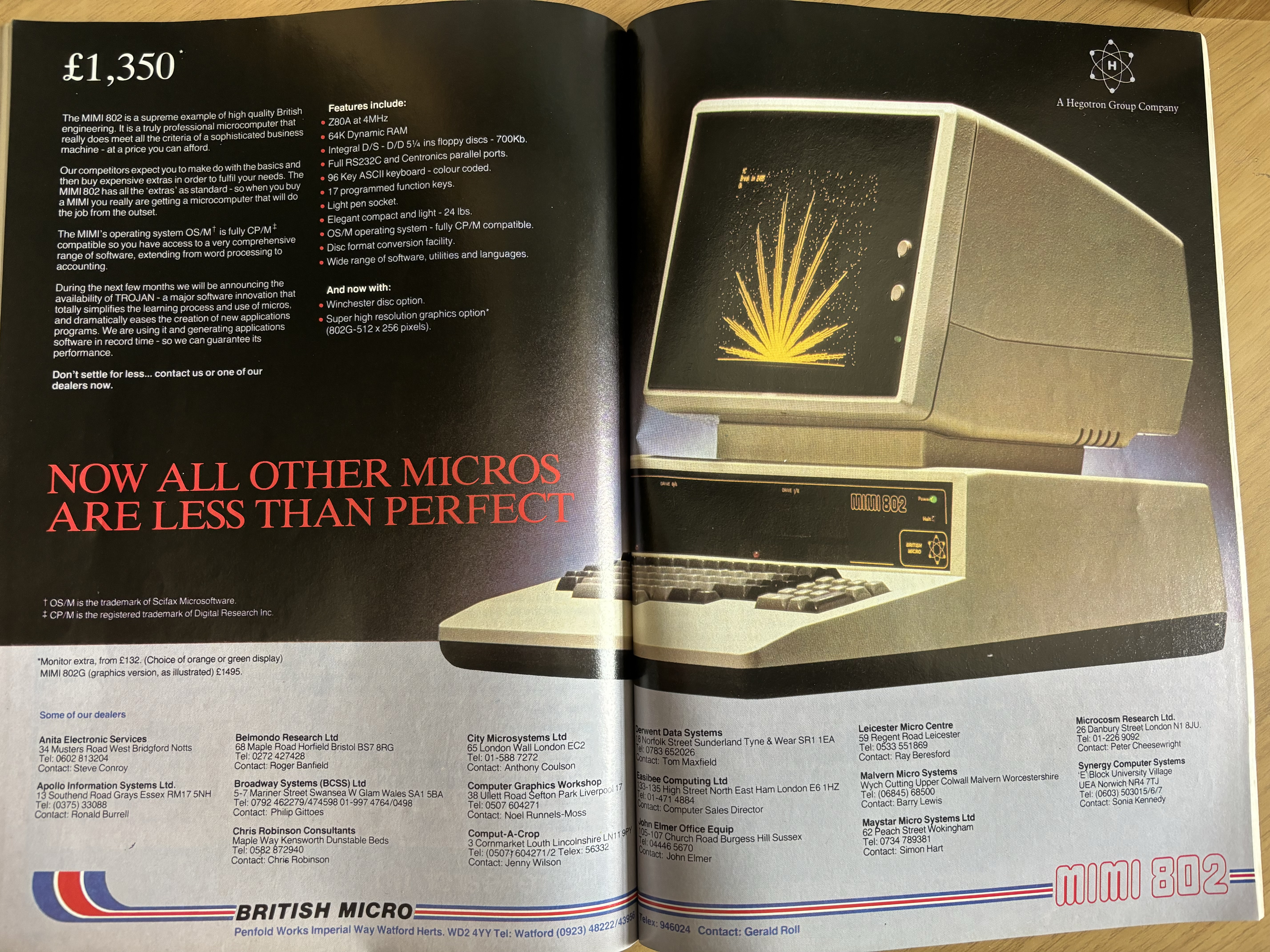
And the same could be said for the British Micro MIMI802, priced at a cool £1,350 minus the monitor (from £132) and not actually the machine pictured (that is the MIMI 802G at £1,495. Even the address is suitably patriotic for those who cared for such things: Penfold Works, Imperial Way. Needless to say, it was just another Z80 CP/M-ish (OS/M actually) desktop that would go the way of the dodo soon enough.


1982 was still very early days for the microcomputer and interested folk were spoilt for choice, a lot of which depended on the depth of your pockets. Yet despite the plethora of 'puters, pretty much anything (even ones like the Ace and Newbrain) would have been good enough for the next couple of years, by which point, the home market was settling down somewhat and the business world had IBM compatible clones to consider. 

Next time, I think a journey to a different century is in order. However, in the best tradition of Crimewatch UK (don't have nightmares now), I shall leave you with this Stepford-inspired (and completely "not acceptable then, never mind now") back page ad...

What the actual???

Saturday, 30 March 2024

The Con50le by Mike Diver - Book Review

It shouldn't be a surprise to me that the humble home games console is over fifty years old, but that does seem like a really long time. There again, I'm old enough to vaguely (mis) remember some gaming console TV commercial alongside ads for LaserDisc players (featuring Raise the Titanic) and Richard Clayderman LP's, so yeah... excuse me whilst I crumble to dust...

Anyhoo, this recent release in White Owl's ever-growing range of video games related titles originates from the pen/keyboard of Mike Diver, an all-encompassing guide to the home console. Starting with the Magnavox Odyssey and ending with the Evercade VS, Mr Diver takes the reader on a journey detailing the first and lasts, the highs and lows, the PlayStations and whatever the hell the 8-bitters were thinking in 1990. And nope, I don't think anyone knows even now... I certainly don't, and I own one of them!

The 190 pages focus mainly on the hardware, but there is some light shed on the major software releases for most of the machines. Some just get a single "Must play" mention, more popular/succesful machines get five, but the reader should consider that this book is all about the kit, and there is a lot of it.

Once passed the Introduction, the foreword from Julian 'Jaz" Rignall is a heartening welcome to the topic. Computer and Video Games, and Mean Machines were constantly perused guides to what was hot and not back when I was in school. To have this contribution front and centre should be taken as a sign of the care and attention the author has placed on the subject. There are few who could write about home consoles in their formative years in the UK than Mr Rignall. 

When it comes to the machines themselves, we get a chronological and concise history of the hardware development, sales success, and what became of the format. Sales figures (where available, or best estimates where none are forthcoming) highlight just how good (or bad) a specific platform faired, and when we're talking Amstrad GX4000 numbers, that's pretty bad... 

Each entry is well written and guides the user through stories that, at times, can be quite involved. Clarity and insight are foremost, and each machine is handled evenly. As for the stand out games, the selection here may be debatable but there is an element of personal choice. Readers should recall that this is predominantly a hardware story anyway. 

Given the large number of consoles covered, not all get the in-depth treatment. For example, Commodore's attempts with the C64GS, CDTV and CD32 are pushed into one three page section, yet they neatly fit into the 1990's so not really an issue. Other rare systems like the Bandai ATMARK (Pippin), the rash of micro consoles, and whatever the hell the Zeebo and Phantom were aimed at, also get brief mentions, but given their limited (Zeebo) to zero (Phantom by name and by nature) market effect, they are rightly considered oddities. 

There are plenty of photographs too, even where the hardware in question only gets the briefest of mentions, and this raises my one and only issue with the book. It would have been nice to have images captioned, if only to clearly identify the consoles in question. Sure, I know what the Konix Multisystem looks like, but many may not, and when it comes to the mixed menagerie of Japanese hardware, some labelling would be really handy. 

That being said, this is a fine single volume on the history of the home video console and will be of great use for anyone interested in the subject. You can pick up a copy direct from the publisher's website here or order it from the usual online and physical bookstores. You can also follow the author on Twitter/X: @MikeDiver

Saturday, 23 March 2024

Magazines of Yesteryear - PC Pro Issue 1 - November 1994

PC Pro is the only monthly general computing magazine left in the UK and as it nears its 30th birthday, I thought I would try and revisit the first issue. I was a mere month in to college life (focusing on A-level Geology - not even Russell Watson could warble about the long road from there to Software QA tester!) when this first hit the newsstands, and although I have no memory of Windows Magazine, seeing this on the shelves of Consett's biggest newsagent (back when such establishments were a thing) made it an instant purchase. This isn't that particular copy - time, house moves, and poorly organised hoarding skills have all contributed to that loss - and I did pay slightly more than £2.25 for this copy, but it's issue one of PC Pro! Aside from the missing Gateway 2000 insert, everything else is present and correct, even the cover CD, so what does the magazine promise?

No need to speak to your newsagent about the missing disc here.

POWER 486's, and to be fair, in late 1994 a DX2/66 was the sweet spot for desktop computing - the early Pentiums were not terribly good value yet as we shall see, even if there was one reviewed here for £1,199. A four speed CD drive, Texas Instruments multimedia notebook, and a discussion on 32-bit operating systems (how quaint, and I say this as a regular RISC OS user) round off the cover stars. Oh, and a competition to win a Pentium PC-TV! I'll explain that later for the younglings amongst you. 


Much like its contemporaries, PC Pro was the bane of Posties everywhere, starting off at just over 400 pages. Most of the editorial content was in the front two thirds, with the back taken up by the ads, although there were a fair few of those dotted around in general.

That's one hell of an advertisers list.

Launch editor Barry Plows kicks off proceedings with a look at the forthcoming year and the continued dominance of Microsoft and Intel. Aiding them would be the focus on Plug and Play. Such simplicity was long overdue, and the combination of hardware partners and Microsoft's new Windows 95 OS would bring some degree of PnP to the market. Oaks, acorns and all that.

Then...

And now. Some familiar names too.

The news section leads with coverage of that same topic, as well as what would define 'PC '95'. As you can see, they were an advancement on what the market was then offering and would make the Windows PC even more appealing to home users. 


HP was dropping Canon from their new colour laser offering, picking Konica for the laser printer engine in it's £5,850 Color Laserjet. There was also news of a 128-bit graphics card. With up to 8Mb of VRAM, 32Mb of DRAM and 2Mb of Mask DRAM, the Imagine-128 card was set to cost £650-ish. A professional card if ever there was one, it marked the continuation of a ramping up of specs for future graphical wonders. 

OS/2 version 3 was due out in October, beating Windows 95 by a decent length. Also known as Warp, it did see some traction in the UK. I'm sure Escom offered it as an option for their high-street range, and I was a semi-regular user over the following couple of years, much preferring it to Win 95, but Microsoft would prevail. 

It turned out there wasn't a Dr. in the house when Novell announced the discontinuation of DR-DOS. After struggling to gain even 10% market share, the forthcoming Win 95 would seal the fate of any DOS, and it didn't helped that Microsoft hadn't played fair the previous few years - demanding a licence fee from manufacturers even when their DOS wasn't supplied! They got told off for that, but it was too late for Novell, just as it would be for IBM and OS/2. 

Talk of an add-on CD-i card for PC's seemed to buoy fans of Philips' multimedia monster - not that anyone else cared. If you had a suitable PC for such a card, you already had access to better software than the CD-i could provide. The same would go for the Creative 3DO Blaster mentioned in the story too. 

A comment from the US about the seemingly lethargic advancements of the PowerPC consortium raises an eyebrow. Although it makes a good point about lacking a speed advantage over Intel's cheaper options, they did help keep the Mac afloat for a few more years. I say help, because Apple really tried its best to commit seppuku in the 90's. 

It was the disappointingly mediocre of times, it was the better than average of times.

The big review test next and just have a look at those names! Amstrad, Apricot, Dan, Elonex, Evesham, Locland, Mitac, MJN, Panrix and Viglen - all UK brands that, at various points of the 90's offered reasonable, if not spectacular hardware. Then there were the international marques such as AST, Brother, Compaq, Dell, Gateway, IBM, NEC and Tulip. Prices ranged fro £1,249 (Mitac) to £2,305 (NEC), with most coming in between £1,400 to £1,800 ish. The round up requested 8Mb of RAM, 400Mb-ish of storage, a 15-inch monitor, a secondary cache and VESA Local Bus/PCI - integrated local bus was also permitted. Some included CD-ROM drives, and most were generally decent. Two awards were given: Panrix received one for Speed, offering a 4Mb hard drive cache, SCSI controller and Diamond Stealth graphics, all for £1,799, whilst Gateway took the Value nod, yours for £1,508. Either would have seen you well served. Honourable mentions went to Compaq, AST and IBM. 

Once company who didn't do well was Amstrad. Their 9486 suffered from slow speed, poor monitor and a terrible keyboard. That and a cost of £1,399.99 meant that it's two star score was really bad. It also served to show how far the 80's giant had fallen. Once the market leader in well-priced PC compatibles, it was now just another box shifter, costing more than some and offering less than most. 

Winner, winner, PC-TV dinner!

Competition time! Your chance to win the "The Ultimate Multimedia PC" - Peter Sissons not included. Win either an ICL Pentium or 486-based PC-TV plus the full Microsoft Office Professional and a bundle of five CD-ROMS. Ten runners up would bag the software alone, and the total giveaway was valued at £10k! Not a bad bunch of swag, and for those of you unfamiliar with the concept, the PC-TV was a fad (come on, it really was) of trying to combine, as the name suggests, your PC and television in a multimedia menagerie. It wasn't a wholly bad concept, but never quite gelled. The questions, by the way, aren't too hard, and the second has possibly the best "wrong answer" of the lot - Microsoft Office is... an anagram of "The Devil's Work." Good call, PC Pro, good call.

ES(y)COM, ES(y)-go.

On to the Reviews section, and the varied selection kicks off with the ESCOM Pentium P60. At £1,199 ex VAT (£1,409 inc), it's cheap for a Pentium, but with two stars out of six, not recommended. Too many corners cut (4Mb of RAM, bad monitor and keyboard, and limited expansion) led Jon Honeyball to advise that if the price was all you can afford, get a more balanced 486 system. Apricot's XEN PC LS 560 is another Pentium 60 system but arrives at £2,619 ex (£3,077 inc). Here though, the extra money delivers a system worthy of five stars out of six and demonstrates the purpose of the next generation of Intel processors. You just have to pay for the privilege.

ELONEX! Ah-ha, Ah-ha! Elonex is gonna rock ya! (Apologies to KLF)

Elonex have a rather decent 486 workstation, whilst Dan Technology's Dantium (see what they did there) 90 lacks the oomph for such high end kit, eclipsed by the only slightly more expensive (but much faster Apricot XEN). ICL's middling MD 60V is another P60 system and defines average, scoring threes across the board, where as Texas Instruments Travelmate 4000M delivers a multimedia laptop (if you buy the docking station which includes the CD-ROM drive) for a grand total of £3,700 ex VAT (£4,344 inc). It's a 486 system with too little RAM but a respectable (for the period and the technology) three and a half hour battery life. 

I mean, it's lovely and all, but you wouldn't want to travel with it, mate.

Brother and Dell rock up with 486 portables at the upper end of the price scale (£2,339 and £2,899 ex respectively), neither of which would disgrace your lap (that doesn't sound right, does it?), and Hewlett Packard's latest A3 laser printer, the Laserjet 4V delivers cracking quality and value for under £2k ex. Adaptec's ReadySCSI Plug and Play SCSI Adaptor offers a glimpse of the PnP future (but really needs Chicago - aka Windows 95) to prove what it can really do, whilst Intel's 14.4 PCMCIA Fax/Modem receives reasonable praise for offering travellers an outside connection. The cover-featured Toshiba quad-speed CD-ROM drive proves a disappointment - it's expensive (£400-ish) and hogs the CPU too much.

Referring back to multimedia and PC-TV shenanigans, Miro's DC1 TV capture card offered superb quality video catpure (and a copy of Adobe's Premiere 1.1) for £799 inc - proving that such marvels could be had, but you needed to spend some serious cash first. There again, it was cheaper than many professional set ups so if you required the capability, it was a no-brainer. 

"When Ah were lad, we had reet proper databases."

On the software side of things, Freehand 4 (£450 ex, £529 inc) took care of your graphics needs, Omnis 7 Version 3 could handle your database requirements for £3,995 ex(!), Sidekick for Windows had your personals organised for less than a ton, and Quickbooks 2 sorted your finances for £128 ex (£150 inc). This highlights something that many modern users won't notice - the total cost of ownership. If you were to buy a Windows or Linux PC these days, there'd be either software already installed or free open source options available for almost any requirement. The same can be said for Mac, Chromebooks and RISC OS machines. There are some (relatively) niche or professional software cases where you'd have to pay, either up front or a subscription service, but on the whole, buying today has you covered out of the box. A quick check of the likes of Evesham Micros shows that adding Works for Windows would add an extra £90 ex VAT onto your initial purchase price, so (relative) youngsters may need to understand that the hardware was only part of the buying process and additional packages could be very pricey, depending upon your use cases. 

32-bits? What has it ever done for us, eh?

The first of the features now and a piece on 32-bit operating systems. Truly one of the things hampering the PC (as opposed to the Mac and then still extant Acorn) was the kludge that was the DOS and Windows set up. Within a year of this issue's publication date, that would cease to be such an concern (hey, 95 wasn't that bad - it had its "features" but on the whole, a decent first/second/third attempt...). 

The final two features cast their light upon Parallel port expansion and digital video. The former is rather quaint, living as we do in a USB world these days (I know, but back then you had parallel, serial, SCSI, ADB, PS/2 and other more fanciful ports, so connectivity was a tad more "involved" than it is now, and that's before we get to the config!). The latter tries to convince readers that DV on your PC is a thing - in truth it was but it also meant much gold being exchanged. Even the initial numbers for the tech needed are impressive (this is before encoding, and times have changed), as a single frame of PAL video was 768 x 576 pixels at 24-bit colour, meaning 1.3Mb per frame. 66Mb per second, 4Gb per minute and 248Gb per hour! Without sound. Now, of course, encoding is your friend here, and the technology was advancing at a brisk rate. The future looked bright and as costs dropped, the capabilities on offer would improve rapidly. 

You could just stare at this background for ages!

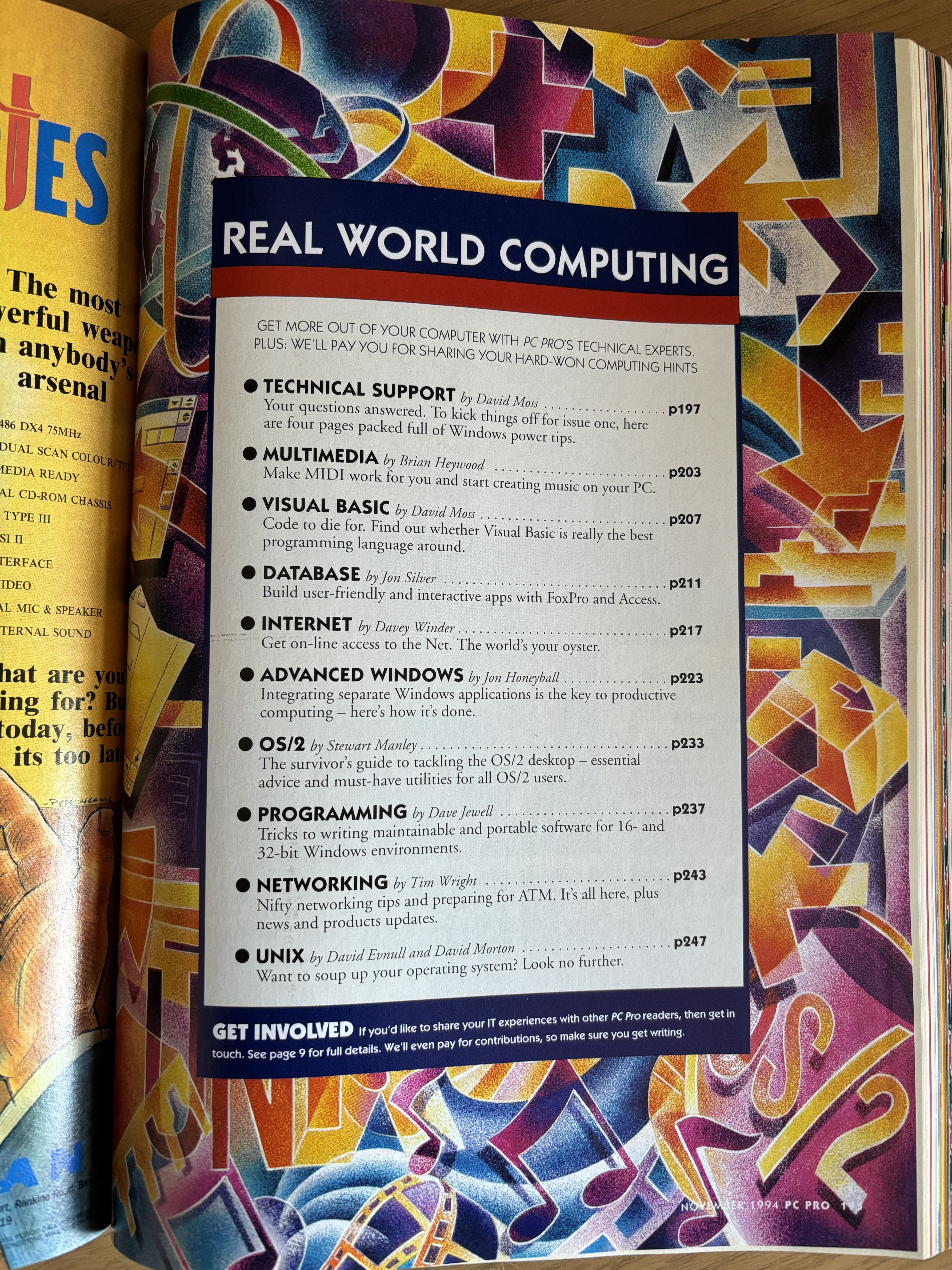
Ah, Real World Computing, a selection of columns offering tips, news, advice, experiences and the like. Some of the names here are still writing for PC Pro (Messers Honeyball and Winder specifically, and I should have mentioned Mr Pountain, the current PC Pro's Editorial Fellow), although the titles of the columns have changed slightly - OS/2 being the most obvious to have departed. 

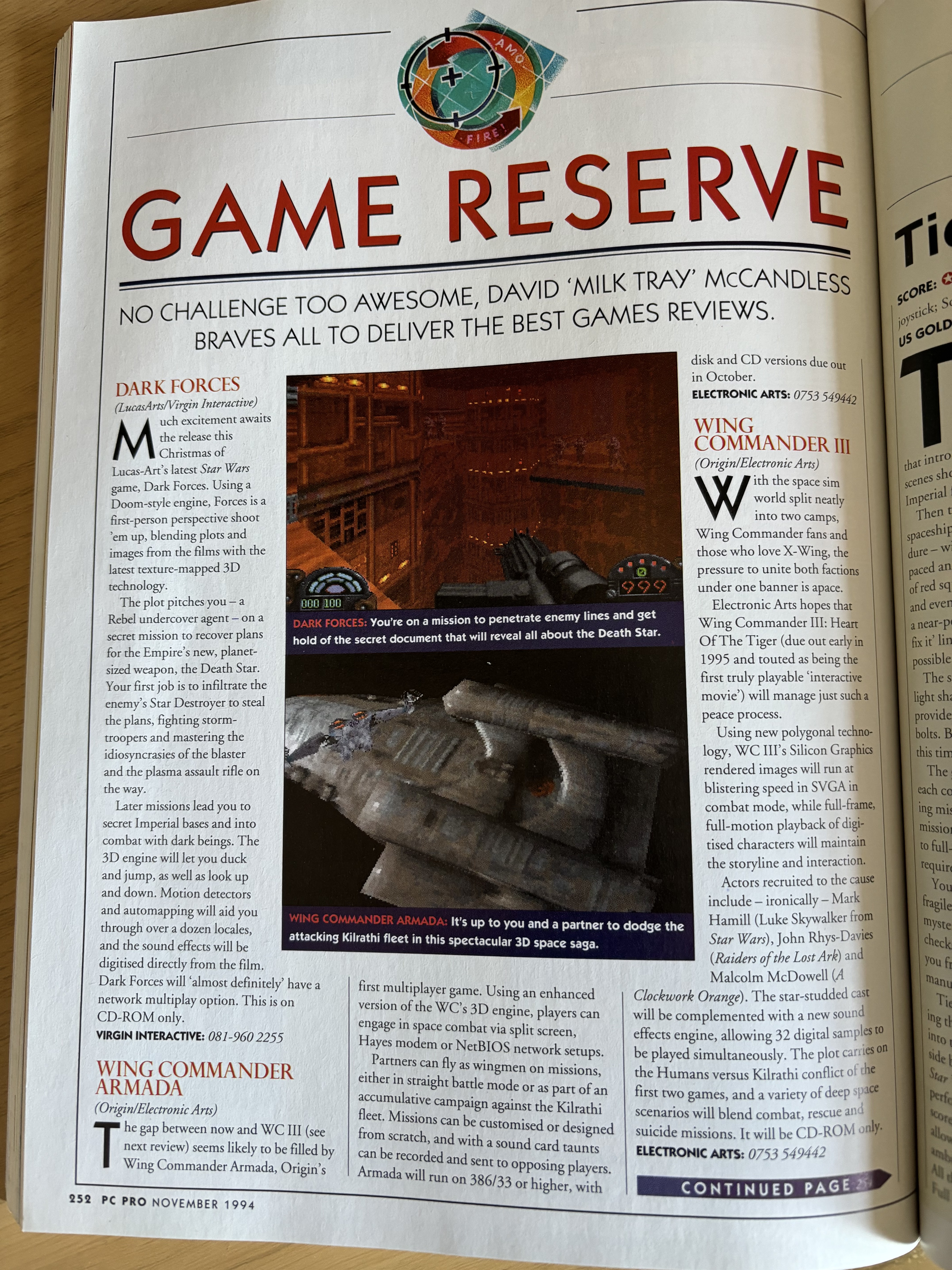
Ah, the innocent days of Wing Commander. Long before whatever Star Citizen is. 

It wasn't all serious stuff though, as the games section proves. There's news of Dark Forces (which has recently received the full on remaster treatment), Wing Commander Armada and Wing Commander 3. Tie Fighter rightly receives a glowing review, and there's updates on Win G (a 32-bit graphics/games shell for Chicago/Windows 4/Win 95), Harvester, DOOM II, and System Shock. A final piece on the nature of using a Pentium for gaming centres on Magic Carpet and how the new generation of Pentium processors who keep the PC well ahead of the next generation of games consoles - Sony's PSX (PlayStation), Nintendo's Project Reality (Ultra 64, later N64) and Panasonic's M2, the last of which never made it to the consumer market. 

The final piece of editorial content is Ctrl-Alt-Del, a humorous coda to the magazine, asking whether Windows was a virus (nope, as viruses tend to have a better update schedule that Windows, otherwise they accomplish the same things), news of receiving twenty copies of Sidekick mis-addressed to a completely different continent, and what might now be considered an off-key comment about the Rolling Stones now having an internet presence. Oh little did they know the lengths Microsoft would go to to promote the new Start button in Win 95...

The included cover CD is a wealth of mid-90's fun. The highlight is Astound for Windows, a multimedia presentation tool for those of you who were tired of Powerpoint's old schtick. An exclusive pop video from Drake (not that one), a demo of Universal Word (a multilingual word processor) and a demo of Star Crusader almost wrap up the goodies. We mustn't forget about the selection of Windows sounds and 20 True Type fonts, either! 

As always, it's now time for the adverts, and I pretty much covered this period with my Computer Shopper  issue 80 look back last July, but there are still some observations to make. 

Danger, Will Robinson!

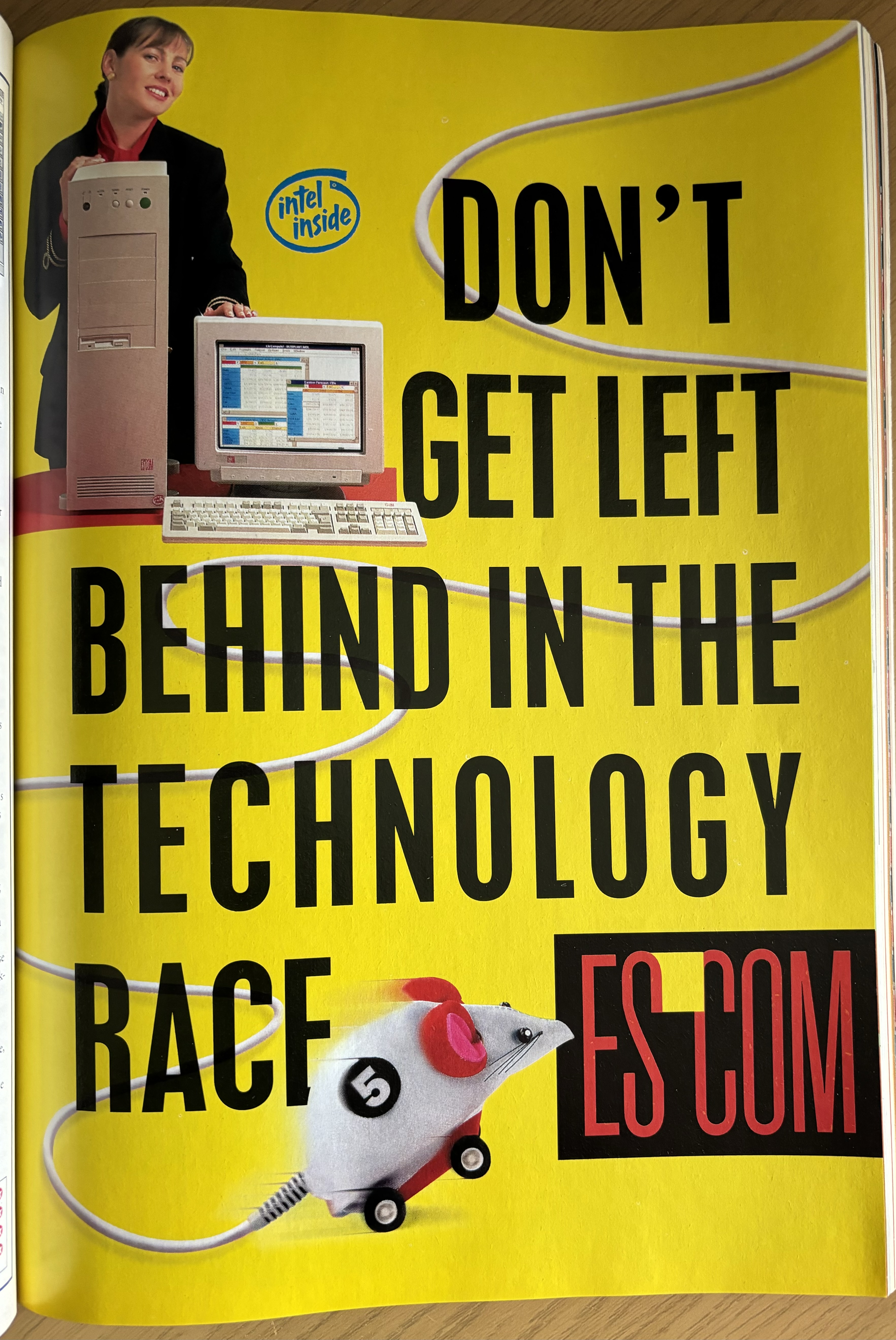
Escom were making themselves well known (besides the overly cheap P60) with an ad whose colours suggest the "endangered toxic frog" aesthetic. This was before they tried to establish a retail wing using former Radio Rentals stores (even Stanley had one... briefly), but their time in the sun would be short. 

Obviously the ad-line doesn't refer to upgrades.

Colossus advertised a full range of desktops, starting at just £699 ex for a 25MHz 486 SX (which Crown pictured further below matched), marking the starting point for any reasonable PC spec. Memory was a pricey upgrade (£150 ex for 4Mb), and they included PC-DOS rather than MS' varient alongside Windows 3.1. Those "Portable" machines are certainly an option, but the additional costs for a TFT screen are eye-watering! There again, there is something truly magnificent about a gas plasma display. Not to use, you understand, just to bask in its retro-chic glow. 

NOOOOOOOOOOOOOOOOO!!!

Apricot's advert seems more appropriate to an opticians eye test, and even my basic accessibility testing skills are screaming "No!" to that colour ensemble. They were a smidge more expensive than the low end box-shifters but there is something about that low profile case that still appeals to this day. 

That's 'king cheap from Crown.

Speaking of low-end, Crown were a budget range, and their 486 SX33 is a very nicely priced offering... unless you wanted any real expansion options, but for a basic Windows machine, it did enough. 

'King cheaper, 'king no chance!

Let's just say IBM had budgets of all sizes covered.

Not doubting the quality, really doubting the value though.

For the same price, you could get a Compaq Contura i386SL laptop from P&P, but to be honest, the era of 386 machines were over. And for all I like the all-in-one design ethos, that Compaq 486 for £599 was far too limited. As I navigate my mid-40's, the thought of a 14-inch CRT makes me shudder. At least they were better than Amstrad's ability to bundle their machines with 10-inch displays!

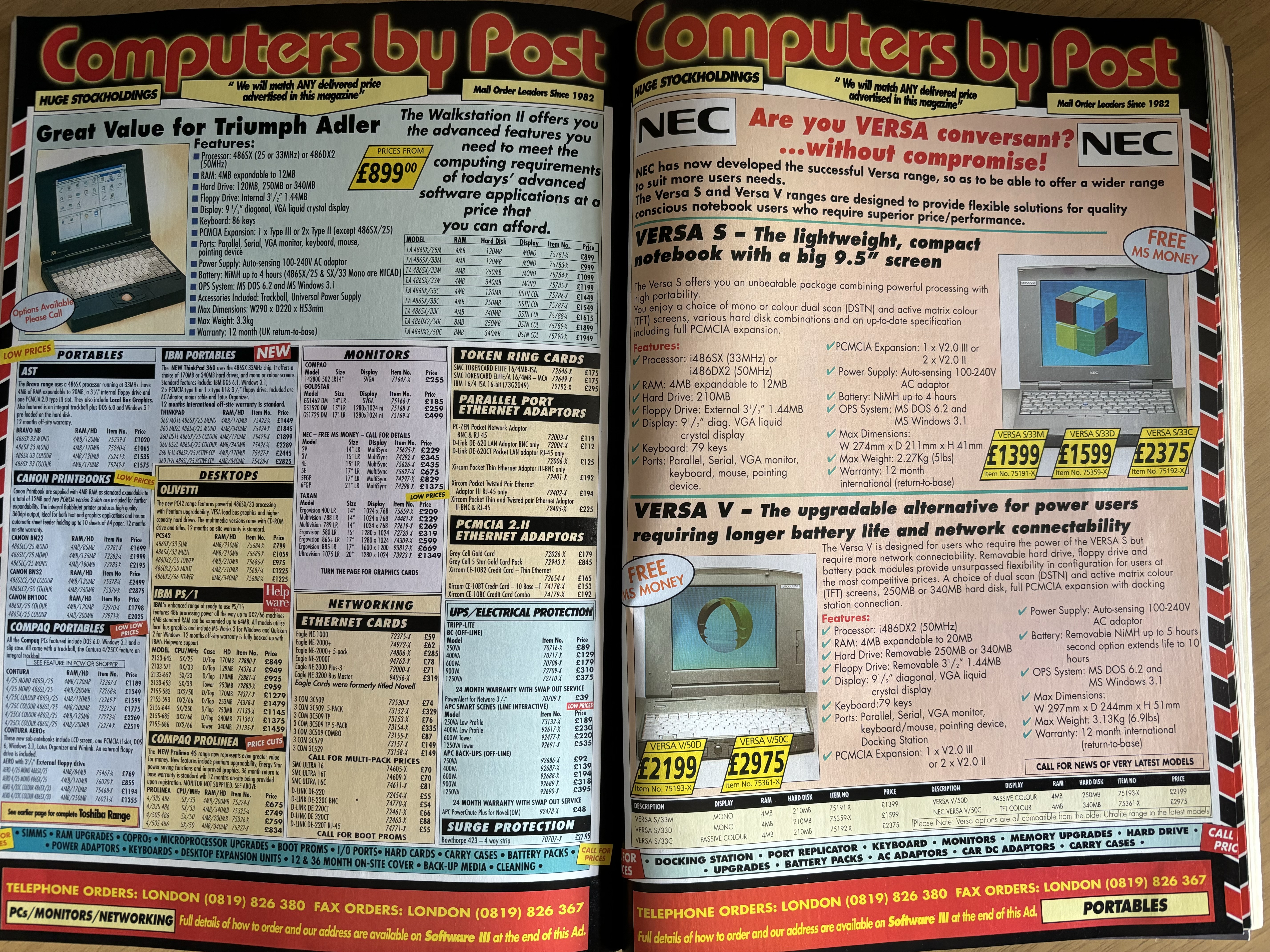
You can get these Computers, By Post!

Computers By Post were a great source of big name brands, and although these weren't the cheapest of options out there, if you wanted a "name" then CBP were an obvious choice. 

What is it with RISC advertising? Acorn's in the late 80's were similarly drab.

Motorola must have heard in advance about the criticisms of it's PowerPC range of processors as they have a double page spread to show off how good they could be, or at least tempt people to try a machine powered by one - aka a Mac.

Finally, just because it's there, here's a reminder of the Olivetti Echos. Is it not a thing of beauty???

Swoon!

That's PC Pro issue one. A brilliant start to a magazine that is still going strong and which hopefully will celebrate its 30th birthday later this year. Long may it continue. As always with looking back at old computer magazines, it's partially a nostalgia trip but also a way of reminding myself (and by extension you, gentle reader), that the story of general computing in the UK is long, involved and fascinating. It has indeed been a long road, getting from there to here...

Saturday, 16 March 2024

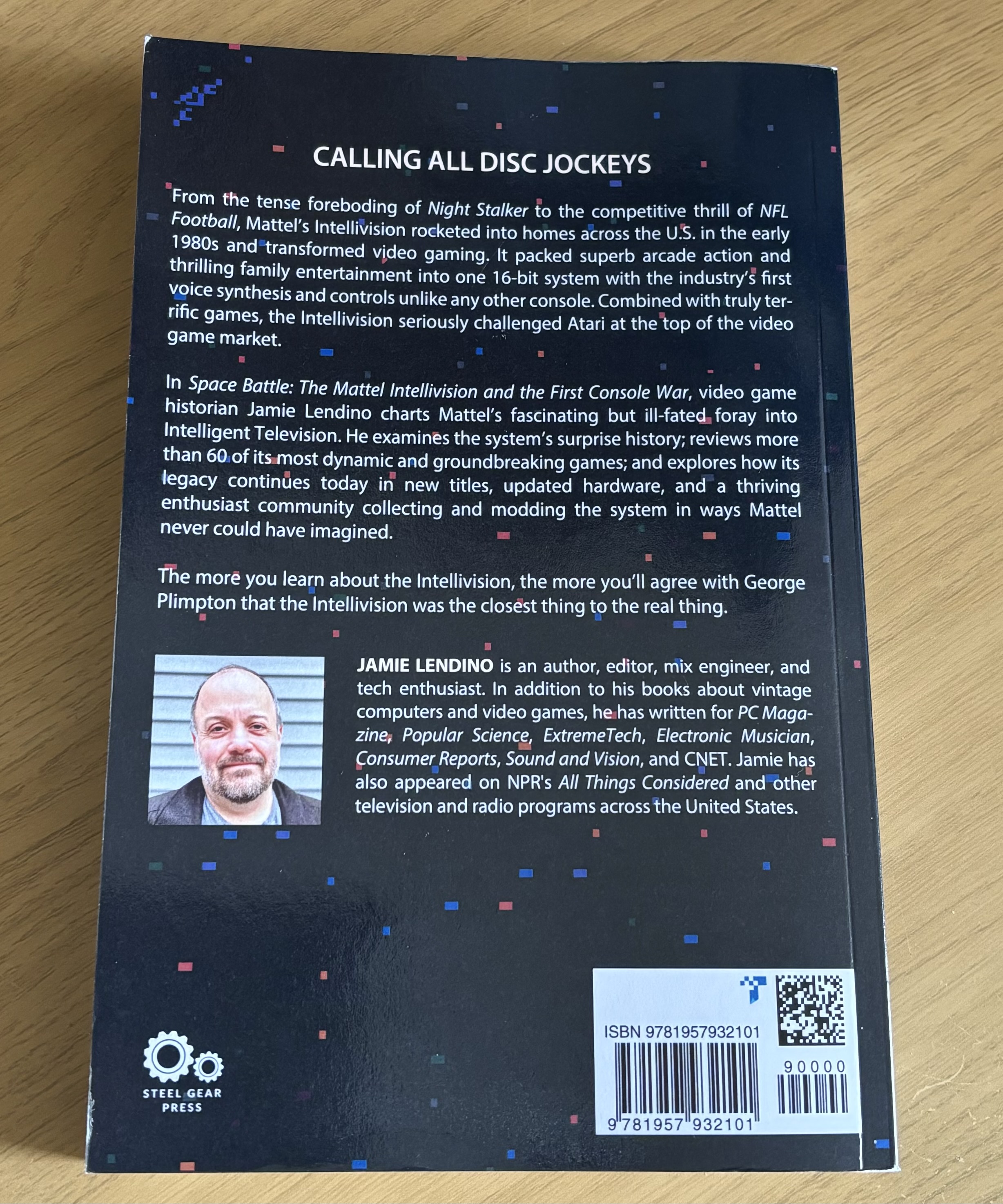
Space Battle by Jamie Lendino - Book Review

Jamie Lendino is back once again, and this time he's taking a look at Atari's primary competitor in the first console war - Mattel's Intellivision. And for UK readers, yes, it made it here too, just with all of the impact of a plummeting feather - the UK was far more interested in home microcomputers at the time, if they could afford one anyway... But I digress... 


The Intellivision was a fierce competitor to Atari's VCS, and one that, as so many other tech orientated companies did, over promised but also kind of delivered. It brought a powerful console spec (for the time), a range of games that could arguably be described in many instances as genre defining, and the a concept for expansions that, well, you'll find out in this 280-odd page paperback, as Mr Lendino lays focus on the machine, its story, and its software.


If you've read his previous tomes, you'll be familiar with the style of presentation. Each of the nine chapters covers a specific period of the machine's life - from the story of the company that released it to the modern day efforts at emulation, new game development and, yep, mention of that "homage". Cards on the table, I had a pre-order for the Amico through UK retailer Argos and, when things really started to turn sour, cancelled and got my money back. I wanted to believe it could be something different, but it turned out to be nothing much at all. Sigh. 


The book itself lacks colour aside from the cover, which is no great loss - imagery and screenshots are handled well anyway, and it is the writing that should concern us here. It's an easy read, yet packed with detail, including snippets from magazine articles and interviews providing contemporary thought on the console in its prime. 

And what a prime it was. Although I never experienced an Intellivision first hand, I had heard of more than a few of its major software successes - Utopia, B-17 Bomber, Astrosmash to name but three. Many more are covered within these pages and each is shown the love, care and attention they deserve. It is apparent that, like the other formats the author has covered, there is a real sense of enjoyment in experiencing these games, a celebration of the best that home gaming could offer in the early 1980's.


There were some missteps along the journey of the Intellivision, mostly to do with the hardware - the keyboard expansion caused a great deal of pain, but there were also some triumphs. Synthesised speech was a new one for gamers at the time, and I had never heard of Playcable before, yet this early subscription-based download service was a game changer (literally) for those who used it.


It's a cliche, but if you want a single volume on the Intellivision, this has to be it. Engaging, informative and yet another damn good read from Mr Lendino, it offers a history of a console that, really, saw relatively little action outside of the US, yet still has an active group of users developing new titles for it. You can pick up a copy from Amazon here (note this is for the Kindle version, so remember to check right for other options).