Saturday, 27 July 2024

What if... RISC OS part one

This is the first of three articles published in the Wakefield RISC OS Computing Club newsletter last year. The articles focussed on three key years for the Acorn Archimedes and its successors - their original launch (with the Arthur OS) in 1987, the introduction of the A3000 (and RISC OS) in 1989, and finally, the belated attempt at the wider UK home computer market with the A3010 in 1992. 


I have taken the opportunity to expand each piece, and all views that appear here are my own, as are any omissions. I hope you like the slightly tongue in cheek approach to questions that were answered decades ago. No slights or offence intended. Please, enjoy.

What ifs abound in the world of RISC OS. What if the Archimedes had launched with ARX rather than the rapidly put together Arthur operating system? What if Acorn had chased the mainstream home computer market rather than the self-proclaimed "serious home user" after the launch of the A3000? What if they had latched on to the interest generated by Zarch?

Zarch review from The Games Magazine.

Truly the title that defined the Archimedes when it first hit the streets, Zarch built upon Lander, the game bundled with the OS and was, for 1987, a stunning and groundbreaking experience in a world flooded by 8-bit micros. Mouse breaking too if you lacked patience... System sellers have long been a key driver in new computer and console sales, and there is no doubt that Zarch could have fulfilled that role for Acorn. To be fair, the Archimedes' basic price was an antidote for such hyperbole, but as example of what the ARM 2 could do, that was it, and it became a poster child for the Arc. 

September 87 show advert with Lander front and centre. 

Naturally, this garnered some attention, with the long established publication Computer and Video Games rating it a C+VG Hit in their January 1988 issue (albeit with screenshots for another game entirely), whilst ACE magazine gave it a whopping 979 out of 1000 (I know, a weird scoring system, but it remained their highest rated game for a couple of years) in its December 1987 issue. The Games Machine (another multi-format magazine similar to C+VG who would occasionally focus on the Archie, such as in their September 1988 issue), rated it at 81% but queried the price of the machine, and Acorn User was suitably impressed too. For the next six months, that was pretty much it until Conqueror took the base code of Zarch and made a tank game out of it. Again, this was covered in Acorn User and ACE, the latter bestowing a 931/1000 score alongside a comment about the game's complexity and 1MB RAM requirement - hefty for any 1988 format. Neither C+VG nor ACE were niche periodicals. The former boasted a circulation of over 100,000, the latter reached nearly half that, so when you think of the readership these two magazines held, never mind TGM, surely there was an opportunity here? 

TGM contents page September 1988.

ACE was very much the Edge of its day, and loved to cover exciting new technology as well as the more down to earth games market, and issue three featured a three-way comparison between the Archie, the ST and the Amiga. Archie came last, but only due to lack of software and, to be fair, it was just a few months out of the gate. It also featured Archie every month in the Pink Pages section, listed alongside every other common computer of the time, tech specs, prices and all. This, gentle reader, was a good thing, as there were no adverts for Acorn's range in the gaming press, and their initial ads in the likes of Personal Computer World were intellectually interesting but pretty drab.

For a 256-colour machine, the ads were a little... John Major-like.

The Pink Pages also began listing the best games on the market and, of course, both Archie titles were there too. Zarch appeared with the comment that it "could do for the Archimedes what the 'juggler' demo did for the Amiga." The context here is that when the Amiga was first demonstrated with an animated juggler, it was jaw dropping compared to the existing machines on the market. It was a vain hope for the Archimedes, as ACE always noted that both price (compared to the Amiga and ST), as well as software availability, would hinder Acorn's finest. Still, they would continue to cover the format well into 1990, with Clares' Interdictor grabbing 650/1000 early that year. 

In 1987, the ST was superb value. And relatively cheap. 

Could Acorn have shone the spotlight on the games that exemplified the sheer power of the computers it was supposed to be selling? Not really. With margins being so tight and the company neither regularly nor comfortably profitable, getting into the ST vs Amiga fight was not a sensible or realistic possibility. Even so, when Acorn User carried two page ads from Atari in 1988 (cheekily advertising the fact their ST Summer Pack contained £414 worth - at RRP - of games in a package selling for £399), you kind of get the impression advertising was not Acorn's strong point, although they did get one back in 1992 by advertising the A3010 in ST Format, but that was akin to whistling in the wind by that point... or was it? (You'll find out in part three).

The competition to the Arc in 1987.

That also ignores the state of the home computer market at the time. 8-bit machines ruled, with the Spectrum, CPC (both from Amstrad by this point), and the C64 surviving the cull of formats that wiped out many competitors between 1984 and 1987. Acorn's own BBC Master still sold in limited numbers outside of the educational market, and the Electron was still receiving a modicum of software support even then. The ST was the only reasonably priced 16-bitter at the time of Archie's launch. The DOS PC was epitomised at the time by the Amstrad PC1512/1640 (the latter was launched only a month of so prior to the Arc), and they started at £400-ish ex VAT for a mono single drive machine. Colour (CGA) took the price way above that of the 16-bitters, and add-ons such as hard drives or EGA placed the asking price of even Amstrad machines into Archimedes territory and beyond. Choose something other then Alan's kit and there was literally no limit. As for the Mac, that started at stratospheric and only went up; and Commodore were only just getting used to the idea that the Amiga 1000 was priced just a smidge over the odds for what people wanted. Even after the release of the A500 in the same year as the Archimedes, it would take a couple of years of plugging away to see sales tick up. The point here is that whilst Acorn had an immensely powerful desktop, you could get either cheaper machines with better software support and reasonably good graphical and audio capabilities, or equally priced/more expensive machines that delivered a greater overall capability. A hard drive wasn't yet an essential piece of kit in the DOS world, but the writing was on the platter...

The Mac in 1987. How much???

Maybe, if they had have noted the attention Zarch had garnered in those very early days, a few well placed ads might have picked up a handful of new users. Sales of both Zarch and Conqueror were considered disappointing (ACE issue 13, October 1988), not because of the reach of the games themselves in the Archimedes market, more that said market was still rather small. Cost of ownership was hugely important and, in any case, there was a looming two-way battle in the UK between Atari and Commodore, one that would demonstrate the need for huge developer support and corporate financial muscle (or canny juggling abilities) to compete in it - two characteristics Acorn was sorely lacking in. As it was, neither Commodore not Atari would survive the conflict anyway - Atari would concede after leaving the ST platform to wither for far too long, and Commodore would have a financial heart attack after years of "poor" corporate management. Even without such bullet/foot shenanigans, a combination of home consoles and the evolution of the DOS PC into a gaming powerhouse would likely have doomed both anyway. But I digress...

THIS IS A FUN COMPUTER!!! (sarcasm).

If Acorn had placed even a smidge more focus on the gaming potential of the hardware, it might have helped. A handful of ports (possibly paid for by the ever cash-strapped Acorn, perhaps, but extremely unlikely), and maybe a couple of bundled games, might have moved the needle, even slightly, anything to gain a little more traction in a market that, to be fair, wasn't ready to move on from the 8-bit era just yet. You didn't need mega-numbers of sales to be considered a successful title either - as late as 1993, Amiga Format reported that sales of 10k for a floppy game were enough for it to be considered a big hit. Even 5,000 was acceptable. Consider those figures in a 1987/88 context and you could have a valid financial reason to support the platform. 

Clares advert from October 87 with the first commercial game release, Minotaur.

So let's say that Acorn did push the A305 as a game machine, even though it was soon apparent that the A310 was the machine of choice due its greater memory spec. They sell another 5k machines to those gamers with deep pockets and/or understanding bank managers (no mean feat considering a) the early supply numbers, only 2000 A3xx series machines were expected in the first three months following launch, and b) the general UK economic climate as the 1980's drew to a close). What happens next?

ACE 3-way showdown page one December 1987.

First, it increases the reach of the machine. The estimated user base by the close of 1988 was something around 10k (according to ACE issue 13), where as of issue 7, they had the ST around 80-90k and the Amiga at 22-25k. Price cuts since that earlier edition had helped both American machines, so they were selling well for their price point. Even at 15k, though, that still created a market for games... providing those additional 5,000 sales were to home users. Sorry, Acorn fans, but school sales, whilst keeping the actual company afloat, didn't really count when it came to games. 

ACE 3-way showdown page 2 December 1987.

Even so, by the time the cost-reduced A3000 arrives, there are encouraging signs that low cost ports will sell on Acorn's machine, which could only benefit the newer machine, but it still wouldn't be enough. As far as the wider market was concerned, the Archie would never be the lead machine to develop on, so getting software that took real advantage of the extra power (especially the ability to display 256 colours) would have been difficult. It was also too early for the PC to help out, as until VGA took hold at prices approaching the sub-£1000 mark a couple of years later, there was little on offer to cross over. Yet as one of the UK supermarkets says, every little helps, and those extra users would have created a tail of sales support and awareness that certainly wouldn't have hurt the format. There would still, however, have been the issue of a relatively small installed user base compared to contemporaries and the educational stigma that would be hard to shift.

Less of a what if and more of a why not, the A3xx/4xx series were the trailblazers for Acorn. But could a cheaper machine, the A3000 have changed things around at a later date? With a more developed 16-bit market and the beginnings of the DOS PC's rise to ultimate glory, was there a chance for Acorn then?

That, gentle reader, is a what if for another time. 

Sunday, 14 July 2024

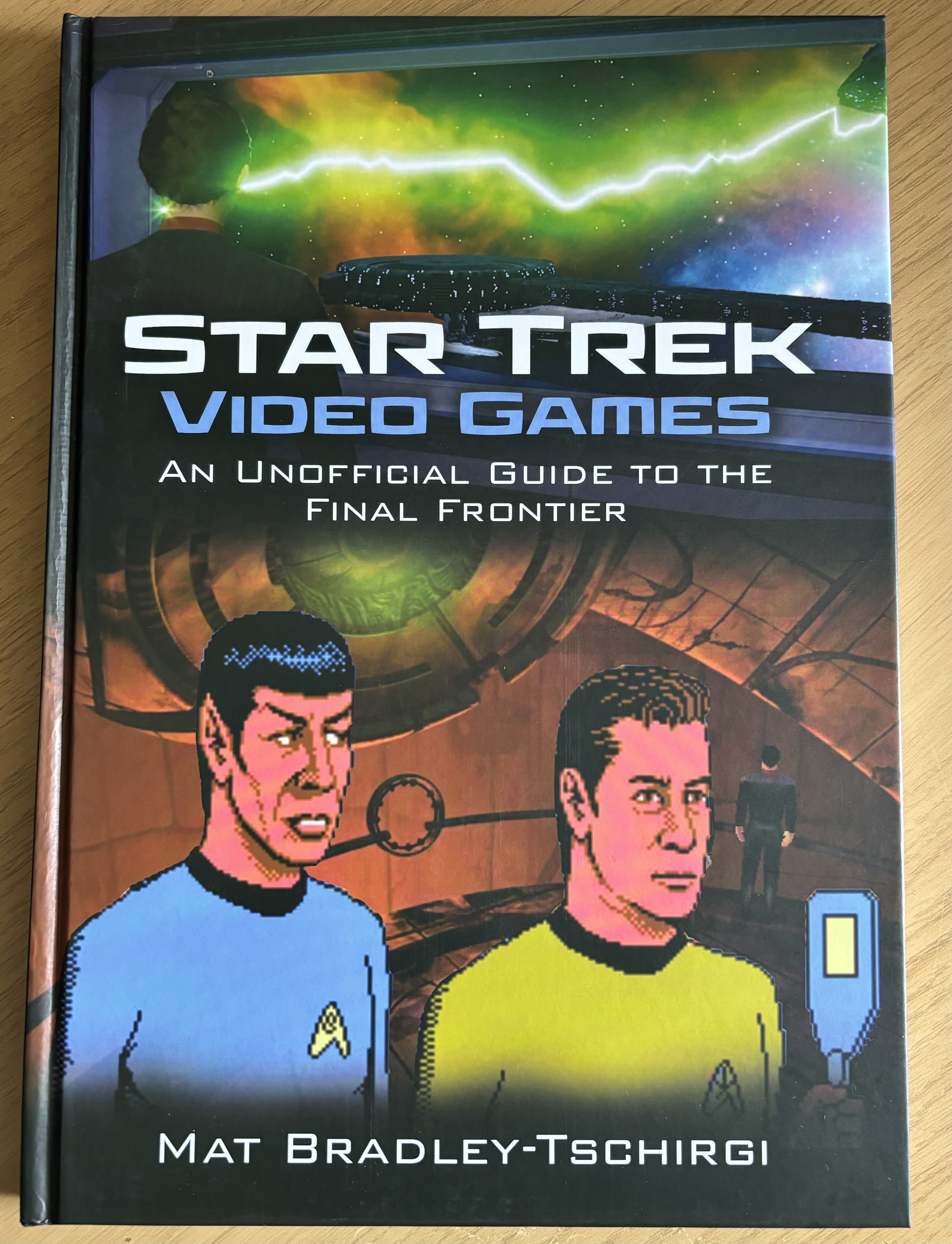
Star Trek Video Games by Mat Bradley-Tschirgi - Book Review

Subtitled "An Unofficial Guide to The Final Frontier", Mat Bradley-Tschirgi has delivered, via White Owl Books, a curated guide to the interactive worlds of Star Trek in a 150-page hardback that continues the publisher's fine efforts in video game-themed tomes. Come join me as a Voyager on a mission of Discovery to the Strange New Worlds of Trek, as the series remained a source of enjoyment as computers and consoles moved from the previous to The Next Generation. Fitting Deep Space 9 in there was but a futile Enterprise... 

When it comes to Star Trek, the sheer magnitude (and varying degrees of quality, licensed and unlicensed titles alike) of games would have made a single volume impossible. And much like the TV shows and films, such a compendium would have highlighted that, when it's at the top of it's game, Trek can match the best that a particular medium can offer, and at its worst, can be a pile of sh...

It isn't heresy for me to say that of something I have enjoyed for the past forty plus years. TOS episodes that enthralled me as a child in the 80's today look cheap, contain woeful dialogue and, lord love a duck, the acting! Oh. The. Acting! That isn't to say there aren't some belters in there, just that as a weekly sci-fi show in the mid-late 60's, Star Trek was far from the cultural beacon it later became. A recent re-watch of TOS was indeed a timely reminder of that and other points: the 1960's were a different time - they did things differently there, but more importantly, even "bad" Trek is still preferable to no Trek*, and so it is with Star Trek games.

The book is divided into several sections, beginning as it should with The Original Series. Much like the TV show, many of the games here have not aged well at all, but that doesn't mean they're not worth playing. Indeed, for that very reason, you should give them a go if you can. EGA Trek, in particular, sounds like an absolute blast!

The Next Gen crew get some really good coverage, as do Deep Space 9 and Voyager. What I really like about the period these shows cover is that technology had moved on, to the point that you could have full motion video (not the panacea it promised to be for video games) as well as more interactive gaming mechanics - I still have a soft spot for Elite Force on the PS2. 

In news to me, there are more feature film related games than I realised, and I'd totally forgotten about the Generations tie in. Crossovers receive a smaller section, and the final grouping takes on the Paramount+ era and beyond.

Each entry is clear and concise, and the author has a knowledge and love of the topic that shines through on the pages. Whether a game is good or not is beside the point, because it's their inclusion here that matters. The concepts were considered viable at the time the games were made and, on the whole, you'll not waste your time checking many of these titles out - even the unreleased Star Trek V: The Final Frontier on the NES. Screenshots are vivid and punchy, and there is something timeless about EGA/VGA graphics compared to the full motion video stills. 

It's not just about the games though, as there are short interviews with individuals connected to Trek gaming dotted throughout. These add detail and context to many of the featured games and to be honest I would have liked to have seen more of these. That, gentle reader, is my only tribble, I mean, quibble, about this fine book.

For Trek fans and gamers alike, this is an excellent study on the subject of Star Trek gaming and begs the question of a second volume covering some of the more obscure (and maybe the un-licensed) releases. As it stands, this is another great addition to the White Owl collection and is thoroughly recommended. 

You can pick up a copy direct from the publisher here, as well as from the usual physical and online bookstores. You can also follow the author on Twitter/X - @MatWBT

* "Bad" is a subjective term. I don't want to get into a long and involved discussion here, but if you consider the renaissance of Trek over that last few years, I'd rather have had several seasons of Discovery and Picard than not. Sure, they varied in quality alot, but that is true of any entertainment medium. All I would suggest is that before hating on a show because it's not your idea of what the show is, give it a chance. You might just end up enjoying it.

Sunday, 23 June 2024

A Trans History of Gaming by Dani Cross - Book Review

Like any art form, video games can be representative of society, yet that representation can often be lacking. In the mainstream, the desire to maximise revenue has often meant a broad spectrum approach to audiences, as well as a "play it safe attitude". However, people always find a way, and when it comes to the subject of trans representation in video games, Dani Cross' self published tome on the subject proves highly illuminating. 

Available via the Kindle publishing platform, A Trans History of Gaming delivers an informative, erudite, and often moving guide to trans characters in gaming. Over its 160-odd pages, the author has provided a deep dive into the best, and worst, portrayals of trans personages in video games. Divided into three sections: 1980's to 2009, 2010's, and 2020 and beyond, we start our journey with Birdo from Super Mario Bros. 2, all the way up to Nocturne in Baldur's Gate 3. Each entry gets a character image or in-game screenshot, and a write up detailing their origins, how good/bad their portrayal is, and context within the wider scope of gaming and, crucially, society.

In some instances, the gender of a character is only implied, switched during translation, or added for "comedic" effect, no matter how offensive that might be. Their inclusion within games might be half hearted, or ambiguous, but there are titles within the pages of this book that focus on realistic and sympathetic characters, where gender depiction is a natural facet of the individual. Some games are from traditional mainstream publishers, and there are encouraging signs that they are getting better at trans representation. In other examples, that is less true. 

There are a number of indie titles covered too, some coming from trans developers whose personal experiences add emotional depth to their games, not only bringing the player deeper into the story but also increasing awareness of trans people and the challenges they face in real life. The entry for A Year of Springs, for example, highlights Japan's approach to trans people and a disregard for individual rights that is enshrined in law. As an aside, this book also supports my belief that given the near broken state of the AAA games industry, indie developers and the titles they release are pretty much the spiritual heart of video games right now. 

With a warm writing style and a wry sense of humour, there is much to enjoy about this book. You will learn more than just about video games, and this is a welcome text on the representation of trans characters that have, in one way or another, been around since the 1980's. The only (tiny) criticism I can make about the book is the slight colour bleeding in my copy, but since this is a Kindle Direct Publishing tome, that is no fault of the author. Indeed, it would be great to see this publication in something like the big format style used by White Owl Books. 

A Trans History of Gaming is a great read, and not just for the gaming history. There is societal context as well as finely delivered commentary about inclusion of trans people within the video games industry at all levels. Having a well realised trans character played by a cisgender actor does raise questions, and if (the absolutely brilliant) TV show Sense8 can get it right, then games developers/publishers can too. It may just be that awareness needs to be raised, and this fantastic book is a brilliant place to start.

You can pick up a copy of A Trans History of Gaming direct from Amazon here, as well as follow the author on Twitter/X @DaniCross_

Sunday, 16 June 2024

Magazines of Yesteryear - Acorn User No. 119 - June 1992

Acorn User began its exceedingly long run in July 1982 and lasted all the way to issue 267 dated Christmas 2003. From the original Beeb to the A6 running Virtual Acorn (although Iynoix, Microdigital and RiscStation machines were still be advertised and, in some cases, actually sold as the final issue rolled off the press!), Acorn User appeared for many years to be the newsstand magazine for Acorn users. I know I picked up more than a few copies from WH Smiths back in the mid-90's. Today, we'll drop a bit further back, to a point where Acorn seemed to be doing pretty well, and check out what the summer of '92 had in store. 

Got to say it takes a very "period" approach to the cover, and that top strip still has the BBC logo - that would disappear from issue 138, January '94. The full Acorn range is covered, and the venerable BBC Micro and Master (the latter hidden by the "Best Selling" corner label) remain in place next to the slightly spritelier Archimedes, the then three year old A3000 and 1991's A5000. And now to the news desk...

All together now: "Where in the world...?"

The first item is about PC World, and we're talking about the very first store! A year later, they would become part of the Dixons Group, and thus spread like wildfire to high streets, shopping centres and retail parks across the land. But back in '92, it was just a single store, and one of Acorn's largest dealers, selling several thousand units per year! Ah, such innocent times...

Contents ahoy!

Acorn take second place with news that they have weathered the recession, returning to profitability for the second half of 1991. A net profit of £694,000 in H2 offset the first half's £420,000 loss, although operating profit was down to £1.1million from £2.6 million. For the year, once interest payments and a "related" company write off of £102,000 had been dealt with, net profit was £274,000 compared to 1990's £1.58 million. Sales volumes dropped from £45.1 million to £40.9 million, but cost control and greater margins helped the previous overdraft of £6.5 million switch to a surplus of £1.4 million. Market share in Australia and New Zealand increased, and Olivetti maintained confidence in the UK firm.

If you take a quick look at how Acorn's competitors in the UK home computer market were fairing at the time, you can see that Acorn wasn't doing that bad considering the margins and market share of their more international foes. Atari posted a net profit in 1991 of $25.6m, which compares nicely with Commodore's $48.2m. Except neither result was anything to shout out about. Atari's figure included a realised profit of $40.9m from the sale of its Taiwanese manufacturing facilities - Archive.org has the 1991 financial report here. Commodore's profit came off the back of $1.04 billion in revenue. Neither of those situations should have inspired confidence at the time. Atari were loss making in general trading terms, and Commodore were haemorrhaging money uncontrollably so that even a relatively minor drop in sales would see profits wiped out. As it turned out, 1992 would see $911m in revenue and a profit of $27.6m. The following year, those figures were $590.8m and a loss of $356.5m (all Commodore figures from The Silicon Underground here). Whilst Acorn was never hugely or consistently profitable, they did enough, and had another string to their bow anyway...

Page 9 sees the news that Acorn has won its second Queen's Award for Technological Achievement for the ARM chip development (their first was for the BBC Micro). Present in over 180,000 Archimedes computers by that time, design had started eleven years earlier and was now handled by spin-of company Arm Ltd. 

Speaking of Arm, a side bar notes the announcement of the Arm610, delivering 15 mips at 20 MHz. This was rather better than the Arm 3 in the A5000 and A540 (13.5 mips at 25MHz), and it wouldn't be long before the Arm610 found a home across the sea, as Arm co-owner Apple Computers would plonk one in their Newton PDA. 

There a quick diversion to the usual  Questions and Answers page, offering solutions to readers queries, before we get to the cover story... ARC vs MAC and PC!

A trio of specs battle it out. Acorn have their less than a year old A5000 pricing at £1,531 in its Learning Curve Pack guise. For that, you get a 25MHz Arm 3 chip (see above), 4Mb of RAM and a 40Mb hard drive. It suffers by lacking a maths co-processor, but still offers Super VGA (800x600) graphics modes and the sleek, minimalist footprint of RISC OS. Apple is represented by their Mac IIsi, with 5MB of RAM and 40Mb hard drive. There is disdainful commentary of the aging GUI and the slightly flaky System 7 OS, but the 68030 processor stands up reasonably well, and as noted, although the £2,500 asking price is much higher than the A5000, the more budget (ha!) conscious LCII models would have been closer in performance to the aging Archimedes A3000 and any generic 386SX. Finally, the PC rocks up with a 4Mb RAM/40Mb hard drive-equipped 486 running at 25MHz. At £1,365, this was about right for the time, but price benefit was set in contrast to the PC is held back by its legacy expansion bus and the wobbly mix of DOS and Windows. The key question was: which was best?

I mean, really? You have to ask in an Acorn mag?

Comparisons are made across Desktop Publishing, "Business" packages, Graphics, Printing and hardware expansion. "Typical users" will find everything they need on Acorn's machine, and whilst the Mac and PC had their place, viewing the A5000 on its merits means that it would be difficult to match the OS/hardware package anywhere else. Not surprising, but less partisan than expected. That didn't, however, really distract from the fact that the best general all-rounder then was the DOS/Windows PC. 

Tell your kids this was The Matrix pre-1999.

Moving on, there are features on getting the most from Impression (a DTP package that still proves useful to this day and a version of which was used to create Acorn User), Assembly Line programming help, the first in a new series on programming in C, the usual Yellow Pages of listings, and sections on Business, Graphics and Educational software.

Somewhere, beyond the C...

Games are also covered, and by this stage of the Archimedes' life, there were quite a few leisure titles out there, belying the reputation RISC OS had garnered as just being suited to educational purposes. Aliped gets a decent review, Pesky Muskrats also just about passes muster, whilst Grievous Bodily 'Arm proves that side scrolling beat 'em ups are a thing for RISC OS players. 

I see what they did with that fighting game title...

It's adverts time now, and as this is a format specific mag, there are a lot of smaller companies to go alongside the more recognisable names (both within the RISC OS market as well as the wider computing scene).


ICS - a cornucopia of RISC OS kit.

ICS lead off with two pages of software and hardware, covering pretty much all of your possible computing needs. You could argue that a sorting by type would have been useful but you can't deny that there was a good amount of software available. 


When Watford closed down, they left a hell of a Gap in the market (not sorry at all!).

Watford Electronics were another long time dealer of Acorn kit, and they take up thirteen pages! There is an absolute boatload of hardware, and it's cool to see the Cambridge Z88 still being advertised too. They were also a very familiar name in the PC world and would make a name for themselves selling reasonable DOS/Windows PC's for a few years.

Desktop Projects would sell you Acorns at rather reasonable prices - that basic A3000 with a 2Mb RAM upgrade for £599 ex VAT wasn't silly, and neither were the monitor packages either. That you could get an ST for less than £300 and an Amiga A1200 for under £400 was neither here no there, honest, guv'nor!

Some fine school memories unlocked with this advert.

Clares had their impressive range of graphical packages for sale, and I remember using ProArtisan quite frequently back in comprehensive. Sadly, the school would never shell out for Render Bender II.

Dealers like these were once the lifeblood of the home computing market.

There also quite a few smaller ads from dealers who would willingly flog you the Acorn set up of your dreams, and in true foot meets bullet style, Acorn would rearrange its dealer relations in the summer of 1995 and dismiss two thirds of its registered approved education dealers. A money decision to be sure, it also removed a good amount of local knowledge for potential buyers - but Acorn weren't the first to do that. In the US in 1987, Atari bought the Federated Group to provide dedicated retail space for the ST, as well as focussing on larger and more specialised resellers. As a result, the small dealer network abandoned the platform. Not saying if they hadn't, it would have changed things much, but it sure as hell didn't help!

A selection of superior Superior software?

Finishing with games, and both The Fourth Dimension and Superior Software had been prolific with releases, and as you can see from both of their ads, they had games aplenty for players of all levels and interests.

4D really were rather prolific back in the early 90's.

That was Acorn User, a popular format specific publication that, while not as big as say Amiga or ST Format would be for their users, was more than good enough for the RISC OS and Beeb owning crowd. As for today's users, Archive magazine and Drag 'N' Drop still fly the flag for an OS that remains in active use and development. Check out RISC OS Open for updates on the current OS, and Riscository and The Icon Bar for news. The former has banners for the various RISC OS shows you can attend throughout the year, and here's a link to this year's Wakefield Show with a handy guide to most of movers and shakers in the RISC OS world. 

Sunday, 9 June 2024

Supercade - A Visual History of the Videogame Age 1985-2001 by Van Burnham - Book Review

The first volume of Supercade wasn't exactly a shrinking violet when it came to its page count, but volume two goes even further, adding seventy pages for a total of over 520! And with fold outs too! We haven't been this spoiled this that waiter dude handed out those choccies at the ambassador's shindig! (One for older British readers there...)

It should go without saying that the period covered by this tome was a tad busier than that by the first book, encompassing as it does the rise of the NES in America, the 16-bit computer and console generations, and then the true breakout of the 32-bit (and successor) machines up to the turn of the century. 

Being a US-centred tome, the starting point has to begin with the fallout from the Great Video Games Crash. A defining moment in the US market, it pretty much had naff-all effect anywhere else. Indeed, whilst US home consoles became something of a taboo subject as far as retailers were concerned, here in the UK, we were seeing a sorting out of the 8-bit home computer market, leaving the three main formats (Sinclair Spectrum - soon to be owned by Amstrad, Amstrad's CPC range and the Commodore C64). There were others (Acorn's BBC Micro and Electron being the most common of the rest) but of consoles, Britain seemed to care little at the time...

So here we are, 1985, and it's the NES that kicks off the timeline, which is as it should be considering its impact. There are brief mentions of the Amiga 1000 (two pages), Atari ST and Commodore C128 (a half page each). That sums up the computer angle of the book and whereas the mainstream consoles are featured as the years pass, there is no mention of the PC. I get why as you face the choice of what manufacturer to pick, and when from. Was it the 286 processor and EGA graphics? 386 and VGA? The introduction of 3D graphical acceleration? Tough call, but maybe a couple of pages wouldn't have gone amiss, especially as there are more than a few PC titles covered.

That is nit-picking to the extreme, however, as Supercade is all about the games and, as you'd expect, they receive the proper attention they deserve. Presentation is once again top notch and this truly is a delight for the eyes. Each game gets a write up too, and these are informative, informed and entertaining. A series of VIP Gallery entries add extra sauce to the content, and as befits a tome with scholarly leanings, the bibliography and webography offer plenty of sources to peruse.

Really, there is not much I can add other than to say that this volume is a perfect follow up to the first and does justice to a period of video games history that proved formative for many. My first console was a Sega MegaDrive back in 1990, and from there came the Game Gear, SNES, N64, PlayStation and pretty much everything since. Many of the games given full treatment here were defining experiences for my console gaming education, so that added warming glow of nostalgia was a cherry on top whilst devouring the pages. 

I picked my copy of Supercade Volume 2 up from the local Waterstones, but a quick search can find you a new copy for under £30 from the usual online sources. As with the best of coffee table tomes, the Supercade duo will remain highly valued reading material on my shelves for many years to come. Once again, congratulations to Van Burnham and team. 

Sunday, 2 June 2024

Magazines of Yesteryear - What Micro? - October 1989

As Autumn arrived in 1989, Black Box's "Ride on Time" had knocked Jive Bunny and the Mixmasters off the top of the singles chart (for my sins, I received the Jive Bunny album that Christmas), Bodger and Badger, The Poddington Peas, and Challenge Anneka hit the small screen, whilst Batman, Dead Poets Society, and Lethal Weapon 2 were entertaining cinema goers. Meanwhile, What Micro? was casting a gimlet eye on the top twelve PC's you could buy, alongside integrated packages, Word 5, Lotus 1-2-3 Release 2.2, and the Macintosh portable. What a time to be alive!

Looking a tad rough with age, I know exactly how this mag feels.

In the news, Digital Matrix were adding 25 and 30MHz versions to their 386 range, with the base Hercules display equipped model with 1Mb of RAM and 20Mb of hard drive storage for £1,715. A top-specced mono model (2/300 plus 60Mb tape streamer) was yours for £3,760, and a three user system (for what else did one need a 386 for in 1989?), with 4/65, a 40Mb streamer plus two (count 'em) Wyse 120 terminals primed bank manager angst at £4,995! You got SCO Office Portfolio and SCO Xenix 386 included, but that was just for the 25MHz version. An extra 5Mhz would cost £2,310, £4,609 and £5,740 respectively. 


Meanwhile, Tandy had a sub-£1k '086 portable sans hard drive for £999 (spinning rust was £700 extra), and Toshiba were bundling a printer worth £345 with their mains-only AT portable, the T1600 for £3,195. What a bargain! If you wanted something capable of use on the move (ish), Packard Bell's PB286LE with 1/20 started at £2,195, combining a 15lb all up weight (complain about an extra 100 grams on you next ultra-portable, why don't you!) and a three hour battery life. I've had Teams meetings last longer than that!


There was also a competition to win a Commodore PC20, complete with MS-DOS, a 20Mb hard disk and a monitor. The same spec machine did rather well in...


... the cover group test for the Top 12 PC's, and the mag defined PC rather tightly - they were talking about the original XT spec and not the later AT (286 and above with high density floppy drives etc) one, and this meant that the dozen desktops on display here were what would be classed as "affordable", as far as 1989 DOS machines went. This truly was the great and the good of the era, and also highlights that for UK home users at this particular point in time, the ST, Amiga and Archimedes were far better all-round machines than any DOS-powered wonder. Amstrad makes up a quarter of the review samples, with their PC1512, PC1640 and the latest 2086, and the reviewer notes the first two machines are definitely long in the tooth but also still capable "budget" computers - the base PC1512 rocks up a mono display and a single floppy for £399. Advent, Commodore, Epson, Elonex, IBM, Opus, NESS, Samsung and Tulip round out the rest to varying degrees of success, The verdict box makes it's very much a buyers choice, but spending anything over a grand here was considered wasteful. There again, the question of whether or not an AT-spec machine would see you right also raises an interesting comment - people who need a mainstream machine for the next five years should consider a 386. What was the saying about never going into the prophecy business? Over the next three years, the £1,000 level barrier would shatter through three processor generations (286, 386 and 486) with surprising ease.


The Mac Portable is next and, it is a doozy of a machine - having seen a real one at the North West Computer Museum, it's a desirable piece of kit even now, though my back wouldn't like me for carrying one. Its size is noted, as is the cost (£4,500 with a hard drive, £4,000 floppy only). Using a different kind of battery tech (lead acid, hence the weight), the off-grid longevity was claimed to be five to eight hours, twelve for the floppy-only model! The 16MHz 68000 made it a speedy Mac, and even though there were similarly pricey DOS options (the 12MHz Zenith Turbosport 386 and Toshiba's T5200 reach and break the £5k barrier), users wanting any kind of portable computer could find cheaper. Just not a Mac. 


There's a feature on word processors, how they could help people who wanted to type long documents, what defined the concept of a word processor, and why a PC loaded up with a then-modern day piece of software would be much more useful than any dedicated kit (looking at you, Amstrad PCW). There's hints and tips about formatting, font choices and how to make the most of any word processing software, and for the time, this was very informative stuff. 


There were other software options to the dedicated word processor, and this is where the "integrated package" comes in. A round up of six contenders vie for the title of best all-in-one business bundle, offering word processing, databases, spreadsheets (those last two are NOT the same thing!), and maybe some comms capabilities. Prices aren't bad - £36 for the questionably named "The Secretary Bird", to £199 for Ability Plus. Good old 90's bundled favourite Microoft Works tips in at £145. There is no overall winner, just shades of grey recommendations, which is as it should be as each package has its own strengths and weaknesses. Any would see you right for most needs. Just try not to panic at having to spend actual money on what these days are considered "free" applications. 


Cost is something to consider when looking at Microsoft Word v5.0, and neatly demonstrates how massively times have changed. £395 would get you the over-sized box complete with a 640-page user's guide, 250-page reference manual, 300-pages on using Word with printers(!), a 30-page pocket guide, a 110-page "ideas" guide, a 10-page newsletter and two advertising leaflets. There's even a six-page road map on how to use the manuals! After buying a new bookcase for this assortment of knowledge, you then have to deal with 13 floppies, and although you can get away with using Word 5 on a dual-floppy machine, it's best to install the bugger, where it harvests 2Mb of space. The overall verdict is that Word 5 is state of the art, but possibly overkill for most. Can't argue with that point of view. 


Speaking of cutting edge, Lotus 1-2-3 falls into the version trap with a strangely numbered Release 2.2, coming as it does after Release 3.0. The latter was the all-singing, all-dancing 3D packed 286/386 bothering deity-level app, requiring 4Mb of hard drive space. 2.2, however, was for mere mortals, but still cost £395 (seems a popular price - just less than a billy basic Amstrad PC1512). Upgrades were much cheaper (as little as £35 for some), but the advice is that if you wanted something like Lotus 1-2-3 then Release 3.0 was a much better option and, as such, required you to jump on board the AT bandwagon. Few with XT-class machines would find Release 2.2 good value for money. 


Of course, being 1989, whatever serious work you do would need to be shared, and this would primarily involve a printer. Handily, a guide to such decibel deliverers is here for options under £500. The budget level is catered for by 9-pin dot matrix wonders, with listed prices starting at £125. The more capable (I did not say better!) 24-pinners begin at £249. For those of you with only contempt for your hearing, Daisywheel printers offer typewriter levels of quality as well as enough volume to wake the dead. Finally, there are a handful of inkjet and thermal types that will deliver peace and quiet, but not necessarily good quality text or value for money. Not yet, anyway... The recommended models include the Panasonic KX-P1124, the Amstrad LQ5000di (albeit with relatively poor print and very poor build qualities), as well as the ever-present Star LC10, truly the budget connoisseur's 9-pin option. 


Finally, there is the Buyer's Guide. After a PC clone, AT-compatibles or portables, this here is your list, and there is a lot to ponder. Many manufacturers, specs and budgets, but as it's 1989, your trip to Dixons would probably net you an Amstrad... Serious software gets a look in too. 


The really fun part now: the adverts, and this absolute corker from IBM targets the business user with a rather confident statement about buying one of their latest 486 machines. Well, almost. If you purchased a PS/2 Model 70-A21 386 desktop, you'd be able to swap out the processors when the new fangled three times more powerful Intel chips landed. Cool idea, but considering this ad from Compumart has the expandable 70-A21 at £4,103 excluding VAT, that's some serious moolah to drop on the promise of spending even more money on faster things to come - never mind the reliance on Micro Channel Architecture, nor the fact that a monitor and DOS appears to be extra! Put another way, with VAT, that was £4,718 from a reseller. That amount today equates to a smidge over £12k! You might not get fired for buying IBM, but you could go bankrupt!


NESS is next, and they can start you on an 8088 XT (also covered in the group test) for £695. Although the ad makes zero reference about display options, that's for the mono model. CGA came in at £870, EGA at £990 and the (then) holy grail of VGA at £1,130. You can guess that the 286's would have suitable additions to their prices for colour, and that 386 would be pricey indeed (though far less than an IBM option). 


Here's a name that's definitely still with us: Dell. Their base 286 (none of that XT rabble for these legends) starts at £1049 for a mono system. The top of the line System 325 386 is as eye watering as IBM's offering: £5,399 ex VAT for 4Mb of RAM and a 150Mb hard drive. Seriously powerful for the time, but also seriously expensive. The more basic System 325 with 1/90 and mono VGA was still £3,949 ex. One year later, that would be £2,099. A year after that, half again. That's not to say these were over-priced. They were not. I merely point out the changes to evidence the sheer speed of change the PC market underwent between 1989 and 1994. 


Megaland, self-proclaimed "specialists in mail order" seemed to have everything and, in a nice touch for personal buyers, published VAT-inclusive prices as well. Both PC's (Samsung, Commodore and Amstrad) and Amigas (B2000 and A500) get a look in, as does the PCW and Commodore C64. It's a useful advert as it offers Amiga A500-based business packs (computer, monitor and printer) for £745 inc, or £853 inc with a half meg RAM upgrade. More expensive than an Amstrad PCW, but so much more capable. The problem the Amiga would have in the next couple of years is that the cost of a hard drive equipped 286 with VGA colour would drop from the £2,146 listed Commodore PC40-III (1/40) to well under a grand. As noted above, the 386 would be snapping at its heels too. Meanwhile, the Amiga and ST stagnated - and no, neither the 68020-powered A1200 nor the ever-so beautiful Falcon '030 could keep up with the advancements in the DOS, later Windows/DOS world. The PC woulds still cost more, but could also do a hell of a lot more - and piss poor management by both Commodore and Atari would doom those companies long before DOOM stamped itself on the PC for gamers.


Speaking of the those UK home computer favourites, we'll end with a pair of Silica ads: one each for the Amiga and the ST. Classics of their time (the computers and the adverts), the 16-bitters had never had it so good. From the viewpoint of October 1989, there was plenty of life left in them and the DOS PC was no competition at all. Ah, the innocence of youth...


Anyway, that's it for 1989. For the next Magazines of Yesteryear, I rather fancy something a little more... niche...