Sunday, 27 August 2023

Magazines of Yesteryear - Personal Computer World Volume 10, Number 10 - October 1987

Cast your mind back thirty six years (if you are old enough to do so). What do you remember about the autumn of '87? Michael Jackson's Bad album sitting on top of the charts? Rick Astley delivering both a perfect election manifesto and the best philosophical paradox ever? Were you watching Lethal Weapon and The Living Daylights at the cinema? Or were you doing what I was and reading the latest issue of Britain's biggest microcomputer (that dates things) magazine, Personal Computer World?

1987 was smack bang in the middle of Amstrad's dominance of the UK computer market. For "home" users, the CPC range had you sorted. "Serious" users could rely on the very cheap PC1512/1640 combo (their portable PPC512/640 brethren were a few months out yet). For those "serious home" (a category that Acorn would continue to trot out to justify the pricing of their Archimedes range for years) users, the PCW was the one for you, and it was the latest in that range that PCW (confusing, isn't it?) placed on their cover. 

At just under 300 pages, this isn't yet the chunky behemoth that the 1990's would witness, but neither is it a small magazine either. Colour is limited throughout, with editorial making the most of it and adverts in either mono or just a couple of colours. 

Newsprint begins on page 56 with the announcement that Atari is developing a Transputer system. For those not in the know, Transputer was a parallel processing based system that was supposed to herald the next generation in processor architecture. It didn't quite work out like that and, although Atari did release the Atari Transputer Workstation, only around 250-300 were actually made and the architecture itself disappeared in the early 1990's. Other than that, it seemed a pretty quiet month.

The review of Amstrad's latest is given four pages and the overall conclusion is that the company had done an excellent job of improving the 8000-series and the extra cost (£499) was worth it. To be fair, it was a seriously nifty little machine and if you didn't want the complexity (or cost of a DOS-powered machine) but you did want a printer, then the package was very much cracking value for money.

Next up comes a double review of 386-powered desktops, and these were pretty impressive beasts for the time. The Mission 386 faced off against the Tulip 386 AT, and in the specs race, both featured a 16MHz chip (note, this was before the1988 SX/DX split, so these were full 32-bit data bus specimens, or DX's under later nomenclature). The Mission rocked 2MB of RAM, a 40MB hard drive and a single 1.2MB 5.25 floppy in a case weighing 47lbs (WTAF?) which measured 20ins x17ins x 7ins. Tulip supplied their competitor with 1,640kb of RAM but the same storage abilities. Its case measured only 15ins x 17ins but is described as very heavy. What, heavier than 47lbs??? Both came with MS-DOS 3.2 for the review, and both were considered decent, even considering their individual foibles. As for the pricing, well, the Mission as supplied and with a mono monitor would set you back £3290. And that's without VAT. Bump the hard drive to 80MB and you'd pay £3,990, whilst 130MB would take the cost to a whopping £5,990! EGA pricing options were yet to be decided. Tulip would give you a 386 AT for 4,225 golden beer tokens if you wanted a Hercules mono monitor, four colour CGA (mostly purple) would take that to 4,560 tokens, and the technicolour joys of EGA graphics would set you back 5,095 of Her Majesty's doubloons. Crikey. And if you wanted a Microsoft-compatible mouse? £96. Ninety-Six Quid! Ok, not that much when you're dropping six grand plus Nigel's share on the main event, but fookin' 'ell!

At least sense was restored with the next piece, a look at... oh, nope, no it wasn't. Mac upgrades, and the challenges of making a Mac Plus into something useful - hey, don't hate me, the Plus was a very limited machine. Less so than the original Mac, but only just. RAM upgrades were cheaper from third party providers, but the key thing here was the cost of the actual memory chips, the cheapest price quoted was £500 per pair of 1MB SIMMS. Expansion boards to make you Plus go faster were also an option, but fitting a 68020 add-on would be around £3,000. A faster 68000 could be had for about £1,200. The final upgrade was for the screen, and yet here again, prices got silly, mostly because monitors were pricey buggers. One product mentioned uses a 21-inch screen, and a quick perusal of the ads shows that a similar sized monitor alone (19-inch Taxan Viking with a resolution of 1280x960) would have cost £2,150 ex VAT.

It wasn't all seriously expensive tech as PCW also covered the latest in games consoles. Yep, it was Nintendo vs Sega vs Atari, with their NES, Master System and 65XE Computer Games System respectively. Pricing was varied (NES = £159.95 with R.O.B., £99.95 Standard pack, Sega MS at £99,95 and the XE65 hitting £199,95 for the kit and caboodle). The group is described as "gamester's dreams", with the XE being probably the best all round package but with the other two being very singular solutions meriting a closer look. Oh well, can't get it right all of the time... 

WordPerfect fans were catered for with a review of the Amiga version, although with some personal gripes expressed and a very apt question as to who the package was for. Costing £250 (and this on top of a £500 single drive A500, where as an A2000 with a hard drive would be better), the reviewer felt that any potential users might actually be better off with the DOS version (and associated hardware) anyway. 

We now move to the adverts and, given the publication's vintage, it very much has that period look. Thoughts and Crosses on page 56 has a wide range of stock, also quoting prices VAT inclusive, a rarity at the time. Your basic PC1512 single drive mono display was £516, and the top of the range colour and hard drive equipped model was £1,229. An Atari 520 STFM would set you back £299 (power without the price indeed), with the competing Amiga A500 coming in at £545. 8-bit fans could be happy with a Speccy Plus 2 (£149), BBC Master (£425) or a Colour CPC for £299. Acorn's Archimedes was so new that prices were on application only. 

Acorn were at least advertising the Archie, although the seriously grey classical look didn't do it any favours. Arthur, the OS, didn't either, so perhaps for the best. RISC OS was still a couple of years out. 

Viglen were stretching their legs with a good range of machines, and comparatively high prices to match. And those cases, darling, they'll just never do! When you consider Amstrad was busy trying to upsell the PC1640, those prices need looking at though as Viglen advertised adding an actual EGA monitor to a 286 would mean an extra £359 ex VAT, with a package including the associated display card costing £449 ex VAT.

It is pleasing, however, to see Morgan Computers present, and that Epson HX20 for £195? Absolute bargain! Also a bargain was shareware, and two vendors went page to page to share their wares... (I don't apologise at all, but also check out Richard Moss' excellent tome on the topic here!).

This issue of Personal Computer World harks back to the time when serious computing magazines abounded. As the genre developed, you still got news and reviews, but the idea of listings disappeared as the readership also changed. The rise of the consumer, not the tinkerer, meant that this publication's approach to the its audience changed, as did the content. Next time, we'll see what the 1990's brought to PCW, but in the meantime, I shall leave you this final advert for a range of productivity software for the Psion Organiser II - including the handy note on the right that "Fingering is that advocated by Harvester's Finger Organiser Typing Method," I don't care what fancy fingering method you used, the Organiser II was in no shape to act as a word processor!

Saturday, 19 August 2023

The 100 Greatest Console Video Games 1988-1998 by Brett Weiss - Book Review

Top 100 lists, and indeed lists of any length, are always subjective, and when it comes to console games, it pretty much depends on your favourite genres as to what games to include within any defined limit. If you, however, ignore the genre bias then it can be quite easy to come up with a number of titles that, in no particular order, would find themselves in a Top 100. Except Rock N' Roll Racing. What the fuck even is that???

Following on from an earlier volume (1977-1987 not surprisingly, and one that I will get my hands on at some point), 1988-1998 covers a period in console gaming that was very different in tone to its predecessor. Put simply, whereas the first decade was the time of Atari, with competition from Coleco, MB and others, 1987 saw Nintendo as the dominant factor in the US market while NEC and Sega were warming up their console offerings. The PC Engine was a superb little machine that straddled what would later become the 8-bit and 16-bit generations, and Sega were learning from their Master System experiences and heading towards the behemoth that would be the Mega Drive/Genesis. By the end of the following decade, NEC had long dropped out, Sega were bruised and hoping for salvation with the Dreamcast, and Nintendo had been handed their arse by the now established Sony. The range of games in this volume amply testifies to those tumultuous times. 

The author states from the beginning that this is a US-centric book, and that isn't as bad as you'd think. This ten year stretch saw console gaming become an established globally, and titles were often released in multiple territories (kinda excluding the PC Engine itself in Europe - long story), and taking into account the unexpected bonus PAL territories received if (not when) the developers optimised titles for differing TV standards. The youth of today know nothing of the 50/60Hz issue, nor the significance of having a game run slower because of it. 

The 100 games featured here are presented in alphabetical order and each gets two or three pages. Box art is included as well as a handful of screenshots, a fun fact, and an explanation as to why the title appears on this list. Ah, so that explains Rock N' Roll Racing. Mr Weiss contributes over a dozen entries, with the rest coming from a variety of writers and industry names. It's a good mix and each game is treat with respect and love - and given the range of titles released during the highlighted period, there are some absolute corkers here. Indeed, regardless of whether you agree or not with a specific inclusion, the justifications provided are well argued. 


Truth be told, I cannot criticise this tome for what it provides. You get a comprehensive set of well written essays on games that truly defined the period, and the one potential issue (the US-centric approach) is addressed at the very beginning. As a one stop volume on the period, it is very much worth your time.

You can pick up a copy from Amazon here, and you can follow the author on X/Twitter/AnalMusk's site here

PS - Having played Rock N' Roll Racing, yeah, I get it now. Good call!

Saturday, 12 August 2023

A Guide to Movie Based Video Games 1982 - 2000 by Christopher Carton - Book Review

After a fantastic first book, A Guide to Video Game Movies, Christopher Carton's latest games-related tome takes the opposite approach: games based on movies. Given the much meatier subject (there are far more games of movies than movies of games), the author has chosen to split the subject into two volumes, the first of which takes the reader through the period 1982 to 2000. In order to get the contractually obliged crap reference out of the way, will this tome be a box-office smash or an Indy 5 sized flop (topical yet also naff)?


As with every other White Owl publication, it's a well made tome and has the usual high production standards. With 200 plus pages, the layout is pretty straightforward. Each game gets a write up including details of the developer, publisher, years of release and the formats it came out on. Most get a screenshot (some get two), and entries range in size from a third of a page to a full page (Goldeneye 007, Aladdin and Hook are amongst those receive that treatment). 


Speaking of the aforementioned Bond classic, the foreword is supplied by non other than Dr David Doak, formerly of Rare and one time supplier of dodgy door decoders. The games themselves are organised in to a variety of subjects/genres.


The coverage for each game is relaxed yet informative, and you'll learn about both the games and the films that inspired them. I for one did not know that Top Gun had been so comprehensively covered - and yet none of those titles had the volleyball scene in them. A missed opportunity for a flight sim/Dead or Alive Xtreme Beach Volleyball crossover, I feel. Similarly, the author has missed a chance to warn humanity that 007 Racing is dire. Not a "one for the fans", it's just terrible, Muriel! (Why was there never a dating sim based on that Australian classic? A travesty, I tell you, a travesty!)

The James Corden of Bond video games.

With over 300 titles given their moment in the sun, this book is also a chance to lay to rest the "movie tie-ins are always crap" myth (although 007 Racing really, really is!). Sure, lazy 8-bit efforts provide a grain of truth to it, just as Goldeneye 007 was a big middle finger to the lie, but on the whole, there are actually some very accomplished gaming experiences featured here and it has inspired me to try and locate some to experience them myself. Got to love Retroarch!


Mr Carton has done it again in writing a cracking walkthrough of a video game genre up to the turn of the century. It will join his other book (as well as a growing range of White Owl publications) on the shelves to await the second volume next year. In the meantime, I'm also preordering his next book, The History of the Adventure Video Game, which is due out next month. 

It's a collection, not a shrine!

If you want to purchse a copy of A Guide to Movie Based Video Games 1982-2000, you can do so directly from the publishers website here, as well as pick up the author's other books and check out White Owl's growing range of gaming titles. You can also pick it up from the usual physical and online bookstores, and can follow the author on X (fucking stupid name, should have just kept it Twitter) here

Saturday, 5 August 2023

Cold War Commander v2 - First game and thoughts

Many moons ago (2016), we TWATS, we happy TWATS, we band of sarcastic wargamers, tried to play three modern games in one afternoon, each using a different rule sets. The aim was to compare Team Yankee, Command Decision and Cold War Commander using an identical scenario. Due to time constraints, we only managed Team Yankee and Cold War Commander (and CD was already our go to ruleset for moderns anyway), but Mr Loaf's numerative statement proved accurate, and the group opinion of Cold War Commander was that it was too dice heavy and too gamey. Last year, I picked up a copy of the second edition from the Pendraken stand at the local Border River show, yet it was only last Saturday that we finally got round to giving them a try.

So it was that five of us (almost a full twattery) arrived at our now usual venue with the idea of trying a simple scenario to see how the basics worked. Being in a bar, there was the odd pint of Moretti consumed, as well as the usual excellent beef butties and chips from Ros in the kitchen. Andy and Paul played as the British, whose sole aim was to get to the far end of the table. Steve and Shaun were the opposition, located behind some hills and a small village, and tasked with kicking seven shades out of the British. Note that there was no overall Commanding Officer present on either side (deliberately so), so there was no Hail Mary roll (with attached penalty) for any of the players, although they didn't know this as I forgot to tell them. Oops!

The scenario dictated that the British should go first, so Andy got things started by bringing his Scimitars forward for a recce. Shaun, sensibly thinking that flank shots against the Challenger 1's he knew were coming were the only real option he had, rolled to get this T72's onto the hill. Seven or less, he rolled an 8. The tanks stayed put. The BMP's he controlled were more successful and promptly took to the top of the hill. Steve wanted to get his BMP's closer to the action, and also rolled an 8 when 7 or less was the goal. He did, however, get his infantry sorted with a handy double 1 and moved them into the village. Caution saw him keep his T-72's in reserve. 

The next British phase saw the rest of their forces come on to the table, Paul commanding the Warriors and heavy support platoon. Between the two of them, there wasn't a duff dice roll to be had by Andy or Paul and they swiftly got themselves sorted out. Shaun, on the other hand... His BMP's thought action was needed and took shots at one of the Scimitars (a miss) and an ATGW shot at one of the Charlies. Two hits, two saves. Compounding this lack of effect, the T72's failed their command roll again. Steve switched his problems around this turn, the infantry failing their roll but the BMP's finally entering the town. 

After victualling (thanks again, Ros!), the next British phase saw the Scimitars have at the BMP's on the hill, suppressing them but failing to kill either despite a number of hits. Andy managed to get two of his Challenger's on to said terrain feature and engage a couple of Shaun's T72's, neatly suppressing them but killing nothing. The supporting infantry in their Warriors moved up, whilst the support platoon de-bussed to set up their mortars. Steve, being the sneaky type, decided to bring his BMP's into a nearby "wood". Shaun attempted to respond to the British attacks and spectacularly failed the command rolls again! It really wasn't a great day for these guys, but at least they lost their suppression markers at the end of their active phase.

What ended up being the final phases of the game saw Andy fail to command the Challengers, although he did get his Scimitars out of the way to let the Warriors advance onto the hill. Paul rolled a double six, the resulting blunder seeing the support platoon make a half move towards the enemy. Oh dear. 

In what was a perfect example of how horrid a day Shaun was having, both the T72's and BMP's failed the command rolls (10 and 11 respectively). The final ignominy of the game came from Steve. His BMP's failed their roll, and it was only with the intervention of the umpire (moi) to say that if he moved his tanks forward a bit, he could have a couple of shots at the approaching pair of Challengers. Scoring three and five hits respectively, maybe this reserve tank force could do something worthwhile. As it turned out, Andy's dice rolling saved each and every one of those hits. Other than some scratched paint, no evidence remained of this final attack.

As a test run of this new version of Cold War Commander, the game was considered to be decent enough. Things flowed quite smoothly, and the general consensus was that they are definitely worth another bash. I haven't compared the two editions yet, and time may preclude me from doing so for a while, but our main take from this game was that we now have another moderns ruleset that can come out to play in the future. I'm still not sure on the hits basis for attacks, as actually knocking out the enemy seems rather difficult. It's the opposite issue of Team Yankee (BANG! You're dead!). Another couple of playthroughs are needed and then we may give consideration of tinkering with the processes. As for the ruleset itself, it's a good quality book with plenty of pictures for those who like such things and a handy range of worked examples of the main mechanics. Army lists for the British, Soviets and Americans are included, with others available via the Pendraken Forum. You'll also find a Quick Reference Sheet and optional rules here as well. 

If Cold War Commander interests you, check out the Pendraken website here where you can pick up a copy as well as view their range of 10mm moderns. We used Andy's 15mm collection for this game and the rules do adapt to scales rather well. Check out the Old Glory website here for their 15mm Command Decision range.

Sunday, 30 July 2023

GamesMaster - The Oral History by Dominik Diamond and Jack Templeton - Book Review

It's hard to imagine now (or indeed remember), but there was a time where news, reviews and commentary on video games were not instantly available. Leaving aside the benefits and pitfalls of the capability to have instant information 24 hours a day (Cthulhu, that makes me sound old), let us journey back to the early 1990's and a time when, if you wanted to learn about the latest in videogames, magazines were your lot. Until television got involved. 

GamesMaster was the quintessential television programme about videogames. Over the course of seven series, it informed, educated and entertained viewers, as well as providing its own share of drama too. Beat that, Lord Reith! There were other shows: ITV's Bad Influence was one that I remember watching, and although it took a different approach to GM, there was more than enough room for both to exist. Much like the excellent Bits, which Channel 4 broadcast around the turn of the century (never has a turn of phrase aged so many so quickly), GamesMaster never took the audience for fools (and unlike Bad Influence, it wasn't limited by its time slot - 6.30pm was very much not seen as children's TV time despite being quite early in the evening), and was all the better for it. But what was the story behind it? Dominik Diamond and Jack Templeton will tell you. 

As an oral history, this tome has a wonderful collection of contributions, from production staff to hosts to contestants, all wrapped up in a framework that takes the reader series by series (and, it has to be said, the 1990's), with added commentary and content from Dominik himself. In the wrong hands, this could have been a disaster, as ego and fading memories could combine to rake over the coals, but here there is an over-riding sense of fairness, that each voice and point of view is heard, leaving the reader to make their own mind up about contentious events during the show's long run. 

It's a funny tale, and very much destroys/enhances (depending on your point of view) the sheen of what you might have remembered watching on the TV, but therein lies the draw. You get the warts and all details from the key players, and this book comprehensively demonstrates the concept of the past being a different country. Having said that, as someone who worked in mobile phone retail in the early to mid-noughties, there are some distinct... similarities to the work hard/play hard attitude evidenced here. More than once whilst reading the book, I asked myself "how did they get away with that?" before realising that, yes, it was the '90's. Much like there is a slowly greying generation out there who are probably wistfully saying "Ah, but it was the 00's."

Anyway, I digress. 

There are plenty of photographs, including many from behind the scenes, adding proof, if proof were needed, of some of the more "WTF" stories - looking at you, Bill Gates' car! And as for seeing what they put Dominik through at times, it's amazing he managed to walk away at all at the end. 

The back of the book has a couple of cool appendices - a list of all of the challenges (who competed, what they had to do and whether they did it or not), every review score (starting at Sensible Soccer at 97%, all the way down to Garfield Labyrinth at 28%), and finally a rather tongue in cheek Consolation Zone.  

I was always a fan of GamesMaster, even that difficult third series with Dexter. This volume is an excellent memoir for those who spent their early evenings watching a Scottish bloke fit in as many risqué gags as possible into a pre-watershed show. Oh, and also talk about games. An honest and frank account about the first truly great video games TV show, GamesMaster: The Oral History is worth your time and money, as well as being a snapshot of a decade long gone. 

You can pick up a copy of GamesMaster: The Oral History directly from the publisher here, as well as the usual online and physical book stores.

Saturday, 22 July 2023

From Vultures to Vampires Volume Two by David John Pleasance and Trevor Dickinson - Book Review

Three years since the original Kickstarter for a singular book under the name of From Vultures to Vampires was successfully funded to the tune of £42,813 from 1005 backers (number 317 myself) on 19th July 2020, and two and half years since the need for a second book was announced, volume two has finally started to arrive in the hands of backers of the extended project. After such a long period of time, it was a relief to finally get this book, as well as have hopes raised about the third volume. When that one arrives, there will be a review and a "Notes on a Kickstarter" piece with thoughts and comments about the project as a whole. That one is going to be... interesting... In the meantime, was this one worth the wait?

A 24x16x2-ish cm hardback, first impressions are positive, and there is a quality feel to the cover and paper stock within. Total page count is 288, but there is some filler in there too. 

Following on from volume one's coverage of the post Commodore years of 1995 to 2004, we kick off straight away with 2005, each of the following chapters taking the journey on a year at a time until the conclusion in June 2010 and the Vintage Computer Fair at Bletchley. A final section provides an explanation of what happened to the Commodore name, as well as the C64/A500 Mini projects. 

It's mostly well written, with only a couple of occasions where another light editing pass might have removed the odd instance of repetition. The narrative does, however, take a tangent at times - the page and a bit used to talk about the son of Pentti Kouri (with a photo of him) has nothing to do with the actual story and shouldn't have been included at all. 

There are plenty of photographs too, and I think too many, considering this volume was described as necessary due to sheer amount of content (as was the upcoming third volume when it was announced). Do we really need a mugshot of every almost every person mentioned in the text, especially when they're a one line mention? Do we really need a picture of a CDi? Or Trevor's multiple (and in one case, Frankenstein-like) computer collection? And the logos? They're also on the back cover!

This building is of only passing interest, and we really don't need a picture of it.

It feels like padding, what with 275 pages of actual content, and that's down from the 360 total/336 actual content split of volume one. It'll be interesting to see where volume three comes in at, but the inclusion of the ads at the back of this one, including two pages for the ill-fated Amiga Global Alliance project, adds to the impression that, with better planning, two volumes could have been more than enough. 

Anyway, for the price I paid - £17.50 plus £7 p&p (with actual postage only costing £2.99 so a raised eyebrow there too (I didn't realise I was paying e-Bay postage prices...) - I'm reasonably happy with what I received. Not with the timescale (that's for the later post), but they got copies out there in the end. Here's hoping for volume 3.

Not really need in this book - no slight to CDi fans either

David Pleasance has a website where you can buy both the first and second volumes. Not wanting to appear too waspish (moi, darling?), but the actual front page hasn't been updated since mid-2022, as he only talks about two volumes and a possible July 2022 shipping date for the book I'm looking at here. Click on volume 2 in the shop and it has an estimated July 2021 availability(!). As of KS update #42 (12th May 2023), David would happily take your money via Paypal Friends and Family (it's the fee, you know), for a direct order. Uh-huh... Both currently available volumes are priced at £35 for the physical copies, £15 for the e-books. It is up to you, gentle reader, to decide if that represents good value. If I were approaching as an interested potential buyer now, I'd baulk at the idea of dropping £42 per physical copy (including postage). As for £15 per e-book, not for me, and there is a whole cannery to open when it comes to e-book pricing anyway. 

So, a good read? Mostly. Would I recommend? If you can get a copy cheap enough, maybe. The travails of the campaign have soured more than a few backers (as evidenced in the comments section on Kickstarter), and my thoughts on the project will follow after reviewing volume three. For now, it's a qualified recommendation at best. You will learn stuff, it compliments the first volume very well, and they have delivered a decent read. How they have delivered that, dear hearts, is a question for another time. 

Friday, 7 July 2023

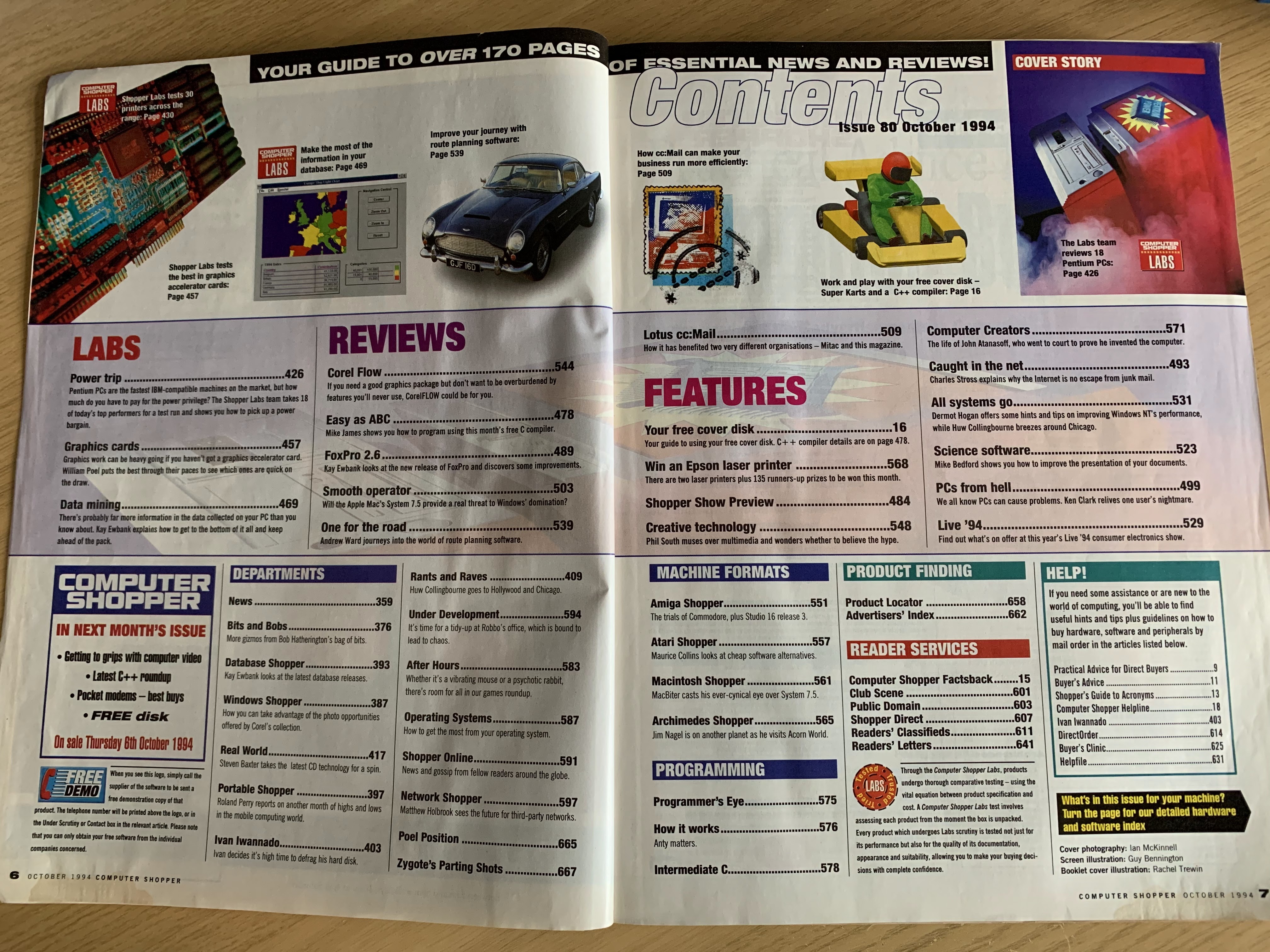
Magazines of Yesteryear - Computer Shopper Issue 80 - October 1994

It's another magazine of yesteryear and this time we're travelling to October 1994 (by issue date, the publication date was early September) and issue 80 Computer Shopper.

The magazine has grown, now coming in at 670 pages, and you have to feel for the posties of the 90's and how their poor backs faired when lugging multiple copies of this around. As for contents, we have a Pentium 90 group test (for a bargain price, but we'll see about that), graphics cards, a decent rage of software being rated, as well as the good old machine reference guide, still in place even if the pickings were increasingly slim for the non-DOS formats. That was to be expected considering Atari had abandoned the computer scene for one last crack of the whip at consoles, and Commodore had imploded earlier in the year. Acorn was still kicking out (the Risc PC (swoon) had arrived in April), and Apple was still Apple - although resellers such as Crown Computer Products Direct were offloading older stock at frankly silly prices - an original Mac LC 2/40 for £199 ex VAT!

Contents - some interesting stuff here.

The format specific list - and check out that circulation figure bottom right - 134k plus! 

In the news was Apple's announcement of licensing its System 7 OS to other hardware manufacturers. This they certainly did, and in my best (imaginary) Morgan Freeman voice, it did not end up being a good idea. Microsoft settled a four year anti-trust investigation (the what if's abound if Gates hadn't folded), Compaq pushes into retail (Dixons, Currys, John Lewis and PC World), and London's underground would soon be getting fifty multimedia information kiosks to supply up to date travel information to travellers. This truly was the future, or so it seemed at the time. 

From the group test, and interestingly, a section at the bottom about the actual company.

Now that's a group test specification table!

The big group test is for Pentium 90-powered machines at a budget price. This, gentle reader, depends on your definition of "budget" - and when it came to the then hot new processor, you started at £1,895 ex VAT and went upwards. These were high spec machines for the time, most coming with 16MB of RAM and a 15 or 17" monitor. Except for Lowland (£2,897 ex) and Dotlink (£2,085 ex), who cheaped out with a 14" screen. Tight basta...

These machines were also supplied with PCI or VLB (VESA Local Bus) graphics cards, and a round up of some of the latest models reveals a) they were varied in pricing - £110 to £599 ex, b) these were serious productivity tools - the 3D graphics cards race was still a while off, and c) they were pretty much maxed out at a resolution of 1,280x1,024, although a couple could handle virtual desktops of up to 2,048x1,536 at 256 colours. The key thing here was that getting a monitor to ably handle such resolutions was probably going to cost you as much, if not more, as the card. Taxan Ergovision monitors were being handled by dealers for around £339 and £669 ex for 15 and 17" varieties respectively. 

Don't be tempted. Not for one minute!

For the format specific stuff, Amiga Shopper is still going, as is Atari Shopper. Jim Nagel hosts the Archimedes Shopper column, while the legendary MacBiter keeps an eye on Macintosh Shopper. His column was one of the main reasons to buy Shopper, and his look at System 7.5 will have you chuckling away even after nearly thirty years. 

Elonex were another decent manufacturer lost to the mists of time.

To the adverts now and this was a time when the PC market was in rude health prior to the consolidation and mass market changes that were to come as the decade progressed. Manufacturers offered machines directly and via dealers, so let's have a look at what you could have bought back in 1994.

Discounted Apples - and no, not worth it either.

First thing you realise is that anything less than a 25MHz 486 SX is dead in the water. Aside from a couple of really cheap laptops (and laptops were coming to the fore even then), there isn't a 386 to be found outside of a Morgan Computers or (in this issue) Crown Direct ad - the latter had a monitor-less Amstrad PC4386 for £299 ex. If you were in the market for a current spec PC, the 486 was your starting point.

The Gateway 2000 opener...

MJN's in return

Gateway 2000's price list compared to...

... MJN's - totally different, obviously.

Naturally, competition was fierce, and this led to some unfortunate coincidences. Take Gateway 2000, once seen as a true competitor to Dell, it leads with a fold out insert featuring Sherlock Holmes. Their ads were often high quality narrative productions, having the machines front and centre of course. Prices aren't too bad either, and a 486 DX2-66 Family PC could be had for £1,299 ex. Pentiums were much more pricey. But what is this? MJN have also gone for a Holmes run (not apologising for that at all), and theirs is laid out in a very "similar" way, albeit with cheaper pricing. Hmmm. Other then-famous names in the market included Elonex, Viglen, Watford Electronics and Byte Direct, the latter of which was eventually purchased by PC World. 

A cracking little laptop, that Contra Aero.

As for laptops, Toshiba and Compaq were the dealer's favourites, although the pair of Olivetti machines looked pretty tasty, and I still love the colour of that Echos model (see below). What is really noticeable is that technology has advanced, and while these machines still have a weight issue (and that's mostly a battery thing), their prices are now, certainly at the lower end of the market, commensurate with their desktop cousins. Check out the Toshiba TC1900S - 486 SX at 25MHz, 4MB RAM, 120MB hard drive, 9.5" screen, internal floppy, DOS 6.22 and weighing under 6.5lbs - all for £829 ex. Now the Viglen Contender desktop - 486 SX at 25MHz, 4MB RAM, 240MB hard drive, DOS 6.22 and Win 3.11, plus a 14" monitor - £799 ex. Admittedly, there were cheaper manufacturers - Time could do the same spec with a Mitac branded machine for £699 - but that's not my point. What had changed was that laptops could now get very close to desktop pricing within the limits of the form factor. Colour screens and faster chips added much more, but on one level, the laptop was getting there. 

Laptop progression - that T1900S is pretty tasty for the price. 

The Viglen Contender range - could have been's...

This was the high point of the Win/DOS combination before the might of Windows 95 changed the perception of the PC for the general consumer. That and putting the Pentium processor front and centre when it came to sales. It also wouldn't be long before 3D graphics cards started to show up. This is about the time in the PC's history that I feel most nostalgic about - and yes, I am aware that nostalgia can tint those glasses in a spectacular way, but PC's at this point were both cool, moderately accessible but also still requiring some technical knowledge to get things to work. Old man shouting at clouds here, but I sometimes do miss playing about with interrupts and HIMEM.SYS.

Anyway, that's two for Shopper, so next time, I'll have a look at a more "scholarly" title. Well, Personal Computer World, but since it described itself as a journal, it's the posh one compared to Shopper. I will leave you with the advert of the Olivetti Echos. Still a looker after all these years...