Sunday, 3 March 2024

The History of the Adventure Video Game by Christopher Carton - Book Review

This is a bit of a belated review as I didn't get round to reading Mr Carton's fourth book until after Christmas, which is quite bad considering I bought it on back in September! Sorry! Anyway, I've had the time to give this a considered read and, with maybe one minor niggle, this is a very good book on a video games genre that, having peaked in the early 1990's, is now experiencing very much of a renaissance. 

This 150 page hardback is up to the usual high standards for a White Owl publication. Stock quality is good and the plethora of screenshots within pop off the page. The text itself is quite large, making it an easy to read tome with no chance of eye strain even for my tired old peepers - and yes, I mentioned this last week too! Separate reading glasses are inbound as I type. 

There are six chapters in total, starting with the very beginning of the adventure game genre and text adventures. Colossal Cave Adventure, Zork, and The Hobbit are specifically mentioned, although there are countless more of their kind. My personal enmity is reserved for The Hitchhikers Guide To The Galaxy which had me stumped on the CPC back in the day, although a recent couple of RISC OS text adventures (Gateway to Karos and The Mirror of Khoronz - http://www.boulsworth.co.uk/intfict/) did keep me entertained in the run up to the festive period.

The second chapter moves on to the beginning of the graphical adventure and the works of Ken and Roberta Williams. Yep, Sierra On-Line were the name in adventure throughout the 1980's and early 90's. As well as their early titles, each of the main series (King's Quest, Space Quest, Police Quest) are covered along with Leisure Suit Larry, Gabriel Knight (a personal favourite) and the later CD-ROM adventures such as fantastic Phantasmagoria. 

Next up is LucasArts, from their take on Labyrinth to their final effort, The Dig. Between those two titles are some of the most revered examples of the genre, and this chapter highlights the love and affection the author has for adventure games. It can be difficult to write about specific releases when they've already been covered to death, but Mr Carton manages to bring a freshness to the descriptions of these gaming legends.  

That's got to be a caption competition opportunity.

Chapter four is all about influential classics and goes through a whole menagerie of them. From The 7th Guest to Putt Putt, Broken Sword to Discworld, Simon the Sorcerer to Myst, this collection highlights the different styles and approaches to the adventure game as it developed throughout the 90's and beyond. That some series are still in active development is testament to the appeal of the adventure game, and if I could justify the expense (and accept Meta's data collection policies, which is a big deal), I'd be playing The 7th Guest in VR now. Modern day examples such as the Life is Strange series also get a mention. 

Telltale Games is the subject of the fifth chapter, with their (mostly) licensed output, becoming a near standard in the genre as the noughties became the teens. Prolific doesn't begin to cover how many games they released, and there are some gems in there too. 

The final chapter details the return of the classic adventure game, with the likes of Thimbleweed Park, Broken Age and Return to Monkey Island featuring, again demonstrating the ever present love of the genre by its fans and the support they give to new releases. It is also a fine way to end the book. 

However, I mentioned a niggle in the opening paragraph, and although absolutely nowhere near enough to even consider not recommending this book, it should be noted. 

It would have been nice to have a bit more coverage on the indie scene. These efforts have brought weird and wonderful titles to adventure game aficionados. The Mystery of Woolley Mountain, Lamplight City, Lucy Dreaming - just three releases from outside of the mainstream market that thrive on the likes of Steam et al (and which I have reviewed for Fusion magazine, as well as the more recently released The Will Of Arthur Flabbington). I know this book isn't a comprehensive guide to the field of adventure games, but some of the best games of their type in the last few years have come from that arena. That being said, to give full due the indie adventure scene would probably need separate book all of its own. 

Still, this doesn't take away from my opinion that if you want a general overview of adventure games, then this one from Christopher Carton has you covered. Easily readable and handsomely bedecked with pictures galore, it's another fine addition to the bookshelf. You can pick up a copy from the usual online/physical book retailers, as well as direct from the publisher here. You can also follow the author on Twitter/X - search for @chriscarton89.

Sunday, 25 February 2024

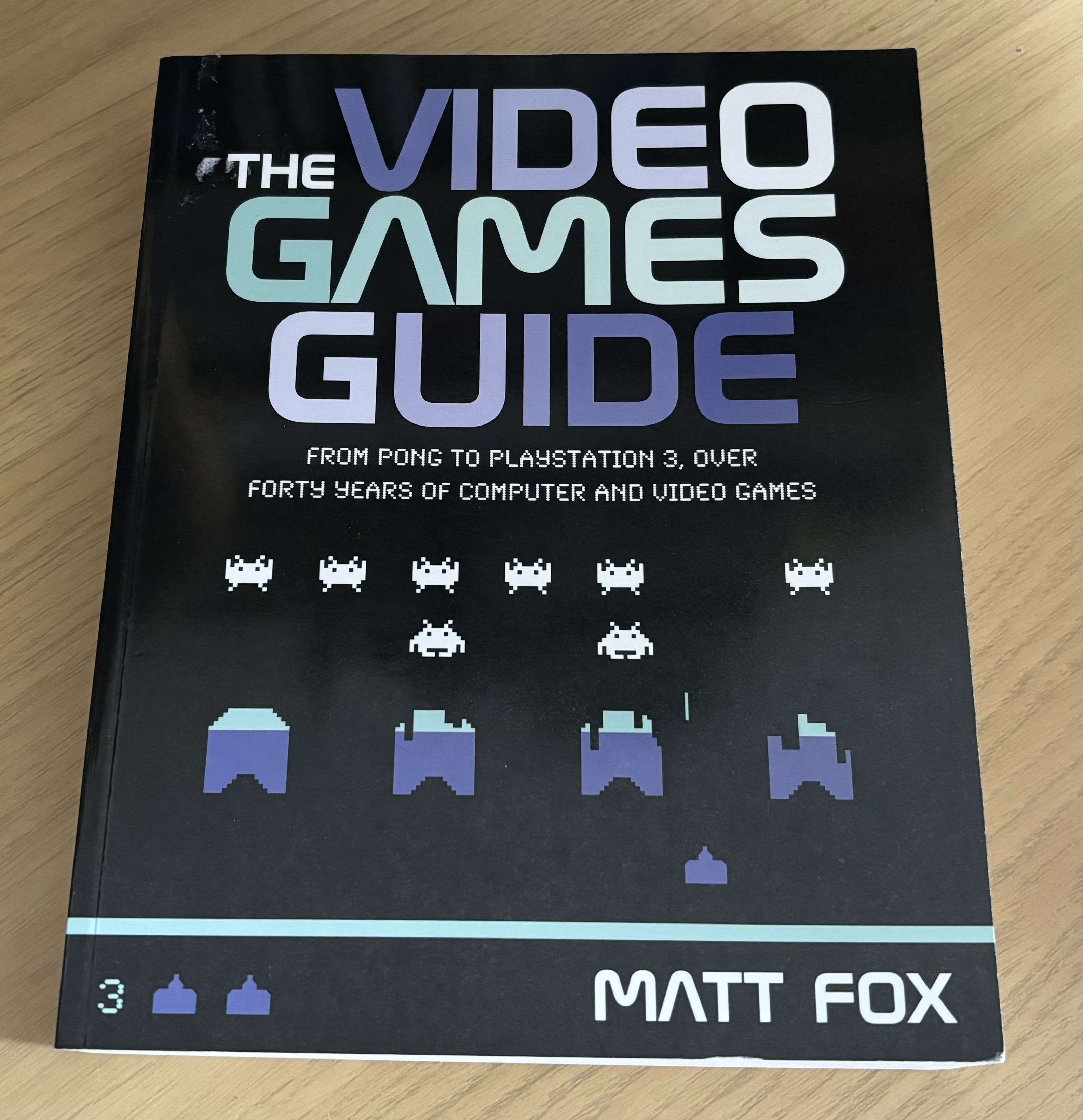
The Video Games Guide by Matt Fox - Book Review

I love a good rummage around charity shops. There is something to be said about finding old or out of print books, CD's etc, and also supporting a charity where you can. In this instance, a quick visit into the (now sadly closed) Oak Tree Animals charity shop in the Washington Galleries led me to this, a review compilation I'd never seen before, for three quid. Sold!

Published in 2006, the guide offers to take the reader from Pong to PlayStation 3, and given that it clocks in at 550 pages, it feels like it could do decent work. Flicking through the pages shows a clean layout and decently sized text - not too large to pad the tome out, not too small to cause eyestrain to your humble scribe.

The foreword is from Tim and Chris Stamper, whom at the point of publication were still at Rare (they would depart the company they co-founded the following year), and is a nice kick off to the contents proper - the games. 

Arranged alphabetically, each title gets a star rating, details of developer, publisher, platform and year of release, then a write up by Mr Fox. Games are awarded scores out of five, with five going to a classic and one being poor. It's the in between that only kind of makes sense to me - four stars denotes excellence, three is good and two is fair. This does, in my humble opinion, weigh the scoring system to good or better titles. Given that the "comprehensive guide" wouldn't want to focus solely on bad games, and it could be argued that unless you deliberately target the crap end of the spectrum, you're going to have a predominance of three star games and above. In any case, every five star title gets a screenshot in the colour plate section in the centre of the book. The screenshots aren't huge but make a nice break from the text. 

Starting at A, it soon becomes clear that the author knew his stuff when he started writing this book. Commentary is fair, albeit within the bounds that these are his opinions, and yours (and mine) can and will differ. Airwolf on the ZX Spectrum, for example, isn't worth two stars any day of the week, and the two stars Headhunter for the Dreamcast gets is a travesty! I also wouldn't consider SSX or Tiger Woods PGA Tour 2003 absolute classics (best spoken in a Welsh accent), but there you go. 

Once you've passed Z, there's a chronology of the entries, from 1962 (Spacewar, naturally) to 2006 (too many to mention), followed by the similar list for hardware (DEC PDP-1 to Sony's PlayStation 3). Programmers and Designers get their own section, with a curated selection of games awards lists falling between those and the glossary. 

Covering a five decade period, of course there are going to be games that are missed out, but at the same time, there are some obscure releases that get a proper mention, so swings and roundabouts abound. If I am going to be really picky, the entry for Zarch/Virus did grate a little. The full article is under the Virus entry, with Zarch's referring the reader to that. Virus may be the name people of a certain vintage remember the mouse-threatening controls, but the original was Zarch and as it's rated a four, surely deserves to be remembered under its original and best guise? 

To be fair, The Video Games Guide is, to most, a curio of a long gone era - 2006 was a long time ago, yet it also provides a well written, handy resource for those who wish to learn about some of the less well known gems as well as the clunkers that tend to be forgotten. Voyeur on the CDi, anyone?

I am pleased I picked this up, not only for the charitable cause but also for the different points of view it gives on a wide selection of (now very) historical games. If the history of the art form holds your attention, then you'll get much use out of this book. Secondhand copies are available (at the time of writing) on Amazon for not much more than I paid for my copy, so have at it if you wish. I know I'll be referring to my copy for years to come. 

Saturday, 17 February 2024

Magazines of Yesteryear - What Personal Computer? Issue 14 - September 1990

The last issue of What Personal Computer? I looked at carried the news of Amstrad's latest attempt to become relevant with a 286 in late 1991. That didn't work out too well for them, but what about the company that began the whole x86/DOS shenanigans in the first place? In the September 1990 issue, Big Blue provided an answer to the question: what PC do you sell to the average consumer?. Well, they thought they did, but at least it got a cover photo. And yes, kids, computers were both as beige and as downright ugly back then too. 

The main news item was rapidly decreasing PC prices. Elonex were knocking £200 off their 386V/33 (a 33MHz 386 system as if you couldn't tell, featuring the EISA (Extended Industry Standard Architecture) bus - an open competitor to IBM's more strictly controlled MCA (Micro Channel Architecture) bus), taking the headline price down to £2,295 ex VAT for the 40Mb HD mono model. Similarly, their 286 40Mb VGA colour system was down to £1,145 ex, and the 386SX equivalent comes in at a "mere £1,395." Mere, they say? Olivetti took £100 off both their PCS86 and PCS286 ranges, whilst Gandlake (1990's computing equivalent to Accrington "Who are they?" Stanley) priced their entry 286 at £899, a £96 cut.

In other news, DR-DOS was hitting version 5, adding additional memory management for those 640/384Kb blues, as well as a disk cacheing ability to improve disk access times. A new release of MS-DOS was rumoured but the report notes that it probably wasn't going to be called MS-DOS 5. Oh, what little faith yea had in imaginative marketing types... MS-DOS 5 would land in June 1991. Apple also gets a mention in the news - a new model rumoured to be called the Classic, which did in fact hit the market in October 1990.

The first feature we get to is the Bunch Test, this month comparing laser printers under £2,000. You may snigger at the back, but in 1990, that was budget level. The winner was the Panasonic KX-P4420, rocking a £1,395 price tag, quick performance and extra fonts. It only emulated a LaserJet (the then-defacto standard for laser printers), and was a tad chunky, but was otherwise good enough to take the crown. 

The cover star is next, and it really does look nasty. Expansion by additional slices can work (the pinnacle of which was Acorn's Risc PC in 1994), but here it just looks clunky. That second, 5.25" floppy, looks like it'd be blocked by the keyboard on smaller desks, yet the 3.5" drive, for all of its weird angular looks, defined IBM's aesthetic of the period, and I still kind of like the cut of its jib - just not the box it's attached to. As for the rest of the hardware, this home-targeted machine was merely average. A 10MHz 286, 3.5" 1.44Mb floppy, a 30Mb hard drive and VGA graphics. However, the negatives outweighed even these slight benefits. Standard RAM was 512Kb, although you could buy a board with an extra 512Kb to experience the joys of that 640/384Kb split. Two proprietary slots (IBM, proprietary? I'm shocked, I tell you, shocked!), could handle a modem and a joystick/audio card, but if you needed 16-bit ISA slots, an additional expansion box could be purchased. No tools were needed for fitting said box, but as it followed the design footprint of the base unit, full length cards were excluded. The final verdict? To quote the boxout, "If you know enough about computers to read this mag, you know enough to leave the PS/1 alone." Ouch! It didn't help that UK pricing wasn't confirmed either, and the recently launched Amstrad PC2286 could give you a larger hard drive and monitor (14" instead of 12" - back in those CRT days, the extra inches often counted), for around a grand excluding the Chancellor's cut.  

A feature on the NeXT machine posits that next-gen PC's will probably look like the NeXT Cube, as well as offering a new GUI-based operating system. A complete package offered 8Mb of RAM, a 40Mb hard drive, 17" Mega Pixel (their words, not mine) display and a 230Mb capacity optical drive for £6,495. At that price, the GUI may be wondrous, but Macs were cheaper (well, some were), and Acorn had RISC OS on its £649 A3000. 

286 workstations go head to head on page 54, with Mitac and Compaq both trying to justify why you should spend £1,399 and £1,895 respectively. They're mostly evenly specc'd - the Mitac edges out the Compaq with its 12.5MHz chip (as opposed to 12MHz), and it's extended VGA display options (800x600). It's a smidge faster than the Compaq but the latter has the option of up to 13Mb of RAM - at a price, of course - £2,730 on top of the base config. The reviewer does note that corporate buyers would go for the Compaq name, but as he's not a large corporation, he'd go for the Mitac, and I can't say I blame him. 

CAD packages receive a round up (EasyCAD 2 for the win), before we reach the reviews section, the most notable of which is the Sygnos 68 LCD monitor. For £799, you got an 8 x 6 inch mono VGA (black on white or white on black) display. Whilst very restful on the eyes for text entry, ghosting made it marginal for anything else, but the review notes that it is recommended to pregnant women worried about CRT display radiation. Yes, that was.a thing. and it wasn't until 1992 that the Swedish Govermnent legislated for the maximum amount of radiation a person could experience at half a metre from the display - MPR II was your friend. A preview of the next issue promised a trio of 386's and a round up of accountancy packages, Woohoo, I near nobody cry.

As is expected, we now come to the adverts, and it's relatively slim pickings as WPC? was not the tree destroyer that PCW or Computer Shopper were. Diamond Computers are the first major advertiser, offering A500 trade ins for Amiga 2000's. The new A3000 was also on sale, but starting at £2,499, it was a niche machine for most. Page 14 continues the Commodore interest with a double spread on their PC Starter Packs. You could save up to £300 on one - naturally, that was the most expensive PC30 model. The small print points out that the PC30 was £1,199 ex VAT (£1,378.85 inclusive) for a colour VGA 286, and the main blurb about getting sorted for less than £500 was for the 8088 powered mono dual floppy PC10 at £499 ex, (£573.85 inc). 

MBC were selling 8088-powered hard drive equipped VGA models for £845 inclusive, 286's for £995 and a 16MHz 386 for £1,245. These had tiny hard drives though, so extra money was needed to get up to 40Mb, but MBC were a rarity in advertising VAT inclusive prices. 

Time Computers were shifting Amstrads, Olivettis and Tandons. As noted above, Amstrad's 2286 was a budget wonder. The 12' High-Res VGA colour option sneaked under a grand ex VAT, and the PC1640's replacement, the 2086, could give you proper VGA colour for three figures including the Treasury's take. The pesky hard drive issue was sorted by this point, but the damage to Alan's reputation was done.

Page 68 offered an ad from American Research Corporation of Croydon, Surrey. A 386SX laptop, it boats of "a complete business partner, ergonomically designed, weighing a slim 15.4lbs." To borrow from Senor Inigo Montoya, they kept using those words but I do not think they mean what ARC think they mean. Looking at the pic, "slim" and "ergonomic" seem to be doing as much heavy lifting as that NFL player. 

Silica make an appearance with Atari's ABC PC compatible. Sadly, the headline £899 (ex VAT) for a 30Mb and EGA toting 286 fails to point out that the EGA is mono. Colour takes the price up to £999 ex, whilst the Turbo model with SVGA adaptor, monitor and fast disk controller is a much more considerable £1,299 ex. What Atari should have been doing at this point was try to rescue the ST from its fate, but no, they pissed around with DOS compatibles and the Portfolio (Silica add on page 85 - a terrific little handheld for the price, by the way, but not really a core product for Team Tramiel) instead. The same comment could be aimed at Commodore as well.


If you were really flush, however, you could grab yourself a 486. G-Com Computers offered a good selection of PC's - that 286 wasn't bad even considering the added cost of colour VGA, the 386's provided more power with the caveat that really there was nothing much yet the typical user could take advantage of, but that 486... £2,995 ex for a mono system. You were paying for the power, most surely, but it was just for bragging rights.  

What this issue demonstrates, especially when compared to the last PCW post, is that the DOS PC market was evolving. Sure, it wasn't totally out of the mid-80's business machine category just yet, but it was getting there, a point easily made by the presence of VGA graphics on machines costing way less than a grand inclusive. Hard drives and faster processors would rocket up the price, but a key element of the DOS machine - the display - was now capable of standing against the more home orientated 16-bit competition. 

It would take another year before the 286 hit the mass market, and by then, a grand in cash would buy you a 286 with VGA,  hard drive, and with a smidge left over for a sound card. Compare and contrast to the Amiga and ST - both were still cruising off the glory days of the 68000 and a TV. Arguments over operating systems would continue (and worthy of some consideration), but the point I am making here is that what might have seemed like a completely outclassed business only machine in 1987 was, by late 1990, developing into the supreme home computer format. Combine that progress with the frankly crazy corporate attitudes of Commodore and Atari to their homegrown formats, and it wouldn't take much for those who were looking for the best thing in computer games to gravitate towards the PC. 

Next time, a journey further back into the mists of UK computing journalism, with a look at an issue of Personal Computer News, a weekly publication from the early to mid 1980's. 

Sunday, 11 February 2024

Tailships by John Rodgaard - Book Review

There has always been something about Cold War anti-submarine warfare that has fascinated me. From reading (and watching) The Hunt for Red October to devouring Red Storm Rising, playing 688 Attack Sub and Cold Waters, the subject has always had a depth (no apologies) that intrigues. And it is in the less well documented area of the Mediterranean that Helion and Co's recent release focusses its attention: Tailships - The Hunt for Soviet Submarines in the Mediterranean 1970-73.

You may think that this will be a bit of a dry text considering the topic and the brevity of the period it covers. That cannot be further from the truth. What the author, a 41-year veteran of the US Navy who retired at the rank of Captain, has done is integrate not only the technical and operational aspects of the small fleet of (outdated and obsolete) converted Destroyer Escorts, but also the social aspects of their crews, the process of manning them as well as the effect their deployments had of their families. There is much more to this than just "one ping only, Vasiley." 

The first couple of chapters set the scene - the Cold War and the importance of anti-submarine warfare. From there, we are given a guide to the theatre of operations, and how the Med was a tricky prospect for those in the ASW game due to its physical characteristics. The core details how the staging of the aging Destroyer Escorts was initiated as well as their operational deployments in-theatre. They quickly demonstrated their usefulness and became a valued capability, despite their mechanical weaknesses and rapid platform obsolescence. Would it be waspish of me to compare the situation to the current Type 23 debacle in the RN? Probably, but no less true. Where that particular organisation is at has many reasons, but running ships with 18-year design lifespans well into their fourth decade has come home to roost. I know, a discussion for another time, but the GP's are thirty plus year old and even the newest ASW ship commissioned nearly 22 years ago, and will be 33 when she reaches her planned decommissioning.

Back to the Med, and Tailships finishes off with a "what happened next" chapter, running quickly passed the SURTASS ships and the current much needed requirements for having towed array equipped vessels in service. 

Throughout, there are many contemporary photographs, with diagrams and maps detailing deployments, concepts and locales, and the centre section artwork is, as always, a feast for the eyes.  The author writes clearly and is as good with technical descriptions as he is with the social studies. The more than comprehensive bibliography at the back is certain to be a source of future reading too. For those looking for action packed sonar hunts, this isn't the book for you, but if you wish to learn more about how such an important capability came into being, and remains as critical today as it did then, then Tailships is the book for you. You can pick it up directly from Helion and Co here.

Saturday, 3 February 2024

Supercade - A Visual History of the Videogame Age 1971-1984 by Van Burnham - Book Review

Now this is a coffee table book and a half. First published in 2001, Supercade: A Visual History of the Videogame Age 1971-1984 (hearby just called Supercade 1, for as Yoda said, there is another), aims to address the requirement for demonstrating the aesthetic beauty of videogames as well as its evolution. Over 440+ pages, Van Burnham and a gaggle of contributors lay out the history of the art form as well as the hardware and characters between 1971 and 1984. And it is stunning.

Seriously, this is an art book first and foremost, with full pages dedicated to photography and screen grabs. Artwork pops off the page, and what would now be considered archaic graphical resolutions are celebrated in luxuriously high detail. Indeed, on my first read through, I pretty much ignored the text and looked at the (very) pretty pictures. But there is more to Supercade 1 than just the eye candy. Oh, much, much more...

As Maria told the von Trapp children, the beginning is a very good place to start, and this they do in Supercade 1. From the foreword by the late Ralph H. Baer, the history lesson begins at Brookhaven National Labs with Tennis for Two before moving on to MIT. It is this grounding in the very early history of computer entertainment and the intertwining of imagery and historical research that makes Supercade 1 a perfect introduction to videogames, what they started out as and how they evolved in their formative years. Every entry is well researched and written in an easy style. Tear yourself away from the visual feast and you will learn stuff too.

You heard the but coming, didn't you?

Yes, but only a little one. This is a US-centric tome and, to be honest, that's understandable. Due to the coverage of arcades, there is a hefty dose of Japanese titles, but only two pieces of Japanese home hardware: Sega's SG-1000 (giving useful context to who Sega were before their 16-bit glory days) and Nintendo's Famicom because, well, obviously! But what about everyone else? You do get the ZX Spectrum. I am not going to deny its obvious importance to the UK gaming scene, and the ZX81 did see a US release as the Timex 1000, but where are the others? The Amstrad CPC? The BBC Micro?? The Grundy NewBrain??? Honestly, some people! ;-)

In truth, it is rather churlish of me to complain too much - this is a visual history of videogames and the early days were heavily driven by US and Japanese companies. There is only so much you can include in a book this size (remember, it's a hefty beast at nearly 450 pages), and what it does cover, it covers extremely well. There are certainly many other resources for those who want to look from a UK/European perspective, and when all is said and done, most of the titles mentioned in Supercade are, at worst, genre classics, and at best, defining examples of the art form. 

Supercade 1 is a superlative feast for the eyes (and the brain) on a subject that, although covered in various guises over the years, really deserved the coffee table treatment, and it sure has received that here. While it is currently sold out at the US-based webshop here, have a Google and you may pick it up from an online retailer for not stupid money. This is the perfect coffee table book about video games, and one that deserves to be on yours. if you don't have a coffee table, buy one or, if you must, place this book carefully on a sturdy bookshelf. 

Saturday, 20 January 2024

Magazines of Yesteryear - Personal Computer World Volume 10 Number 8 - August 1987

Regular readers may recall an August 2023 post featuring the October 1987 issue of Personal Computer World, and might be wondering why I'm returning to the same publication and the same year so soon. Well, good people, it's because of the cover star of this particular issue and the amount of time it took to get my hands on it. 

This, dear reader, was the dog's back in the day. 

Yes, it's the first look at the Acorn Archimedes, packing in Acorn's ARM processor for a desktop costing less than £1,000. There's other stuff too, but as a massive Acorn/RISC OS fan, I've always wanted a copy of this issue and, after several abortive eBay attempts (including one crapping out at north of £20), I managed this example for a tenner. So let's have a look a what's inside. 

It's not all Acorn, by any means, and the review of Atari's PC raises more than just eyebrows, while Psion's Organiser II gets a full airing. There's software tests and the usual columns, and a very intriguing look at the Transputer. Hmmm...

It took a couple more years but the OS did improve. 

News was a bit slow that month so we're straight into the Acorn review. A pre-production machine, this wasn't entirely representative of the final hardware but was good enough to run some tests on, and by 'eck as like, it were fast! As Mr Pountain evangelised, "the A500 [the designation of this development system] felt like the fastest computer I have ever used, by a considerable margin." And so it was, capable of blitzing through anything you'd care to through at it (mostly synthetic benchmarks here), and all for under a grand exclusive of VAT. Yes, the base A305 (single floppy, 512k RAM) was £799, and a colour monitor added another £200. You could cheap out with a green mono monitor for just £50 but why limit this technicolour beast in such a manner? A 1MB model was £875 sans display, while the more expandable 1MB A410 (with a hard disk controller but no actual HD) took you up to £1,399. For the true power user, an fully decked out A440 (4MB RAM, 20MB HD) would take £2,299 from your wallet. Well, way more, as a monitor and VAT would see that total reach nearly £2,900! There again, an IBM AT from your average dealer was north of three grand, and a hard drive equipped Mac SE was about same price as the A440. Of course, not everything was as expensive, and it was Atari that now stepped up to the DOS wicket to see what they could offer against the value-packed Amstrad clones. 

Could this have been a go-er?  No. It couldn't.

A chance of death, it seems, as their rather flimsy (and "relatively mediocre") machine had an unshielded and unprotected power supply. Take the hint, buyers, DO NOT open this machine. Not that you could do much with it once you have dared to take the cover off as there were neither expansion slots nor drive expansion options (despite some labelling that hinted otherwise), but you could upgrade the memory to 640k (from the base 512k), as well as add an 8087 maths co-processor. The socket for the latter was under the power supply, so perhaps not then... 

Many Bothans PCW staff died bring us this information...

It's not all doom and gloom for the Atari - its graphics capabilities were rather good for the time, stretching from MDA to EGA. Yep, the presence of 256kb of video RAM meant 16-colour 640x350 was just a connection away! That sounds sarky, but this machine (albeit with a mono monitor) could have been yours for £499 VAT inclusive. In other words, a cheaper headline price than Amstrad's popular PC1512. However, that had space for three expansion cards, and adding a hard drive card was relatively easy. You pays your money and all that jazz, but a single drive PC even in 1987 was just too limiting.

Allegedly the most fun you could have one handed back in 1987...

The other big review this issue is for the Psion Organiser II, a nifty little handheld computer that I wrote about for Pixel Addict magazine in issue 8. It's a cracking little device which could do the job it needed to back in the day, albeit with a keypad that took some getting used to. It's well liked here and it was a success for Psion at the time.

There has to be a "What If...?" out there about this, surely? 

The feature on the Transputer is something else though. Promising a breakthrough in computing power beyond the contemporary constraints of processor technology, it offered super-computer levels of floating point power and easily scalable parallel processing shenanigans. There were issues though, primarily the lack of a mainstream operating system (and by default bugger all software), and a question of who would need such power. The author notes that a Z80 was more than enough to handle a word processor on Amstrad's PCW8256, though they go on to say that in the future, animated graphics would need the power, as well as a Hollywood director to make the game. He jests but...

GEM Desktop Publisher got the thumbs up (good enough for the asking price of £295 ex VAT), whilst a round up of dBase compilers would be of use to someone... somewhere... As will the piece on the then recently announced OS/2 from Microsoft. It was never destined to end well, but the conclusion at the end of the piece deserves its own screenshot.

OS/2 success and 640k... Indeed...

Guild of Thieves received an alright verdict in the Screentest section, and gamers were also catered for in Program File, where an Adventure Creator was detailed over 16(!) pages of code in very small text and varying degrees of contrast. It gave me a headache just glancing over it.

And they blamed porn for blindness in the 80's...

To the adverts now and DOS PC's were pretty much split into two camps - the XT level 8086/8088/NEC V20 machines that gave you a basic PC starting from about £450 ex VAT before heading up north of a grand. The more you paid, the better you got, with a mono hard drive offering to be had for not quite four figures including VAT. If you wanted EGA graphics though, add another £400 plus on top. The other camp was the AT spec of machines - 286 processors, high density floppy drives and EGA colour if you so desired. Hi-Voltage would sell you an SBC-branded 286 with a 30MB hard drive and an EGA colour monitor for £2,199 ex VAT! You could get cheaper, but not by much, and this pretty much explains the success of the ST and the newly introduced Amiga 500. If you wanted an actual IBM PC, Compumart had the real deal XT starting from £1,100 for a mono machine, whilst your new-fangled AT with a colour display was £3,170! At least they included a keyboard, mouse and DOS for that. Sheesh!

Danger! Danger! Hi-Voltage! 

"Portables" were a thing as the ad for Toshiba machines demonstrates below. Not sure if they were practical enough, but hey, you could tote around your work computer if you so wanted to (and if you had the muscles). Compaq was also an option, as were several other clone manufacturers, but most followed the luggable concept with built-in CRT displays rather than a portable as we would know it. 

They could be carried... with some effort. 

As Acorn were star of the cover show, they decided to advertise their wares with what can only be described as a... marketing choice...? I get it, they went for the Greek connection, but when you have a machine that offered graphical capabilities beyond its contemporaries, a mono advert does seem kinda weird. 

Could they not even afford a colour ad? Probably not...

Apple does something a little different, with a splash of colour for their logo if nothing else. There again, with Mac prices back then, did it really matter? ATT Peripherals Corporation had the Mac Plus at £1,550 ex VAT, a dual floppy SE for £1,875, and fully pimped out SE with 20MB hard drive for £2,450 ex. You may think pricey, yet only slightly more expensive than the monitor-less Apricot Xen 386 below it - but check out the addition of an EGA card and display. An additional £924 on top of the £2,350 for the desktop! Unlike the Mac though, the use cases for a 386 in 1987 were pretty extreme, thus balance was restored to the Mac/PC price comparison. Before we leave ATT though, have a gander at the DTP package. As a sign of how things changed between then and even the beginning of the following decade, a DOS-based DTP bundle including a 286 machine with a Canon laser printer was £4,300 ex VAT. Trick it out with colour and a 386 and you were looking at nearly seven grand! You'd have kept Nigel Lawson happy though, with VAT at 15%...

For a price, you cheeky sod, for a price...

For the next Magazines of Yesteryear, I think a change of decade (just) is in order. We shall jump forward to 1990 and a rather more slender publication. I shall leave you with some more of the ads - starting with ATT Corporation Ltd... (and a final question of Atari that I don't think shlud be asked in polite conversation...)

Not AT&T, obviously.


Other formats were available. 

Your cheapest business dot matrix printer: £444 ex VAT!


Can they be "hotlines" if there's only one?

I mean, it's a question...

Saturday, 13 January 2024

Every Hazard and Fatigue by Joshua Provan - Book Review

When it comes to military history, I find it does me good to read a book on a subject I know next to nothing about. A cynic might suggest I should do the same in my professional life but I do know my CCFA's from my SYSTABS, and my KTYPES from my KSPAR6's... Mostly ;-). Anyway, at the Battleground show last November, I picked up a copy of Andy and Jim's book, Khalsa! (reviewed here) from the Helion & Co stand, as well as this little gem by Joshua Provan. Having read and thoroughly enjoyed his 2022 effort, Bullocks, Grain, and Good Madeira (reviewed here), I had an inkling that his treatment of the Siege of Pensacola in 1781 would be worthy of perusal. I was not to be disappointed. 


West Florida wasn't exactly the centre of Britain's struggle in North America but it was of some importance. With Spain joining the conflict on the side of the rebellious Americans and the French, it placed additional strain on British (and their allies) resources. Over some 200 pages, Mr Provan weaves a tale worthy of your time, even if to most it is a fairly forgotten vignette amongst the many more famous events that defined the conflict.


There are twelve chapters in total, along with orders of battle for each side. The opening sections introduce us to the Spanish, British and Allied Nations, with much attention placed on the latter whose importance was both recognised and, at times, unwanted given the difference in cultures. The author takes an even approach to all, supported by numerous contemporary letters and illustrations. 


After discussing the terrain and the locale, as well as the events that preceded the actual siege, we are then given four chapters that provide a day by day account of the struggle. Highly detailed, clearly organised, and with a pleasing narrative style, Mr Provan paints an evocative picture of siege warfare at a time when gentlemanly conduct was seen as a prerogative. It was not an easy fight, yet standards were held high even after the British surrendered, albeit not to everyone's satisfaction.


There are maps and imagery aplenty, and the central section with the colour plates will be of great use to those wishing to re-enact the struggle on a table top, as will the orders of battle. As always with Helion & Co publications, the bibliography included at the end of the book will provide a great deal of follow up reading if you're enamoured with this treatment of the siege. 


With highly readable prose and a narrative structure that builds to a dynamic conclusion, Every Hazard and Fatigue is another great release from Helion and a fantastic effort from Mr Provan, suitable for readers no matter their level of existing knowledge. If the American War of Independence/Revolutionary War is your thing, you'll do yourself a great favour in picking up a copy from Helion & Co here. It is also an essential purchase if you want to bring Pensacola to your wargaming table. The American War of Independence/Revolutionary War is not a period I have read much about (outside of a few more general texts), but having been spurred on by this volume, I dare say some further, more in-depth reading is required. I can give no higher praise.